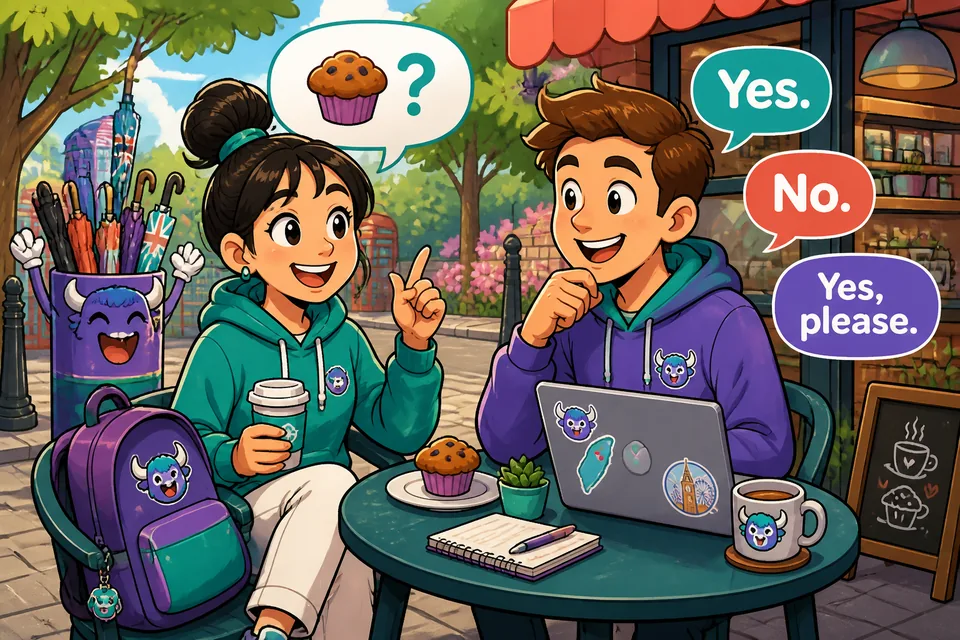
Welcome back — Lesson 21! Quick and friendly: today we practice short answers you’ll hear all the time in French. Repeat, listen, and then speak aloud.
Level A1: In this lesson you'll practice simple yes/no replies and polite responses like "Oui, s'il vous plaît." and "Non, merci." We'll cover plain yes/no, softer refusals ("Pas vraiment."), agreement words ("D'accord.", "Ça marche."), and uncertain replies ("Je pense que oui."). This CEFR-aligned practice is short, useful, and made to fit everyday talk.
After this lesson you'll be able to:
Recognize and use short French replies for offers and yes/no questions.
Respond politely to offers (accept with "Oui, s'il vous plaît.", refuse with "Non, merci.").
Use softer or uncertain answers like "Pas vraiment." and "Je pense que oui." (Level A1).
Ready? Let's go!
When you tap play on phrases, we track your progress through this lesson.
1. Reading + Listening Practice
Hear core phrases, repeat aloud.
Oui
Yes.
Meaning: Yes.
When to use: Use this as a short, neutral affirmative answer to yes/no questions or offers.
Tu veux venir? — Oui.
Do you want to come? — Yes.
Anna: Tu as faim? David: Oui.
Anna: Are you hungry? David: Yes.
Non
No.
Meaning: No.
When to use: Use this as a short, neutral negative answer to yes/no questions or offers.
Tu as le temps? — Non.
Do you have time? — No.
On part maintenant? — Non.
Are we leaving now? — No.
Oui, s'il vous plaît.
Yes, please.
Meaning: Yes, please.
When to use: Polite way to accept an offer in formal situations: use with strangers or service staff.
Tip: Don't always use "s'il te plaît" in formal settings; use "s'il vous plaît" with strangers.
Serveuse: Un café? — Oui, s'il vous plaît.
Waitress: A coffee? — Yes, please.
On veut un peu d'aide? — Oui, s'il vous plaît.
Do you want some help? — Yes, please.
Non, merci.
No, thank you.
Meaning: No, thank you.
When to use: Polite refusal of an offer; friendly and neutral.
Tip: Omitting "merci" can sound blunt; include it to be polite.
On vous apporte un dessert? — Non, merci.
Shall we bring dessert? — No, thank you.
On veut des sacs? — Non, merci.
Do you want bags? — No, thank you.
Bien sûr.
Sure.
Meaning: Sure.
When to use: Casual affirmative answer used among friends or colleagues.
Tu peux m'aider? — Bien sûr.
Can you help me? — Sure.
On se voit demain? — Bien sûr.
See you tomorrow? — Of course / Sure.
Oui
Yes, I am.
Meaning: Yes, I am.
When to use: Short reply to a question about yourself (state or identity), using a plain 'Oui.' instead of repeating a verb.
Tu es prêt? — Oui.
Are you ready? — Yes (I am).
Tu es étudiant? — Oui.
Are you a student? — Yes (I am).
Non
No, I'm not.
Meaning: No, I'm not.
When to use: Short reply to a question about yourself, using 'Non.' instead of repeating the verb.
Tu es libre ce soir? — Non.
Are you free tonight? — No (I'm not).
Tu es pressé? — Non.
Are you in a hurry? — No (I'm not).
Oui
Yes, I do.
Meaning: Yes, I do.
When to use: Use 'Oui.' as a short answer about habits, actions, or possession.
Tu fais du sport? — Oui.
Do you do sports? — Yes (I do).
Tu as un stylo? — Oui.
Do you have a pen? — Yes (I do).
Non
No, I don't.
Meaning: No, I don't.
When to use: Use 'Non.' as a short negative answer about actions, habits, or possession.
Tu manges viande? — Non.
Do you eat meat? — No (I don't).
Vous avez des clés? — Non.
Do you have keys? — No (I don't).
Pas vraiment.
Not really.
Meaning: Not really.
When to use: Use this softer negative to avoid a direct 'no' when you want to be gentle.
Tip: Beginners sometimes say 'non' when a softer 'pas vraiment' is more natural in polite conversation.
Tu aimes ce film? — Pas vraiment.
Do you like this movie? — Not really.
Il fait beau aujourd'hui? — Pas vraiment.
Is it nice weather today? — Not really.
D'accord.
Okay.
Meaning: Okay.
When to use: Use to show agreement or acceptance in many neutral situations.
On commence à neuf heures? — D'accord.
We start at nine? — Okay.
Je vais appeler plus tard. — D'accord.
I'll call later. — Okay.
Ça marche.
All right.
Meaning: All right.
When to use: Casual acceptance of a plan or suggestion; common in spoken French.
On se retrouve à midi? — Ça marche.
Meet at noon? — All right / That works.
Je peux venir chez toi? — Ça marche.
Can I come to your place? — Sure, that works.
Je pense que oui.
I think so.
Meaning: I think so.
When to use: Use when you agree but want to show some uncertainty or that you are not 100% sure.
Il va pleuvoir demain? — Je pense que oui.
Will it rain tomorrow? — I think so.
Elle viendra à la fête? — Je pense que oui.
Will she come to the party? — I think so.
2. Conversational Listening Practice
Hear phrases in a real mini-conversation.
At a café: an offer and quick decisions
Anna
Vous voulez un café ?
Do you want a coffee?
David
Oui, s'il vous plaît.
Yes, please.
Anna
Et du sucre ?
And sugar?
David
Non, merci.
No, thank you.
Anna
On part après ?
Shall we leave after?
David
Je pense que oui. Ça marche.
I think so. All right.
3. Guided Practice
Quizzes and matching to lock in meaning.
How do you say 'No, thank you.' in French?
Which phrase best matches 'Not really.'?
How do you say 'All right' (casual agreement) in French?
Which French phrase expresses uncertainty but leans toward 'yes'?
Yes, please.
On vous apporte le dessert ? — ___.
Not really.
Tu veux sortir ce soir ? — ___.
Okay.
On commence la réunion à dix heures. — ___.
Match the core phrases
Match the extra phrases
4. Speaking Practice
Say phrases yourself (mic/recording).
Recording stays on your device only. Check speech uses your browser's speech tools when available.