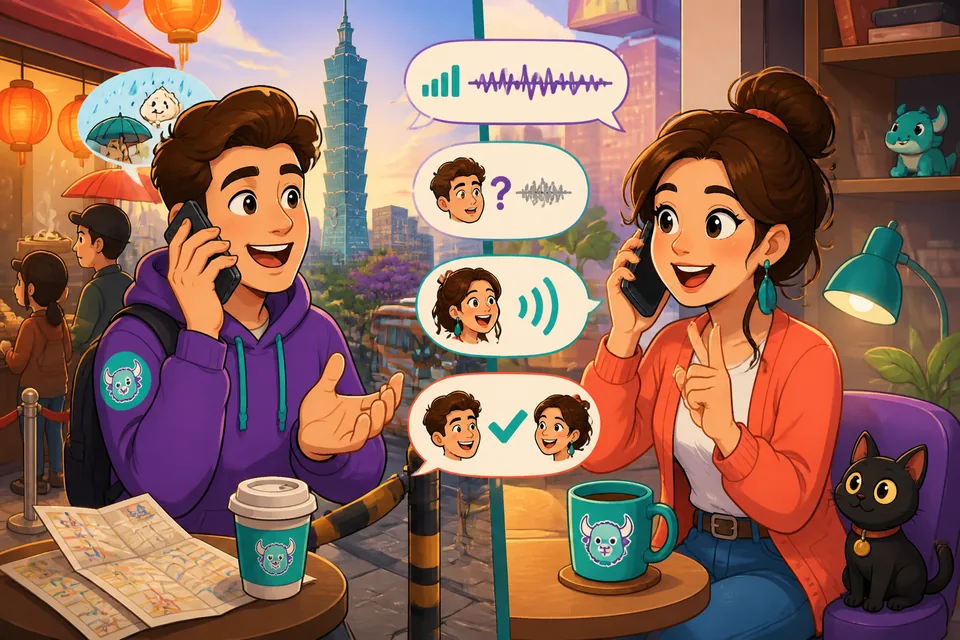
Bonjour! Ready to tidy up messy conversations? In this lesson you'll practice short phrases that help when you don't hear or understand someone. Keep it friendly—these are everyday fixes for calls and chats.
Level A2: This lesson focuses on practical phrases for repairing conversations—asking someone to repeat, checking a word, explaining a bad connection, and clarifying meaning. CEFR-aligned and full of useful lines you can say right away in phone calls, video chats, or face-to-face talks.
After this lesson you'll be able to:
Practice 12 common phrases for repairing conversations and fixing misunderstandings.
Be able to ask someone to repeat, speak louder, or explain a word.
Use these phrases naturally in calls and short conversations (Level A2).
Ready? Let's go!
When you tap play on phrases, we track your progress through this lesson.
1. Reading + Listening Practice
Hear core phrases, repeat aloud.
C'est pas ce que je voulais dire.
That's not what I meant.
Meaning: That's not what I meant.
When to use: Say this when the other person has misunderstood your intention or comment and you want to correct that idea.
Tip: Don't confuse with «Je ne voulais pas dire ça» (I didn't mean to say that) which has a slightly different nuance.
Non, c'est pas ce que je voulais dire, je voulais parler du prix, pas de la qualité.
No, that's not what I meant — I meant the price, not the quality.
Après la discussion: «C'est pas ce que je voulais dire, désolé si j'ai été confus.»
That's not what I meant — sorry if I was confusing.
Corrige-moi si je me trompe.
Please correct me if I'm wrong.
Meaning: Please correct me if I'm wrong.
When to use: Use when you're guessing or unsure and you want the listener to correct you if needed.
Tip: Use «Corrigez-moi si je me trompe» in formal situations with vous.
Corrige-moi si je me trompe, mais la réunion est à 14h, non ?
Correct me if I'm wrong, but the meeting is at 2 pm, right?
Je crois que le train part à 18h30 — corrige-moi si je me trompe.
I think the train leaves at 6:30 — correct me if I'm wrong.
Tu peux parler un peu plus fort ?
Can you speak up a little?
Meaning: Can you speak up a little?
When to use: Ask this when the speaker is too quiet and you need them to raise their voice.
Excuse-moi, tu peux parler un peu plus fort ? Je t'entends mal.
Excuse me, can you speak up a little? I can't hear you well.
En classe: «Tu peux parler un peu plus fort ?» pour que tout le monde entende.
In class: 'Can you speak up a little?' so everyone can hear.
Je t'entends mal.
I can't hear you well.
Meaning: I can't hear you well.
When to use: Use this to tell someone you are not hearing them clearly, especially on calls.
Désolé, je t'entends mal — tu peux répéter ?
Sorry, I can't hear you well — can you repeat?
Pendant l'appel: «Je t'entends mal, la connexion coupe.»
During the call: 'I can't hear you well, the connection is cutting out.'
La connexion n'est pas bonne.
The connection is bad.
Meaning: The connection is bad.
When to use: Explain that technical problems (phone or internet) are causing poor audio or video.
Pardon, la connexion n'est pas bonne, je perds des mots.
Sorry, the connection is bad, I'm losing words.
La connexion n'est pas bonne; on peut raccrocher et rappeler ?
The connection is bad; shall we hang up and call back?
J'ai raté la fin.
I missed the last part.
Meaning: I missed the last part.
When to use: Use when you didn't hear or understand just the end of what someone said.
J'ai raté la fin, tu peux répéter la dernière phrase ?
I missed the end — can you repeat the last sentence?
Pendant la vidéo: «J'ai raté la fin, qu'est-ce que tu as dit ?»
In the video: 'I missed the end, what did you say?'
C'était quoi, le dernier mot ?
What was the last word?
Meaning: What was the last word?
When to use: Ask this when just one word was unclear and you need it repeated.
Excuse-moi, c'était quoi, le dernier mot ?
Excuse me, what was the last word?
Je n'ai pas bien entendu: «C'était quoi, le dernier mot ?»
I didn't hear well: 'What was the last word?'
Qu'est-ce que tu veux dire par ___ ?
What do you mean by ___?
Meaning: What do you mean by ___?
When to use: Use this to ask the speaker to explain the meaning of a word or phrase in context.
Tip: In formal situations use «Qu'est-ce que vous voulez dire par ___ ?»
Qu'est-ce que tu veux dire par "flexible" ?
What do you mean by 'flexible'?
Qu'est-ce que tu veux dire par cette expression ? Peux-tu donner un exemple ?
What do you mean by that expression? Can you give an example?
Je ne comprends pas bien ___.
I'm confused about ___.
Meaning: I'm confused about ___.
When to use: Point to the part of the message that you don't understand so the speaker can clarify.
Je ne comprends pas bien la date de l'événement.
I'm confused about the event date.
Je ne comprends pas bien ce que tu veux dire avec ce mot.
I'm confused about what you mean with that word.
C'est le bon mot ?
Is this the right word?
Meaning: Is this the right word?
When to use: Use when you suggest a word and want to check if it fits the meaning or context.
Je pense à «rapide» — c'est le bon mot ?
I'm thinking of 'rapide' — is that the right word?
Tu veux dire «arriver» ou «venir» ? C'est le bon mot ?
Do you mean 'arriver' or 'venir'? Is that the right word?
Tu veux dire lequel ?
Which one do you mean?
Meaning: Which one do you mean?
When to use: Ask this to clarify which person or item the speaker is referring to.
Tip: Change form to «laquelle / lesquels / lesquelles» to match gender and number.
Tu veux dire lequel, le livre rouge ou le livre bleu ?
Which one do you mean, the red book or the blue book?
Si quelqu'un dit 'le professeur', tu peux répondre: «Tu veux dire lequel ?»
If someone says 'the teacher', you can ask: 'Which one do you mean?'
Pardon, je t'ai perdu un instant.
Sorry, I lost you for a moment.
Meaning: Sorry, I lost you for a moment.
When to use: Use on calls when the connection cuts briefly and you want the speaker to repeat or continue.
Pardon, je t'ai perdu un instant — tu peux répéter la dernière partie ?
Sorry, I lost you for a moment — can you repeat the last part?
Pendant l'appel: «Pardon, je t'ai perdu un instant, la connexion était instable.»
During the call: 'Sorry, I lost you for a moment, the connection was unstable.'
2. Conversational Listening Practice
Hear phrases in a real mini-conversation.
Phone call with a bad connection
Anna
Salut David, tu m'entends ?
Hi David, can you hear me?
David
Je t'entends mal, la connexion n'est pas bonne.
I can't hear you well, the connection is bad.
Anna
Pardon, je t'ai perdu un instant.
Sorry, I lost you for a moment.
David
C'était quoi, le dernier mot ?
What was the last word?
Anna
C'est pas ce que je voulais dire — je disais que la réunion commence à 10h.
That's not what I meant — I was saying the meeting starts at 10.
David
D'accord. Corrige-moi si je me trompe, c'est bien 10h ?
Okay. Correct me if I'm wrong — it's at 10, right?
3. Guided Practice
Quizzes and matching to lock in meaning.
Which phrase would you use to ask someone to speak louder?
How do you say 'I missed the last part.' in French?
Which phrase asks for the meaning of a specific word or phrase?
Which phrase explains that the audio/video quality is poor?
On the call the sound is low. You say: 'Can you speak up a little?'
On the call the sound is low. You say: '___'
You missed the end of what they said. You say: 'I missed the last part.'
You missed the end of what they said. You say: '___'
A speaker uses a new word and you want its meaning. You say: 'What do you mean by ___?'
A speaker uses a new word and you want its meaning. You say: '___'
Match the core phrases
Match the extra phrases
4. Speaking Practice
Say phrases yourself (mic/recording).
Recording stays on your device only. Check speech uses your browser's speech tools when available.