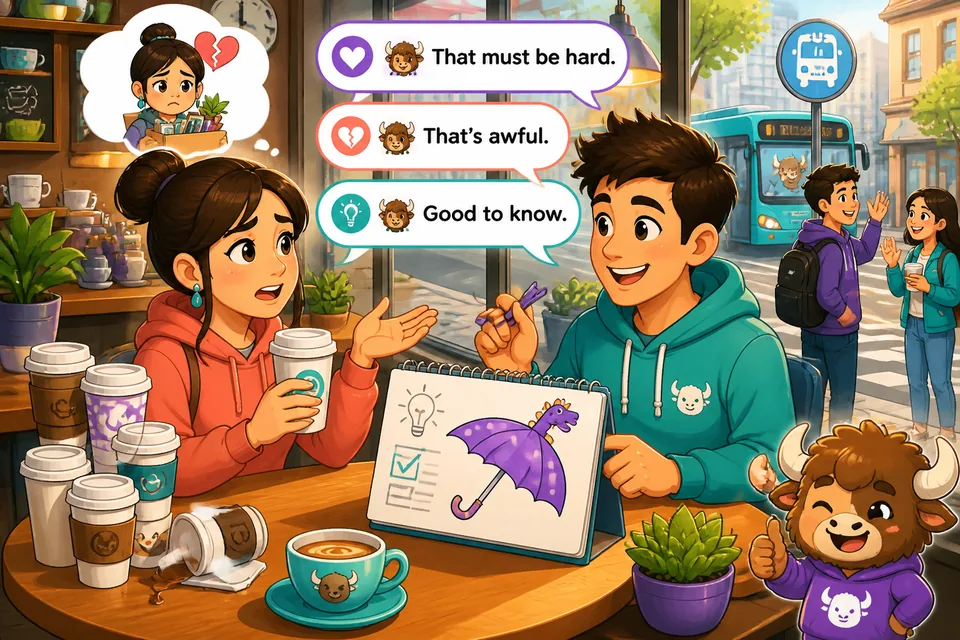
Welcome back — Lesson 77! A little friendly practice goes a long way when you want to connect in French. In this short lesson you'll hear, repeat, and use four natural reaction phrases.
Level A2: In this lesson you'll practice four everyday French reactions: Ça doit être dur., C'est horrible., Bon à savoir., and C'est intéressant. We'll listen, repeat, and use them in a short conversation so you can respond naturally in real chats. A tiny bit of social glue — lesson 77 sticks!
After this lesson you'll be able to:
Recognize and use four common French reaction phrases.
Show empathy, express shock, mark useful information, and show interest in short responses.
Practice listening and speaking these phrases in brief conversations (Level A2).
Ready? Let's go!
When you tap play on phrases, we track your progress through this lesson.
1. Reading + Listening Practice
Hear core phrases, repeat aloud.
Ça doit être dur.
That must be hard.
Meaning: That must be hard.
When to use: Use when someone describes a difficult personal situation — to show empathy and understanding.
Tip: Don't use this for small annoyances; it's for genuinely difficult situations.
Tu dois tout gérer seul maintenant ? Ça doit être dur.
You have to manage everything alone now? That must be hard.
Après sa séparation, il a beaucoup de travail. Ça doit être dur pour lui.
After his breakup, he has a lot of work. That must be hard for him.
C'est horrible.
That's awful.
Meaning: That's awful.
When to use: Say this after hearing very bad or shocking news to show a strong negative reaction.
Ils ont perdu leur maison dans l'incendie. C'est horrible.
They lost their house in the fire. That's awful.
Tu as entendu la nouvelle ? C'est horrible.
Did you hear the news? That's awful.
Bon à savoir.
Good to know.
Meaning: Good to know.
When to use: Use this short reaction when someone gives practical or useful information.
Le bus passe toutes les trente minutes — bon à savoir.
The bus runs every thirty minutes — good to know.
On peut payer en ligne maintenant. Bon à savoir.
You can pay online now. Good to know.
C'est intéressant.
That's interesting.
Meaning: That's interesting.
When to use: Use to show curiosity or polite interest when someone tells you something worth noting.
Tip: Watch your tone: 'C'est intéressant' can sound polite or distant; intonation shows sincerity.
Il a changé de carrière à 40 ans — c'est intéressant.
He changed careers at 40 — that's interesting.
La façon dont elle organise son travail, c'est intéressant.
The way she organizes her work is interesting.
2. Conversational Listening Practice
Hear phrases in a real mini-conversation.
Anna tells David about losing her job and a helpful tip she found.
Anna
J'ai perdu mon travail la semaine dernière.
I lost my job last week.
David
Oh non... C'est horrible.
Oh no... That's awful.
Anna
Oui, et maintenant les factures s'accumulent.
Yes, and now the bills are piling up.
David
Ça doit être dur.
That must be hard.
Anna
J'ai trouvé des informations sur des aides et des ateliers de recherche d'emploi.
I found information about aid and job-search workshops.
David
Bon à savoir.
Good to know.
Anna
Il y avait aussi un petit conseil pour améliorer le CV.
There was also a small tip to improve the CV.
David
C'est intéressant.
That's interesting.
3. Guided Practice
Quizzes and matching to lock in meaning.
Which phrase would you say after hearing very upsetting news?
You learn a useful fact about train schedules. Which reaction fits best?
Someone describes a long illness in the family. To show empathy, you say:
You hear a surprising detail about a friend's hobby that you didn't know — you respond:
My neighbor told me their car was stolen last night — I say: That's awful.
My neighbor told me their car was stolen last night — I say: ___.
She tells me a website with free language lessons — I reply: Good to know.
She tells me a website with free language lessons — I reply: ___.
He explains the stress of caring for a sick parent — I answer: That must be hard.
He explains the stress of caring for a sick parent — I answer: ___.
Match the core phrases
Match the extra phrases
4. Speaking Practice
Say phrases yourself (mic/recording).
Recording stays on your device only. Check speech uses your browser's speech tools when available.