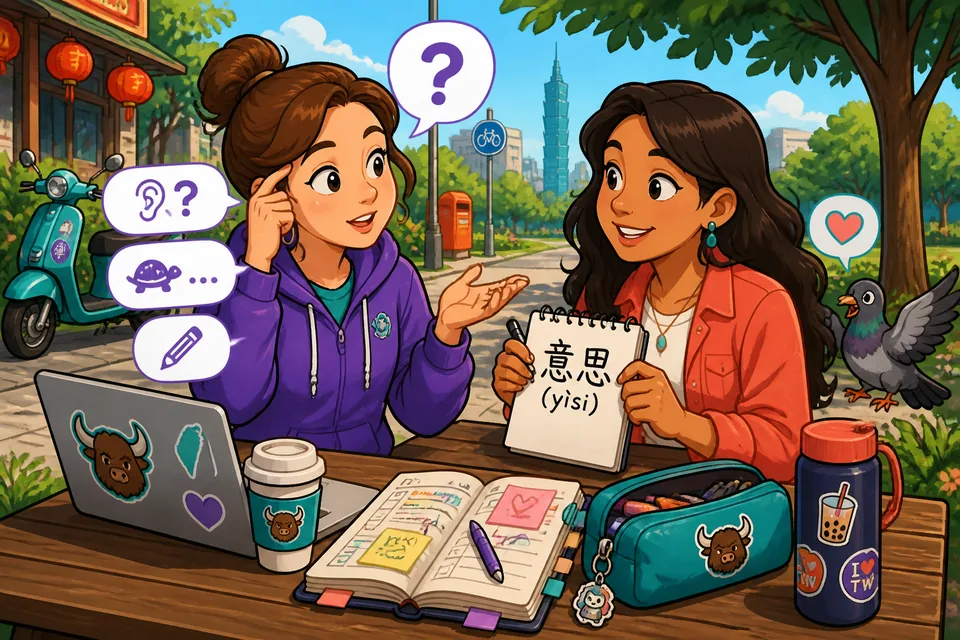
Ready to ask for help when French gets fast or fuzzy? In this lesson you'll learn friendly, simple phrases to ask someone to repeat, slow down, or explain a word. Have fun — it's okay to ask for clarification!
Level A1: This short lesson teaches common clarification phrases in spoken French. You'll practice saying and hearing phrases like "Je comprends pas", "Tu peux répéter ?" and "Comment on dit ___ en anglais ?". These are CEFR-aligned, survival phrases that help you keep a conversation going when you don't understand.
After this lesson you'll be able to:
Recognize and use basic clarification phrases at A1 level.
Ask someone to repeat, slow down, write, or explain a word.
Practice short conversational checks to confirm meaning.
Ready? Let's go!
When you tap play on phrases, we track your progress through this lesson.
1. Reading + Listening Practice
Hear core phrases, repeat aloud.
Je comprends pas.
I don't understand.
Meaning: I don't understand.
When to use: Say this when you didn't catch or follow what someone said.
Tip: Some learners try to say the full negative every time ('Je ne comprends pas'); the shorter spoken form is fine in conversation.
Je comprends pas, pouvez-vous répéter ?
I don't understand, can you repeat?
Désolé, je comprends pas cette phrase.
Sorry, I don't understand that sentence.
Tu peux répéter ?
Can you repeat that?
Meaning: Can you repeat that?
When to use: Ask this when you missed part of what someone said.
Tu peux répéter ? Je n'ai pas entendu la date.
Can you repeat? I didn't hear the date.
Excuse-moi, tu peux répéter s'il te plaît ?
Excuse me, can you repeat please?
Tu peux parler plus lentement ?
Can you speak more slowly?
Meaning: Can you speak more slowly?
When to use: Use this when someone speaks too fast and you need a slower pace.
Tip: Beginners sometimes say 'parlez' with 'tu' by mistake; use 'tu peux' for informal speech.
Tu peux parler plus lentement ? Je suis débutant.
Can you speak more slowly? I'm a beginner.
Peux-tu parler plus lentement, s'il te plaît ?
Could you speak more slowly, please?
___, ça veut dire quoi ?
What does ___ mean?
Meaning: What does ___ mean?
When to use: Ask this to learn the meaning of a word or phrase someone used.
« Boulangerie », ça veut dire quoi ?
What does 'boulangerie' mean?
« À demain », ça veut dire quoi exactement ?
What exactly does 'À demain' mean?
Comment on dit ___ en anglais ?
How do you say ___ in English?
Meaning: How do you say ___ in English?
When to use: Use this when you want the English word or phrase for something in French.
Tip: Don't confuse word order; the natural phrase is 'Comment on dit ___ en anglais ?' not 'Comment dit-on en anglais ___ ?'
Comment on dit 'chien' en anglais ?
How do you say 'chien' in English?
Comment on dit 'fenêtre' en anglais ?
How do you say 'fenêtre' in English?
Tu peux l'écrire ?
Can you write it down?
Meaning: Can you write it down?
When to use: Ask this when you need the word or information written on paper or screen.
Tu peux l'écrire ? J'ai besoin de l'orthographe.
Can you write it down? I need the spelling.
Si tu peux l'écrire, je le note.
If you can write it down, I'll write it down.
C'est ___ ou ___ ?
Is it ___ or ___?
Meaning: Is it ___ or ___?
When to use: Use this to check between two possible words or answers.
C'est 'train' ou 'tram' ?
Is it 'train' or 'tram'?
C'est 'mardi' ou 'mercredi' ?
Is it 'Tuesday' or 'Wednesday'?
Tu veux dire ___ ?
Do you mean ___?
Meaning: Do you mean ___?
When to use: Check your understanding when you think you heard a specific word or idea.
Tu veux dire 'arrêt' ?
Do you mean 'stop'?
Tu veux dire 'maintenant' ou 'tout à l'heure' ?
Do you mean 'now' or 'later'?
Tu peux utiliser des mots simples, s'il te plaît ?
Please use simple words.
Meaning: Please use simple words.
When to use: Ask this when someone uses difficult vocabulary and you need easier language.
Tu peux utiliser des mots simples, s'il te plaît ? Je suis débutant.
Please use simple words, I'm a beginner.
Pourriez-vous utiliser des mots simples, s'il vous plaît ?
Could you use simple words, please? (formal)
Je comprends juste un peu.
I only understand a little.
Meaning: I only understand a little.
When to use: Say this to show you have partial understanding.
Je comprends juste un peu, pouvez-vous répéter lentement ?
I only understand a little; can you repeat slowly?
Désolé, je comprends juste un peu le français.
Sorry, I only understand a little French.
Je ne connais pas ce mot.
I don't know that word.
Meaning: I don't know that word.
When to use: Say this when someone uses a word you haven't learned.
Je ne connais pas ce mot, tu peux l'expliquer ?
I don't know that word, can you explain it?
Je connais pas ce mot, c'est quoi ?
I don't know that word, what is it?
Tu peux m'expliquer ___ ?
Can you explain ___?
Meaning: Can you explain ___?
When to use: Ask this when you want a short explanation of a word, phrase, or idea.
Tu peux m'expliquer 'billet' ?
Can you explain 'billet'?
Vous pouvez m'expliquer comment ça marche ?
Can you explain how this works? (formal)
Tu peux l'épeler ?
Can you spell that?
Meaning: Can you spell that?
When to use: Use this to ask for the spelling of a word, name, or address.
Tu peux l'épeler ? Je veux être sûr de l'orthographe.
Can you spell that? I want to be sure of the spelling.
Pouvez-vous l'épeler, s'il vous plaît ?
Can you spell it, please? (formal)
2. Conversational Listening Practice
Hear phrases in a real mini-conversation.
Anna asks for help understanding a word and requests it written down.
Anna
Je comprends pas.
I don't understand.
David
Tu peux répéter ?
Can you repeat?
Anna
Tu peux parler plus lentement ?
Can you speak more slowly?
David
C'est 'bibliothèque' ou 'librairie' ?
Is it 'bibliothèque' or 'librairie'?
Anna
Tu peux l'écrire ?
Can you write it down?
3. Guided Practice
Quizzes and matching to lock in meaning.
If you didn't hear what someone said, which phrase would you use?
Which phrase asks someone to use simpler vocabulary?
How do you ask for the English word for something?
You want someone to check between two options. Which phrase fits?
You missed a word and want to know its meaning. You ask: '___, ça veut dire quoi ?' (What does ___ mean?)
You missed a word and want to know its meaning. You ask: "___"
The speaker is talking very fast. You politely ask: 'Tu peux parler plus lentement ?' (Can you speak more slowly?)
The speaker is talking very fast. You politely ask: "___"
You didn't hear the phone number. You say: 'Tu peux l'écrire ?' (Can you write it down?)
You didn't hear the phone number. You say: "___"
Match the core phrases
Match the extra phrases
4. Speaking Practice
Say phrases yourself (mic/recording).
Recording stays on your device only. Check speech uses your browser's speech tools when available.
Say this phrase out loud:
Je comprends pas.
I don't understand.
Say this phrase out loud:
Tu peux répéter ?
Can you repeat that?
Say this phrase out loud:
Tu peux parler plus lentement ?
Can you speak more slowly?
Say this phrase out loud:
___, ça veut dire quoi ?
What does ___ mean?
Say this phrase out loud:
Comment on dit ___ en anglais ?
How do you say ___ in English?
Say this phrase out loud:
Tu peux l'écrire ?
Can you write it down?
Say this phrase out loud:
C'est ___ ou ___ ?
Is it ___ or ___?
Say this phrase out loud:
Tu veux dire ___ ?
Do you mean ___?
Say this phrase out loud:
Tu peux utiliser des mots simples, s'il te plaît ?