
New here? This is lesson 229 of a free 240-lesson French course.
The neighborhood meeting in French
Sam's courtyard is full of folding chairs. Monsieur Lefebvre has called a residents' meeting about a bike rack by the stairwell.
Inès is already there. Lefebvre wants this brief.
You will propose an idea, object once, back another, call a show of hands, and close the vote.
Vous stays in place: this is not the café, and Lefebvre still keeps it formal.
By the end of this lesson
Propose, object, and vote at a residents' meeting.
- J'aimerais faire une proposition.I'd like to make a proposal.
- Quelqu'un s'y oppose ?Does anyone object?
- Je suis plutôt favorable à cette idée.I'm rather in favour of this idea.
- J'y vois plutôt un inconvénient.I see a drawback there, myself.
- On passe au vote, à main levée.Let's vote, by a show of hands.
- Donc c'est adopté, merci à tous.So it's carried, thanks everyone.
Scene — the courtyard vote
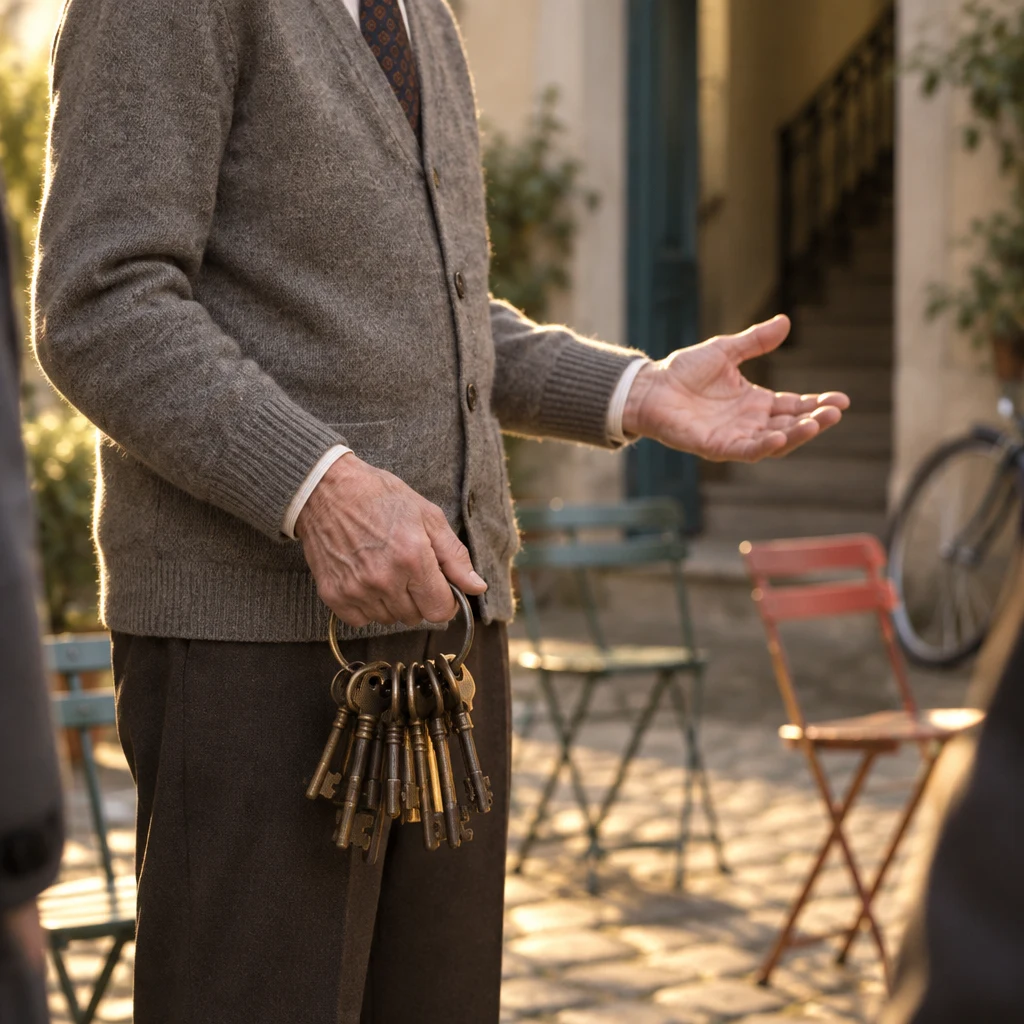
Late afternoon in the courtyard of Sam's walk-up. Folding chairs sit on the cobbles by the stairwell. A bicycle leans on the wall.
Monsieur Lefebvre stands with his keys. Inès has a notebook. Sam has just come down from the fourth floor. No café, no yak: this is the residents' meeting.

Learn — propose, object, vote
Six lines take you through a small vote: propose, ask for objections, and back an idea.
You also flag a drawback, call a show of hands, and close the vote.

J'aimerais faire une proposition.
I'd like to make a proposal.
When to use it: Use this when you want to put an idea on the table at a meeting.
J'aimerais is a polite would-like; it softens the start of a proposal.
Say it: The final s in aimerais is silent.

Quelqu'un s'y oppose ?
Does anyone object?
When to use it: Ask this after a proposal, before you move to a vote.
S'y here means object to it; y stands for the idea just named.

Je suis plutôt favorable à cette idée.
I'm rather in favour of this idea.
When to use it: Say this when you mostly support the idea on the table.
Plutôt here means rather, so you lean yes without sounding absolute.

J'y vois plutôt un inconvénient.
I see a drawback there, myself.
When to use it: Say this when you want to flag a drawback without a hard no.
J'y vois points at the idea; y stands for what was just proposed.

On passe au vote, à main levée.
Let's vote, by a show of hands.
When to use it: Use this to call a show of hands once debate is done.
À main levée means people vote by raising a hand, not on paper.
Donc c'est adopté, merci à tous.
So it's carried, thanks everyone.
When to use it: Close the vote when the motion has passed.
Adopté means the motion is carried, so the group has agreed to do it.
Say it: In c'est adopté, the t of c'est links into adopté.
Story — a show of hands
Watch the courtyard vote on a bike rack. Lefebvre keeps it short. Sam proposes, objects once, then raises his hand.
The highlighted words are the lines you just learned. Turn on Show English if you need it.
- Folding chairs scrape on the cobbles. Lefebvre checks his watch.
 Monsieur LefebvreBon, on ouvre la réunion.Right, let's open the meeting.
- Monsieur LefebvreIl s'agit du râtelier à vélos, près de l'escalier.This is about the bike rack, by the stairs.
- Sam raises a finger. Inès looks up from her notebook.
 SamJ'aimerais faire une proposition.I'd like to make a proposal.
- SamUn râtelier dans la cour, contre le mur, ça irait.A rack in the courtyard, against the wall, could work.
 InèsJe suis plutôt favorable à cette idée.I'm rather in favour of this idea.
- Monsieur LefebvreQuelqu'un s'y oppose ?Does anyone object?
- A neighbour glances at the bikes already stacked by the door.
- SamJ'y vois plutôt un inconvénient.I see a drawback there, myself.
- SamSi c'est trop près de la porte, on bloque le passage.If it's too near the door, we block the way.
- InèsAlors plus loin, près des poubelles ?So farther along, by the bins?
- SamJe suis plutôt favorable à cette idée.I'm rather in favour of this idea.
- InèsJe suis d'accord.I agree.
- Monsieur LefebvreQuelqu'un veut ajouter quelque chose ?Does anyone want to add anything?
- Nobody speaks. Lefebvre nods once.
- Monsieur LefebvreOn passe au vote, à main levée.Let's vote, by a show of hands.
- Sam raises his hand. Inès does too. Lefebvre counts, once.
- Monsieur LefebvreDonc c'est adopté, merci à tous.So it's carried, thanks everyone.
- InèsBon, ça va aider le soir.Right, that will help in the evening.
- Monsieur LefebvreTrès bien. On s'arrête là.Very good. We'll stop there.
Practice — for or against
Eleven short tasks wait here. You'll listen, match, fill a gap, and build a line.
They stay on the courtyard vote, so the round stays tight.
0 of 11 done
What did you hear?
What did you hear?
Match the pairs
French
J'aimerais faire une proposition.Drop the English hereQuelqu'un s'y oppose ?Drop the English hereJ'y vois plutôt un inconvénient.Drop the English hereDonc c'est adopté, merci à tous.Drop the English hereEnglish
What do you say?
What do you say?
A neighbour has just proposed a bike rack farther from the door. You rather like that.
Pick the reply
Monsieur Lefebvre says:
Pick the reply
Quelqu'un s'y oppose ?
Does anyone object?
And you reply with:
Fill the gap
Fill the gap
Let's vote, by a show of hands.
On passe au vote, à main ____.
What does it mean?
What does it mean?
Quelqu'un s'y oppose ?
Swap the word
Swap the word
The show of hands has passed. Close the vote and thank everyone.
Donc c'est ____, merci à tous.
Build the line
Build the line
Let's vote, by a show of hands.
, .
Tap the words in order.
True or false?
True or false?
You say this to close the vote after a show of hands.
What do you say?
What do you say?
You chair the residents' meeting in the courtyard. Start it.
Fill the gap
Fill the gap
I agree.
Je suis ____.
Say it — raise your hand
Now you are Sam at the courtyard meeting. When it is your turn, tap the microphone and speak the line.
Tap ▶ first if you want to hear the line. Your recording stays on your device.
- Monsieur LefebvreBon, on ouvre la réunion.Right, let's open the meeting.
- Sam (you)You want to put an idea on the table.
You want to put an idea on the table.
J'aimerais faire une proposition.
I'd like to make a proposal.
0 of 3 said
Recap — what you can say now
| French | English | Play |
|---|---|---|
| J'aimerais faire une proposition. | I'd like to make a proposal. | |
| Quelqu'un s'y oppose ? | Does anyone object? | |
| Je suis plutôt favorable à cette idée. | I'm rather in favour of this idea. | |
| J'y vois plutôt un inconvénient. | I see a drawback there, myself. | |
| On passe au vote, à main levée. | Let's vote, by a show of hands. | |
| Donc c'est adopté, merci à tous. | So it's carried, thanks everyone. |
Save your progress — it’s free
Keep your place in the course and see which lines you’ve learned.
Want the next lesson in your inbox?
Get the next lesson by email, one a day.
Join the newsletterDaily lesson emails are coming soon. Newsletter subscribers get them first.
Keep practicing with Yak Cards
Want these meeting lines on the stairs? Grab the Yak Cards for this lesson and review them anywhere.
A quick round with the Yak Cards keeps propose, object and vote ready for the courtyard.
Open Yak Cards