
New here? This is lesson 137 of a free 240-lesson French course.
The street market in French
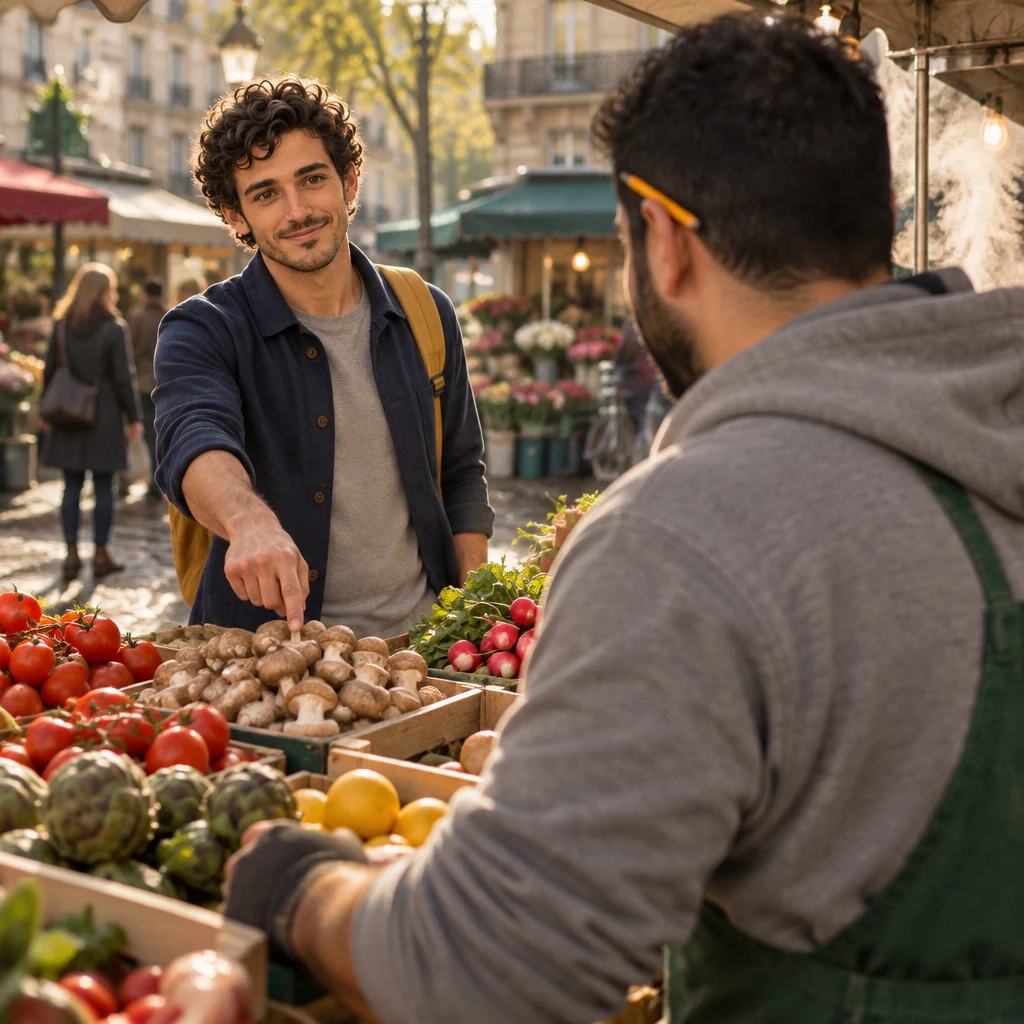
Saturday morning on the boulevard: stalls, steam, and Karim's crates next door. Sam is at a food stall, not the fruit.
Gaspard already wants a taste. The vendor has not even had a hello yet.
You'll ask what's in season, order politely, check the kilo price, and ask for a homemade taste.
Say hello first. Vendors you do not know get vous.
By the end of this lesson
Order street food and ask what is in season.
- Qu'est-ce qui est de saison ?What's in season?
- Je voudrais ___.I'd like ___.
- C'est combien le kilo ?How much is it a kilo?
- Vous me faites goûter ?Can I try a taste?
- C'est fait maison ?Is it homemade?
- Juste un petit peu, merci.Just a little, thanks.
Scene — beside Karim's stall
Saturday on the boulevard between Parmentier and Oberkampf. Karim's fruit crates sit in the sun. Next to him, a food stall has trays of galettes and a pan still steaming.
Gaspard is already at the counter, tote on his arm, a baguette sticking out. His café crème sits unfinished back at the café.
The vendor waits. Sam still has to say hello.

Learn — in season and to order
Six market lines: what's in season, I'd like, the kilo price, a taste, homemade, and just a little.
You'll use vous with a vendor you do not know.

Qu'est-ce qui est de saison ?
What's in season?
When to use it: Ask a stall what food is good right now.
Use qui here, not que, because you ask what thing is in season.
Say it: Qu'est is que plus est, said as one piece.
Je voudrais ___.
I'd like ___.
When to use it: Order at a stall, then name the food in the blank.
Voudrais is the polite form; it does not change with your gender.
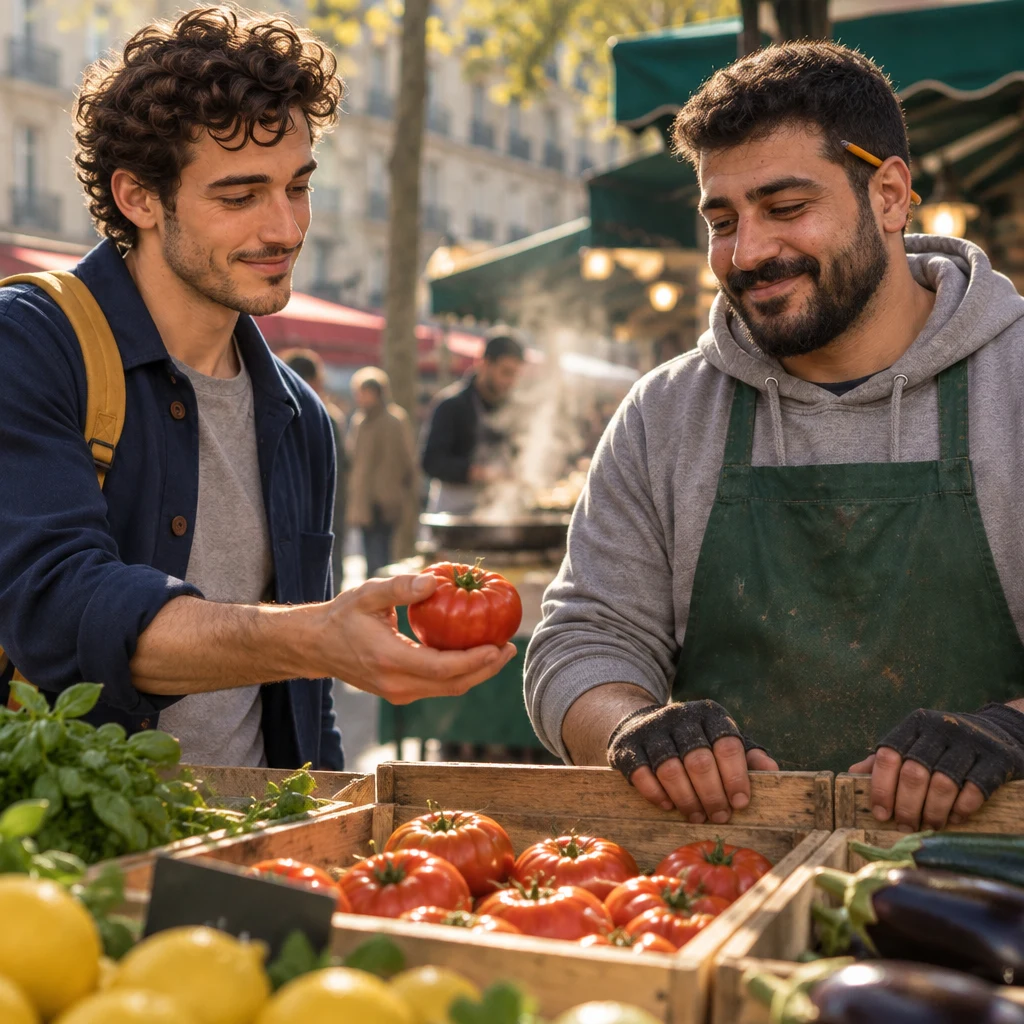
C'est combien le kilo ?
How much is it a kilo?
When to use it: Ask the price when food is sold by weight.
Le kilo stays le even if the food itself is feminine.

Vous me faites goûter ?
Can I try a taste?
When to use it: Ask a new vendor if you can try a small taste.
A stall you do not know gets vous, not tu.
Say it: The last s in faites is silent.
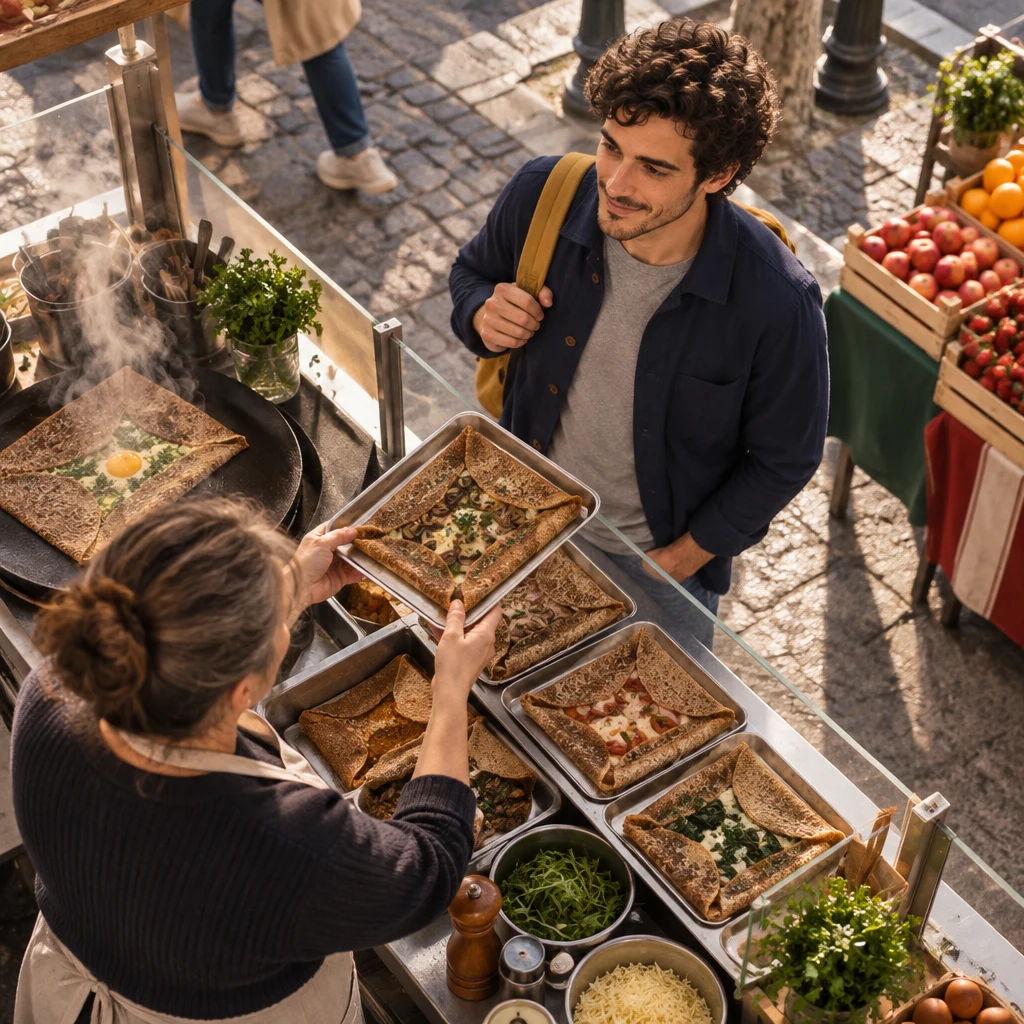
C'est fait maison ?
Is it homemade?
When to use it: Ask if the stall made the food themselves.
Fait maison stays in this form for any food on the stall.

Juste un petit peu, merci.
Just a little, thanks.
When to use it: Limit a taste when they start to give you a lot.
Un petit peu is one piece meaning a small amount.
Say it: The last t in petit is silent.
Story — he wants a taste
Watch Sam at the food stall beside Karim. Gaspard wants a taste before he has said hello.
The highlighted words are the lines you just learned. Turn on Show English if you need it.
- Saturday on the boulevard. Karim's crates sit beside the food stall. Gaspard is already too close to the trays.
 SamBonjour.Hello.
- VendorBonjour.Hello.
- SamQu'est-ce qui est de saison ?What's in season?
- VendorLes champignons, là. Et la galette du jour.The mushrooms, there. And today's galette.
- SamC'est fait maison ?Is it homemade?
- VendorOui, ce matin.Yes, this morning.
- Gaspard leans in over the pan. He has not said hello yet.
 GaspardVous me faites goûter ?Can I try a taste?
- VendorBonjour, d'abord.Hello first.
- GaspardBonjour. Vous me faites goûter ?Hello. Can I try a taste?
- VendorAllez-y.Go ahead.
- GaspardJuste un petit peu, merci.Just a little, thanks.
- SamC'est combien le kilo ?How much is it a kilo?
- VendorHuit euros le kilo.Eight euros a kilo.
- SamJe voudrais une galette.I'd like a galette.
- Karim watches from the next stall and grins. Gaspard still has not finished a drink.
Practice — kilo or a taste
Eleven short tasks wait here. You'll listen, fill a gap, build a line, and pick what to say at the stall.
They stay quick, so you can get back to the market.
0 of 11 done
What did you hear?
What did you hear?
What does it mean?
What does it mean?
Qu'est-ce qui est de saison ?
What do you say?
What do you say?
You have chosen a galette. Tell the vendor what you'd like.
Fill the gap
Fill the gap
How much is it a kilo?
C'est combien le ____ ?
Pick the reply
Vendor says:
Pick the reply
Vous en voulez beaucoup ?
Would you like a lot of it?
And you reply with:
Build the line
Build the line
Just a little, thanks.
, .
Tap the words in order.
Swap the word
Swap the word
You want a taste from a vendor you do not know.
Vous me faites ____ ?
Match the pairs
French
Qu'est-ce qui est de saison ?Drop the English hereJe voudrais ___.Drop the English hereC'est combien le kilo ?Drop the English hereVous me faites goûter ?Drop the English hereEnglish
Fill the gap
Fill the gap
What's in season?
Qu'est-ce qui est de ____ ?
What do you say?
What do you say?
You are looking at the galette and want to know if the stall made it.
True or false?
True or false?
This asks the price per kilo.
Say it — order at the stall
Now you're Sam at the stall. When it's your turn, tap the microphone and speak the line.
Tap ▶ first if you want to hear the line. Your recording stays on your device.
- VendorBonjour.Hello.
- Sam (you)Say hello first. It is still morning.
Say hello first. It is still morning.
Bonjour.
Hello
0 of 7 said
Recap — what you can say now
| French | English | Play |
|---|---|---|
| Qu'est-ce qui est de saison ? | What's in season? | |
| Je voudrais ___. | I'd like ___. | |
| C'est combien le kilo ? | How much is it a kilo? | |
| Vous me faites goûter ? | Can I try a taste? | |
| C'est fait maison ? | Is it homemade? | |
| Juste un petit peu, merci. | Just a little, thanks. |
Save your progress — it’s free
Keep your place in the course and see which lines you’ve learned.
Want the next lesson in your inbox?
Get the next lesson by email, one a day.
Join the newsletterDaily lesson emails are coming soon. Newsletter subscribers get them first.
Keep practicing with Yak Cards
Want these market lines handy at the stall? Grab the Yak Cards for this lesson and review them anywhere.
A quick round with the Yak Cards keeps in-season, kilo, and I'd-like ready for Saturday.
Open Yak Cards