
New here? This is lesson 16 of a free 240-lesson French course.
How much is it in French
Sam is back at Café des Tilleuls, still learning the chalkboard. Odile names a price, and Gaspard nods as if it is obvious.
Sam nods too, then realises he has no idea what he agreed to.
By the end, you will ask how much something is, hear a price in euros, and say when it is too much.
Gaspard still has not finished his café crème.
By the end of this lesson
Ask the price and say a price in euros.
- C'est combien ?How much is it?
- Ça fait combien ?How much does that come to?
- Deux euros cinquante.Two euros fifty.
- C'est trop cher.That's too expensive.
- Vous avez moins cher ?Do you have anything cheaper?
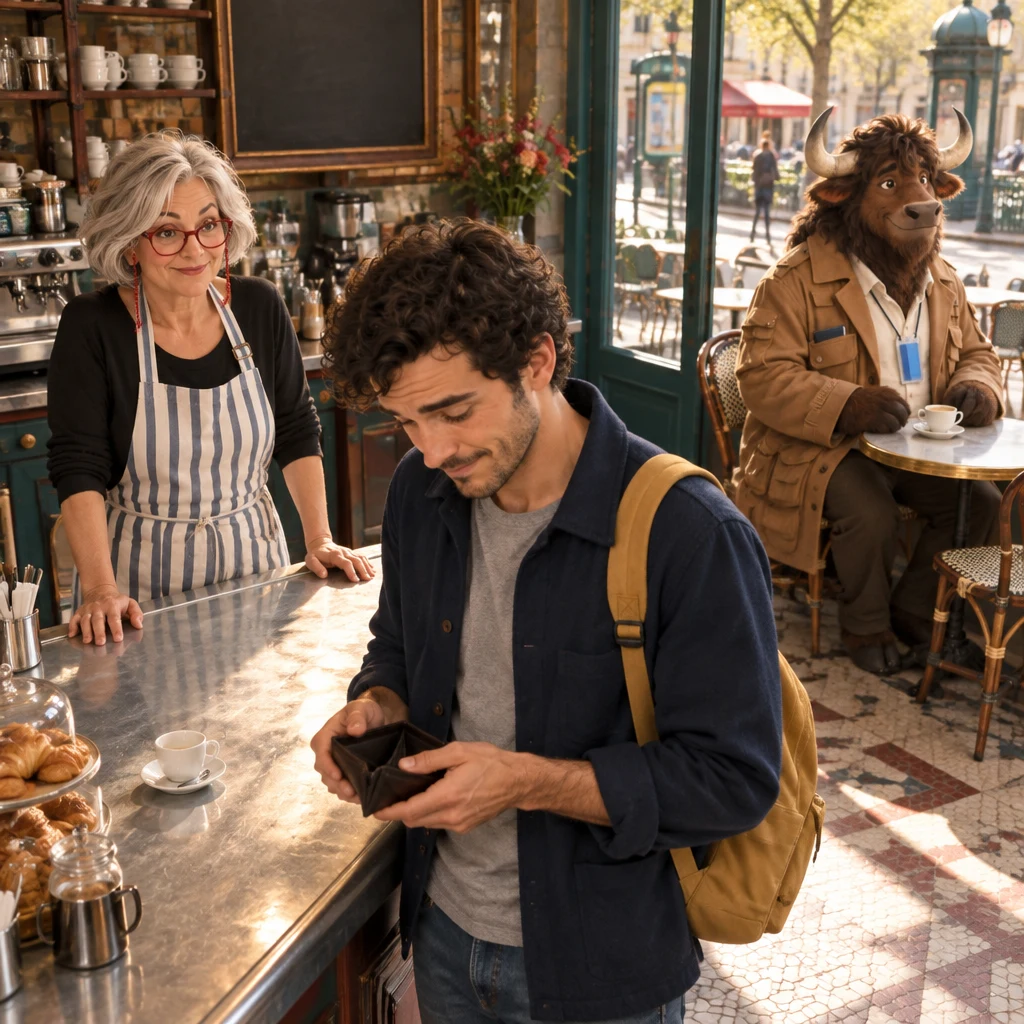
- Je n'ai pas assez.I don't have enough.
Scene — the price on the board
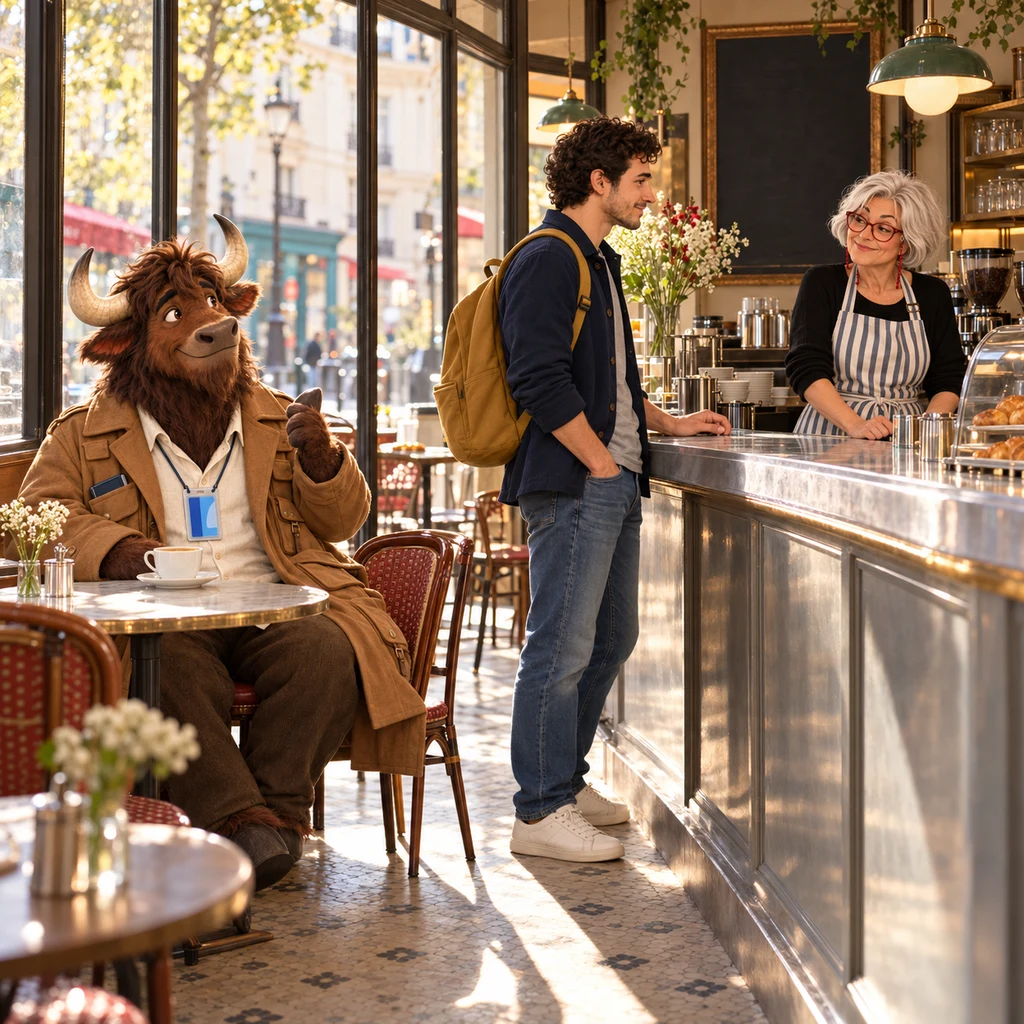
Same café on rue des Tilleuls. Sam is at the zinc counter. Odile waits with the chalkboard.
The window table has its blank brass sign. Gaspard sits next to it on two chairs, café crème still full. He nods at a price as if Sam already knows it.
Learn — how much is it
Six short lines cover asking the price, hearing two euros fifty, and saying it is too much.
You will also ask for something cheaper, and say you do not have enough.

C'est combien ?
How much is it?
When to use it: Ask this when you want the price of one thing.
Learn it as one piece at the counter.
Say it: The e of ce drops in C'est.

Ça fait combien ?
How much does that come to?
When to use it: Ask this for a bill or a total at the counter.
Learn it as one piece for the total.

Deux euros cinquante.
Two euros fifty.
When to use it: Say this when the price is two euros fifty.
Learn it as one piece for this price.
Say it: The x in deux links as z before euros.

C'est trop cher.
That's too expensive.
When to use it: Say this when the price is more than you want.
Learn it as one piece when it costs too much.
Say it: The p in trop is silent.

Vous avez moins cher ?
Do you have anything cheaper?
When to use it: Ask staff if they have a cheaper option.
Learn it as one piece with shop staff.
Say it: The s in vous links as z into avez.
Je n'ai pas assez.
I don't have enough.
When to use it: Say this when you cannot pay that price.
Learn it as one piece when money is short.
Say it: The e of ne drops in n'ai.
Story — he nods too soon
Watch Sam ask the price, then the total at the counter. He agrees too fast, then has to say it is too much.
The highlighted words are the lines you just learned. Turn on Show English if you need it.
- The chalkboard is behind Odile. Sam waits at the zinc counter.
 OdileBonjour.Hello.
 SamBonjour. C'est combien ?Hello. How much is it?
- OdileUn euro.One euro.
- Sam takes a coffee too. Odile adds both on the counter.
- SamÇa fait combien ?How much does that come to?
- OdileDeux euros cinquante.Two euros fifty.
- Gaspard nods from the next table. Sam nods too.
 GaspardDeux euros cinquante.Two euros fifty.
- Sam stops nodding. He has no idea what he agreed to.
- SamC'est trop cher. Vous avez moins cher ?That's too expensive. Do you have anything cheaper?
- OdileNon, désolée.No, sorry.
- Odile does not change the price. Gaspard stays at the next table, café crème still full.
- SamJe n'ai pas assez. Au revoir.I don't have enough. Goodbye.
Practice — euros and enough
Eleven quick exercises wait here. You'll listen, pick, match, fill a gap, and build a line.
They stay tiny, so the round moves fast.
0 of 11 done
What did you hear?
What did you hear?
Match the pairs
French
C'est combien ?Drop the English hereÇa fait combien ?Drop the English hereDeux euros cinquante.Drop the English hereEnglish
What do you say?
What do you say?
You are at Odile's counter. You want the price of one thing on the chalkboard.
Fill the gap
Fill the gap
How much does that come to?
Ça ____ combien ?
What does it mean?
What does it mean?
C'est trop cher.
Build the line
Build the line
Do you have anything cheaper?
?
Tap the words in order.
Pick the reply
Odile says:
Pick the reply
Deux euros cinquante.
Two euros fifty. You have two euros.
And you reply with:
Swap the word
Swap the word
Odile has just named the total. Repeat two euros fifty.
Deux euros ____.
What do you say?
What do you say?
You walk into Café des Tilleuls in the morning. Odile looks up and waits.
Find the mistake
Find the mistake
What do you say?
What do you say?
You cannot pay. You leave the counter in the daytime.
Say it — ask the price
Now you're Sam at Odile's counter, asking the price. When it's your turn, tap the microphone and speak the line.
Tap ▶ first if you want to hear the line. Your recording stays on your device.
- OdileBonjour.Hello.
- Sam (you)Ask how much it is.
Ask how much it is.
C'est combien ?
How much is it?
0 of 6 said
Recap — what you can say now
| French | English | Play |
|---|---|---|
| C'est combien ? | How much is it? | |
| Ça fait combien ? | How much does that come to? | |
| Deux euros cinquante. | Two euros fifty. | |
| C'est trop cher. | That's too expensive. | |
| Vous avez moins cher ? | Do you have anything cheaper? | |
| Je n'ai pas assez. | I don't have enough. |
Save your progress — it’s free
Keep your place in the course and see which lines you’ve learned.
Want the next lesson in your inbox?
Get the next lesson by email, one a day.
Join the newsletterDaily lesson emails are coming soon. Newsletter subscribers get them first.
Keep practicing with Yak Cards
Want to keep these prices handy? Grab the Yak Cards for this lesson and review them anywhere.
A quick round with the Yak Cards each day keeps your prices ready at the counter.
Open Yak Cards