French - Encouragement

Lesson 95 of 159

Two friends chatting in French about encouragement phrases — learning to support others in French, lesson on encouragement.

Goal: Short, supportive phrases to help and comfort others

Free French lessons with guided practice, audio, and speaking support.

Welcome back — Lesson 95! Today we focus on quick phrases that bring people together when things are hard. These lines are small but powerful. Have fun practicing — say them out loud when you can.

Level A2: In this short, friendly lesson you'll learn three common French encouragement phrases: how to offer to do something together, how to reassure someone after a mistake, and how to recognize someone’s effort. CEFR-aligned and practical — by the end you'll hear them in a mini-conversation, practice matching and multiple-choice items, and say each phrase aloud.

After this lesson you'll be able to:
  • Recognize and use three A2 encouragement phrases in French.
  • Hear the phrases in a short conversation and understand the gist.
  • Practice with quizzes and say each phrase out loud to build confidence.
A short, friendly French conversation between Anna and David where one comforts the other — ideal for A2 learners practicing supportive language.

Ready? Let's go!

When you tap play on phrases, we track your progress through this lesson.

1. Reading + Listening Practice

Hear core phrases, repeat aloud.

On va ___ ensemble.

Let's ___ together.

Meaning: Let's ___ together.

When to use: Use this neutral, spoken frame to offer shared effort. Put an infinitive verb in the blank (e.g. essayer, travailler, le faire).

Tip: Beginner error: don't conjugate the verb after 'On va' — use the infinitive (e.g. 'essayer', not 'essaie').

On va essayer ensemble.
Let's try together.
On va le finir ensemble.
We'll finish it together.

Tout le monde fait des erreurs.

Everyone makes mistakes.

Meaning: Everyone makes mistakes.

When to use: A reassuring, neutral phrase used after someone makes a mistake or feels bad about an error.

Ne t'inquiète pas, tout le monde fait des erreurs.
Don't worry, everyone makes mistakes.
Après une erreur, rappelez-vous : tout le monde fait des erreurs.
After a mistake, remember: everyone makes mistakes.

Tu as fait de ton mieux.

You did your best.

Meaning: You did your best.

When to use: Use this phrase to acknowledge effort and comfort someone who may be disappointed with a result.

Tip: Watch for formality: to be polite to adults you don't know well, use 'Vous avez fait de votre mieux.'

Tu as fait de ton mieux pendant l'examen.
You did your best during the exam.
Même si le résultat n'est pas parfait, tu as fait de ton mieux.
Even if the result isn't perfect, you did your best.

2. Conversational Listening Practice

Hear phrases in a real mini-conversation.

Anna made a mistake at work and David comforts her, then they plan to study together.
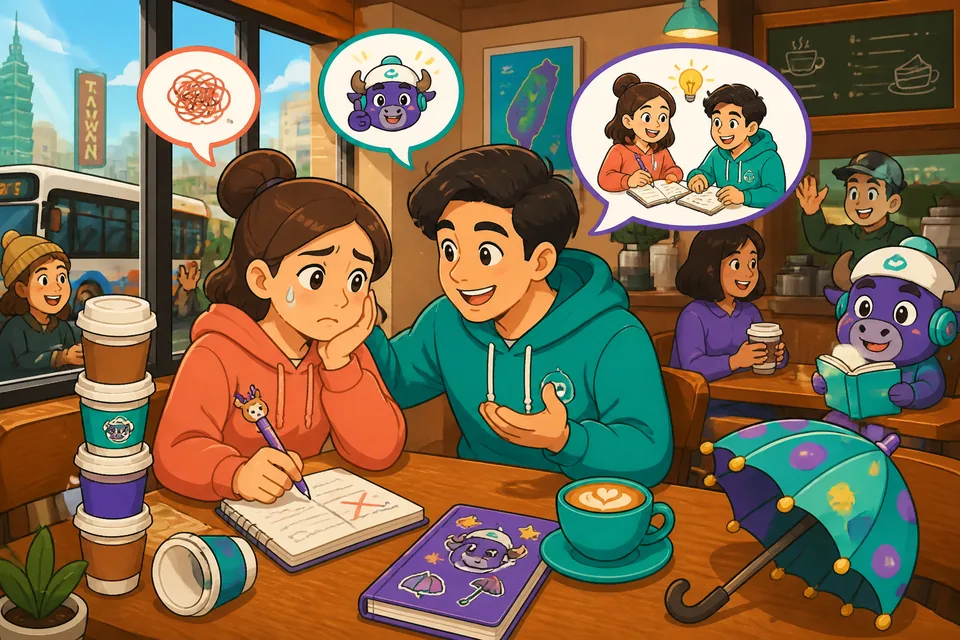
Anna and David encouraging each other in French: phrases for mistakes, effort, and working together.

What do Anna and David decide to do together?

Portrait of Anna in a French lesson dialogue

Anna

J'ai mal présenté mon projet, je suis un peu triste.

I presented my project badly, I'm a bit sad.

Portrait of David in a French lesson dialogue

David

Ne t'inquiète pas — tout le monde fait des erreurs.

Don't worry — everyone makes mistakes.

Portrait of Anna in a French lesson dialogue

Anna

Oui, mais j'aurais voulu mieux faire.

Yes, but I wanted to do better.

Portrait of David in a French lesson dialogue

David

Tu as fait de ton mieux, et on va réviser ensemble.

You did your best, and we'll review together.

Portrait of Anna in a French lesson dialogue

Anna

D'accord, on va réviser ensemble demain.

Okay, let's study together tomorrow.

3. Guided Practice

Quizzes and matching to lock in meaning.

Which French sentence means 'You did your best.'?

Which phrase would you use to comfort someone after they make a mistake?

Choose the sentence that best completes this English idea: 'Let's finish this together.'

Which phrase offers to try something together?

David: 'Everyone makes mistakes.'

Anna is worried after a mistake. David comforts her: '___'.

You say: 'On va essayer ensemble.'

You want to offer shared work: 'On va ___ ensemble.'

You say: 'You did your best.'

After a long effort, your friend is unsure. You say: '___.'

Match the core phrases

Match the extra phrases

4. Speaking Practice

Say phrases yourself (mic/recording).

Recording stays on your device only. Check speech uses your browser's speech tools when available.

Say this phrase out loud:

On va ___ ensemble.

Let's ___ together.

Say this phrase out loud:

Tout le monde fait des erreurs.

Everyone makes mistakes.

Say this phrase out loud:

Tu as fait de ton mieux.

You did your best.