
New here? This is lesson 232 of a free 240-lesson English course.
Reading notices and signs in English
Ana finds a typed notice taped in the three-flat hall. The words look formal, so she reads them twice.
Mr. Kowalski is on the first-floor porch with his keys. She asks him what one short line means.
You will read signs and notices: alley rules, closed shops, and when a service starts again.
These lines are written English. People say them when they read a notice out loud.
By the end of this lesson
Read a building notice, a sign, and a short formal message.
- Please do not block the alley.Do not put cars or trash where trucks need to go.
- Closed until further notice.Not open, and we do not know the return day.
- For questions, contact the building manager.If you need help, write or call the person who runs the building.
- We ask for your understanding.Please be patient about this change.
- Effective immediately.This rule starts now.
- Service will resume on Monday.The service will start again on Monday.
Scene — the hall notice
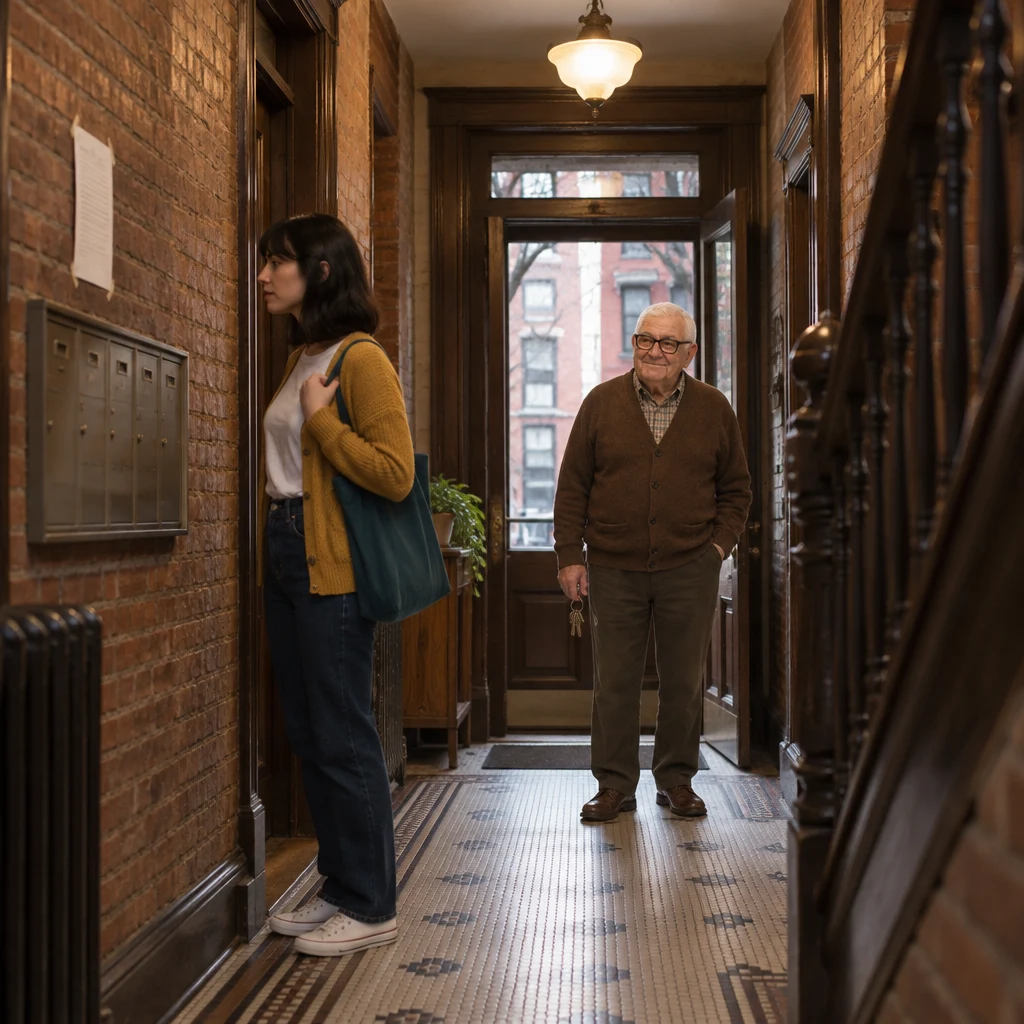
Same brick three-flat on Larch Street. A typed notice is taped in the hall by the mailboxes.
The paper has no readable writing in the picture, but Ana stops and reads it twice.
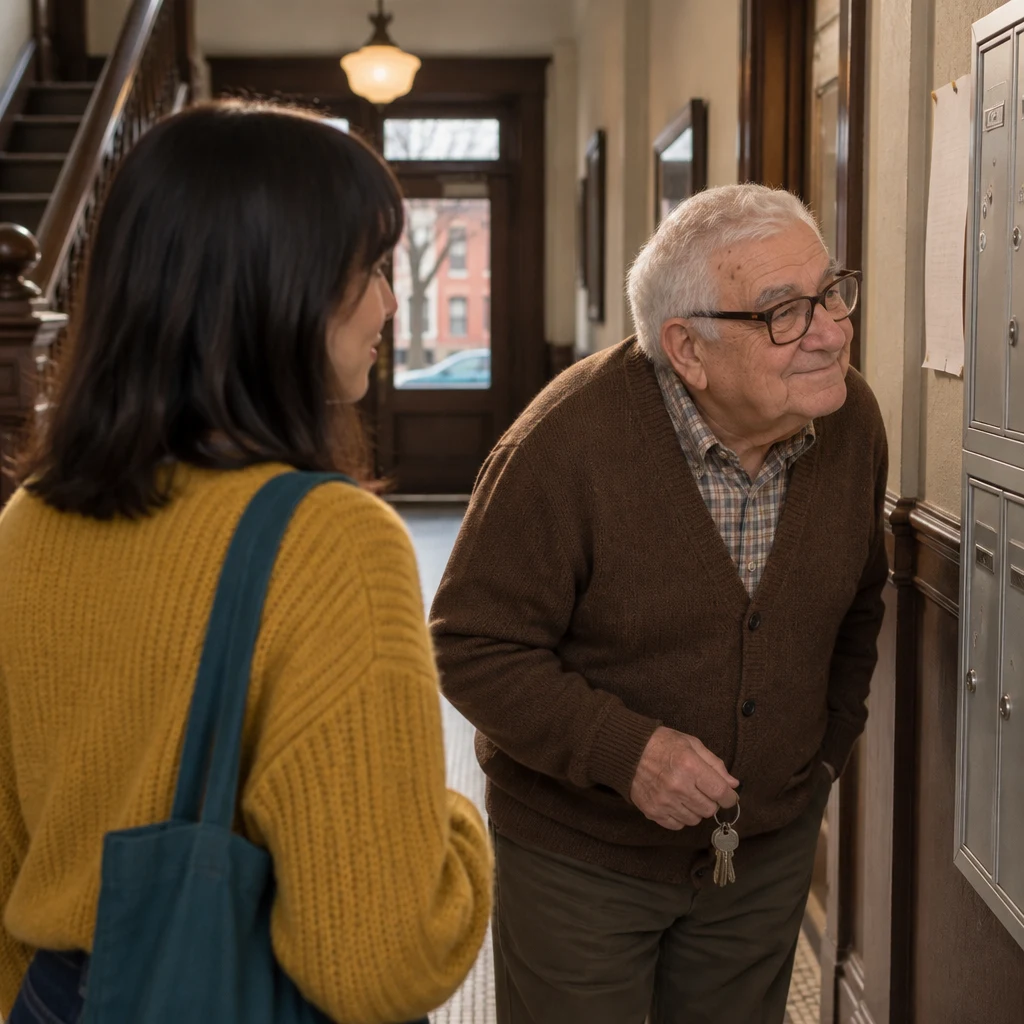
Mr. Kowalski comes out from the first floor with his keys. He waits while she points at one short line.
Learn — notices and signs
Six lines from signs and notices. They are formal, not diner talk.
You will hear them out loud, then use them when you read a posted note.

Please do not block the alley.
Do not put cars or trash where trucks need to go.
When to use it: Say this when a sign tells people to keep the back lane clear.
Signs use Please do not as a polite order not to do something.
Closed until further notice.
Not open, and we do not know the return day.
When to use it: A shop or office uses this when it is shut with no return date.
Further notice means they will tell you later, not now.
Say it: The th in further sounds like the th in this.

For questions, contact the building manager.
If you need help, write or call the person who runs the building.
When to use it: A notice names who to call when you need help.
Contact means get in touch. You can write, call, or speak to the person.

We ask for your understanding.
Please be patient about this change.
When to use it: A formal notice says this after a rule or delay.
This polite line asks you to be patient about a change.

Effective immediately.
This rule starts now.
When to use it: A notice uses this when a rule starts at this moment.
Effective here means the rule is in force from this time.
Say it: Stress falls on the second part of immediately.

Service will resume on Monday.
The service will start again on Monday.
When to use it: A notice uses this when a service stops, then starts again.
Resume means start again after a pause.
Say it: Resume has stress on the second part.
Story — she reads it twice
Watch Ana read the hall notice twice. Mr. Kowalski will not wait through a long speech.
The highlighted words are the lines you just learned.
- The hall light is on. A typed notice is taped by the mailboxes.
 AnaExcuse me.you say this to get someone's attention
 Mr. KowalskiYes, Miss.He answers and waits.
- AnaThere's a notice on the wall. I've read it twice.She has read the paper two times.
- She points at the first line.
- AnaPlease do not block the alley.Do not put cars or trash where trucks need to go.
- Mr. KowalskiYes. Effective immediately.This rule starts now.
- AnaWhat does "effective immediately" mean?She asks the meaning of those two words.
- Mr. KowalskiThe rule starts now. Keep the alley clear for the trucks.He explains that the alley rule is in force today.
- AnaClosed until further notice.Not open, and we do not know the return day.
- Mr. KowalskiThe laundry was closed until further notice. A new notice says service will resume on Monday.The old sign had no return day. A new sign names Monday.
- AnaSo, for questions, contact the building manager.If you need help, write or call the person who runs the building.
- Mr. KowalskiYes. That is me.He says he is the person to call.
- AnaWho is responsible for repairs?Who must fix things when they break?
- Mr. KowalskiI am. Put it in a message if something breaks.He will fix things if she writes to him.
- AnaWe ask for your understanding.Please be patient about this change.
- Mr. KowalskiThat last line is polite. We ask for your understanding.He says the notice is asking people to be patient.
- AnaThank you.you say this when someone helps you
Practice — the alley and the laundry
Eleven short exercises wait here. You will listen, pick, fill a gap, and build a line.
They stay on notices, so you practice the same formal words.
0 of 11 done
What did you hear?
What did you hear?
What does it mean?
What does it mean?
Closed until further notice.
What do you say?
What do you say?
You read a notice. The new alley rule starts now, not next week.
Match the pairs
English
Closed until further notice.Drop the Simple English hereFor questions, contact the building manager.Drop the Simple English hereEffective immediately.Drop the Simple English hereService will resume on Monday.Drop the Simple English hereSimple English
What do you say?
What do you say?
A notice ends with a polite line. It asks people to be patient about a change.
Build the line
Build the line
If you need help, write or call the person who runs the building.
, .
Tap the words in order.
Pick the reply
Mr. Kowalski says:
Pick the reply
A new notice says the laundry starts again on Monday. Which line names that day?
He wants the line that names Monday as the return day.
And you reply with:
Swap the word
Swap the word
The hall notice is about the alley behind the building, not a driveway.
Please do not block the ____.
Which one doesn’t belong?
Which one doesn’t belong?
Pick the reply
Mr. Kowalski says:
Pick the reply
Effective immediately.
This rule starts now.
And you reply with:
What do you say?
What do you say?
Choose the line that asks who must fix a broken washer.
Say it — say the notice back
Now you're Ana in the three-flat hall. When it's your turn, tap the microphone and speak the line.
Tap play first if you want to hear the line. Your recording stays on your device.
- Mr. KowalskiLook at the first line, Miss.He wants you to read the top of the notice.
- Ana (you)Read the rule about cars and trash where trucks need to go.
Read the rule about cars and trash where trucks need to go.
Please do not block the alley.
Do not put cars or trash where trucks need to go.
0 of 6 said
Recap — what you can say now
| English | Simple English | Play |
|---|---|---|
| Please do not block the alley. | Do not put cars or trash where trucks need to go. | |
| Closed until further notice. | Not open, and we do not know the return day. | |
| For questions, contact the building manager. | If you need help, write or call the person who runs the building. | |
| We ask for your understanding. | Please be patient about this change. | |
| Effective immediately. | This rule starts now. | |
| Service will resume on Monday. | The service will start again on Monday. |
Save your progress — it’s free
Keep your place in the course and see which lines you’ve learned.
Want the next lesson in your inbox?
Get the next lesson by email, one a day.
Join the newsletterDaily lesson emails are coming soon. Newsletter subscribers get them first.
Keep practicing with Yak Cards
Want to keep these notice lines handy? Grab the Yak Cards for this lesson and review them anywhere.
A quick round with the Yak Cards each day keeps these notice lines ready for a hallway wall.
Open Yak Cards