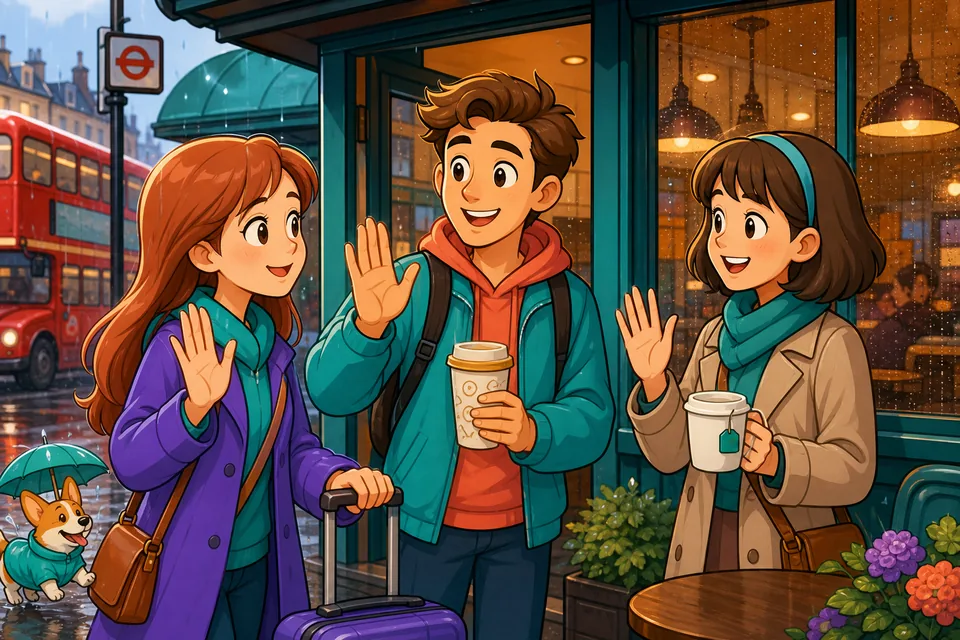
Goodbyes can be short, but they can feel very kind. In this lesson, you’ll learn easy ways to end a conversation warmly.
Ready? Let’s make your goodbyes sound natural—not like a robot waving at a bus.
Level A1: You’ll practice everyday goodbye phrases like “Thanks again,” “Good luck,” and “See you soon.” You’ll also learn how to wish someone a nice trip, activity, or next meeting. These small phrases are very useful at shops, hotels, work, school, and with friends.
After this lesson you'll be able to:
Say goodbye after someone helps you.
Wish someone fun, luck, or safe travel.
Use “Enjoy your ___” with simple activities or things.
Choose between “See you soon” and “See you next time” in friendly situations.
Ready? Let's go!
When you tap play on phrases, we track your progress through this lesson.
1. Reading + Listening Practice
Hear core phrases, repeat aloud.
Thanks again.
Say goodbye after help or service has been given.
Meaning: Use this after someone helps you or gives you a service. It is a friendly final thank-you.
When to use: At the end of a short interaction, especially after help at a shop, hotel, office, or station.
Tip: Do not use this as the first thank-you if nobody helped yet. It means you are thanking them again.
Thanks again. See you soon.
A friendly goodbye after help.
Thanks again for the directions.
You are thanking someone one more time.
Thanks for your help.
Close an interaction by thanking someone for assistance.
Meaning: Use this to thank someone for helping you before you leave.
When to use: After someone answers a question, gives directions, fixes a problem, or supports you.
Thanks for your help. Have a good day.
A polite goodbye after help.
Thanks for your help with my ticket.
You name the help you received.
Have fun.
Wish someone enjoyment as they leave or before an activity.
Meaning: Use this to wish someone a good and enjoyable time.
When to use: Before someone goes to a party, a game, a trip activity, a class, or another fun plan.
Tip: Use this for enjoyable activities, not serious problems or emergencies.
Have fun at the concert!
You wish someone enjoyment at an event.
Have fun. See you soon.
A friendly goodbye before an activity.
Good luck.
Wish someone success when ending an interaction.
Meaning: Use this to wish someone success.
When to use: Before a test, interview, meeting, trip, performance, or important task.
Good luck with your interview.
You wish success before an interview.
Good luck. See you next time.
A short goodbye with a success wish.
Safe travels.
Say goodbye to someone who is traveling.
Meaning: Use this to say goodbye to someone who is going on a trip.
When to use: When someone is leaving by plane, train, bus, car, or another travel plan.
Tip: Use this for travel, not for a normal goodbye when someone is just going to another room.
Safe travels. Text me when you arrive.
A caring goodbye before a trip.
Safe travels, David!
A short travel goodbye with a name.
Enjoy your ___.
Wish someone enjoyment of a thing or activity when parting.
Meaning: Use this to wish someone enjoyment of a thing or activity. Add a noun after “your.”
When to use: Before someone starts a meal, holiday, class, coffee, weekend, movie, or other activity.
Enjoy your coffee.
You wish someone enjoyment of their drink.
Enjoy your weekend!
You wish someone a nice weekend.
See you next time.
Say goodbye with an expectation of another future meeting.
Meaning: Use this when you expect to meet the person again in the same place or situation.
When to use: After a class, lesson, appointment, club meeting, or regular visit.
Great class today. See you next time.
You expect another class later.
Thanks again. See you next time.
A friendly goodbye for a repeated meeting.
See you soon.
End an interaction politely with a simple farewell
Meaning: Use this to say a friendly goodbye when you expect to meet or talk again soon.
When to use: With friends, coworkers, classmates, or helpful people when another meeting may happen soon.
Bye, Anna. See you soon.
A warm goodbye to someone you may meet again soon.
Thanks for your help. See you soon.
A polite ending after help.
2. Conversational Listening Practice
Hear phrases in a real mini-conversation.
Anna is at a train station. David helped her find the right platform. Now they are saying goodbye.
Anna
Thanks for your help, David.
Anna thanks David because he helped her.
David
No problem. Safe travels!
David wishes Anna a safe trip.
Anna
Thanks again. I’m going to visit my sister.
Anna thanks him one more time and says where she is going.
David
Enjoy your trip.
David wishes Anna a nice trip.
Anna
Thank you! See you soon.
Anna says a friendly goodbye.
David
See you next time.
David says they may meet again another time.
3. Guided Practice
Quizzes and matching to lock in meaning.
Someone helped you find your hotel. What can you say before leaving?
Your friend is leaving for the airport. What is the best goodbye?
Your classmate has an exam tomorrow. What can you say?
You finish your weekly lesson and expect another lesson later. What can you say?
Anna says “Thanks for your help” because David helped her find the bus stop.
Anna: I found the bus stop now. ___ David: You’re welcome!
Anna says “Safe travels” because David is leaving for a flight.
David: I’m leaving now for my flight. Anna: ___
David says “Have fun” because Anna is going to a party.
Anna: I’m going to a party tonight. David: Nice! ___
Match the core phrases
Match the extra phrases
4. Speaking Practice
Say phrases yourself (mic/recording).
Recording stays on your device only. Check speech uses your browser's speech tools when available.
Say this phrase out loud:
Thanks again.
Say goodbye after help or service has been given.
Say this phrase out loud:
Thanks for your help.
Close an interaction by thanking someone for assistance.
Say this phrase out loud:
Have fun.
Wish someone enjoyment as they leave or before an activity.
Say this phrase out loud:
Good luck.
Wish someone success when ending an interaction.
Say this phrase out loud:
Safe travels.
Say goodbye to someone who is traveling.
Say this phrase out loud:
Enjoy your ___.
Wish someone enjoyment of a thing or activity when parting.
Say this phrase out loud:
See you next time.
Say goodbye with an expectation of another future meeting.
Say this phrase out loud:
See you soon.
End an interaction politely with a simple farewell.