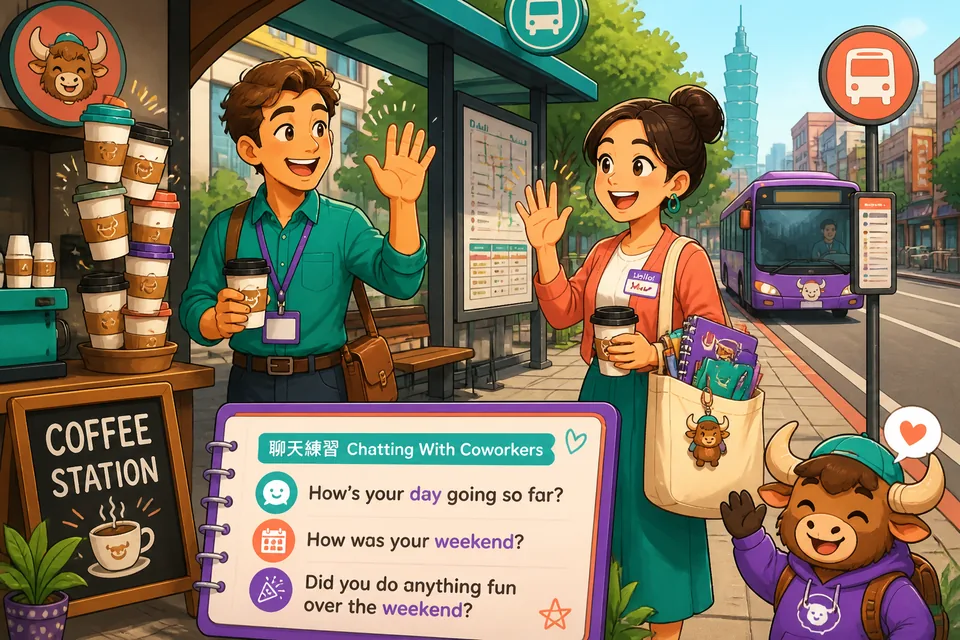
Hi — welcome back! This short lesson helps you sound natural when chatting with coworkers about the day, breaks, and plans. Say the phrases aloud and try the quick quizzes.
Level B1: In this lesson you will practice common workplace small talk phrases for checking in, offering to get coffee, and asking about plans. These ready-to-use lines help you start short friendly conversations with teammates and keep the tone natural and casual. (CEFR-aligned, useful for real office chats.)
After this lesson you'll be able to:
Level B1: Use friendly workplace phrases to ask about someone's day and weekend.
Offer or accept small favors (like getting coffee) and invite a short break.
Talk briefly about being busy, adjusting to changes, and after-work plans.
Ready? Let's go!
When you tap play on phrases, we track your progress through this lesson.
1. Reading + Listening Practice
Hear core phrases, repeat aloud.
How's your day going so far?
Ask about a coworker's day in an informal way
Meaning: Ask about a coworker's day in an informal way.
When to use: Use this as a friendly opener during the workday. Examples: 1) When you pass a teammate at 10 a.m.: 'How's your day going so far?' 2) At a desk near their computer to start a quick chat: 'How's your day going so far?'
How's your day going so far?
Ask about a coworker's day in an informal way.
Hi! How's your day going so far?
A friendly way to start a short conversation at work.
How was your weekend?
Ask about a coworker's weekend
Meaning: Ask about a coworker's weekend.
When to use: Ask this on Monday or after time off. Examples: 1) 'Hey—how was your weekend?' 2) After seeing photos someone posted: 'How was your weekend?'
How was your weekend?
Ask about a coworker's weekend.
How was your weekend? Did you relax?
Follow-up question after the opener.
Did you do anything fun over the weekend?
Ask about free-time activities in a friendly way
Meaning: Ask about free-time activities in a friendly way.
When to use: Use this to invite a short story about someone's weekend without being too personal. Examples: 1) 'Did you do anything fun over the weekend?' 2) 'Did you do anything fun over the weekend, like go hiking?'
Tip: Remember to use past tense 'did' for the weekend. Beginners sometimes say 'Do you do anything over the weekend?' which sounds wrong for past events.
Did you do anything fun over the weekend?
Ask about free-time activities in a friendly way.
Did you do anything fun over the weekend or just rest?
Gives the other person options to answer.
It's been a busy day, but it's going okay.
Respond briefly to small talk about being busy
Meaning: Respond briefly to small talk about being busy.
When to use: Use this short response when someone asks about your day and you want to be honest but brief. Examples: 1) 'It's been a busy day, but it's going okay.' 2) 'Thanks—it's been a busy day, but it's going okay.'
It's been a busy day, but it's going okay.
Respond briefly to small talk about being busy.
It's been a busy day, but it's going okay—how about yours?
Add a return question to keep the conversation going.
It's pretty busy today, isn't it?
Comment on shared workload or pace of the day
Meaning: Comment on shared workload or pace of the day.
When to use: Use this to invite agreement or to complain lightly with a coworker. Examples: 1) 'It's pretty busy today, isn't it?' 2) 'It's pretty busy today, isn't it? We have a lot of meetings.'
It's pretty busy today, isn't it?
Comment on shared workload or pace of the day.
It's pretty busy today, isn't it? Want to take a quick break later?
Combine with an offer to take a break.
I'm going to grab coffee. Do you want anything?
Offer to get something while on a break
Meaning: Offer to get something while on a break.
When to use: Use this when you're heading to get coffee or a snack and can bring something back. Examples: 1) 'I'm going to grab coffee. Do you want anything?' 2) 'I'm going to grab coffee—do you want anything from the cafe?'
I'm going to grab coffee. Do you want anything?
Offer to get something while on a break.
I'm going to grab coffee. Do you want anything from the machine?
Clarifies where you'll get the item.
Do you want to take a quick break?
Invite a coworker to take a short break
Meaning: Invite a coworker to take a short break.
When to use: Use this to suggest stepping away for a few minutes. Examples: 1) 'Do you want to take a quick break?' 2) 'Do you want to take a quick break and stretch?'
Do you want to take a quick break?
Invite a coworker to take a short break.
Do you want to take a quick break? We could walk to the coffee station.
Combine the break suggestion with a plan.
Do you have any plans after work?
Ask about after-work plans without being too personal
Meaning: Ask about after-work plans without being too personal.
When to use: Use this for light conversation toward the end of the day. Examples: 1) 'Do you have any plans after work?' 2) 'Do you have any plans after work, or are you free to join us?'
Do you have any plans after work?
Ask about after-work plans without being too personal.
Do you have any plans after work? We're thinking of getting dinner.
Use to invite a coworker to join an activity.
I can't believe it's already Friday.
Share a light comment about time passing
Meaning: Share a light comment about time passing.
When to use: Use this to express surprise that the week went fast or to start a casual conversation. Examples: 1) 'I can't believe it's already Friday.' 2) 'I can't believe it's already Friday—this week flew by.'
I can't believe it's already Friday.
Share a light comment about time passing.
I can't believe it's already Friday. Do you have plans?
Follow the comment with a question.
I'm still getting used to ___.
Mention adjusting to a workplace change or routine
Meaning: Mention adjusting to a workplace change or routine.
When to use: Use this to explain you are still learning or adjusting to something new. Examples: 1) 'I'm still getting used to the new schedule.' 2) 'I'm still getting used to the software here.'
Tip: Be careful to include 'to' after 'getting used.' Beginners sometimes say 'I'm still getting used ___' or 'I used to it.'
I'm still getting used to ___.
Mention adjusting to a workplace change or routine.
I'm still getting used to the new system, but it's getting better every day.
Gives a little more detail about what you are adjusting to.
Have you worked here long?
Ask about a coworker's experience at the workplace
Meaning: Ask about a coworker's experience at the workplace.
When to use: Use this to learn how long someone has worked at the company. Examples: 1) 'Have you worked here long?' 2) 'Have you worked here long, or are you new?'
Tip: Don't use simple present 'Do you work here long?' — use the present perfect 'Have you worked here long?' to ask about experience up to now.
Have you worked here long?
Ask about a coworker's experience at the workplace.
Have you worked here long? I'm new and still learning names.
Use when you're new and want context about others' experience.
What do you usually do for lunch?
Ask about lunch habits in a friendly way
Meaning: Ask about lunch habits in a friendly way.
When to use: Ask this when you want to know someone's lunch routine or suggest a plan. Examples: 1) 'What do you usually do for lunch?' 2) 'What do you usually do for lunch—bring food or go out?'
What do you usually do for lunch?
Ask about lunch habits in a friendly way.
What do you usually do for lunch? Want to join me today?
Use to invite a coworker to eat together.
Do you know a good place to get ___ around here?
Ask for a casual local food recommendation
Meaning: Ask for a casual local food recommendation.
When to use: Use this when you want a quick suggestion for food near the office. Examples: 1) 'Do you know a good place to get pizza around here?' 2) 'Do you know a good place to get coffee around here?'
Do you know a good place to get ___ around here?
Ask for a casual local food recommendation.
Do you know a good place to get sandwiches around here? I'm short on time.
Adds context to the recommendation request.
2. Conversational Listening Practice
Hear phrases in a real mini-conversation.
Coffee station small talk
Anna
How's your day going so far?
Ask about a coworker's day in an informal way.
David
It's been a busy day, but it's going okay.
Respond briefly to small talk about being busy.
Anna
It's pretty busy today, isn't it?
Comment on shared workload or pace of the day.
David
Do you want to take a quick break?
Invite a coworker to take a short break.
Anna
I'm going to grab coffee. Do you want anything?
Offer to get something while on a break.
David
Yes, please—do you know a good place to get a sandwich around here?
Ask for a casual local food recommendation.
3. Guided Practice
Quizzes and matching to lock in meaning.
Which phrase asks about someone's weekend?
Which phrase offers to get something for someone?
If someone says 'It's been a busy day, but it's going okay,' what do they mean?
Which phrase invites someone to agree that work is busy?
It's been a busy day, but it's going okay.
Anna: How's your day going so far? David: ___.
I'm still getting used to the new schedule.
I'm still getting used to ___. The new schedule is faster than before.
I'm going to grab coffee. Do you want anything?
Before we go back to work, Anna asks, 'Do you want to take a quick break?' David answers: '____'
Match the core phrases
Match the extra phrases
4. Speaking Practice
Say phrases yourself (mic/recording).
Recording stays on your device only. Check speech uses your browser's speech tools when available.
Say this phrase out loud:
How's your day going so far?
Ask about a coworker's day in an informal way.
Say this phrase out loud:
How was your weekend?
Ask about a coworker's weekend.
Say this phrase out loud:
Did you do anything fun over the weekend?
Ask about free-time activities in a friendly way.
Say this phrase out loud:
It's been a busy day, but it's going okay.
Respond briefly to small talk about being busy.
Say this phrase out loud:
It's pretty busy today, isn't it?
Comment on shared workload or pace of the day.
Say this phrase out loud:
I'm going to grab coffee. Do you want anything?
Offer to get something while on a break.
Say this phrase out loud:
Do you want to take a quick break?
Invite a coworker to take a short break.
Say this phrase out loud:
Do you have any plans after work?
Ask about after-work plans without being too personal.
Say this phrase out loud:
I can't believe it's already Friday.
Share a light comment about time passing.
Say this phrase out loud:
I'm still getting used to ___.
Mention adjusting to a workplace change or routine.
Say this phrase out loud:
Have you worked here long?
Ask about a coworker's experience at the workplace.