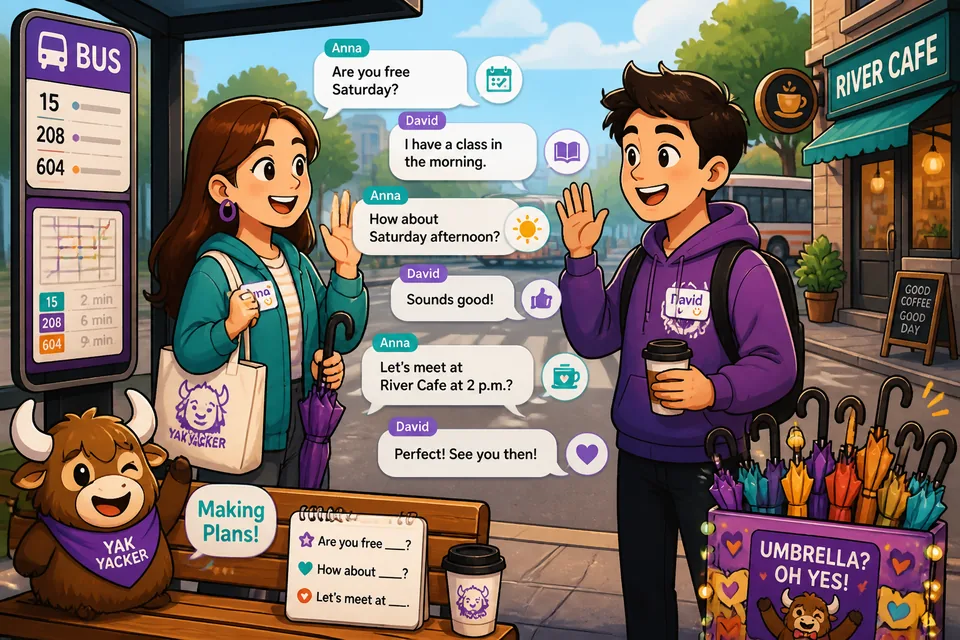
Welcome! In this short lesson you'll practice common phrases for planning with friends. Repeat, listen, and then try the speaking prompts out loud — simple and useful.
Level A2: In this lesson (Lesson 128) you'll learn and practice key plan-making frames like "Are you free ___?", "How about ___?", "I can do ___.", and "I can't make it." We'll use short examples and a friendly mini-conversation to help you arrange times and places. This lesson is CEFR-aligned and designed for quick, confident practice.
After this lesson you'll be able to:
Use basic questions to ask about availability and times (Level A2).
Suggest times, places, and alternatives using common frames.
Confirm or decline plans politely and clearly.
Ready? Let's go!
When you tap play on phrases, we track your progress through this lesson.
1. Reading + Listening Practice
Hear core phrases, repeat aloud.
Are you free ___?
Ask if someone is available for a plan
Meaning: Ask if someone is available for a plan.
When to use: Start a plan when you want to know if the other person has time.
Tip: Don't forget the preposition in fuller examples: say "Are you free on Saturday?" rather than "Are you free Saturday?" if you want to be clear.
Are you free tomorrow evening?
Are you free tomorrow evening?
Are you free on Saturday?
Are you free on Saturday?
How about ___?
Suggest a time, place, or activity
Meaning: Suggest a time, place, or activity.
When to use: Use to offer an idea when arranging a plan.
How about 7 pm?
How about 7 pm?
How about the new cafe?
How about the new cafe?
Let's meet at ___.
Suggest meeting at a specific time or place
Meaning: Suggest meeting at a specific time or place.
When to use: Use to propose a concrete meeting detail after discussing options.
Let's meet at the station.
Let's meet at the station.
Let's meet at 5 pm.
Let's meet at 5 pm.
What time works for you?
Ask for a suitable time
Meaning: Ask for a suitable time.
When to use: Use when you want the other person to choose a convenient time.
What time works for you?
What time works for you?
What time works for you on Friday?
What time works for you on Friday?
I can do ___.
State availability
Meaning: State availability.
When to use: Say this when a suggested time is good for you.
I can do Monday morning.
I can do Monday morning.
I can do 6 pm.
I can do 6 pm.
I can't make it.
Decline because of availability
Meaning: Decline because of availability.
When to use: Use to politely say you are not available.
Tip: This means you are unavailable — avoid saying it if you mean you can't do the activity itself (use "I can't do it" for ability).
I can't make it on Friday.
I can't make it on Friday.
I can't make it at 2 pm.
I can't make it at 2 pm.
Can we do ___ instead?
Suggest an alternative plan detail
Meaning: Suggest an alternative plan detail.
When to use: Use this to offer a different time or place when the first one doesn't work.
Can we do 5 instead?
Can we do 5 instead?
Can we do the cafe instead?
Can we do the cafe instead?
Let's plan for ___.
Confirm a plan decision
Meaning: Confirm a plan decision.
When to use: Use to finalize and agree on the plan.
Let's plan for Saturday.
Let's plan for Saturday.
Let's plan for 4 pm.
Let's plan for 4 pm.
What should we do?
Ask for a plan idea
Meaning: Ask for a plan idea.
When to use: Use when you want suggestions for an activity or plan.
What should we do on Saturday?
What should we do on Saturday?
What should we do after work?
What should we do after work?
Where should we meet?
Ask about the meeting place
Meaning: Ask about the meeting place.
When to use: Use to decide or confirm the location.
Where should we meet?
Where should we meet?
Where should we meet on Sunday?
Where should we meet on Sunday?
What day is best for you?
Ask about the meeting day
Meaning: Ask about the meeting day.
When to use: Use to choose which day works for the group or person.
What day is best for you?
What day is best for you?
What day is best for you next week?
What day is best for you next week?
Who else is coming?
Ask who will attend
Meaning: Ask who will attend.
When to use: Use when you want to know the guest list or who will join.
Who else is coming?
Who else is coming?
Who else is coming to dinner?
Who else is coming to dinner?
I'll be there at ___.
Confirm arrival time
Meaning: Confirm arrival time.
When to use: Use when you want to say the time you will arrive.
I'll be there at 6.
I'll be there at 6.
I'll be there at 3:30.
I'll be there at 3:30.
2. Conversational Listening Practice
Hear phrases in a real mini-conversation.
Anna and David plan a Saturday meet-up using availability and alternatives.
Anna
Are you free on Saturday?
Ask if someone is available for a plan.
David
I can do Saturday afternoon.
State availability.
Anna
How about 3 pm at the park?
Suggest a time and place.
David
I can't make it at 3. Can we do 4 instead?
Decline one time and suggest an alternative.
Anna
Sounds good. Let's plan for 4. Where should we meet?
Confirm the new time and ask about the place.
David
I'll be there at 4. Who else is coming?
Confirm arrival time and ask who will attend.
3. Guided Practice
Quizzes and matching to lock in meaning.
Which phrase asks if someone is available?
Which phrase is a polite way to offer a new time?
If you are not available, which phrase should you use?
Which question asks for a convenient time?
Anna: Are you free on Saturday evening? David: I can do that.
Anna: ___ Saturday evening? David: I can do that.
Tom: I can't make it at 5. Sara: Can we do 6 instead?
Tom: I can't make it at 5. Sara: ___ 6 instead?
Lina: Where should we meet? Mark: The new cafe is fine.
Lina: ___? Mark: The new cafe is fine.
Match the core phrases
Match the extra phrases
4. Speaking Practice
Say phrases yourself (mic/recording).
Recording stays on your device only. Check speech uses your browser's speech tools when available.