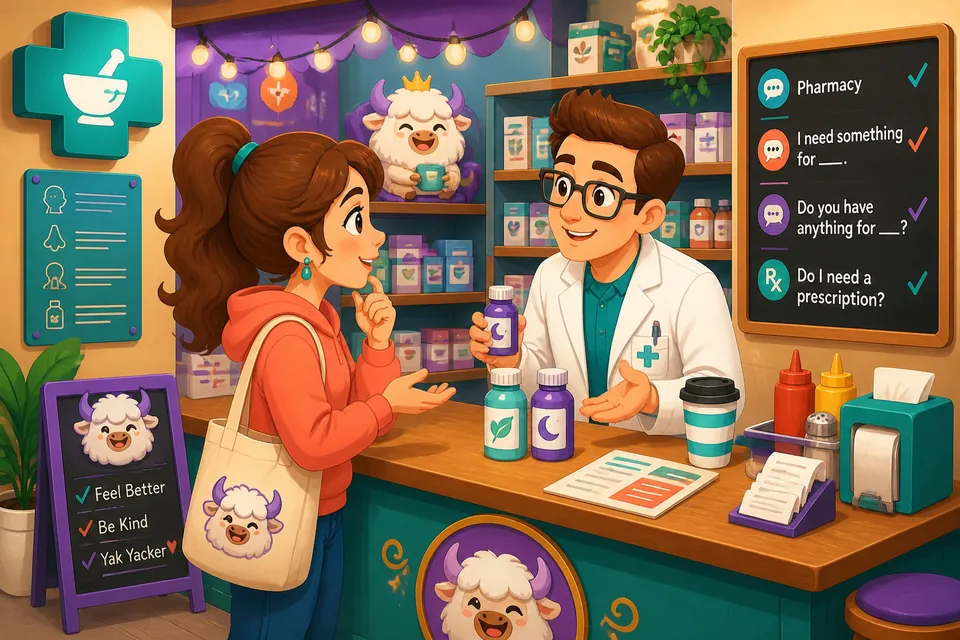
Welcome! In this short lesson you will learn the key phrases for a pharmacy visit. Practice saying them aloud, listen in a short dialogue, then try quick quizzes.
Level A2: This lesson (116) helps you ask for medicines and advice at a pharmacy. You will practice frames like asking for something for a problem, checking if a prescription is needed, and asking about dosage, safety, and interactions. CEFR-aligned and practical — perfect for a real-world pharmacy run.
After this lesson you'll be able to:
Understand and use common pharmacy questions and requests at level A2.
Be able to ask if a prescription is needed, how to take medicine, and about side effects.
Practice speaking short pharmacy phrases clearly so you can ask for help in real life.
Ready? Let's go!
When you tap play on phrases, we track your progress through this lesson.
1. Reading + Listening Practice
Hear core phrases, repeat aloud.
I need something for ___.
Ask for medicine for a health problem
Meaning: Ask for medicine for a health problem
When to use: Use this when you need medicine for a specific symptom.
I need something for a headache.
I need something for a headache.
I need something for an upset stomach.
I need something for an upset stomach.
Do you have anything for ___?
Ask if the pharmacy has medicine for a problem
Meaning: Ask if the pharmacy has medicine for a problem
When to use: Use this to ask if the shop stocks a remedy for your symptom.
Do you have anything for a sore throat?
Do you have anything for a sore throat?
Do you have anything for allergies?
Do you have anything for allergies?
Do I need a prescription?
Ask if a prescription is required
Meaning: Ask if a prescription is required
When to use: Use this to find out whether a doctor’s prescription is needed.
Do I need a prescription?
Do I need a prescription?
Do I need a prescription for this cream?
Do I need a prescription for this cream?
How often should I take it?
Ask for dosage frequency
Meaning: Ask for dosage frequency
When to use: Use this when you want to know how often to take a medicine.
Tip: Learners sometimes confuse this with 'How many should I take?'. Frequency = how often; amount = how many.
How often should I take it?
How often should I take it?
How often should I take the tablets?
How often should I take the tablets?
How many should I take?
Ask for dosage amount
Meaning: Ask for dosage amount
When to use: Use this to ask how many pills or tablets to take at one time.
Tip: Don't mix with frequency questions. 'How many' = amount at once, not how often.
How many should I take?
How many should I take?
How many tablets should I take for pain?
How many tablets should I take for pain?
Should I take it with food?
Ask whether to take medicine with food
Meaning: Ask whether to take medicine with food
When to use: Use this to check whether you should take medicine on an empty stomach or with a meal.
Should I take it with food?
Should I take it with food?
Should I take this with food or on an empty stomach?
Should I take this with food or on an empty stomach?
Are there any side effects?
Ask about possible side effects
Meaning: Ask about possible side effects
When to use: Use this to learn about common or serious unwanted effects.
Tip: Beginner learners may forget to ask what to do if side effects occur; ask follow-up if needed.
Are there any side effects?
Are there any side effects?
Are there any side effects I should watch for?
Are there any side effects I should watch for?
Can I take this with ___?
Ask if a medicine is safe with another medicine
Meaning: Ask if a medicine is safe with another medicine
When to use: Use this to check interactions with other medicine, supplements, or alcohol.
Can I take this with my blood pressure pill?
Can I take this with my blood pressure pill?
Can I take this with ibuprofen?
Can I take this with ibuprofen?
Is this available without a prescription?
Ask whether a medicine can be bought without a prescription
Meaning: Ask whether a medicine can be bought without a prescription
When to use: Use this to find out if you can buy the product over the counter.
Is this available without a prescription?
Is this available without a prescription?
Is this available without a prescription, or do I need a doctor?
Is this available without a prescription, or do I need a doctor?
Is there a generic version?
Ask for a cheaper or non-brand medicine option
Meaning: Ask for a cheaper or non-brand medicine option
When to use: Use this to ask if a generic (cheaper) version exists.
Is there a generic version?
Is there a generic version?
Is there a generic version of this medication?
Is there a generic version of this medication?
I take ___ every day.
Tell the pharmacist about regular medicine use
Meaning: Tell the pharmacist about regular medicine use
When to use: Use this to inform the pharmacist about medicines you already take every day.
I take blood pressure medicine every day.
I take blood pressure medicine every day.
I take vitamin D every day.
I take vitamin D every day.
Is this safe for ___?
Ask if a medicine is safe for a person or group
Meaning: Ask if a medicine is safe for a person or group
When to use: Use this to check safety for children, pregnant people, or people with conditions.
Is this safe for pregnant women?
Is this safe for pregnant women?
Is this safe for children under 12?
Is this safe for children under 12?
How long should I take this?
Ask about the total length of treatment
Meaning: Ask about the total length of treatment
When to use: Use this to find out for how many days you should take the medicine.
How long should I take this?
How long should I take this?
How long should I take the antibiotic?
How long should I take the antibiotic?
2. Conversational Listening Practice
Hear phrases in a real mini-conversation.
Anna at a small pharmacy counter asking about cough medicine
Anna
Hi. I need something for a cough.
Hi. I need something for a cough.
David
Do you have anything for a cough? We have syrup and lozenges.
Do you have anything for a cough? We have syrup and lozenges.
Anna
I take blood pressure medicine every day. Can I take the syrup with that?
I take blood pressure medicine every day. Can I take the syrup with that?
David
Good question. Can I take this with your blood pressure medicine? No, it's fine. Also, do I need a prescription? No, this is available without a prescription.
Good question. Can I take this with your blood pressure medicine? No, it's fine. Also, do I need a prescription? No, this is available without a prescription.
Anna
How often should I take it and are there any side effects?
How often should I take it and are there any side effects?
David
Take two teaspoons every 6 hours. You may feel drowsy. Avoid driving for a while.
Take two teaspoons every 6 hours. You may feel drowsy. Avoid driving for a while.
3. Guided Practice
Quizzes and matching to lock in meaning.
Which question asks about how often to take medicine?
Which phrase asks if you can buy medicine without a doctor's note?
Which sentence tells the pharmacist about daily medication?
Which phrase asks about possible unwanted effects from a medicine?
To find out if I need a doctor's note for this cream, I ask: Do I need a prescription?
To find out if I need a doctor's note for this cream, I ask: ___
I already take diabetes medicine. At the counter I say: Can I take this with ___?
I already take diabetes medicine. At the counter I say: ___
Before I drive, I want to know about drowsiness. I ask the pharmacist: Are there any side effects?
Before I drive, I want to know about drowsiness. I ask the pharmacist: ___
Match the core phrases
Match the extra phrases
4. Speaking Practice
Say phrases yourself (mic/recording).
Recording stays on your device only. Check speech uses your browser's speech tools when available.
Say this phrase out loud:
I need something for ___.
Ask for medicine for a health problem
Say this phrase out loud:
Do you have anything for ___?
Ask if the pharmacy has medicine for a problem
Say this phrase out loud:
Do I need a prescription?
Ask if a prescription is required
Say this phrase out loud:
How often should I take it?
Ask for dosage frequency
Say this phrase out loud:
How many should I take?
Ask for dosage amount
Say this phrase out loud:
Should I take it with food?
Ask whether to take medicine with food
Say this phrase out loud:
Are there any side effects?
Ask about possible side effects
Say this phrase out loud:
Can I take this with ___?
Ask if a medicine is safe with another medicine
Say this phrase out loud:
Is this available without a prescription?
Ask whether a medicine can be bought without a prescription