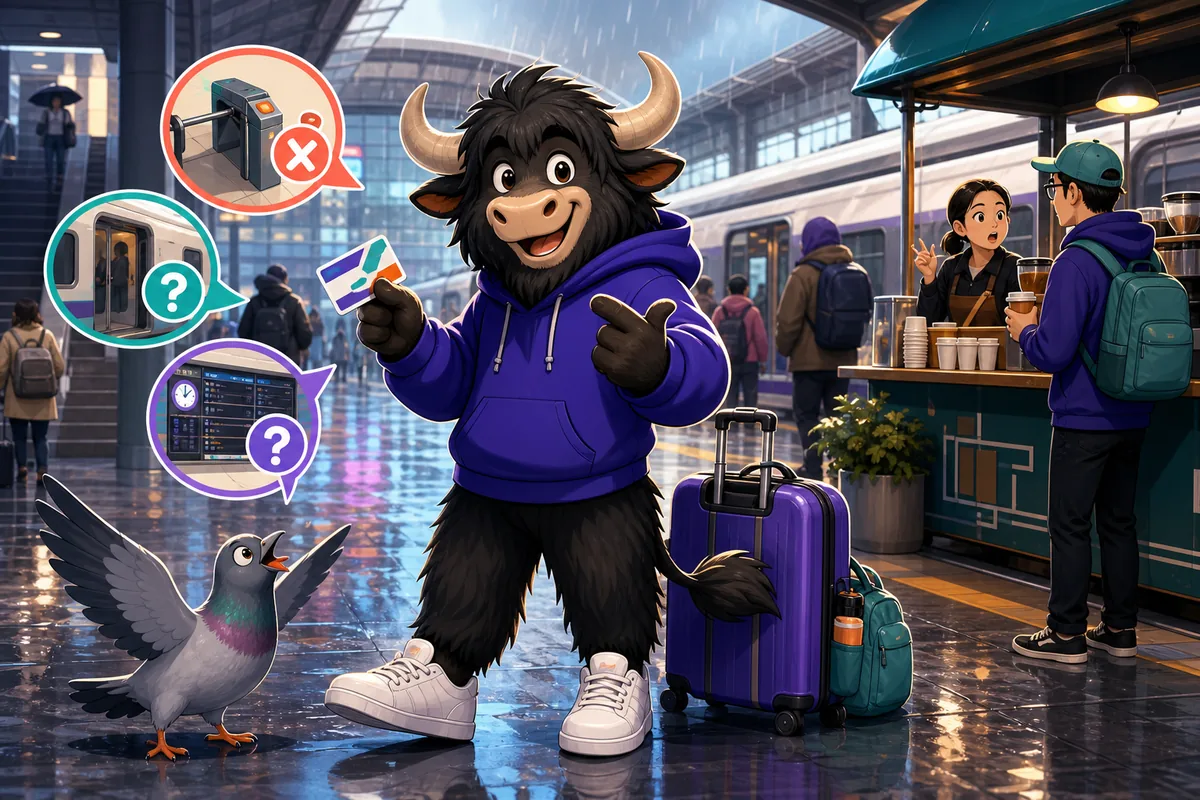
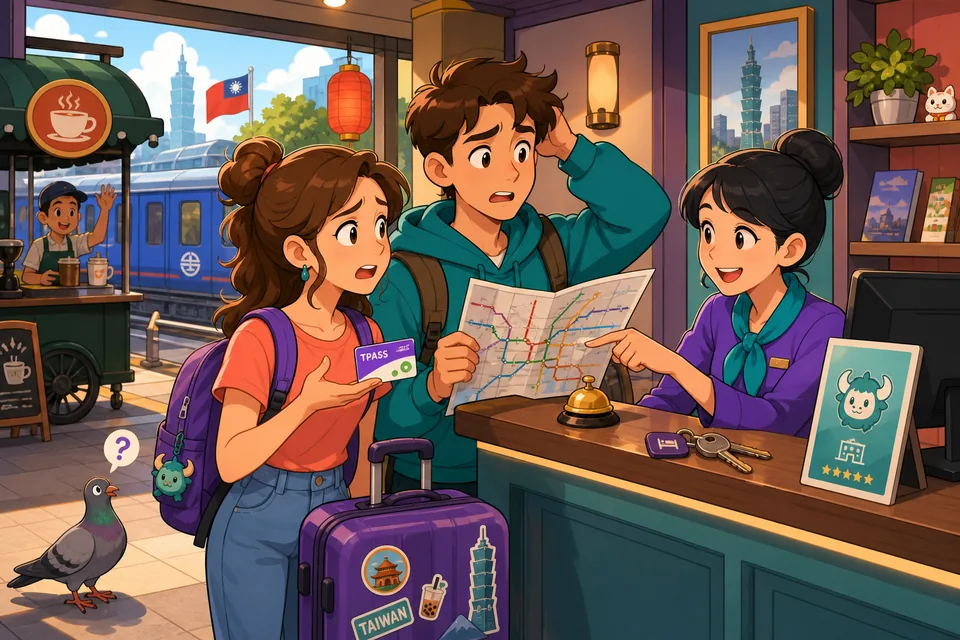
Uh-oh moments happen: a broken key, a lost ticket, a missed bus. Good news: you do not need big grammar to explain the problem.
In this lesson, you’ll learn short, clear problem phrases you can use right away. Tiny words, big help.
Level A1: Today you’ll practice saying when something is wrong, broken, missing, or painful. You’ll use phrases like “I have a problem,” “It doesn’t work,” “I’m lost,” and “My ___ hurts.” Yak Yacker tip: when trouble starts yakking, you can answer clearly.
After this lesson you'll be able to:
Say a basic problem clearly in everyday situations.
Use simple frames with a missing word, like “I lost ___” and “There is no ___.”
Describe simple travel, object, access, and health problems at A1 level.
Ready? Let's go!
When you tap play on phrases, we track your progress through this lesson.
1. Reading + Listening Practice
Hear core phrases, repeat aloud.
I have a problem.
State that there is a problem
Meaning: “I have a problem.” = Say there is a problem.
When to use: Use it to start explaining trouble politely and clearly.
Excuse me, I have a problem.
Excuse me, I have a problem.
I have a problem with my room.
I have a problem with my room.
Something is wrong.
Say that something is not correct or not okay
Meaning: “Something is wrong.” = Say something is not correct or not okay.
When to use: Use it when you do not know the exact problem yet.
Something is wrong with my ticket.
Something is wrong with my ticket.
Something is wrong with this app.
Something is wrong with this app.
It doesn't work.
Say that a thing or service is not functioning
Meaning: “It doesn’t work.” = Say a thing or service is not functioning.
When to use: Use it for machines, cards, apps, keys, or services.
Tip: Say “It doesn’t work,” not “It no work.”
The machine is on, but it doesn't work.
The machine is on, but it doesn't work.
My card is here, but it doesn't work.
My card is here, but it doesn't work.
I lost ___.
State that something is lost
Meaning: “I lost ___.” = Say something is lost.
When to use: Use it with an object you cannot find.
Tip: Use “I lost my bag” for an object. Use “I’m lost” when you do not know where you are.
I lost my phone.
I lost my phone.
I lost my passport.
I lost my passport.
I'm lost.
State that one does not know where one is or where to go
Meaning: “I’m lost.” = Say you do not know where you are or where to go.
When to use: Use it when you need directions.
I'm lost. Can you help me?
I'm lost. Can you help me?
Sorry, I'm lost in this station.
Sorry, I'm lost in this station.
I feel sick.
State a simple health problem
Meaning: “I feel sick.” = Say you feel ill or physically unwell.
When to use: Use it for a general health problem.
I feel sick. I need to sit down.
I feel sick. I need to sit down.
I feel sick after lunch.
I feel sick after lunch.
There is no ___.
State that something needed is missing or unavailable
Meaning: “There is no ___.” = Say something needed is missing or unavailable.
When to use: Use it when something is not there.
There is no water.
There is no water.
There is no bus today.
There is no bus today.
I can't open ___.
state that you cannot open something
Meaning: “I can’t open ___.” = Say you cannot open something.
When to use: Use it for doors, bags, files, apps, or accounts.
I can't open the door.
I can't open the door.
I can't open the file.
I can't open the file.
I can't use ___.
state that you cannot use something
Meaning: “I can’t use ___.” = Say you cannot use something.
When to use: Use it when something is not available to you or is too difficult to use.
I can't use my card.
I can't use my card.
I can't use the Wi-Fi.
I can't use the Wi-Fi.
My ___ hurts.
state that a body part hurts
Meaning: “My ___ hurts.” = Say a body part has pain.
When to use: Use it with a body part.
Tip: For one body part, say “hurts”: “My head hurts.”
My head hurts.
My head hurts.
My stomach hurts.
My stomach hurts.
I hurt my ___.
state a minor injury
Meaning: “I hurt my ___.” = Say you injured a body part.
When to use: Use it after an accident or small injury.
I hurt my hand.
I hurt my hand.
I hurt my foot.
I hurt my foot.
The ___ is broken.
state that something is broken
Meaning: “The ___ is broken.” = Say something is damaged or not working.
When to use: Use it for objects, tools, or simple services.
The door is broken.
The door is broken.
The phone is broken.
The phone is broken.
I missed ___.
state that you missed transport or an event
Meaning: “I missed ___.” = Say you were too late for transport or an event.
When to use: Use it for buses, trains, flights, meetings, or appointments.
I missed the train.
I missed the train.
I missed my appointment.
I missed my appointment.
2. Conversational Listening Practice
Hear phrases in a real mini-conversation.
Anna and David are at a train station after a difficult morning.
Anna
David, I have a problem. I lost my ticket.
Anna says she has a problem and cannot find her ticket.
David
Oh no. Something is wrong with the ticket machine, too.
David says the machine has a problem.
Anna
It doesn’t work?
Anna checks if the machine is not functioning.
David
No, and I can’t use my card here.
David says he cannot use his card.
Anna
I missed the train, and now I feel sick.
Anna says she was too late for the train and feels unwell.
David
Let’s ask for help. We can say, “We have a problem.”
David suggests asking for help clearly.
3. Guided Practice
Quizzes and matching to lock in meaning.
You do not know where you are. What do you say?
A ticket machine is not functioning. What do you say?
You cannot find your passport. What do you say?
Your head has pain. What do you say?
Anna: My key card is here, but it doesn’t work. David: Let’s ask the hotel desk.
Anna: My key card is here, but ___. David: Let’s ask the hotel desk.
At the cafe, Anna looks at the empty table and says: “There is no water. Can I please have water?”
At the cafe, Anna looks at the empty table and says: “___. Can I please have water?”
David: The train left at 8:00. I arrived at 8:10, so I missed the train. Anna: Oh no!
David: The train left at 8:00. I arrived at 8:10, so ___. Anna: Oh no!
Match the core phrases
Match the extra phrases
4. Speaking Practice
Say phrases yourself (mic/recording).
Recording stays on your device only. Check speech uses your browser's speech tools when available.
Say this phrase out loud:
I have a problem.
State that there is a problem.
Say this phrase out loud:
Something is wrong.
Say that something is not correct or not okay.
Say this phrase out loud:
It doesn't work.
Say that a thing or service is not functioning
Say this phrase out loud:
I lost ___.
State that something is lost.
Say this phrase out loud:
I'm lost.
State that one does not know where one is or where to go
Say this phrase out loud:
I feel sick.
State a simple health problem.
Say this phrase out loud:
There is no ___.
State that something needed is missing or unavailable.