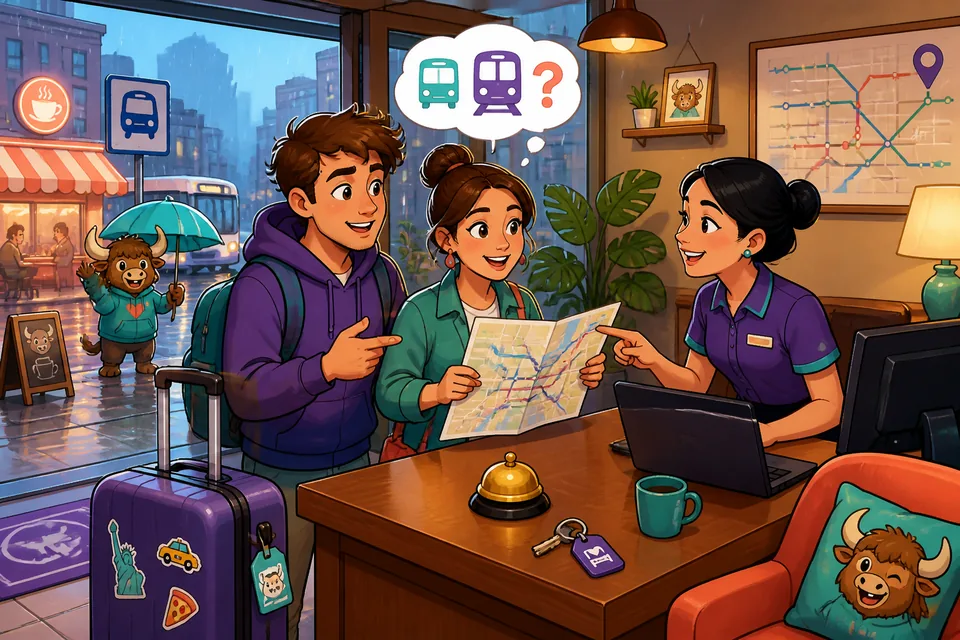
Ready to ride? This lesson helps you ask clear questions at stations, stops and ticket counters. Keep it light — public transport language is practical and useful every day.
Level A2: In this lesson you will practice 13 common transit phrases for asking about buses, trains, platforms, tickets, stops, and times. We'll listen to short questions, repeat the phrases, and use them in a mini-conversation so you feel ready to ask for help when travelling. (CEFR-aligned language frames.)
After this lesson you'll be able to:
Ask and understand common transit questions (A2 level).
Use phrases to check buses, trains, platforms, and ticket prices.
Say polite ticket requests and ask where to get off.
Ready? Let's go!
When you tap play on phrases, we track your progress through this lesson.
1. Reading + Listening Practice
Hear core phrases, repeat aloud.
Which bus goes to ___?
Ask which vehicle to take
Meaning: Ask which vehicle to take.
When to use: High-frequency transit question for finding the correct bus.
Tip: Sometimes learners say "Which bus is going to ___?" which is okay but a bit longer; keep to the simple frame for quick questions.
Which bus goes to Central Station?
Which bus goes to Central Station?
Which bus goes to the airport?
Which bus goes to the airport?
Does this train go to ___?
Ask if a route reaches a destination
Meaning: Ask if a route reaches a destination.
When to use: Reusable question for confirming destinations on public transit.
Tip: Avoid mixing tenses like "Do this train go to..." — use "Does" with singular "train."
Does this train go to the city center?
Does this train go to the city center?
Does this train go to North Station?
Does this train go to North Station?
Where should I get off?
Ask where to exit
Meaning: Ask where to exit.
When to use: Essential spoken question when unsure of the correct stop.
Where should I get off for the museum?
Where should I get off for the museum?
Where should I get off for my hotel?
Where should I get off for my hotel?
What is the next stop?
Ask about the next stop
Meaning: Ask about the next stop.
When to use: Practical question for orientation while riding transit.
What is the next stop?
What is the next stop?
Excuse me, what's the next stop?
Excuse me, what's the next stop?
What time does the ___ leave?
Ask about departure time
Meaning: Ask about departure time.
When to use: Core timetable question for public transport situations.
What time does the bus to the airport leave?
What time does the bus to the airport leave?
What time does the 7:30 train leave?
What time does the 7:30 train leave?
When does it arrive?
Ask about arrival time
Meaning: Ask about arrival time.
When to use: Simple reusable question after a route or vehicle has been identified.
When does it arrive at Central Station?
When does it arrive at Central Station?
When does it arrive in town?
When does it arrive in town?
How much is a ticket to ___?
Ask about ticket price
Meaning: Ask about ticket price.
When to use: Survival phrase for buying or checking transit fares.
Tip: Don't forget to include the destination. "How much is a ticket?" is okay but may need the place to get an accurate price.
How much is a ticket to the museum?
How much is a ticket to the museum?
How much is a ticket to Zone 2?
How much is a ticket to Zone 2?
I'd like a ticket to ___, please.
Request a ticket
Meaning: Request a ticket politely.
When to use: Polite and reusable ticket-buying frame.
I'd like a ticket to downtown, please.
I'd like a ticket to downtown, please.
I'd like a ticket to Central Station, please.
I'd like a ticket to Central Station, please.
Do I need to change trains?
Ask about transfers
Meaning: Ask about transfers.
When to use: Useful for checking whether a direct ride is possible.
Do I need to change trains for Riverside?
Do I need to change trains for Riverside?
Do I need to change trains at East Station?
Do I need to change trains at East Station?
The bus is late.
Report a delay
Meaning: Report a delay.
When to use: Common statement for explaining a transit problem in simple language.
The bus is late.
The bus is late.
The train is late today.
The train is late today.
Is this the right bus for ___?
confirm the correct vehicle or route
Meaning: Confirm the correct vehicle or route.
When to use: High-frequency survival question for confirming public transport before boarding.
Is this the right bus for Central Station?
Is this the right bus for Central Station?
Is this the right bus for the airport?
Is this the right bus for the airport?
Which platform do I need for ___?
ask for the correct platform or track
Meaning: Ask for the correct platform or track.
When to use: Practical station question with a reusable destination slot.
Which platform do I need for the express train?
Which platform do I need for the express train?
Which platform do I need for Platform 3?
Which platform do I need for Platform 3?
How many stops is it to ___?
ask how far a destination is by number of stops
Meaning: Ask how far a destination is by number of stops.
When to use: Common spoken question for planning when to get off.
How many stops is it to Central Station?
How many stops is it to Central Station?
How many stops is it to the museum?
How many stops is it to the museum?
2. Conversational Listening Practice
Hear phrases in a real mini-conversation.
Two travelers checking their route to Central Station.
Anna
Which bus goes to Central Station?
Ask which bus goes to Central Station.
David
Is this the right bus for Central Station?
Confirm the bus is the right one.
Anna
How many stops is it to Central Station?
Ask how many stops until the destination.
David
What is the next stop?
Ask about the next stop.
Anna
Do I need to change trains at East Station?
Ask whether a transfer is needed.
David
Where should I get off for the museum?
Ask where to exit for a nearby place.
3. Guided Practice
Quizzes and matching to lock in meaning.
You are at a stop and want to know if the bus goes to the airport. Which question should you ask?
You are already on a train and want to know when you will arrive. What do you ask?
At the ticket counter you want a ticket to downtown. Which phrase is correct?
You are at a platform and need to know which track serves your train. What do you ask?
At the bus stop Anna says: "The bus is late."
At the bus stop Anna asks: "___ the bus is late?"
You are on a train and want to know the next stop: "What is the next stop?"
You are on a train and want to know the next stop: "___?"
At the station you need to know if you must change trains: "Do I need to change trains?"
At the station you need to know if you must change trains: "___?"
Match the core phrases
Match the extra phrases
4. Speaking Practice
Say phrases yourself (mic/recording).
Recording stays on your device only. Check speech uses your browser's speech tools when available.