Welcome! This short lesson helps you speak clearly on buses and trains. Practice these useful, everyday phrases so you feel ready the next time you travel.
Level A2: In this lesson you'll practice 10 practical public-transport phrases like asking where to buy a ticket, telling the driver your stop, and asking about tapping in and out. This CEFR-aligned set focuses on real-life lines you can say on a bus or at a station — listen, repeat, and try the quick quizzes to lock them in.
After this lesson you'll be able to:
Level A2: Use short, polite phrases for common transit needs (stops, tickets, seats).
Ask where to buy tickets and whether you can buy on the bus.
Tell the driver where you need to get off and ask to be let off next.
Practice simple questions about tapping cards and direct services.
Ready? Let's go!
When you tap play on phrases, we track your progress through this lesson.
1. Reading + Listening Practice
Hear core phrases, repeat aloud.
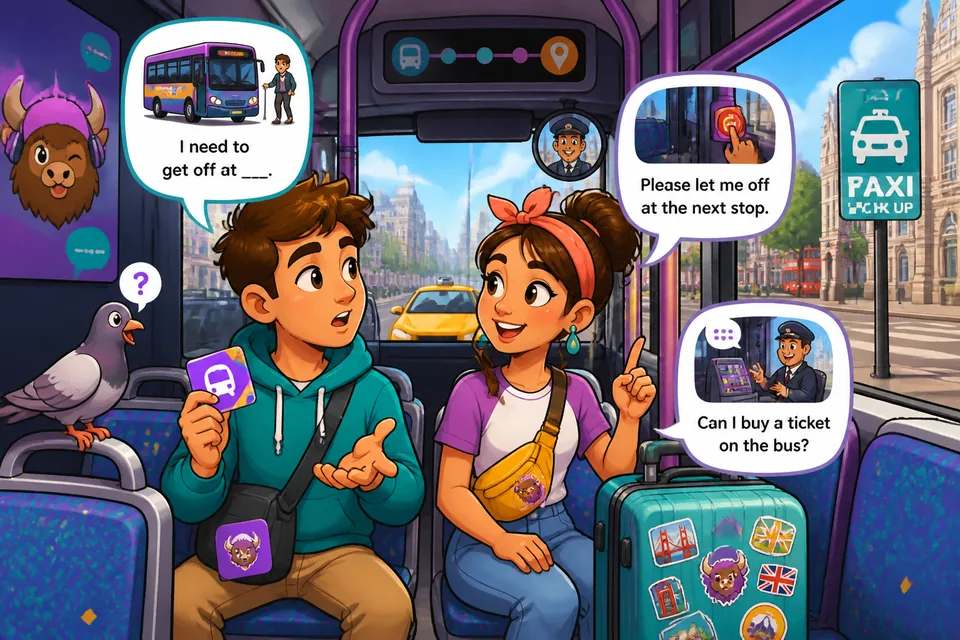
I need to get off at ___.
state intended stop or destination
Meaning: State the stop or station where you will leave the vehicle.
When to use: When you want to tell someone your destination.
Tip: Some learners omit 'at' and say 'get off Central Station' — include 'at' before the place.
I need to get off at Central Station.
I need to get off at Central Station.
I need to get off at Elm Street, please.
I need to get off at Elm Street, please.
Please let me off at the next stop.
ask the driver to stop at the next stop
Meaning: Ask the driver or conductor to stop at the next stop.
When to use: Use this on buses or trams when you want the driver to stop soon.
Please let me off at the next stop.
Please let me off at the next stop.
Please let me off at the next stop — thank you.
Please let me off at the next stop — thank you.
Can I buy a ticket on the bus?
ask whether buying a ticket after boarding is possible
Meaning: Ask if you can buy a ticket after you board the bus.
When to use: Use on buses or trams if you don't have a ticket yet.
Can I buy a ticket on the bus?
Can I buy a ticket on the bus?
Can I buy a ticket on the bus, or do I need a machine?
Can I buy a ticket on the bus, or do I need a machine?
Do I have to tap in and out?
ask about using a transit card correctly
Meaning: Ask whether you must use a contactless card or card reader when entering and leaving.
When to use: Ask at stations or from staff when the system uses tap-in/tap-out cards.
Do I have to tap in and out?
Do I have to tap in and out?
Do I have to tap in and out for this train?
Do I have to tap in and out for this train?
Is this seat taken?
ask politely if a seat is available
Meaning: Politely ask if a seat is available.
When to use: Use this when looking for a seat on a busy bus or train.
Is this seat taken?
Is this seat taken?
Excuse me, is this seat taken?
Excuse me, is this seat taken?
I missed my stop.
report missing the intended stop
Meaning: Tell someone you passed your intended stop.
When to use: Say this when you realize you stayed on past your stop and need help.
I missed my stop.
I missed my stop.
I missed my stop — what should I do?
I missed my stop — what should I do?
The ticket machine isn't working.
report a problem with ticket purchase equipment
Meaning: Report that the machine to buy tickets is broken.
When to use: Use in stations or platforms when a ticket machine doesn't work.
The ticket machine isn't working.
The ticket machine isn't working.
The ticket machine isn't working — is there another one?
The ticket machine isn't working — is there another one?
Where can I buy a ticket?
Ask where to purchase a transit ticket
Meaning: Ask where you can purchase a ticket.
When to use: Use this at a station, bus stop, or near a transit office.
Where can I buy a ticket?
Where can I buy a ticket?
Where can I buy a ticket for the tram?
Where can I buy a ticket for the tram?
How often does the ___ come?
Ask about service frequency
Meaning: Ask how often a bus, tram, or train arrives.
When to use: Use when planning and you need to know waiting time.
Tip: Don't forget to name the service in the blank, e.g., 'the 5' or 'the bus'.
How often does the 5 come?
How often does the 5 come?
How often does the train come in the morning?
How often does the train come in the morning?
Is there a direct ___ to ___?
Ask if a transit option goes directly to a destination
Meaning: Ask if one service goes directly to your destination without transfers.
When to use: Use when you want to avoid changing vehicles.
Is there a direct bus to the airport?
Is there a direct bus to the airport?
Is there a direct train to downtown?
Is there a direct train to downtown?
2. Conversational Listening Practice
Hear phrases in a real mini-conversation.
A short exchange on a city bus between two passengers.
Anna
Excuse me, is this seat taken?
Anna asks if the seat is free.
David
No, it's free. Go ahead.
David says the seat is available.
Anna
Can I buy a ticket on the bus?
Anna asks if she can buy a ticket after boarding.
David
If the machine isn't working, ask the driver.
David suggests asking the driver for help.
Anna
Please let me off at the next stop. I need to get off at Maple Street.
Anna asks to be let off because her stop is coming.
David
Okay — if you miss it, say 'I missed my stop.'
David gives a tip in case she misses the stop.
3. Guided Practice
Quizzes and matching to lock in meaning.
Which phrase asks the driver to stop soon at the next stop?
Which sentence asks where to buy a ticket?
Which phrase asks about using a transit card correctly?
Which sentence reports a problem with a ticket machine?
The correct choice asks the driver to stop: 'Please let me off at the next stop.'
The bus is almost at my street. ___
She would say 'I missed my stop.' because she stayed on past her stop.
After the bus passed the station, Maria said, '___' because she stayed on too long.
Tom asks 'Do I have to tap in and out?' to check the card rules before travel.
Before boarding the tram, Tom asked, '___' because he had a travel card.
Match the core phrases
Match the extra phrases
4. Speaking Practice
Say phrases yourself (mic/recording).
Recording stays on your device only. Check speech uses your browser's speech tools when available.
Say this phrase out loud:
I need to get off at ___.
state intended stop or destination
Say this phrase out loud:
Please let me off at the next stop.
ask the driver to stop at the next stop
Say this phrase out loud:
Can I buy a ticket on the bus?
ask whether buying a ticket after boarding is possible
Say this phrase out loud:
Do I have to tap in and out?
ask about using a transit card correctly
Say this phrase out loud:
Is this seat taken?
ask politely if a seat is available
Say this phrase out loud:
I missed my stop.
report missing the intended stop
Say this phrase out loud:
The ticket machine isn't working.
report a problem with ticket purchase equipment
Say this phrase out loud:
Where can I buy a ticket?
ask where to purchase a transit ticket
Say this phrase out loud:
How often does the ___ come?
ask about service frequency
Say this phrase out loud:
Is there a direct ___ to ___?
ask if a transit option goes directly to a destination