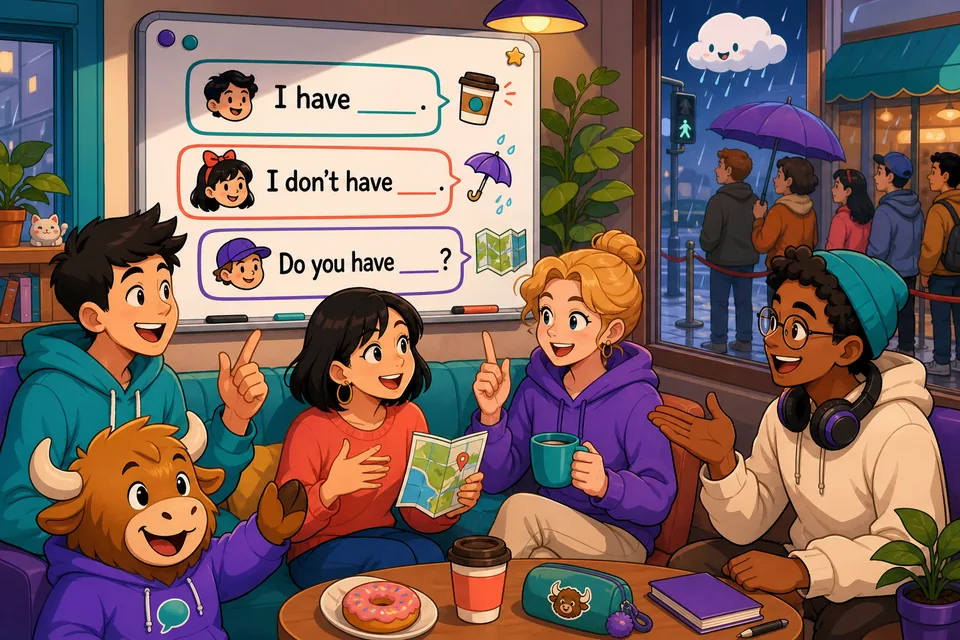
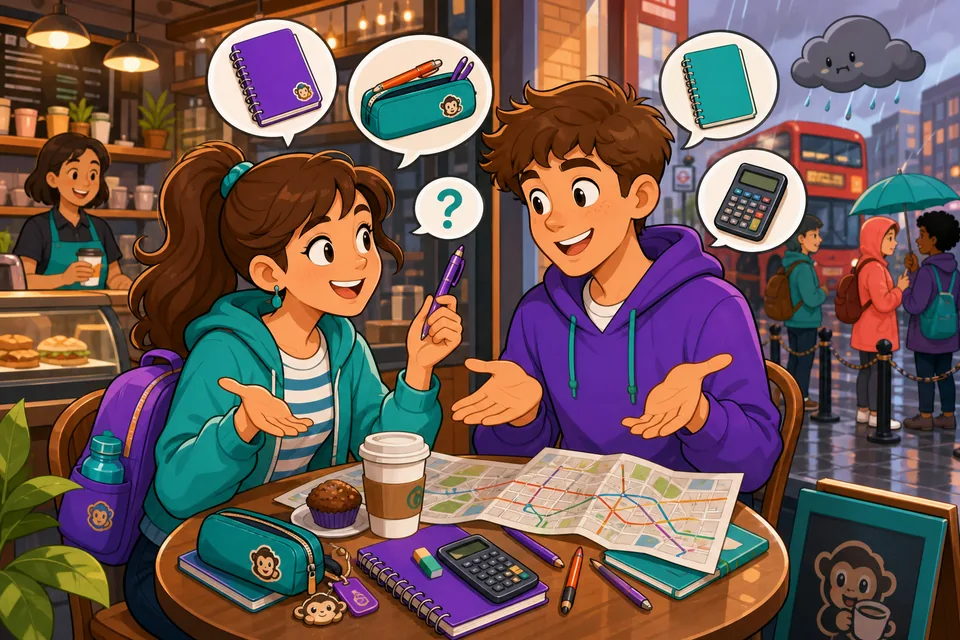
Welcome back! Today we are sorting out bags, pens, tickets, and the classic mystery: “Whose is this?”
These phrases help you sound clear and calm when things are missing, mixed up, or right there in your hand.
Level A1: In this lesson, you’ll practice simple possession phrases like “I have ___,” “Do you have ___?” and “It’s mine.” You’ll also learn how to check ownership with “Is this your ___?” and correct mistakes with “This isn’t mine.” Tiny words, big help—Yak Yacker approves of fewer lost umbrellas.
After this lesson you'll be able to:
Say what you have and what you do not have.
Ask if another person has something.
Say something is yours or not yours.
Check if an item belongs to you or another person.
Ready? Let's go!
When you tap play on phrases, we track your progress through this lesson.
1. Reading + Listening Practice
Hear core phrases, repeat aloud.
I have ___.
State that you have something.
Meaning: Say that you have something.
When to use: Use it when you want to tell someone about an item you have.
I have a ticket.
I have a ticket.
I have my phone.
I have my phone.
I don't have ___.
State that you do not have something.
Meaning: Say that you do not have something.
When to use: Use it when an item is missing or you cannot give it.
Tip: Say “I don't have a pen,” not “I haven't a pen” in everyday beginner English.
I don't have cash.
I don't have cash.
I don't have my keys.
I don't have my keys.
Do you have ___?
Ask if another person has something.
Meaning: Ask if another person has something.
When to use: Use it when you need to check if someone has an item.
Do you have a pen?
Do you have a pen?
Do you have your passport?
Do you have your passport?
Yes, I have ___.
Give a short positive answer about possession.
Meaning: Give a short yes answer about having something.
When to use: Use it after someone asks “Do you have ___?”
Yes, I have a pen.
Yes, I have a pen.
Yes, I have my ticket.
Yes, I have my ticket.
This is my ___.
Say that something belongs to you.
Meaning: Say that something belongs to you.
When to use: Use it when you point to or show your own item.
Tip: Use “my” before a noun: “my bag,” “my phone.”
This is my bag.
This is my bag.
This is my phone.
This is my phone.
Is this your ___?
Ask if something belongs to another person.
Meaning: Ask if something belongs to another person.
When to use: Use it when an item is nearby and you want to check the owner.
Tip: Use “your” before a noun: “your ticket,” “your notebook.”
Is this your bag?
Is this your bag?
Is this your umbrella?
Is this your umbrella?
That's not my ___.
Say that something does not belong to you.
Meaning: Say that something does not belong to you.
When to use: Use it when someone thinks an item is yours, but it is not.
That's not my bag.
That's not my bag.
That's not my notebook.
That's not my notebook.
I have ___ with me.
Say that you have something with you now.
Meaning: Say that you have something with you now.
When to use: Use it when the item is here with you, in your bag, pocket, or hand.
I have my passport with me.
I have my passport with me.
I have a charger with me.
I have a charger with me.
It's mine.
Say that something belongs to the speaker.
Meaning: Say that something belongs to you.
When to use: Use it when the item is already clear, so you do not need to repeat the noun.
Tip: Use “mine” alone. Say “It's mine,” not “It's my.”
It's mine.
It's mine.
The blue bag? It's mine.
The blue bag? It's mine.
It's yours.
Say that something belongs to the listener.
Meaning: Say that something belongs to the other person.
When to use: Use it when the listener owns the item.
It's yours.
It's yours.
This ticket is not mine. It's yours.
This ticket is not mine. It's yours.
Is it mine?
Ask if something belongs to the speaker.
Meaning: Ask if something belongs to you.
When to use: Use it when you are not sure if the item is yours.
Is it mine?
Is it mine?
This black phone—Is it mine?
This black phone—Is it mine?
Is it yours?
Ask if something belongs to the listener.
Meaning: Ask if something belongs to the listener.
When to use: Use it when you want to check if the item is the other person’s.
Is it yours?
Is it yours?
This umbrella—Is it yours?
This umbrella—Is it yours?
This isn't mine.
Say that something does not belong to the speaker.
Meaning: Say that something does not belong to you.
When to use: Use it when someone gives you the wrong item or when items are mixed up.
This isn't mine.
This isn't mine.
Sorry, this isn't mine.
Sorry, this isn't mine.
2. Conversational Listening Practice
Hear phrases in a real mini-conversation.
Anna and David are at a café table with mixed-up school things.
Anna
David, do you have my pen?
David, do you have my pen?
David
I have a pen with me, but this isn't mine.
I have a pen with me, but this isn't mine.
Anna
Is it mine?
Is it mine?
David
Yes, I think it's yours.
Yes, I think it's yours.
Anna
Great. This is my pen. Do you have your notebook?
Great. This is my pen. Do you have your notebook?
David
Yes, I have my notebook.
Yes, I have my notebook.
3. Guided Practice
Quizzes and matching to lock in meaning.
Which phrase asks if another person has something?
Which phrase says you do not have something?
Which phrase means the item belongs to you, without repeating the noun?
Which phrase asks if this nearby item belongs to the listener?
Anna finds a blue bag near David and asks politely: Is this your bag?
Anna finds a blue bag near David and asks politely: ___.
David checks his pocket and shows his passport. He says: I have my passport with me.
David checks his pocket and shows his passport. He says: ___.
Anna gives David a red umbrella. David owns it, so Anna says: It's yours.
Anna gives David a red umbrella. David owns it, so Anna says: ___.
Match the core phrases
Match the extra phrases
4. Speaking Practice
Say phrases yourself (mic/recording).
Recording stays on your device only. Check speech uses your browser's speech tools when available.