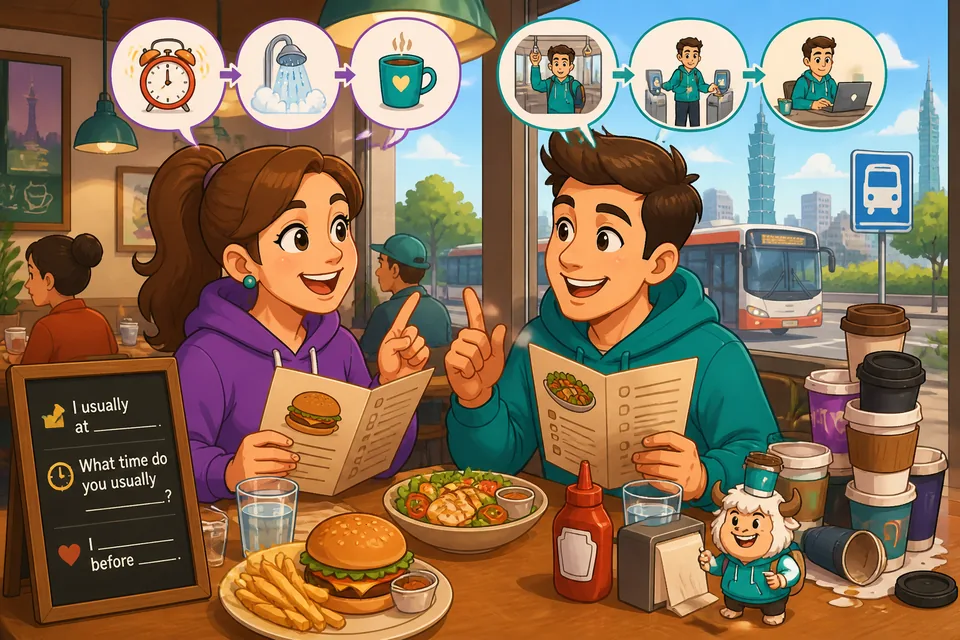
Welcome to Lesson 61 — a friendly, short practice on everyday schedules. Enjoy listening, repeating, and speaking the simple frames that people use every day.
Level A2: In this lesson you'll practice common phrases for talking about daily routines: saying when things happen, asking about times, sequencing actions (before/after), and saying how long tasks take. This lesson is CEFR-aligned and focused on useful, ready-to-use frames for personal life. Learn the patterns, listen to a short conversation, then practice with quick quizzes and speaking prompts.
After this lesson you'll be able to:
Use frames to say when you do routine activities (e.g., I usually ___ at ___).
Ask about other people’s schedules (e.g., What time do you usually ___?).
Describe order (before/after) and duration (It takes me ___ to ___).
Level A2: build confidence speaking short routine sentences aloud.
Ready? Let's go!
When you tap play on phrases, we track your progress through this lesson.
1. Reading + Listening Practice
Hear core phrases, repeat aloud.
I usually ___ at ___.
Describe a regular routine action and time.
Meaning: Describe a regular routine action and time.
When to use:
Tip: Be sure to use 'at' with clock times (at 6:30, at noon).
I usually wake up at 6:30.
I usually wake up at 6:30.
I usually eat lunch at 12:30. When to use: Use this frame to say what you normally do and the exact time.
Example usage of this phrase.
What time do you usually ___?
Ask about the time of a routine action.
Meaning: Ask about the time of a routine action.
When to use:
What time do you usually get up?
What time do you usually get up?
What time do you usually have dinner? When to use: Use to ask friends or colleagues about their normal schedule.
Example usage of this phrase.
I ___ before ___.
Say what happens before another part of the day.
Meaning: Say what happens before another part of the day.
When to use:
I shower before I go to work.
I shower before I go to work.
I read before bed. When to use: Use to show that one action happens earlier than another.
Example usage of this phrase.
After ___, I usually ___.
Say what happens after another routine event.
Meaning: Say what happens after another routine event.
When to use:
After class, I usually go to the library.
After class, I usually go to the library.
After breakfast, I usually check my email. When to use: Use this frame to describe the sequence of daily activities.
Example usage of this phrase.
On ___, I usually ___.
Describe a routine during a part of the week.
Meaning: Describe a routine during a part of the week.
When to use:
On weekends, I usually visit my family.
On weekends, I usually visit my family.
On Mondays, I usually plan my week. When to use: Use to say how your routine changes on specific days.
Example usage of this phrase.
I'm busy from ___ to ___.
Say that a schedule is occupied during a time period.
Meaning: Say that a schedule is occupied during a time period.
When to use:
I'm busy from 9 to 5.
I'm busy from 9 to 5.
I'm busy from 1 to 3 this afternoon. When to use: Use this to tell someone when you are not available.
Example usage of this phrase.
It takes me ___ to ___.
Describe the duration of a routine activity.
Meaning: Describe the duration of a routine activity.
When to use:
It takes me 20 minutes to walk to work.
It takes me 20 minutes to walk to work.
It takes me an hour to finish homework. When to use: Use to explain how long an activity usually takes.
Example usage of this phrase.
I try to ___ every day.
Talk about a regular habit or goal.
Meaning: Talk about a regular habit or goal.
When to use:
I try to exercise every day.
I try to exercise every day.
I try to read before bed every night. When to use: Use to describe a habit or something you attempt to do regularly.
Example usage of this phrase.
I don't usually ___ on ___.
Say that an activity is not part of the usual routine.
Meaning: Say that an activity is not part of the usual routine.
When to use:
Tip: Remember to use the simple present 'don't usually' for habits, not continuous tenses.
I don't usually eat breakfast on weekdays.
I don't usually eat breakfast on weekdays.
I don't usually work on Sundays. When to use: Use to explain exceptions or things you rarely do.
Example usage of this phrase.
What do you usually do in the ___?
Ask about someone’s usual activity in a time period.
Meaning: Ask about someone’s usual activity in a time period.
When to use:
What do you usually do in the evening?
What do you usually do in the evening?
What do you usually do in the morning? When to use: Use this to start a conversation about daily life.
Example usage of this phrase.
My alarm goes off at ___.
State the time an automatic daily routine begins
Meaning: State the time an automatic daily routine begins.
When to use:
My alarm goes off at 6:00.
My alarm goes off at 6:00.
My alarm goes off at 7:15. When to use: Say when something scheduled (like an alarm) starts your routine.
Example usage of this phrase.
I get ready for ___.
Say what someone prepares for in a routine
Meaning: Say what someone prepares for in a routine.
When to use:
I get ready for work.
I get ready for work.
I get ready for bed. When to use: Use to explain what you are preparing to do next.
Example usage of this phrase.
I leave home at about ___.
Say when someone leaves home
Meaning: Say when someone leaves home.
When to use:
I leave home at about 7:30.
I leave home at about 7:30.
I leave home at about 8:00. When to use: Use this to say approximately when you leave for work, school or other plans.
Example usage of this phrase.
2. Conversational Listening Practice
Hear phrases in a real mini-conversation.
Anna and David talk about morning schedules and travel to work.
Anna
My alarm goes off at 6:15.
My alarm goes off at 6:15.
David
I usually wake up at 6:20. What time do you usually leave home?
I usually wake up at 6:20. What time do you usually leave home?
Anna
I leave home at about 7:00. After breakfast, I usually walk to the bus stop.
I leave home at about 7:00. After breakfast, I usually walk to the bus stop.
David
It takes me 25 minutes to get to the office. I'm busy from 9 to 5.
It takes me 25 minutes to get to the office. I'm busy from 9 to 5.
Anna
I try to exercise every day, but I don't usually exercise on Sundays.
I try to exercise every day, but I don't usually exercise on Sundays.
David
Good plan. On weekends, I usually sleep in.
Good plan. On weekends, I usually sleep in.
3. Guided Practice
Quizzes and matching to lock in meaning.
Which reply correctly answers: 'What time do you usually leave home?'
Which sentence shows that one action happens after another?
Which sentence describes how long an activity takes?
Which sentence says the activity is not part of the usual routine on a day?
I usually get up at 6:05. Then I have breakfast and leave for work.
My alarm goes off at 6:00. ____, I have breakfast and leave for work.
After work, I usually go to a movie with friends.
I finish work at 6:00. ____, I usually go to a movie with friends.
It takes me about 30 minutes to get to work.
How long is your commute? ___.
Match the core phrases
Match the extra phrases
4. Speaking Practice
Say phrases yourself (mic/recording).
Recording stays on your device only. Check speech uses your browser's speech tools when available.
Say this phrase out loud:
I usually ___ at ___.
Describe a regular routine action and time.
Say this phrase out loud:
What time do you usually ___?
Ask about the time of a routine action.
Say this phrase out loud:
I ___ before ___.
Say what happens before another part of the day.
Say this phrase out loud:
After ___, I usually ___.
Say what happens after another routine event.
Say this phrase out loud:
On ___, I usually ___.
Describe a routine during a part of the week.
Say this phrase out loud:
I'm busy from ___ to ___.
Say that a schedule is occupied during a time period.
Say this phrase out loud:
It takes me ___ to ___.
Describe the duration of a routine activity.
Say this phrase out loud:
I try to ___ every day.
Talk about a regular habit or goal.
Say this phrase out loud:
I don't usually ___ on ___.
Say that an activity is not part of the usual routine.
Say this phrase out loud:
What do you usually do in the ___?
Ask about someone’s usual activity in a time period.