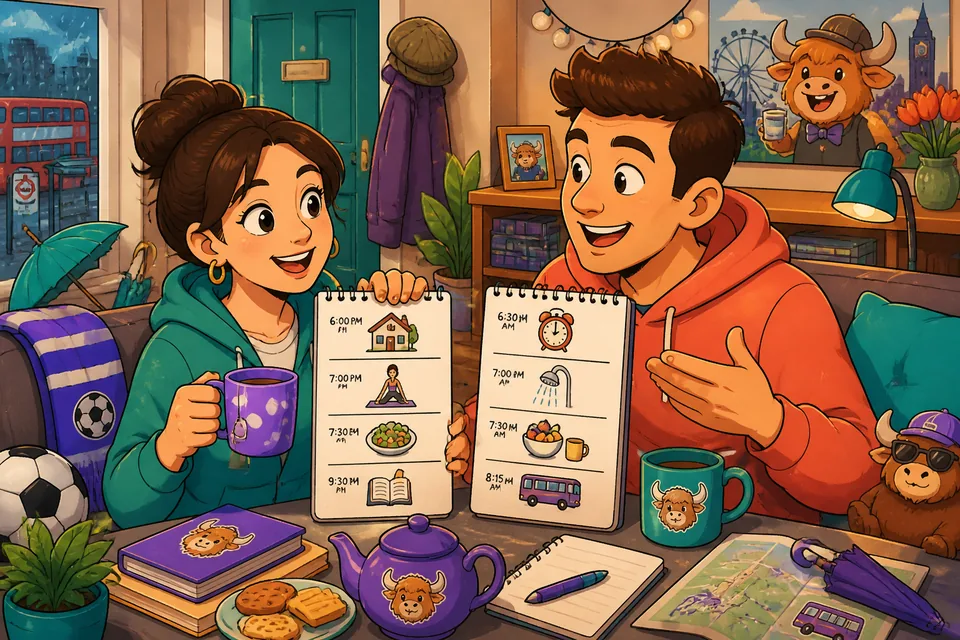
Welcome to Lesson 62 — time to chat about the little routines that make a day feel like yours. Keep it relaxed: these phrases are short and very useful.
Listen, repeat, and then try them out aloud — a few friendly phrases go a long way.
Level A2: In this short lesson (Lesson 62) you'll practice eight easy frames to describe everyday routines: when you wake up and get home, what you have for breakfast, how long you spend on activities, and how your schedule can change. We'll hear the phrases, use them in a short conversation, and then practice with quick quizzes so you can say them naturally.
After this lesson you'll be able to:
Practice saying and answering simple routine questions (wake-up, bedtime, meals).
Use frames to give approximate times and durations (I wake up around ___; I spend about ___ on ___).
Describe small variations: My schedule changes on ___. (Level A2, CEFR-aligned)
Ready? Let's go!
When you tap play on phrases, we track your progress through this lesson.
1. Reading + Listening Practice
Hear core phrases, repeat aloud.
I get back home around ___.
Say when someone returns home
Meaning: Say when someone returns home.
When to use: Use this when you tell someone roughly what time you return home after work or school.
I get back home around 6 p.m.
I get back home around 6 p.m.
I get back home around nine.
I get back home around nine.
I start my day with ___.
Describe the first part of a daily routine
Meaning: Describe the first part of a daily routine.
When to use: Use this to say what you usually do first in the morning.
I start my day with a glass of water.
I start my day with a glass of water.
I start my day with a short walk.
I start my day with a short walk.
I have ___ for breakfast.
Say what someone eats in the morning
Meaning: Say what someone eats in the morning.
When to use: Use this to say your usual morning meal or drink.
Tip: Beginners sometimes say "I eat breakfast" without saying what — add the food after 'have' to be specific.
I have eggs for breakfast.
I have eggs for breakfast.
I have yogurt for breakfast.
I have yogurt for breakfast.
I spend about ___ on ___.
Describe time spent on a regular activity
Meaning: Describe time spent on a regular activity.
When to use: Use this to say approximately how long you do something regularly.
Tip: Don't mix 'on' with 'for' here. Use 'spend about X on Y' (not 'spend about X for Y').
I spend about 30 minutes on exercise.
I spend about 30 minutes on exercise.
I spend about an hour on my commute.
I spend about an hour on my commute.
At night, I like to ___.
Describe an evening habit
Meaning: Describe an evening habit.
When to use: Use this to say what you enjoy doing in the evening before bed.
At night, I like to read.
At night, I like to read.
At night, I like to watch a short show.
At night, I like to watch a short show.
My schedule changes on ___.
Explain that a schedule is not the same every day
Meaning: Explain that a schedule is not the same every day.
When to use: Use this to explain which days you have a different routine.
Tip: Beginners sometimes say 'in Saturdays' or 'at weekends' incorrectly — say 'on Saturdays' or 'on the weekend(s)'.
My schedule changes on weekends.
My schedule changes on weekends.
My schedule changes on Fridays.
My schedule changes on Fridays.
I wake up around ___.
Describe the start of a daily routine
Meaning: Describe the start of a daily routine.
When to use: Use this to give an approximate wake-up time.
I wake up around 7.
I wake up around 7.
I wake up around 6:30.
I wake up around 6:30.
I go to bed around ___.
Describe the end of a daily routine
Meaning: Describe the end of a daily routine.
When to use: Use this to say your usual bedtime approximately.
I go to bed around 11.
I go to bed around 11.
I go to bed around 10:30.
I go to bed around 10:30.
2. Conversational Listening Practice
Hear phrases in a real mini-conversation.
Anna and David compare their daily routines after work.
Anna
I wake up around 7 a.m., and I start my day with coffee.
I wake up around 7 a.m., and I start my day with coffee.
David
I have toast for breakfast, then I spend about 40 minutes on my commute.
I have toast for breakfast, then I spend about 40 minutes on my commute.
Anna
My schedule changes on Saturdays, so I sleep later then.
My schedule changes on Saturdays, so I sleep later then.
David
I get back home around 6 p.m. and at night, I like to read.
I get back home around 6 p.m. and at night, I like to read.
Anna
Nice. I go to bed around 11 most nights.
Nice. I go to bed around 11 most nights.
3. Guided Practice
Quizzes and matching to lock in meaning.
Which sentence tells someone when you go to sleep?
Which sentence answers 'What do you eat in the morning?'
Which sentence tells how long you spend on something?
Which sentence explains a change in routine on certain days?
After work, I usually get back home around 6 p.m.
After work, I usually ___.
Before work, Claire says: "I start my day with a cup of tea."
Before work, Claire says: "___."
Relaxing time: "At night, I like to read."
Relaxing time: "___."
Match the core phrases
Match the extra phrases
4. Speaking Practice
Say phrases yourself (mic/recording).
Recording stays on your device only. Check speech uses your browser's speech tools when available.