Ready to talk about what you want and how you plan to get there? This short lesson helps you say clear, natural goal sentences in everyday conversation. Have fun — think like a coach for your future!
Level B1: In this lesson you'll practice common goal phrases for talking about personal aims, current work, plans with deadlines, and long-term dreams. We'll listen to the chunks, hear them in a short conversation, and do quick practice activities to help you use them confidently. This lesson is CEFR-aligned and focused on practical phrases you can use today.
After this lesson you'll be able to:
Learn useful B1 phrases to state goals, plans, and next steps.
Practice saying and understanding sentences like “My main goal is to …” and “I'm planning to … by …”.
Be able to ask and answer simple questions about someone’s future plans.
Ready? Let's go!
When you tap play on phrases, we track your progress through this lesson.
1. Reading + Listening Practice
Hear core phrases, repeat aloud.
My main goal is to ___.
state a personal goal
Meaning: State a personal goal.
When to use: Use to clearly say the main thing you want to achieve.
My main goal is to finish my degree.
My main goal is to finish my degree.
My main goal is to save enough money for a trip.
My main goal is to save enough money for a trip.
I want to get better at ___.
describe self-improvement
Meaning: Describe something you want to improve.
When to use: Use when talking about skills or habits you want to develop.
I want to get better at public speaking.
I want to get better at public speaking.
I want to get better at cooking healthy meals.
I want to get better at cooking healthy meals.
I'm working on ___.
describe current effort toward a goal
Meaning: Describe current efforts toward a goal.
When to use: Use this to talk about what you are actively doing now.
I'm working on my presentation skills.
I'm working on my presentation skills.
I'm working on a painting for the exhibition.
I'm working on a painting for the exhibition.
I hope to ___ someday.
express a long-term hope
Meaning: Express a long-term hope.
When to use: Use to mention hopes that may happen eventually but are not planned yet.
Tip: Beginners sometimes drop 'to' and say ‘I hope go’ instead of ‘I hope to go’. Keep 'to' before the verb.
I hope to travel around the world someday.
I hope to travel around the world someday.
I hope to find a job I love someday.
I hope to find a job I love someday.
I'd like to ___ in the future.
talk about future ambitions
Meaning: Talk about a polite future ambition.
When to use: Use to say something you would like to do later in life.
I'd like to learn another language in the future.
I'd like to learn another language in the future.
I'd like to run a marathon in the future.
I'd like to run a marathon in the future.
This year, I'm trying to ___.
describe a near-term goal
Meaning: Describe a near-term goal or resolution.
When to use: Use for goals you plan to do this year.
This year, I'm trying to get healthier.
This year, I'm trying to get healthier.
This year, I'm trying to read more books.
This year, I'm trying to read more books.
I need to ___ so I can ___.
explain a goal-related reason
Meaning: Explain an action and its purpose.
When to use: Use to connect what you need to do with why you need to do it.
Tip: Learners sometimes swap the order and make the sentence unclear. Keep the pattern: action + so I can + reason.
I need to practice every day so I can pass the exam.
I need to practice every day so I can pass the exam.
I need to save money so I can move to a new city.
I need to save money so I can move to a new city.
What are you hoping to do next?
ask about someone’s goals
Meaning: Ask about someone’s next plans or goals.
When to use: Use to invite someone to talk about what they plan to do next.
What are you hoping to do next?
What are you hoping to do next?
What are you hoping to do next after graduation?
What are you hoping to do next after graduation?
I haven't decided yet, but I'm interested in ___.
say a goal is undecided
Meaning: Say you are undecided but have interests.
When to use: Use when you are not sure yet, but you can name one area you like.
I haven't decided yet, but I'm interested in graphic design.
I haven't decided yet, but I'm interested in graphic design.
I haven't decided yet, but I'm interested in learning more about digital marketing.
Example usage of this phrase.
My dream is to ___.
State a personal dream or aspiration
Meaning: State a personal dream or big aspiration.
When to use: Use for a heartfelt long-term dream.
My dream is to open a small bakery.
My dream is to open a small bakery.
My dream is to write a novel.
My dream is to write a novel.
I'm planning to ___ by ___.
State a planned goal with a time target
Meaning: State a plan with a time target.
When to use: Use when you have a concrete plan and a deadline.
Tip: Some learners forget to use 'by' with a deadline and say 'in December' when they mean the end date—choose 'by' to show the target date.
I'm planning to finish the course by December.
I'm planning to finish the course by December.
I'm planning to move by next summer.
I'm planning to move by next summer.
My next step is to ___.
Describe the next step toward a goal
Meaning: Describe the next step you will take toward a goal.
When to use: Use to explain the immediate action in your plan.
My next step is to apply for internships.
My next step is to apply for internships.
My next step is to set a study schedule.
My next step is to set a study schedule.
Right now, I'm focusing on ___.
Explain current focus or priority
Meaning: Explain what you are focusing on right now.
When to use: Use to say your current priority.
Right now, I'm focusing on improving my English.
Right now, I'm focusing on improving my English.
Right now, I'm focusing on finishing a project at work.
Right now, I'm focusing on finishing a project at work.
2. Conversational Listening Practice
Hear phrases in a real mini-conversation.
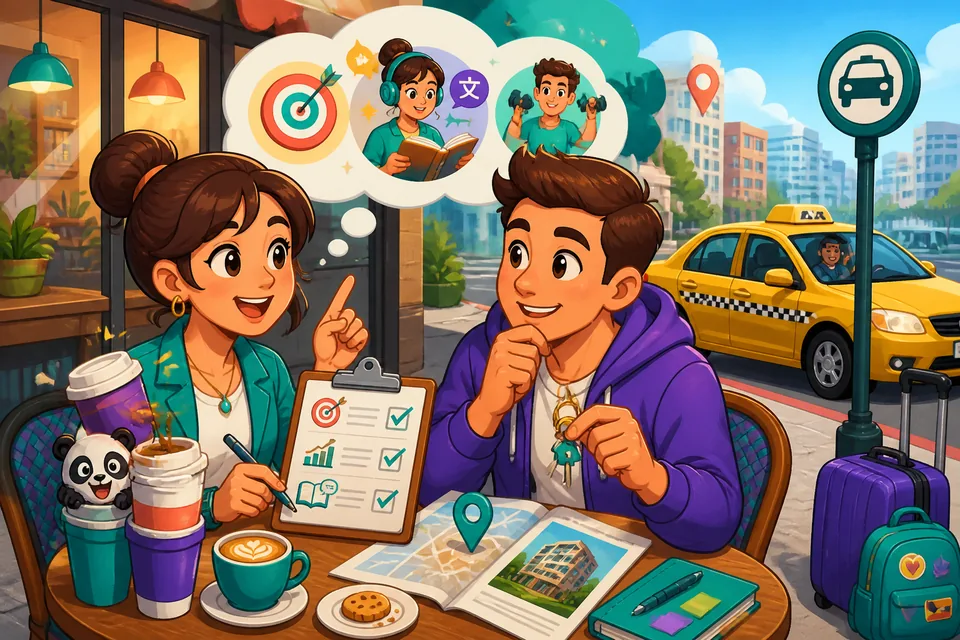
Anna and David talk at a café about plans and dreams.
Anna
What are you hoping to do next?
What are you hoping to do next?
David
I haven't decided yet, but I'm interested in taking a design course.
I haven't decided yet, but I'm interested in taking a design course.
Anna
This year, I'm trying to learn UX tools.
This year, I'm trying to learn UX tools.
David
My main goal is to get a junior design job next year.
My main goal is to get a junior design job next year.
Anna
I'm working on a portfolio now. My next step is to finish three projects.
I'm working on a portfolio now. My next step is to finish three projects.
David
That sounds good. I hope to build a strong portfolio someday.
That sounds good. I hope to build a strong portfolio someday.
3. Guided Practice
Quizzes and matching to lock in meaning.
Which question asks someone about their future plans?
Which sentence describes a current priority?
Which phrase shows a plan with a deadline?
Which sentence explains why someone takes an action?
After finishing school, Jenna said: My dream is to travel the world.
After finishing school, Jenna said: ___.
Carlos wants to improve at presentations, so he says: I want to get better at public speaking.
Carlos wants to improve at presentations, so he says: ___.
When asked about next steps, Mina answered: I haven't decided yet, but I'm interested in teaching.
When asked about next steps, Mina answered: ___.
Match the core phrases
Match the extra phrases
4. Speaking Practice
Say phrases yourself (mic/recording).
Recording stays on your device only. Check speech uses your browser's speech tools when available.