I haven't learned to ___ yet.
say that you have not acquired a skill yet
I haven't learned to drive yet.
I haven't learned to drive yet.
I haven't learned to cook Thai food yet.
I haven't learned to cook Thai food yet.
Lesson 72 of 139

Goal: Say what you can, can't, or want to try
Free English lessons with audio, guided practice, and speaking support.
Welcome! In this short lesson you'll hear useful phrases for talking about abilities in everyday life. Read or listen, then practice aloud — it's a friendly, low-pressure way to build confidence.
Have fun — try saying each phrase out loud. Repeating is the fastest way to make these phrases feel natural.
Level A2: This lesson focuses on everyday frames for talking about skills — what you can do, what you can't do yet, and when you want to try something new. You'll practice short useful phrases like "I haven't learned to ___ yet," "Let me try," and "I'm still learning to ___." (CEFR-aligned).
After this lesson you'll be able to:

Ready? Let's go!
When you tap play on phrases, we track your progress through this lesson.
Hear core phrases, repeat aloud.
I haven't learned to ___ yet.
say that you have not acquired a skill yet
I've never tried to ___.
say that you have no experience doing something
Let me try.
ask someone to let you attempt a task
I feel comfortable ___.
Express confidence or comfort with an ability
I'm not ready to ___ yet.
Express lack of confidence or readiness for an ability
I can ___ if someone helps me.
Say that you can do something with help
I'm still learning to ___.
Say that an ability is still developing
Hear phrases in a real mini-conversation.
Anna and David are at home trying to put together a small bookshelf.
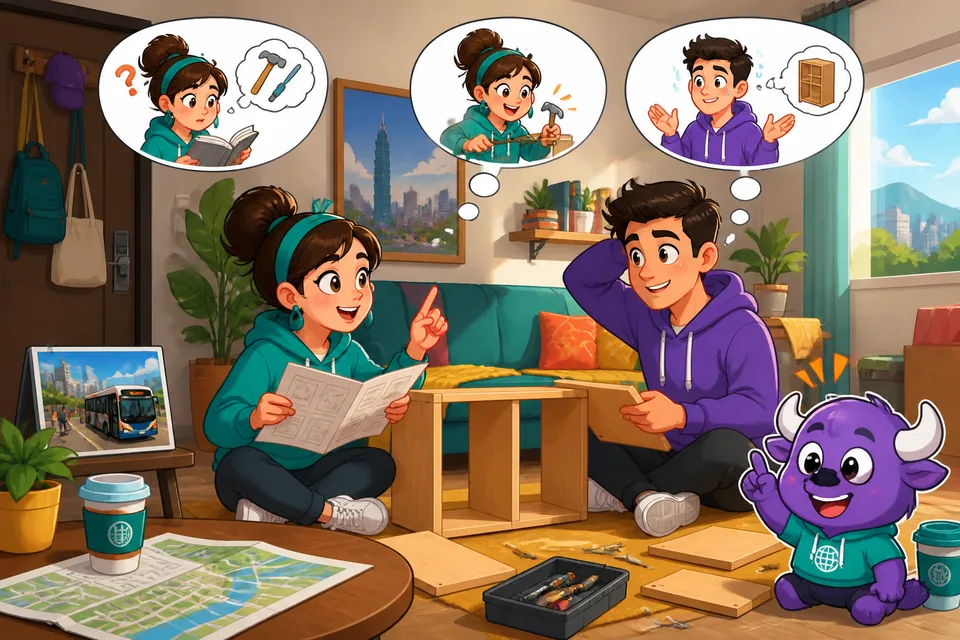

Anna
I've never tried to assemble furniture.
I've never tried to assemble furniture.

David
No problem. I feel comfortable reading the instructions.
I feel comfortable reading the instructions.
Anna
I'm still learning to use the power screwdriver.
I'm still learning to use the power screwdriver.
David
Let me try. You can hold the pieces.
Let me try. You can hold the pieces.
Anna
Thanks. I can tighten some screws if someone helps me.
Thanks. I can tighten some screws if someone helps me.
Quizzes and matching to lock in meaning.
I want to try surfing, but I have no experience: "______".
After a few lessons, you can honestly say: "______ piano."
The climbing wall looks hard. You might say: "______ climbing."
Say phrases yourself (mic/recording).
Recording stays on your device only. Check speech uses your browser's speech tools when available.
Say this phrase out loud:
I haven't learned to ___ yet.
say that you have not acquired a skill yet
Say this phrase out loud:
I've never tried to ___.
say that you have no experience doing something
Say this phrase out loud:
Let me try.
ask someone to let you attempt a task
Say this phrase out loud:
I feel comfortable ___.
express confidence or comfort with an ability
Say this phrase out loud:
I'm not ready to ___ yet.
express lack of confidence or readiness for an ability
Say this phrase out loud:
I can ___ if someone helps me.
say that you can do something with help
Say this phrase out loud:
I'm still learning to ___.
say that an ability is still developing