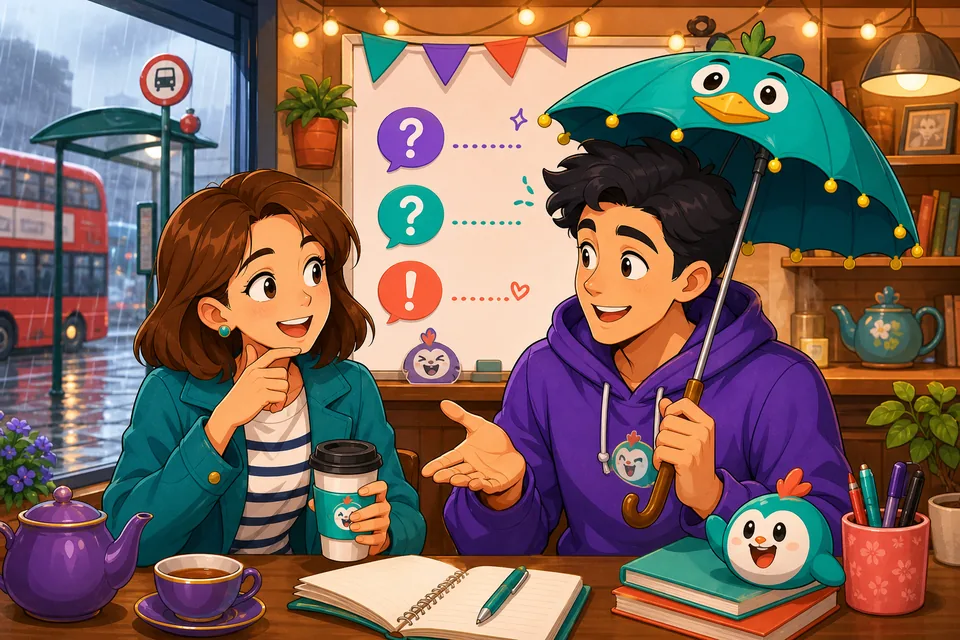
Welcome back! Today your English gets a little more curious.
We will practice short phrases for simple questions, quick reactions, and friendly follow-up. Tiny phrases, big conversation power.
Level A1: In this lesson, you will practice asking for help, asking for clarification, showing interest, and returning to the main topic. You will use phrases like “Tell me more,” “What do you mean here,” and “Can I have basic questions ___?” Think of it as your question toolkit—Yak Yacker approved.
After this lesson you'll be able to:
Ask simple questions in a friendly way.
Ask someone to explain again when you do not understand.
React with interest and invite someone to continue.
Use A1 conversation phrases to keep a short chat going.
Ready? Let's go!
When you tap play on phrases, we track your progress through this lesson.
1. Reading + Listening Practice
Hear core phrases, repeat aloud.
Do you have basic questions ___?
ask about availability (basic questions)
Meaning: Do you have basic questions ___?
When to use: Use this to ask if someone has basic questions or time for basic questions. Add a word or short phrase in the blank, like “today” or “for me.”
Do you have basic questions today?
Ask if the person has basic questions today.
Do you have basic questions for me?
Ask if the person has basic questions for you.
What do you mean here.
ask for clarification (basic questions)
Meaning: What do you mean here.
When to use: Use this when you do not understand one word, sentence, or idea and want a simple explanation.
Tip: Say it with a friendly question voice. A soft voice makes it sound helpful, not rude.
This part is not clear. What do you mean here.
Ask someone to explain this part.
You said “later.” What do you mean here.
Ask for the meaning of one word or idea.
Oh, really now.
show interest in what was said (basic questions)
Meaning: Oh, really now.
When to use: Use this to show interest or surprise when someone tells you something.
Anna: I study English every morning. David: Oh, really now.
David shows interest.
David: The class starts at eight. Anna: Oh, really now.
Anna reacts to new information.
go for a basic questions ___
suggest a simple activity (basic questions)
Meaning: go for a basic questions ___
When to use: Use this to suggest doing a simple basic-questions activity. Add a word in the blank, like “practice” or “session.”
Let’s go for a basic questions practice.
Suggest practicing basic questions.
Can we go for a basic questions session?
Suggest a short question practice session.
No problem please.
respond casually to a request (basic questions)
Meaning: No problem please.
When to use: Use this as a casual, friendly answer when someone asks for help.
Tip: This is casual. With a teacher, manager, or stranger, “No problem” may sound more natural.
Anna: Can you help me? David: No problem please.
David says yes in a relaxed way.
David: Can I ask one more question? Anna: No problem please.
Anna accepts the request.
Can I have basic questions ___?
make a polite request (basic questions)
Meaning: Can I have basic questions ___?
When to use: Use this to make a polite request connected to basic questions. Add what you need in the blank.
Can I have basic questions help?
Politely ask for help with basic questions.
Can I have basic questions practice?
Politely ask for practice with basic questions.
That sounds basic questions ___.
react to an idea (basic questions)
Meaning: That sounds basic questions ___.
When to use: Use this to react to an idea about basic questions. Add a describing word in the blank, like “good,” “helpful,” or “useful.”
That sounds basic questions helpful.
Say the idea sounds helpful.
That sounds basic questions useful.
Say the idea sounds useful.
Tell me more.
invite the speaker to continue (basic questions)
Meaning: Tell me more.
When to use: Use this when you want the other person to continue speaking.
That is interesting. Tell me more.
Invite the speaker to continue.
You have a new idea? Tell me more.
Ask for more information.
Anyway… please.
return to the main topic (basic questions)
Meaning: Anyway… please.
When to use: Use this to gently return to the main topic after a small side conversation.
Tip: Use a gentle voice. This phrase can sound direct if you say it too strongly.
Anyway… please. Let’s start the questions.
Return to the question practice.
Anyway… please. Can we talk about the lesson?
Bring the conversation back to the lesson.
2. Conversational Listening Practice
Hear phrases in a real mini-conversation.
Anna and David are getting ready for a short English practice session.
Anna
Do you have basic questions for me?
Anna asks if David has basic questions.
David
Yes. Can I have basic questions help?
David asks politely for help.
Anna
No problem please. What do you mean here.
Anna says yes and asks him to explain.
David
This word is new for me.
David explains his problem.
Anna
Oh, really now. Tell me more.
Anna shows interest and asks him to continue.
David
Can we go for a basic questions practice?
David suggests practice.
Anna
That sounds basic questions helpful. Anyway… please, let’s start.
Anna likes the idea and returns to the main task.
3. Guided Practice
Quizzes and matching to lock in meaning.
Which phrase asks someone to explain something?
Which phrase is a polite request?
Which phrase invites someone to continue speaking?
Which phrase helps return to the main topic?
David is making a polite request.
David sees Anna’s question list and wants a copy. He asks, “___”
David reacts positively to Anna’s idea.
Anna suggests a short question practice. David likes the idea and says, “___”
Anna brings the conversation back to the lesson.
David starts talking about lunch, but Anna wants to return to the lesson. Anna says, “___”
Match the core phrases
Match the extra phrases
4. Speaking Practice
Say phrases yourself (mic/recording).
Recording stays on your device only. Check speech uses your browser's speech tools when available.