Welcome back! Today we are going shopping with simple, powerful English. Your wallet may stay quiet, but your English will speak up.
Level A1: In this lesson, you’ll practice asking prices, asking about quantity, and checking the total. You’ll also learn helpful shopping phrases like “That’s too expensive,” “Do you have a cheaper one?” and “Cash or card?” Small phrases, big shopping power.
After this lesson you'll be able to:
Ask the price of one item or the total price.
Say or understand a simple price and a price for each item.
Request a quantity politely with “please.”
React when a price is too high or when you do not have enough money.
Ready? Let's go!
When you tap play on phrases, we track your progress through this lesson.
1. Reading + Listening Practice
Hear core phrases, repeat aloud.
How much is ___?
ask the price of an item
Meaning: Ask the price of an item.
When to use: Use this when you point to or name one thing and want the price. Examples: “How much is this bag?” “How much is the coffee?”
Tip: Use “How much is...” for price, not “How many is...”.
How much is this bag?
Ask the price of this bag.
How much is the coffee?
Ask the price of the coffee.
It's ___.
state a price
Meaning: State a price.
When to use: Use this to answer a price question. Examples: “It’s five dollars.” “It’s two euros.”
It’s five dollars.
The price is five dollars.
It’s two euros.
The price is two euros.
How much is the total?
ask for the total price
Meaning: Ask for the total price.
When to use: Use this at checkout when you want the final amount to pay. Examples: “How much is the total?” “I have two coffees and a sandwich. How much is the total?”
How much is the total?
Ask for the final price.
I have two coffees and a sandwich. How much is the total?
Ask for the final price of all items.
How many?
ask about quantity
Meaning: Ask about quantity.
When to use: Use this for countable things when the item is clear. Examples: “Apples? How many?” “Tickets? How many?”
Tip: Use “How many?” for things you can count: apples, tickets, bottles.
Apples? How many?
Ask the number of apples.
Tickets? How many?
Ask the number of tickets.
How much?
ask about amount
Meaning: Ask about amount or price.
When to use: Use this short question when the context is clear. Examples: “This one—how much?” “The total—how much?”
Tip: Use “How much?” for price or amount, not for the number of countable items.
This one—how much?
Ask the price of this one.
The total—how much?
Ask the amount of the total.
___, please.
request a specific quantity
Meaning: Request a specific quantity politely.
When to use: Use this with a number or amount before “please.” Examples: “Two coffees, please.” “One ticket, please.”
Two coffees, please.
Request two coffees politely.
One ticket, please.
Request one ticket politely.
Just ___, please.
request only a limited quantity
Meaning: Request only a limited quantity politely.
When to use: Use this when you want a smaller amount or want to correct the quantity. Examples: “Just one, please.” “Just a small one, please.”
Just one, please.
Request only one.
Just a small one, please.
Request only a small one.
That's too expensive.
say a price is too high
Meaning: Say a price is too high.
When to use: Use this when something costs more than you want to pay. Examples: “That’s too expensive.” “Sorry, that’s too expensive.”
That’s too expensive.
The price is too high.
Sorry, that’s too expensive.
Politely say the price is too high.
Do you have a cheaper one?
ask for a lower-priced option
Meaning: Ask for a lower-priced option.
When to use: Use this when you like something, but the price is high. Examples: “Do you have a cheaper one?” “This is nice. Do you have a cheaper one?”
Do you have a cheaper one?
Ask for a lower-priced option.
This is nice. Do you have a cheaper one?
Ask for a cheaper option after seeing one item.
I don't have enough money.
say available money is not enough
Meaning: Say your money is not enough.
When to use: Use this when you cannot pay the price. Examples: “I don’t have enough money.” “Sorry, I don’t have enough money.”
I don’t have enough money.
You cannot pay the price.
Sorry, I don’t have enough money.
Politely say you cannot pay.
Cash or card?
Ask or offer a payment choice
Meaning: Ask or offer a payment choice.
When to use: Use this at checkout to ask if someone will pay with money or a bank card. Examples: “Cash or card?” “Your total is ten dollars. Cash or card?”
Cash or card?
Ask the payment method.
Your total is ten dollars. Cash or card?
Ask the payment method after giving the total.
Is that each?
Ask if the stated price is for one item
Meaning: Ask if the price is for one item.
When to use: Use this when you hear a price and want to know if it means one item. Examples: “Five dollars? Is that each?” “The apples are two dollars. Is that each?”
Five dollars? Is that each?
Ask if five dollars is for one item.
The apples are two dollars. Is that each?
Ask if two dollars is the price for one apple.
___ each.
State a unit price
Meaning: State a unit price.
When to use: Use this to say the price for one item. Examples: “Two dollars each.” “They’re three euros each.”
Two dollars each.
Each one costs two dollars.
They’re three euros each.
Each one costs three euros.
2. Conversational Listening Practice
Hear phrases in a real mini-conversation.
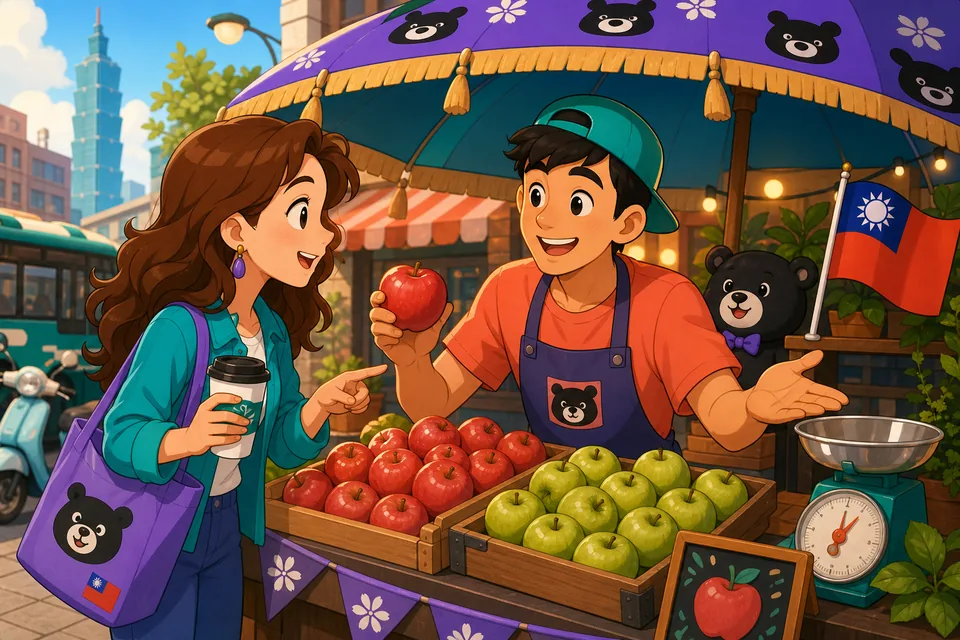
At a small market stall, Anna wants to buy apples from David.
Anna
How much is the bag of apples?
Anna asks the price of the bag of apples.
David
It’s six dollars.
David gives the price.
Anna
Is that each?
Anna asks if the price is for one item.
David
No, six dollars total. The apples are two dollars each.
David explains the total and the unit price.
Anna
Great. Just one bag, please.
Anna asks for only one bag.
David
Sure. Cash or card?
David asks how Anna will pay.
3. Guided Practice
Quizzes and matching to lock in meaning.
You want to know the price of a hat. What do you say?
The shop worker says, “Three dollars.” You want to know if that price is for one apple. What do you ask?
You are at checkout and want the final amount to pay. What do you say?
You want only one bottle, politely. What do you say?
Anna asks for a lower-priced T-shirt.
Anna: I like this T-shirt, but $40 is a lot. ___ David: Yes, this one is $20.
Anna politely asks for four oranges.
David: The oranges are one dollar each. Anna: Great. ___
Anna asks for the final total price.
At checkout, Anna has bread and milk. She asks: ___
Match the core phrases
Match the extra phrases
4. Speaking Practice
Say phrases yourself (mic/recording).
Recording stays on your device only. Check speech uses your browser's speech tools when available.