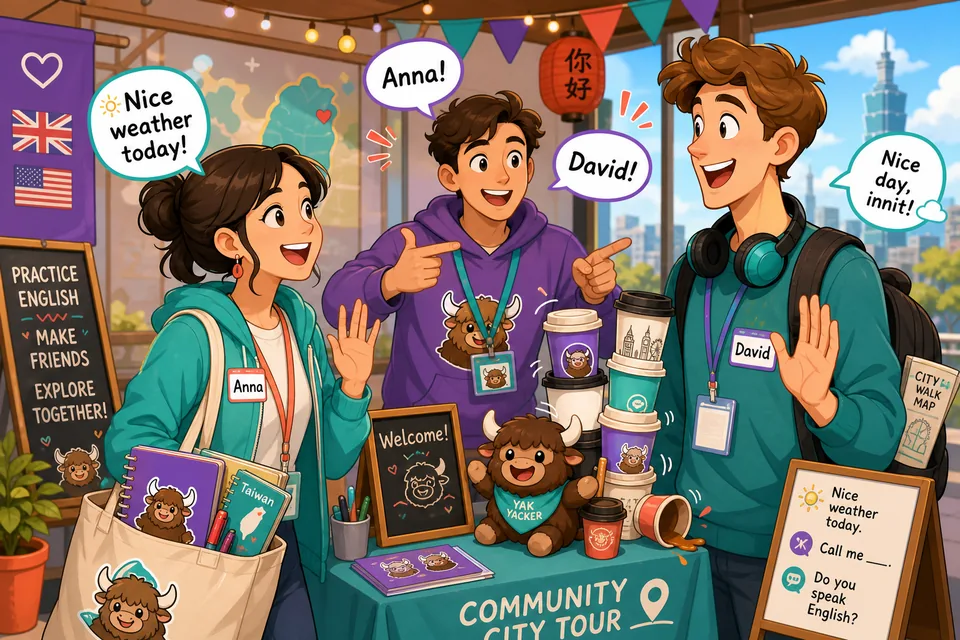
Welcome back! Today we open the conversation door with a few easy phrases. No big speech needed—just small, friendly moves.
Level A1: In this lesson, you’ll practice simple greeting openers like “Nice weather today,” “Good to see you,” and “Do you speak English?” You’ll also learn how to tell someone what name to use and how to return a question with “And you?” Tiny phrases, big yak-power.
After this lesson you'll be able to:
Start simple small talk with a weather comment.
Tell someone what name to use for you.
Ask if someone speaks English.
Greet someone you already know in a friendly way.
Return a simple question with “And you?”
Ready? Let's go!
When you tap play on phrases, we track your progress through this lesson.
1. Reading + Listening Practice
Hear core phrases, repeat aloud.
Nice weather today.
start simple small talk with a neutral comment
Meaning: Start simple small talk with a neutral weather comment.
When to use: Use this when you want to begin a light, friendly conversation. Examples: “Nice weather today.” “Nice weather today. Good for a walk.”
Nice weather today.
Start simple small talk with a neutral comment.
Nice weather today. Good for a walk.
A friendly weather comment to open a chat.
Call me ___.
Tell someone what name to use for you.
Meaning: Tell someone what name to use for you.
When to use: Use this when your full name is long, or you prefer a short name. Examples: “Call me Sam.” “My name is Alexandra, but call me Alex.”
Tip: Do not say “Call me is Alex.” Say “Call me Alex.”
Call me Sam.
Please use the name Sam for me.
My name is Alexandra, but call me Alex.
Please use the shorter name Alex.
Do you speak English?
start contact by asking about a shared language
Meaning: Start contact by asking about a shared language.
When to use: Use this when you need to know if you can communicate in English. Examples: “Do you speak English?” “Excuse me, do you speak English?”
Do you speak English?
Ask if someone can communicate in English.
Excuse me, do you speak English?
A polite way to ask before starting.
Good to see you.
Greet someone you already know in a friendly way.
Meaning: Greet someone you already know in a friendly way.
When to use: Use this when you meet a familiar person again. Examples: “Good to see you.” “Hi, Anna. Good to see you.”
Tip: Use this for someone you already know. For a first meeting, “Nice to meet you” is more common.
Good to see you.
A friendly greeting for someone you know.
Hi, Anna. Good to see you.
Greeting a familiar person by name.
And you?
Return a simple question to the other person in an opening exchange.
Meaning: Return a simple question to the other person.
When to use: Use this after you answer, when you want the other person to answer too. Examples: “I’m fine, thanks. And you?” “I’m here for the tour. And you?”
Tip: “And you?” needs context. Say your answer first, then ask “And you?”
I’m fine, thanks. And you?
Return the same simple question.
I’m here for the tour. And you?
Ask the other person for the same information.
2. Conversational Listening Practice
Hear phrases in a real mini-conversation.
Anna and David meet before a city tour.
Anna
Hi, David. Good to see you.
Anna greets David, someone she knows.
David
Good to see you, Anna. Nice weather today.
David greets Anna and starts small talk.
Anna
Yes, very nice. Do you speak English?
Anna asks if David speaks English.
David
Yes, I do. Call me Dave.
David says English is okay and gives his preferred name.
Anna
Great. I’m here for the city tour. And you?
Anna gives information and returns the question.
David
Me too. Let’s go!
David says he is also there for the tour.
3. Guided Practice
Quizzes and matching to lock in meaning.
Which phrase starts simple small talk with a neutral weather comment?
You want someone to use your short name, Ben. What do you say?
Which phrase asks if the other person can communicate in English?
Anna says, “I’m here for the tour.” She wants to ask David the same thing. What can she say?
Anna: My full name is Katherine, but call me Kate. David: Nice to meet you, Kate.
Anna: My full name is Katherine, but ___. David: Nice to meet you, Kate.
David: Excuse me, I need help. Do you speak English? Anna: Yes, I do.
David: Excuse me, I need help. ___. Anna: Yes, I do.
Anna: I’m here for the city tour. And you? David: Me too.
Anna: I’m here for the city tour. ___. David: Me too.
Match the core phrases
Match the extra phrases
4. Speaking Practice
Say phrases yourself (mic/recording).
Recording stays on your device only. Check speech uses your browser's speech tools when available.
Say this phrase out loud:
Nice weather today.
Start simple small talk with a neutral weather comment.