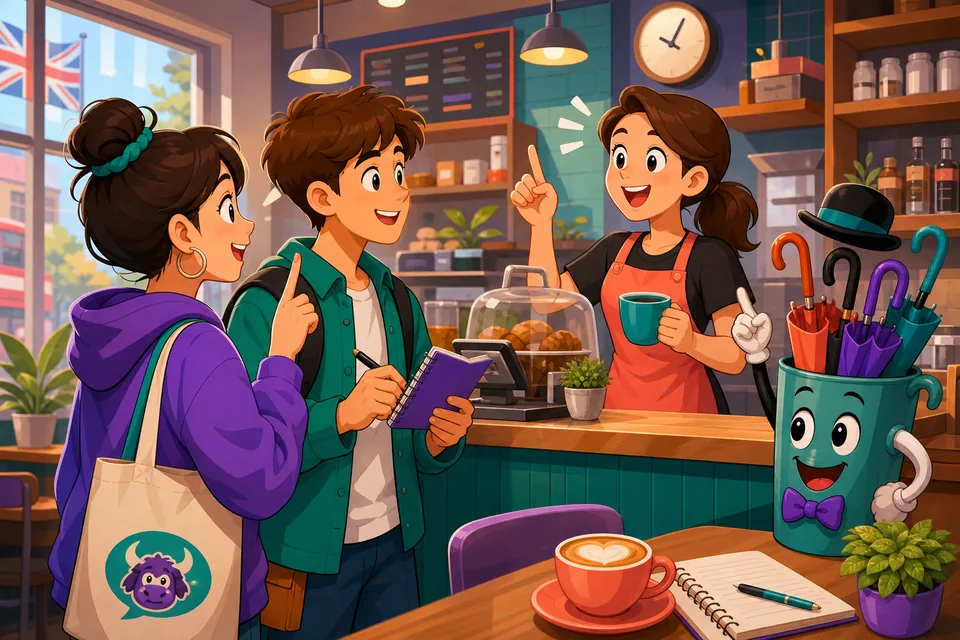
Welcome back! Today we add a little softener to your English—like putting a cushion on your words.
These phrases help you ask, wait, give, thank, and reassure people in a friendly way.
Level A1: In this lesson, you will practice simple polite phrases like “Can I ___, please?”, “Here you go,” and “Don’t worry.” You’ll learn how to ask for something, thank someone for a specific thing, and check if something is okay. Tiny words, big kindness—Yak Yacker approves.
After this lesson you'll be able to:
Ask for something politely using “Can I ___, please?”
Thank someone for a specific thing using “Thanks for ___.”
Ask someone to wait briefly with “Just a moment, please.”
Give something politely with “Here you go.”
Reassure someone with “Don’t worry.”
Check if something is acceptable with “Is that okay?”
Ready? Let's go!
When you tap play on phrases, we track your progress through this lesson.
1. Reading + Listening Practice
Hear core phrases, repeat aloud.
Can I ___, please?
making a polite request for oneself
Meaning: Use this to make a polite request for yourself.
When to use: Use it when you want something or want permission. Examples: “Can I have some water, please?” “Can I sit here, please?”
Tip: Remember to add the action or thing after “Can I.” Say: “Can I have a pen, please?” not just “Can I, please?”
Can I have some water, please?
I want water, and I ask politely.
Can I sit here, please?
I ask for permission to sit here.
Thanks for ___.
thanking someone for a specific thing
Meaning: Use this to thank someone for a specific thing or action.
When to use: Use it when someone helps you, gives you something, or does something kind. Examples: “Thanks for your help.” “Thanks for waiting.”
Tip: After “Thanks for,” use a noun or an -ing verb: “Thanks for the coffee” or “Thanks for helping.”
Thanks for your help.
I thank someone because they helped me.
Thanks for waiting.
I thank someone because they waited.
Just a moment, please.
asking someone to wait briefly
Meaning: Use this to ask someone to wait for a short time.
When to use: Use it when you need a few seconds or one minute. Examples: “Just a moment, please. I’m looking.” “Just a moment, please. I’ll get it.”
Just a moment, please. I’m looking.
Please wait briefly while I look.
Just a moment, please. I’ll get it.
Please wait briefly while I get something.
Here you go.
giving something to someone politely
Meaning: Use this when you give or hand something to someone.
When to use: Use it when passing a phone, ticket, bag, drink, or other item. Examples: “Here you go. Your coffee.” “Here you go. This is your pen.”
Here you go. Your coffee.
I give someone their coffee politely.
Here you go. This is your pen.
I give someone a pen politely.
Don't worry.
reassuring someone after a small problem or apology
Meaning: Use this to tell someone a small problem is not serious.
When to use: Use it after an apology or small mistake. Examples: “Don’t worry. It’s okay.” “Don’t worry. I can wait.”
Tip: Use this for small problems. For serious problems, use more careful words like “I’m sorry to hear that.”
Don’t worry. It’s okay.
I reassure someone after a small problem.
Don’t worry. I can wait.
I tell someone the delay is not a problem.
Is that okay?
Ask if something is acceptable
Meaning: Use this to ask if something is acceptable or fine.
When to use: Use it when you want to check permission or agreement. Examples: “I’ll sit here. Is that okay?” “I can come at five. Is that okay?”
I’ll sit here. Is that okay?
I check if sitting here is acceptable.
I can come at five. Is that okay?
I check if the time is acceptable.
2. Conversational Listening Practice
Hear phrases in a real mini-conversation.
Anna and David are at a small café table. David needs a menu, and Anna is moving her bag.
David
Can I see the menu, please?
David politely asks to see the menu.
Anna
Just a moment, please. My bag is on it.
Anna asks David to wait briefly.
Anna
Here you go.
Anna gives him the menu.
David
Thanks for the menu.
David thanks Anna for the menu.
Anna
I’ll put my bag on this chair. Is that okay?
Anna checks if it is acceptable.
David
Yes, don’t worry.
David reassures her.
3. Guided Practice
Quizzes and matching to lock in meaning.
You want a glass of water. Which phrase is polite?
Someone gives you a pen. What can you say?
You need a short time to find your ticket. What do you say?
You want to check if sitting near Anna is fine. What do you say?
Anna is at a café counter. She wants tea, so she says: “Can I have tea, please?”
Anna is at a café counter. She wants tea, so she says: “___”
David is looking for the key. Anna is waiting. David says: “Just a moment, please. I’m checking my bag.”
David is looking for the key. Anna is waiting. David says: “___ I’m checking my bag.”
Anna accidentally drops David’s napkin and says sorry. David smiles and says: “Don’t worry. It’s okay.”
Anna accidentally drops David’s napkin and says sorry. David smiles and says: “___ It’s okay.”
Match the core phrases
Match the extra phrases
4. Speaking Practice
Say phrases yourself (mic/recording).
Recording stays on your device only. Check speech uses your browser's speech tools when available.
Say this phrase out loud:
Can I ___, please?
making a polite request for oneself
Say this phrase out loud:
Thanks for ___.
thanking someone for a specific thing
Say this phrase out loud:
Just a moment, please.
asking someone to wait briefly
Say this phrase out loud:
Here you go.
giving something to someone politely
Say this phrase out loud:
Don't worry.
reassuring someone after a small problem or apology