Welcome! This short lesson helps you talk about likes, dislikes, and food limits. Practice listening, repeating, and speaking the key phrases aloud.
Level A2: In this lesson you'll practice useful phrases for talking about food preferences and dietary limits — asking about allergies, saying what you can or can't eat, and politely refusing items. This CEFR-aligned lesson focuses on practical, everyday sentences you can use at a restaurant or with friends.
After this lesson you'll be able to:
Ask and answer simple questions about food preferences and allergies.
Say which foods you can eat and which you cannot.
Use polite phrases to refuse food and to soften dislikes (Level A2).
Ready? Let's go!
When you tap play on phrases, we track your progress through this lesson.
1. Reading + Listening Practice
Hear core phrases, repeat aloud.
I can eat ___, but not ___.
Clarify what is acceptable and not acceptable to eat
Meaning: Explain which foods are okay for you and which are not.
When to use: Use this to show partial dietary restrictions or preferences.
Tip: Don't mix negatives incorrectly — say 'I can eat X, but not Y,' not 'I can X but I don't Y.'
I can eat fish, but not shellfish.
I can eat fish, but not shellfish.
I can eat cheese, but not milk.
I can eat cheese, but not milk.
Are you allergic to ___?
Ask about a food allergy
Meaning: Ask if someone has a food allergy.
When to use: Use this to check if a person cannot eat something for health reasons.
Tip: Avoid 'I am allergy to...' — say 'I am allergic to...' when you answer.
Are you allergic to peanuts?
Are you allergic to peanuts?
Are you allergic to dairy?
Are you allergic to dairy?
What kind of food do you like?
Ask about general food preferences
Meaning: Ask about someone's general food likes.
When to use: Use this to start a friendly conversation about food.
What kind of food do you like?
What kind of food do you like?
What kind of food do you prefer — spicy or mild?
What kind of food do you prefer — spicy or mild?
No ___ for me, please.
Politely refuse a food item
Meaning: Politely refuse a specific food or ingredient.
When to use: Use this short phrase when someone offers food you do not want.
Tip: Don't use 'Without me' — say 'No X for me, please.'
No onions for me, please.
No onions for me, please.
No sugar for me, please.
No sugar for me, please.
Is there anything you can't eat?
Ask about someone's dietary restrictions or limits
Meaning: Ask if there are any foods someone cannot eat at all.
When to use: Use this when planning meals or ordering to avoid problems.
Is there anything you can't eat?
Is there anything you can't eat?
Is there anything I should avoid when I cook?
Is there anything I should avoid when I cook?
It's okay, but it's not my favorite.
Explain that a food is acceptable but not preferred
Meaning: Say that a food is acceptable but not preferred.
When to use: Use this to be polite about a mild dislike.
It's okay, but it's not my favorite.
It's okay, but it's not my favorite.
That salad is okay, but it's not my favorite.
That salad is okay, but it's not my favorite.
2. Conversational Listening Practice
Hear phrases in a real mini-conversation.
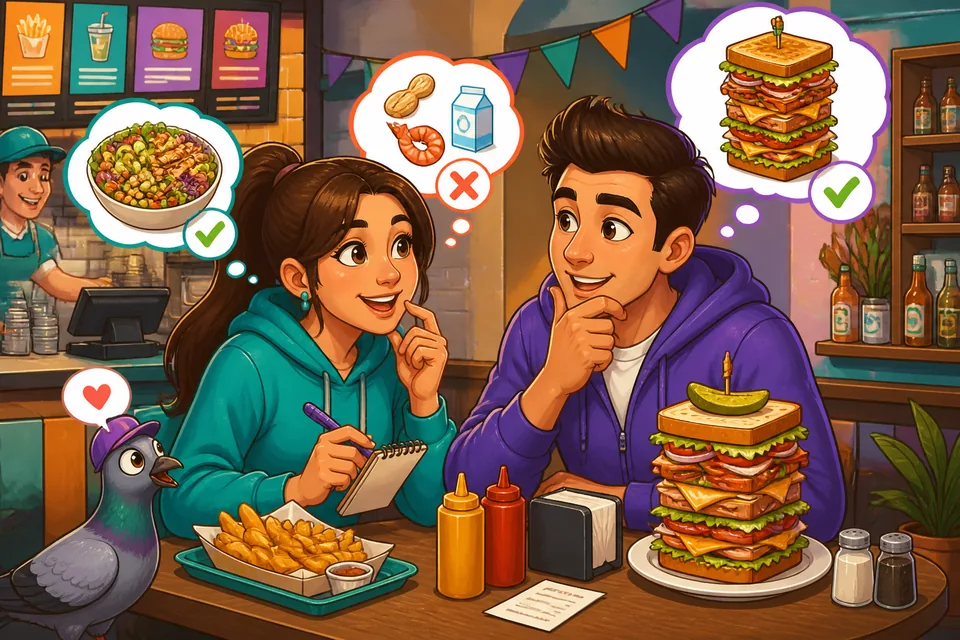
At a small restaurant table, Anna and David talk about what they can and can't eat.
Anna
What kind of food do you like?
What kind of food do you like?
David
I like Italian food. Is there anything you can't eat?
I like Italian food. Is there anything you can't eat?
Anna
Are you allergic to shellfish?
Are you allergic to shellfish?
David
No, I'm not allergic, but I can eat shellfish, but not dairy.
No, I'm not allergic, but I can eat shellfish, but not dairy.
Anna
No dairy for me, please.
No dairy for me, please.
David
It's okay, but it's not my favorite.
It's okay, but it's not my favorite.
3. Guided Practice
Quizzes and matching to lock in meaning.
Which sentence asks about a person's food preferences?
How do you politely refuse a food someone offers you?
Which question checks for food allergies?
Which sentence shows something is acceptable but not preferred?
Before I order, are you allergic to peanuts?
Before I order, ___ peanuts?
When choosing a restaurant, David asks, 'What kind of food do you like?'
When choosing a restaurant, David asks, '___?'
At lunch Sam says, 'I can eat pasta, but not mushrooms.'
At lunch Sam says, '___, but not mushrooms.'
Match the core phrases
Match the extra phrases
4. Speaking Practice
Say phrases yourself (mic/recording).
Recording stays on your device only. Check speech uses your browser's speech tools when available.
Say this phrase out loud:
I can eat ___, but not ___.
Clarify what is acceptable and not acceptable to eat
Say this phrase out loud:
Are you allergic to ___?
Ask about a food allergy
Say this phrase out loud:
What kind of food do you like?
Ask about general food preferences
Say this phrase out loud:
No ___ for me, please.
Politely refuse a food item
Say this phrase out loud:
Is there anything you can't eat?
Ask about someone's dietary restrictions or limits
Say this phrase out loud:
It's okay, but it's not my favorite.
Explain that a food is acceptable but not preferred