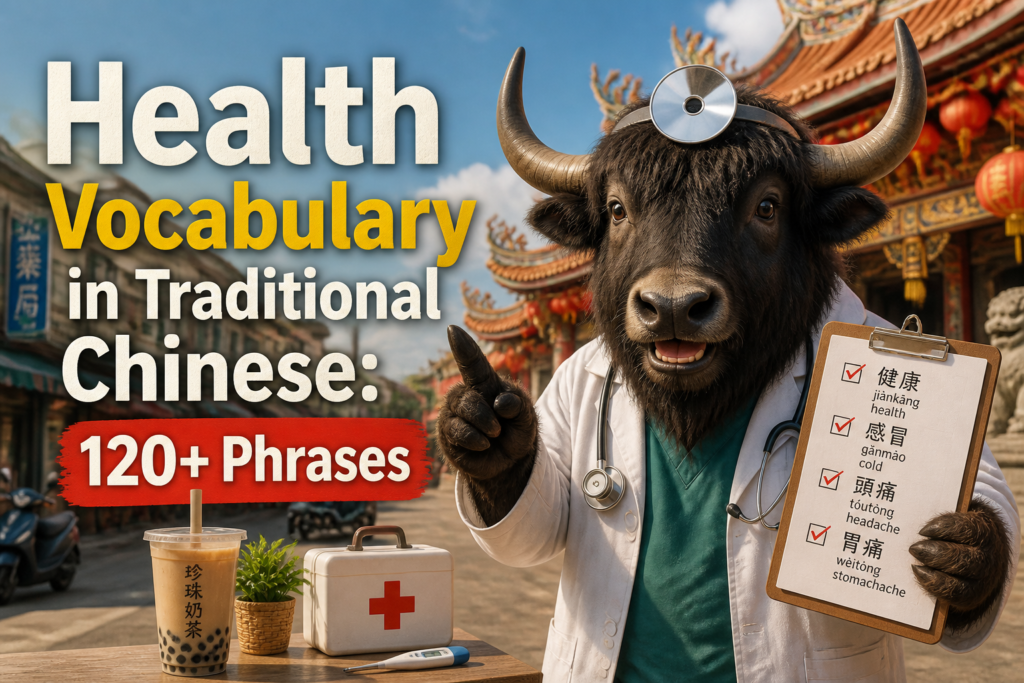
健康詞彙 jiànkāng cíhuì = health vocabulary. If you ever need to say “I’m not feeling great” in Taiwan, this is the kind of language that saves you from awkward pantomime and dramatic facial acting at the clinic. Handy, right?
For the broader learning path, visit our parent guide.
This guide gives you practical Traditional Chinese health words and phrases for real life: symptoms, body parts, medicine, clinic visits, and everyday wellness talk. You’ll see Traditional Chinese, pinyin, and English meaning, plus example sentences you can actually use.
If you want a serious, boring, useful reference, Taiwan’s Ministry of Education is exactly the kind of authority that does not care about your feelings but does care about language standards.
And yes, health words matter because symptoms do not wait for perfect grammar. They show up uninvited, like a cold in winter.
Quick Health Starter Phrases
| Traditional Chinese | Pinyin | Meaning | Example (ZH) | Example (Pinyin) | Translation (EN) |
|---|---|---|---|---|---|
| 我不舒服。 | wǒ bù shūfú | I feel unwell. | 我今天不太舒服。 | wǒ jīntiān bú tài shūfú. | I don’t feel very well today. |
| 我生病了。 | wǒ shēngbìng le | I’m sick. | 我昨天開始生病了。 | wǒ zuótiān kāishǐ shēngbìng le. | I started getting sick yesterday. |
| 我感冒了。 | wǒ gǎnmào le | I have a cold. | 我好像感冒了。 | wǒ hǎoxiàng gǎnmào le. | I think I caught a cold. |
| 我發燒了。 | wǒ fāshāo le | I have a fever. | 我昨晚開始發燒。 | wǒ zuówǎn kāishǐ fāshāo. | I started having a fever last night. |
| 我頭痛。 | wǒ tóutòng | I have a headache. | 我一整天都頭痛。 | wǒ yì zhěng tiān dōu tóutòng. | I’ve had a headache all day. |
| 我肚子痛。 | wǒ dùzi tòng | I have a stomachache. | 我吃完之後肚子痛。 | wǒ chī wán zhīhòu dùzi tòng. | My stomach hurt after I ate. |
| 我喉嚨痛。 | wǒ hóulóng tòng | I have a sore throat. | 我喉嚨痛,聲音也沙啞。 | wǒ hóulóng tòng, shēngyīn yě shāyǎ. | My throat hurts, and my voice is hoarse too. |
| 我咳嗽。 | wǒ késòu | I’m coughing. | 我晚上一直咳嗽。 | wǒ wǎnshàng yìzhí késòu. | I keep coughing at night. |
| 我流鼻涕。 | wǒ liú bítì | I have a runny nose. | 我一直流鼻涕。 | wǒ yìzhí liú bítì. | My nose keeps running. |
| 我要看醫生。 | wǒ yào kàn yīshēng | I need to see a doctor. | 明天如果還沒好,我要看醫生。 | míngtiān rúguǒ hái méi hǎo, wǒ yào kàn yīshēng. | If I’m still not better tomorrow, I need to see a doctor. |
Body Parts You Will Actually Use
| Traditional Chinese | Pinyin | Meaning | Example (ZH) | Example (Pinyin) | Translation (EN) |
|---|---|---|---|---|---|
| 頭 | tóu | head | 我頭很痛。 | wǒ tóu hěn tòng. | My head hurts a lot. |
| 眼睛 | yǎnjing | eye | 我的眼睛很疲勞。 | wǒ de yǎnjing hěn píláo. | My eyes are very tired. |
| 耳朵 | ěrduo | ear | 我耳朵有點痛。 | wǒ ěrduo yǒudiǎn tòng. | My ear hurts a little. |
| 鼻子 | bízi | nose | 我鼻子不太舒服。 | wǒ bízi bú tài shūfú. | My nose doesn’t feel great. |
| 嘴巴 | zuǐba | mouth | 我嘴巴很乾。 | wǒ zuǐba hěn gān. | My mouth is very dry. |
| 牙齒 | yáchǐ | tooth/teeth | 我牙齒痛。 | wǒ yáchǐ tòng. | My tooth hurts. |
| 喉嚨 | hóulóng | throat | 我喉嚨很乾。 | wǒ hóulóng hěn gān. | My throat is very dry. |
| 肩膀 | jiānbǎng | shoulder | 我肩膀很緊。 | wǒ jiānbǎng hěn jǐn. | My shoulders are tense. |
| 手 | shǒu | hand | 我手受傷了。 | wǒ shǒu shòushāng le. | I injured my hand. |
| 腿 | tuǐ | leg | 我腿有點酸。 | wǒ tuǐ yǒudiǎn suān. | My leg is a little sore. |
| 腳 | jiǎo | foot | 我腳痛。 | wǒ jiǎo tòng. | My foot hurts. |
| 背 | bèi | back | 我背很痛。 | wǒ bèi hěn tòng. | My back hurts a lot. |
Common Symptoms
| Traditional Chinese | Pinyin | Meaning | Example (ZH) | Example (Pinyin) | Translation (EN) |
|---|---|---|---|---|---|
| 疼痛 | téngtòng | pain; pain and ache | 他身體有疼痛感。 | tā shēntǐ yǒu téngtòng gǎn. | He feels pain in his body. |
| 發燒 | fāshāo | have a fever | 小孩發燒了。 | xiǎohái fāshāo le. | The child has a fever. |
| 咳嗽 | késòu | cough | 她一直咳嗽。 | tā yìzhí késòu. | She keeps coughing. |
| 流鼻涕 | liú bítì | have a runny nose | 我感冒了,還流鼻涕。 | wǒ gǎnmào le, hái liú bítì. | I have a cold and a runny nose. |
| 打噴嚏 | dǎ pēntì | sneeze | 我一直打噴嚏。 | wǒ yìzhí dǎ pēntì. | I keep sneezing. |
| 頭暈 | tóuyūn | dizzy | 我有點頭暈。 | wǒ yǒudiǎn tóuyūn. | I feel a little dizzy. |
| 噁心 | ěxīn | nauseous | 我有點噁心。 | wǒ yǒudiǎn ěxīn. | I feel a little nauseous. |
| 嘔吐 | ǒutù | vomit | 他昨天嘔吐了。 | tā zuótiān ǒutù le. | He vomited yesterday. |
| 腹瀉 | fùxiè | diarrhea | 我吃壞肚子,今天腹瀉。 | wǒ chī huài dùzi, jīntiān fùxiè. | I ate something bad and have diarrhea today. |
| 便秘 | biànmì | constipation | 我最近有點便秘。 | wǒ zuìjìn yǒudiǎn biànmì. | I’ve been a little constipated lately. |
| 過敏 | guòmǐn | allergy; allergic reaction | 我對花粉過敏。 | wǒ duì huāfěn guòmǐn. | I’m allergic to pollen. |
| 皮膚癢 | pífū yǎng | itchy skin | 我的皮膚很癢。 | wǒ de pífū hěn yǎng. | My skin is very itchy. |
| 紅腫 | hóngzhǒng | red and swollen | 傷口有點紅腫。 | shāngkǒu yǒudiǎn hóngzhǒng. | The wound is a little red and swollen. |
| 疲勞 | píláo | fatigue; tiredness | 我最近很疲勞。 | wǒ zuìjìn hěn píláo. | I’ve been very tired lately. |
Doctor Visit Phrases
| Traditional Chinese | Pinyin | Meaning | Example (ZH) | Example (Pinyin) | Translation (EN) |
|---|---|---|---|---|---|
| 掛號 | guàhào | register for an appointment / check in | 我先去掛號。 | wǒ xiān qù guàhào. | I’ll go register first. |
| 看診 | kànzhěn | see a doctor; have a consultation | 我下午去看診。 | wǒ xiàwǔ qù kànzhěn. | I’m going to see the doctor this afternoon. |
| 門診 | ménzhěn | outpatient clinic | 今天門診人很多。 | jīntiān ménzhěn rén hěn duō. | The clinic is very busy today. |
| 診所 | zhěnsuǒ | clinic | 這家診所離我家很近。 | zhè jiā zhěnsuǒ lí wǒ jiā hěn jìn. | This clinic is close to my home. |
| 醫院 | yīyuàn | hospital | 我需要去醫院。 | wǒ xūyào qù yīyuàn. | I need to go to the hospital. |
| 醫生 | yīshēng | doctor | 醫生說我要多休息。 | yīshēng shuō wǒ yào duō xiūxí. | The doctor said I should rest more. |
| 護士 | hùshì | nurse | 護士幫我量體溫。 | hùshì bāng wǒ liáng tǐwēn. | The nurse helped me take my temperature. |
| 量體溫 | liáng tǐwēn | take temperature | 請先量體溫。 | qǐng xiān liáng tǐwēn. | Please take your temperature first. |
| 診斷 | zhěnduàn | diagnosis | 還要等診斷結果。 | hái yào děng zhěnduàn jiéguǒ. | We still need to wait for the diagnosis. |
| 檢查 | jiǎnchá | check; examination | 我需要做檢查。 | wǒ xūyào zuò jiǎnchá. | I need to get checked. |
| 藥 | yào | medicine | 這個藥一天吃三次。 | zhè ge yào yì tiān chī sān cì. | Take this medicine three times a day. |
| 處方 | chǔfāng | prescription | 醫生開了處方。 | yīshēng kāi le chǔfāng. | The doctor wrote a prescription. |
| 藥局 | yàojú | pharmacy | 我去藥局買藥。 | wǒ qù yàojú mǎi yào. | I’m going to the pharmacy to buy medicine. |
| 救護車 | jiùhùchē | ambulance | 他叫了救護車。 | tā jiào le jiùhùchē. | He called an ambulance. |
| 急診 | jízhěn | emergency room | 我們去急診。 | wǒmen qù jízhěn. | We’re going to the emergency room. |
Tone note: 不 bù changes to bú before a fourth tone, like 不舒服 bù shūfú, and 了 le often shows a new situation, like 我感冒了 wǒ gǎnmào le. Tiny particle, big drama.
Medicine And Treatment Words
| Traditional Chinese | Pinyin | Meaning | Example (ZH) | Example (Pinyin) | Translation (EN) |
|---|---|---|---|---|---|
| 吃藥 | chī yào | take medicine | 你要按時吃藥。 | nǐ yào ànshí chī yào. | You should take medicine on time. |
| 藥丸 | yàowán | pill | 這顆藥丸很大。 | zhè kē yàowán hěn dà. | This pill is very big. |
| 藥水 | yàoshuǐ | liquid medicine | 小孩不喜歡喝藥水。 | xiǎohái bù xǐhuān hē yàoshuǐ. | Kids do not like drinking liquid medicine. |
| 藥膏 | yàogāo | ointment | 請把藥膏塗在傷口上。 | qǐng bǎ yàogāo tú zài shāngkǒu shàng. | Please apply the ointment to the wound. |
| 貼布 | tiēbù | patch; plaster | 我貼了止痛貼布。 | wǒ tiē le zhǐtòng tiēbù. | I put on a pain-relief patch. |
| 止痛藥 | zhǐtòng yào | painkiller | 我吃了止痛藥。 | wǒ chī le zhǐtòng yào. | I took a painkiller. |
| 退燒藥 | tuìshāo yào | fever reducer | 醫生給我退燒藥。 | yīshēng gěi wǒ tuìshāo yào. | The doctor gave me fever medicine. |
| 消炎藥 | xiāoyán yào | anti-inflammatory medicine | 他正在吃消炎藥。 | tā zhèngzài chī xiāoyán yào. | He is taking anti-inflammatory medicine. |
| 維他命 | wéitāmìng | vitamin | 我每天吃維他命。 | wǒ měitiān chī wéitāmìng. | I take vitamins every day. |
| 保健食品 | bǎojiàn shípǐn | health supplement | 她常買保健食品。 | tā cháng mǎi bǎojiàn shípǐn. | She often buys health supplements. |
| 打針 | dǎ zhēn | get an injection | 我不怕打針。 | wǒ bù pà dǎ zhēn. | I’m not afraid of shots. |
| 點滴 | diǎndī | IV drip | 他需要打點滴。 | tā xūyào dǎ diǎndī. | He needs an IV drip. |
| 復健 | fùjiàn | rehabilitation | 他正在做復健。 | tā zhèngzài zuò fùjiàn. | He is doing rehab. |
| 手術 | shǒushù | surgery | 她明天要手術。 | tā míngtiān yào shǒushù. | She has surgery tomorrow. |
Everyday Wellness And Prevention
| Traditional Chinese | Pinyin | Meaning | Example (ZH) | Example (Pinyin) | Translation (EN) |
|---|---|---|---|---|---|
| 健康 | jiànkāng | health; healthy | 保持健康很重要。 | bǎochí jiànkāng hěn zhòngyào. | Staying healthy is very important. |
| 運動 | yùndòng | exercise; sport | 我每天都運動。 | wǒ měitiān dōu yùndòng. | I exercise every day. |
| 休息 | xiūxí | rest | 你要多休息。 | nǐ yào duō xiūxí. | You need more rest. |
| 睡眠 | shuìmián | sleep | 睡眠不足會讓人疲勞。 | shuìmián bùzú huì ràng rén píláo. | Lack of sleep makes people tired. |
| 吃得均衡 | chī de jūnhéng | eat a balanced diet | 我盡量吃得均衡。 | wǒ jǐnliàng chī de jūnhéng. | I try to eat a balanced diet. |
| 喝水 | hē shuǐ | drink water | 多喝水比較好。 | duō hē shuǐ bǐjiào hǎo. | Drinking more water is better. |
| 洗手 | xǐ shǒu | wash hands | 吃飯前要洗手。 | chīfàn qián yào xǐ shǒu. | Wash your hands before eating. |
| 口罩 | kǒuzhào | mask | 我今天忘了戴口罩。 | wǒ jīntiān wàng le dài kǒuzhào. | I forgot to wear a mask today. |
| 體重 | tǐzhòng | body weight | 我想控制體重。 | wǒ xiǎng kòngzhì tǐzhòng. | I want to control my weight. |
| 體溫 | tǐwēn | body temperature | 他的體溫有點高。 | tā de tǐwēn yǒudiǎn gāo. | His temperature is a little high. |
| 免疫力 | miǎnyìlì | immunity | 睡好覺可以提高免疫力。 | shuì hǎo jiào kěyǐ tígāo miǎnyìlì. | Sleeping well can improve immunity. |
| 疫苗 | yìmiáo | vaccine | 我已經打疫苗了。 | wǒ yǐjīng dǎ yìmiáo le. | I’ve already been vaccinated. |
| 預防 | yùfáng | prevent | 預防勝於治療。 | yùfáng shèng yú zhìliáo. | Prevention is better than treatment. |
| 衛生 | wèishēng | hygiene; sanitary | 這裡的衛生很好。 | zhèlǐ de wèishēng hěn hǎo. | The hygiene here is good. |
Curious bit: In Taiwan, people often say 診所 zhěnsuǒ for a clinic and 藥局 yàojú for a pharmacy. If you ask for 藥房 yàofáng, people will still understand you, but 藥局 sounds more natural in everyday speech.
Useful Sentence Patterns
| Pattern | Meaning | Example (ZH) | Pinyin | English |
|---|---|---|---|---|
| 我 + 症狀 | I have a symptom | 我頭痛。 | wǒ tóutòng. | I have a headache. |
| 我 + 身體部位 + 痛 | My body part hurts | 我腳痛。 | wǒ jiǎo tòng. | My foot hurts. |
| 我 + 需要 + 動作 | I need to do something | 我需要看醫生。 | wǒ xūyào kàn yīshēng. | I need to see a doctor. |
| 我 + 有點 + 症狀 | I have a mild symptom | 我有點發燒。 | wǒ yǒudiǎn fāshāo. | I have a slight fever. |
| 請 + 動作 | Please do something | 請幫我掛號。 | qǐng bāng wǒ guàhào. | Please help me register. |
| 要 + 動作 | Need to do something | 我要吃藥。 | wǒ yào chī yào. | I need to take medicine. |
| 先 + 動作 | Do something first | 先量體溫。 | xiān liáng tǐwēn. | Take the temperature first. |
| 如果…就… | If… then… | 如果還發燒,就去看醫生。 | rúguǒ hái fāshāo, jiù qù kàn yīshēng. | If you still have a fever, then go see a doctor. |
Extra Everyday Phrases
| Traditional Chinese | Pinyin | Meaning | Example (ZH) | Example (Pinyin) | Translation (EN) |
|---|---|---|---|---|---|
| 多喝水 | duō hē shuǐ | drink more water | 醫生說我要多喝水。 | yīshēng shuō wǒ yào duō hē shuǐ. | The doctor said I should drink more water. |
| 多休息 | duō xiūxí | rest more | 你今天要多休息。 | nǐ jīntiān yào duō xiūxí. | You should rest more today. |
| 早點睡 | zǎodiǎn shuì | sleep earlier | 今天太累了,早點睡吧。 | jīntiān tài lèi le, zǎodiǎn shuì ba. | I’m too tired today, so let’s sleep early. |
| 保持運動 | bǎochí yùndòng | keep exercising | 保持運動對健康很好。 | bǎochí yùndòng duì jiànkāng hěn hǎo. | Keeping active is good for health. |
| 注意飲食 | zhùyì yǐnshí | pay attention to diet | 最近要注意飲食。 | zuìjìn yào zhùyì yǐnshí. | You should watch your diet lately. |
| 量血壓 | liáng xuèyā | measure blood pressure | 我每天量血壓。 | wǒ měitiān liáng xuèyā. | I check my blood pressure every day. |
| 抽血 | chōuxuè | draw blood | 今天要抽血檢查。 | jīntiān yào chōuxuè jiǎnchá. | There is a blood test today. |
| 驗尿 | yànniào | urine test | 醫生叫我去驗尿。 | yīshēng jiào wǒ qù yànniào. | The doctor told me to do a urine test. |
| 住院 | zhùyuàn | be hospitalized | 他昨天住院了。 | tā zuótiān zhùyuàn le. | He was hospitalized yesterday. |
| 出院 | chūyuàn | be discharged from hospital | 她今天出院。 | tā jīntiān chūyuàn. | She is leaving the hospital today. |
| 病假 | bìngjià | sick leave | 我今天請病假。 | wǒ jīntiān qǐng bìngjià. | I took sick leave today. |
| 康復 | kāngfù | recover | 希望你早日康復。 | xīwàng nǐ zǎorì kāngfù. | Hope you recover soon. |
| 痊癒 | quányù | fully recover; heal completely | 他已經痊癒了。 | tā yǐjīng quányù le. | He has fully recovered. |
Trouble With Similar Words
| Word | Common Confusion | Simple Note |
|---|---|---|
| 感冒 gǎnmào | vs. 發燒 fāshāo | 感冒 means a cold; 發燒 means fever. You can have both at once because the body enjoys chaos. |
| 頭痛 tóutòng | vs. 頭暈 tóuyūn | 頭痛 is headache; 頭暈 is dizziness. |
| 肚子痛 dùzi tòng | vs. 腹瀉 fùxiè | 肚子痛 is stomach pain; 腹瀉 is diarrhea. |
| 診所 zhěnsuǒ | vs. 醫院 yīyuàn | A 診所 is usually a clinic; 醫院 is a hospital. |
| 吃藥 chī yào | vs. 打針 dǎ zhēn | 吃藥 is taking medicine by mouth; 打針 is getting an injection. |
| 兩 liǎng | vs. 二 èr | Use 兩 before measure words: 兩顆藥丸 liǎng kē yàowán. Nice and normal. |
Yak Wisdom: If you can say 我不舒服 wǒ bù shūfú, you can already survive a lot of real-life health situations. Not perfectly. But enough to get help, which is the point.
Practice: Swap The Words
Change the underlined part and practice saying the new sentence out loud.
- 我頭痛。 wǒ tóutòng. → Change to 我肩膀痛。 wǒ jiānbǎng tòng. = My shoulder hurts.
- 我感冒了。 wǒ gǎnmào le. → Change to 我發燒了。 wǒ fāshāo le. = I have a fever.
- 我要看醫生。 wǒ yào kàn yīshēng. → Change to 我要去藥局。 wǒ yào qù yàojú. = I need to go to the pharmacy.
- 請幫我掛號。 qǐng bāng wǒ guàhào. → Change to 請幫我量體溫。 qǐng bāng wǒ liáng tǐwēn. = Please help me take my temperature.
- 我需要休息。 wǒ xūyào xiūxí. → Change to 我需要吃藥。 wǒ xūyào chī yào. = I need to take medicine.
- 我對花粉過敏。 wǒ duì huāfěn guòmǐn. → Change to 我對海鮮過敏。 wǒ duì hǎixiān guòmǐn. = I’m allergic to seafood.
Now try a faster round: say these in Traditional Chinese.
- I feel dizzy.
- I have a sore throat.
- Please give me the prescription.
- I need to rest more.
- I have a runny nose.
- My stomach hurts.
Not this link
Better idea: check your vocabulary progress with the Traditional Chinese Vocabulary Test or try the Traditional Chinese Placement Test TOCFL. If food words help you remember health words, the Traditional Chinese food vocabulary guide, fruits in Traditional Chinese, and kitchen vocabulary in Traditional Chinese are useful next stops.
Quick Reference Summary
| Category | Key Words | Useful Pairing |
|---|---|---|
| Symptoms | 頭痛 tóutòng, 發燒 fāshāo, 咳嗽 késòu, 頭暈 tóuyūn | 我 + 症狀 |
| Body Parts | 頭 tóu, 喉嚨 hóulóng, 肚子 dùzi, 腳 jiǎo | 我 + 部位 + 痛 |
| Doctor Visit | 掛號 guàhào, 看診 kànzhěn, 診所 zhěnsuǒ, 醫院 yīyuàn | 請幫我 + 動作 |
| Medicine | 吃藥 chī yào, 藥丸 yàowán, 藥膏 yàogāo, 止痛藥 zhǐtòng yào | 一天吃幾次 |
| Wellness | 休息 xiūxí, 喝水 hē shuǐ, 運動 yùndòng, 預防 yùfáng | 多 + 動作 |
Yak Takeaway: Health vocabulary is not glamorous, but it is incredibly practical. Learn the core words first, then build simple sentences like 我不舒服 wǒ bù shūfú and 我需要看醫生 wǒ xūyào kàn yīshēng. That way, when your body decides to be dramatic, your Mandarin does not have to.