



I’ve been staring at a bookshelf in my kitchen for two weeks, and I want to talk about it. Not the shelf itself, which is a cheap IKEA number that’s been wobbling since 2019, but what’s on it: a small, slightly sad pile of Traditional Chinese graded readers.
Three books and a phone, to be exact. That was the whole experiment.
A friend and I decided to spend two weeks reading Traditional Chinese at the kitchen table in the evenings, the way normal people watch Netflix, and then I’d write down what actually happened instead of what the product pages promise.
First, some context, because I get emails about this constantly. If you’re learning Chinese and you’ve decided on Traditional characters, whether because you’re targeting Taiwan, Hong Kong, you live in Ontario like me and your local community is Taiwanese, or you just like the way 龍 looks better than 龙, you’ve probably noticed something annoying: the entire graded reading universe bends toward Simplified.
Every “best Chinese graded readers” list you find is really a “best Simplified graded readers” list with a shrug at the end. Meanwhile Duolingo, which I’ve written about before over on my Duolingo review, will happily teach you characters but won’t build you a reading habit in Traditional, and that’s the gap this whole article is about.
So this is the piece I wish had existed when we started. I’m not going to pretend there’s a rich ecosystem of Traditional graded fiction, because there isn’t.
The shelf is thin. That’s not me being pessimistic, it’s just the honest state of things, and I’d rather tell you now than have you find out three orders and sixty bucks later.
What we actually read: the Mandarin Companion Traditional paperback of one of their Level 1 books, the entire tiny catalog of Abby’s Easy Chinese Stories from Talk Taiwanese Mandarin (Level 1, the 虎姑婆 one), and a whole lot of Du Chinese with the Traditional toggle flipped on.
Two weeks. Kitchen table.
Tea going cold. That’s the dataset.
It’s not a lab study, nobody got a certificate at the end, and my characters-learned spreadsheet is embarrassing to look at, but it’s real.
The short version of my verdict: graded readers in Traditional work. The method is sound, the books that exist are mostly good, and reading actual connected stories at the kitchen table beat every flashcard app I’ve ever used for the “does this feel like progress” test.
But the Traditional shelf is thin enough that you’ll exhaust the good stuff faster than you’d like, and you have to be careful about SKUs, because some products look Traditional and aren’t.
7 out of 10 Yaks



That’s the number. Now let me explain where it came from.
What a graded reader is (and why Traditional is a thinner shelf)
If you already know what a graded reader is, skip ahead. If you don’t, here’s the short version: a graded reader is a book written deliberately within a limited vocabulary and character set, so that a learner at a specific level can read it without stopping every third line to look something up.
The whole point is flow. You read a sentence, you get it, you feel good, you read the next one.
Instead of grinding through a real novel with a dictionary in one hand and despair in the other, you read a story that’s been engineered to be almost exactly at your level.
The magic number people talk about is 95 to 98 percent known words. If you know 95 percent of what’s on the page, you’re reading.
You’re guessing the odd unknown word from context, you’re building that lovely feeling of “I am a person who reads Chinese,” and you keep going. Below that, you’re decoding.
Decoding is work. Work is where reading habits go to die.
The concept comes from English as a second language, where graded readers are a massive, mature industry: Oxford Bookworms, Penguin Readers, whole walls of them. Chinese has a smaller but real version of this, built mostly around the HSK, the Mainland’s standardized test.
Simplified, HSK-graded, hundreds of titles, physical bookstores in China have shelves of them.
Traditional is a different story, and I want to be precise about why, because it’s not one problem, it’s three stacked on top of each other.
First, the market. Traditional characters are used by maybe a few tens of millions of people in Taiwan, Hong Kong, and the diaspora, versus over a billion on the Simplified side.
Publishers follow the money. There simply isn’t a big Traditional-native market of adult learners buying fiction, so nobody’s built the print catalog.
Second, the grading problem. Taiwan doesn’t grade fiction the way the Mainland does.
There’s a TOCFL, Taiwan’s test, but there is no honest TOCFL fiction ladder. Nobody has produced the equivalent of “here are 40 novellas from absolute beginner to comfortable reader, all in Traditional, all set in Taipei.”
The Simplified world has roughly that, structured around HSK levels. The Traditional world has fragments.
Third, the conversion problem. A lot of what gets sold as Traditional reading practice is actually Simplified content with the characters swapped.
That sounds fine until you hit it. Characters convert, vocabulary doesn’t.
A story written for a Beijing audience says 馬鈴薯 for potato and 台鐵 never appears; a story written in Taiwan says 馬鈴薯 too sometimes but also 洋芋, and more importantly it just is somewhere. The sentence rhythms, the names, the breakfasts people eat.
When that friend read a “Traditional” story that mentioned someone taking the subway to work in a story nominally set in China, it worked, but it worked as a China story wearing Traditional clothes.
And that’s the shelf. A few genuine Traditional-native books, a couple of publishers doing real Traditional editions of Simplified-first series, and a bunch of apps that will display Traditional characters over Mainland content.
That’s the whole landscape, and we spent two weeks poking at every corner of it.
How we read for two weeks
The setup was simple, almost embarrassingly so. Every evening after dinner, we sat at the kitchen table with whatever the reading material of the day was.

Phones face down except when the reading material was the phone. No timers, no streaks, no gamification.
Just reading until one of us got tired, usually forty-five minutes to an hour, sometimes twenty on weeknights when the day had been long.
I want to be clear about my level going in, because a review of graded readers is useless if you don’t know where the reviewer started. I’m an intermediate-ish reader.
I can get through Simplified web articles with some lookups, and my Traditional was functional but slow, mostly built from signage and menus and one stubborn attempt a few years ago to read Taiwanese news, which stalled around week three because news is a terrible first diet. That friend reads slightly faster than me but had barely touched Traditional at all.
We each picked a main book and agreed to swap notes every few days. I took the Mandarin Companion Traditional paperback.
They took Abby’s Easy Chinese Stories Level 1 from Talk Taiwanese Mandarin, which is genuinely Taiwan-made, and I was jealous of them within a week, for reasons I’ll get to. Then we both used Du Chinese with the Traditional toggle as our “filler,” the thing you read on the couch or in a waiting room when you don’t have the book on you.
The two weeks weren’t clinical. Some nights we read a lot, one night we watched a documentary about eels instead because we’re human.
But the shape of the experience was consistent enough that I feel okay drawing conclusions, and the biggest one came fast: reading a physical book in Traditional at the right level feels completely different from everything else I’d done in Chinese. Twenty years, on and off, of textbook dialogues and app lessons, and this was the first time the language felt like a medium rather than a subject.
I was reading about a guy’s bad day instead of studying. My brain stopped doing the thing where it treats every sentence as a quiz.
There were also wobbles. My first night with the Mandarin Companion book, I sampled a page from the middle of chapter two, counted unknowns, and realized I was sitting around 92, 93 percent known, not the 95-plus I wanted.
So I dropped back a level for the first week and it was the right call. That friend had the opposite problem: their book was slightly easy, which sounds nice but meant they were skimming, and skimming is its own way of not really reading.
We adjusted. That’s the whole craft of this, honestly: finding the page where you’re working at about five percent, then staying there.
More on that in the level-picking section later. The point of this section is just the texture: kitchen table, evenings, books, one app, and two people gradually realizing that the biggest constraint wasn’t motivation.
It was inventory. By the end of week two I could see the bottom of the pile, and that’s the thing that shapes everything I’m about to say.
Mandarin Companion Traditional — check the SKU

Mandarin Companion is the name that comes up first in almost every conversation about Chinese graded readers, and for good reason. They take well-known Western stories, think Sherlock Holmes, The Secret Garden, kinds of plots you already know, and reset them in China with Chinese characters and settings.
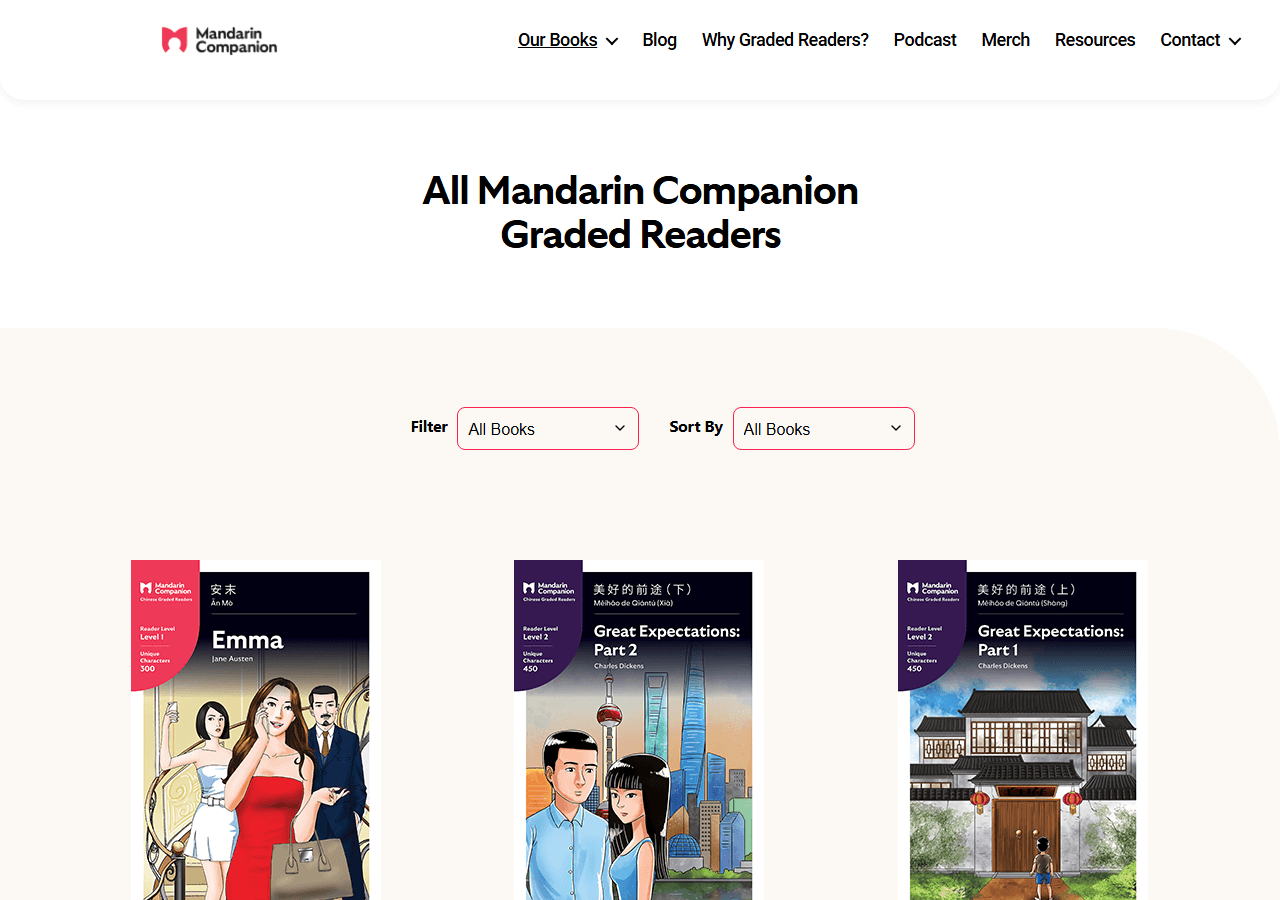
Then they publish them at strict character counts. Breakthrough level uses 150 unique characters.
Level 1 uses 300. Level 2 uses 450.
That discipline is the whole product: the story can only use those characters, so if you’re at that level, you can actually read the thing cover to cover.
Here’s the part that matters for this article: they make Traditional editions. Real ones, in both ebook and paperback, for the series.
Not a font swap on a pirate PDF, actual SKUs you can order, and the paperback we ordered arrived looking like a proper little book, cover, nice paper, the works. There’s a full list of Traditional character editions available in paperback on their site, and my strong advice is that you open that page or the individual product page every single time before you buy, because Traditional availability varies by title.
I’m serious about the SKU-checking. At the time at least one reviewer was writing about this, at least one Breakthrough-level title had no Traditional edition.
And there’s a deeper trap for the inattentive shopper: the story being available in Simplified means nothing. If you search “Mandandan Companion Level 1” on a marketplace and buy the first result, there’s a real chance you get the Simplified paperback, and you’ll be halfway through chapter one before you notice your 書 has turned into 书.
This is the single most common Traditional-learner mistake with this publisher, and I nearly made it myself, hovering over a cart button before going back to the product page and confirming the edition.
Okay, the reading experience. I read a Level 1 Traditional title, the 300-character one, over about nine evenings.
The story is a Western plot reset in China, which I expected to find gimmicky and mostly didn’t. Knowing the plot arc in advance is actually a feature at this level: when every sentence costs you something, having a rough map of where the story goes reduces cognitive load, and the writers use the China reset to justify vocabulary that’s actually useful for daily life, apartments, errands, awkward conversations with neighbors.
The character-count discipline is real. I checked, in the paranoid way I do, and the level held.
That 95 percent+ zone I mentioned? I hit it comfortably once I was at the right level for me.
Unknown words were mostly names and a handful of verbs I could guess from context. There’s a glossary, and honestly the glossary was less important than I expected, which is the sign of a graded reader doing its job: comprehension from context should be doing the heavy lifting, with the glossary as a safety net rather than a crutch.
Two honest complaints. First: no Level 3.
Level 2 at 450 characters is as high as the ladder goes, and then there’s just a cliff. If you start at Breakthrough, you can climb to L2 and then the series is done, and you’re back out into the wilderness of native content with no bridge.
Second: these are China stories. Well-made China stories, but the world of the books is Mainland, so the vocabulary skews toward that world.
Reading it in Traditional characters is great character practice, genuinely, my Traditional recognition got noticeably faster over two weeks. But if your goal is Taiwan specifically, the cultural content isn’t doing you any extra favors.
That friend’s book was doing favors. Let’s talk about that.
Abby / Talk Taiwanese Mandarin
If Mandarin Companion is the famous option, Talk Taiwanese Mandarin, run by Abby, is the one almost nobody mentions. I read a bunch of “best graded readers” ranking posts while prepping for this article, and her books barely show up anywhere, which is a shame, because after two weeks I can say these are the most Taiwan thing on the Traditional graded shelf.
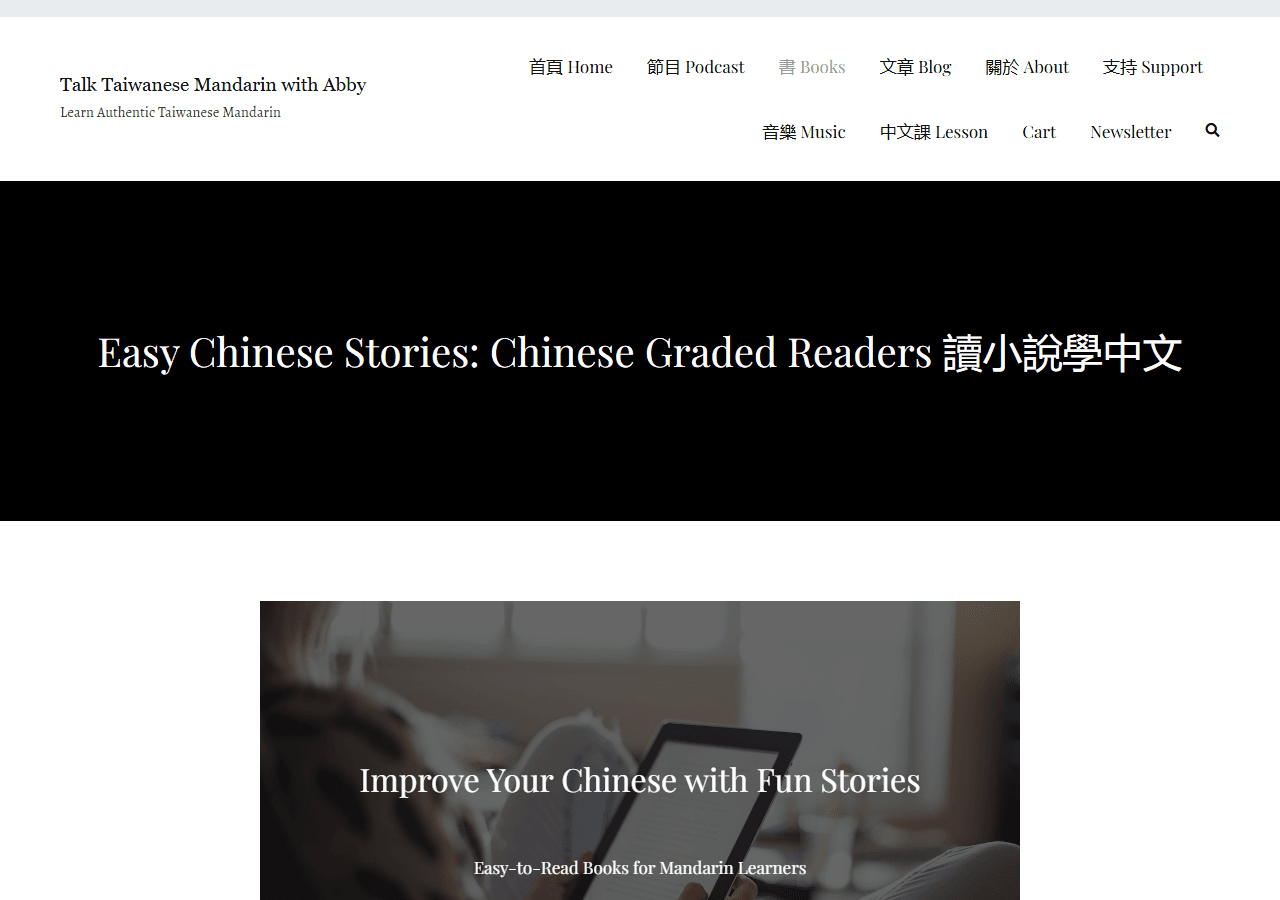
Let me describe what we’re talking about, because you’ve probably never seen these. Abby’s Easy Chinese Stories are short story collections, actual Taiwan culture in Traditional characters.
The Level 1 book is built on 300 unique characters, same count as Mandarin Companion’s L1, and the flagship story is 虎姑婆, the Tiger Auntie folk tale, which is basically Taiwan’s grandmother-tells-you-this-so-you-behave story. If you grew up with any Taiwanese family connection, or you’ve spent time there, these stories land differently than a Sherlock Holmes reset.
That friend read the 虎姑婆 story first and came away delighted in a way I didn’t see from them with any other material in these two weeks. They kept reading bits aloud to me.
“It’s the actual folklore,” they said, “not folklore-flavored.”
That’s the pitch in one line: it’s the gap filler. The Traditional-native, Taiwan-content, folk-story tier that the big publishers have left empty.
There are stories about night markets, ghosts, grandmothers, the texture of the place, written for learners instead of adapted from a Mainland series.
The caveats are real, though, and I’ll give them to you straight because I respect this book too much to oversell it.
The catalog is tiny. Level 1 exists, a 300-character book, and there isn’t much beyond it.
Where Mandarin Companion’s problem is the missing Level 3, Abby’s problem is the missing everything-else. You get your few stories, they’re good, and then you’re done and looking for the next thing, and the next thing at this level in Traditional-native Taiwan content basically isn’t there.
She may publish more, and I hope she does, but you’re buying into a small catalog with a hopeful future, not a ladder.
The production values are learner-functional rather than beautiful. That’s fine, to be clear.
I’d rather have a plain book with real Taiwan stories than a gorgeous book about taking the subway in Shanghai, and the grading itself is done with care, the 300-character discipline is real. But if you’re expecting Mandarin Companion’s shelf polish, adjust expectations.
This feels like what it is: a dedicated teacher making books for the students she actually has.
And the discoverability problem is self-reinforcing. Because ranking blogs almost never name her, new learners don’t find the books, and because nobody finds them, nobody reviews them.
Consider this my small push against that loop. If you’re learning Traditional for Taiwan reasons, buy the 虎姑婆 book.
It’s the only thing on this list that friend finished and immediately wanted more of.
How the two books split between us was interesting, though. I read Mandarin Companion; they read Abby; and by week two we’d each sampled the other’s.
My take on Abby: slightly harder at the same 300-character count, because folk-tale vocabulary has words a reset Western plot doesn’t need. Their take on Mandarin Companion: comfortable and well-made but “it’s China.”
Both true. Which one is better depends entirely on why you’re learning Traditional characters in the first place.
Du Chinese toggle vs a book
Then there’s Du Chinese, which is the app every Reddit thread recommends when someone asks about Traditional reading, and I used it daily for two weeks, so I have thoughts.
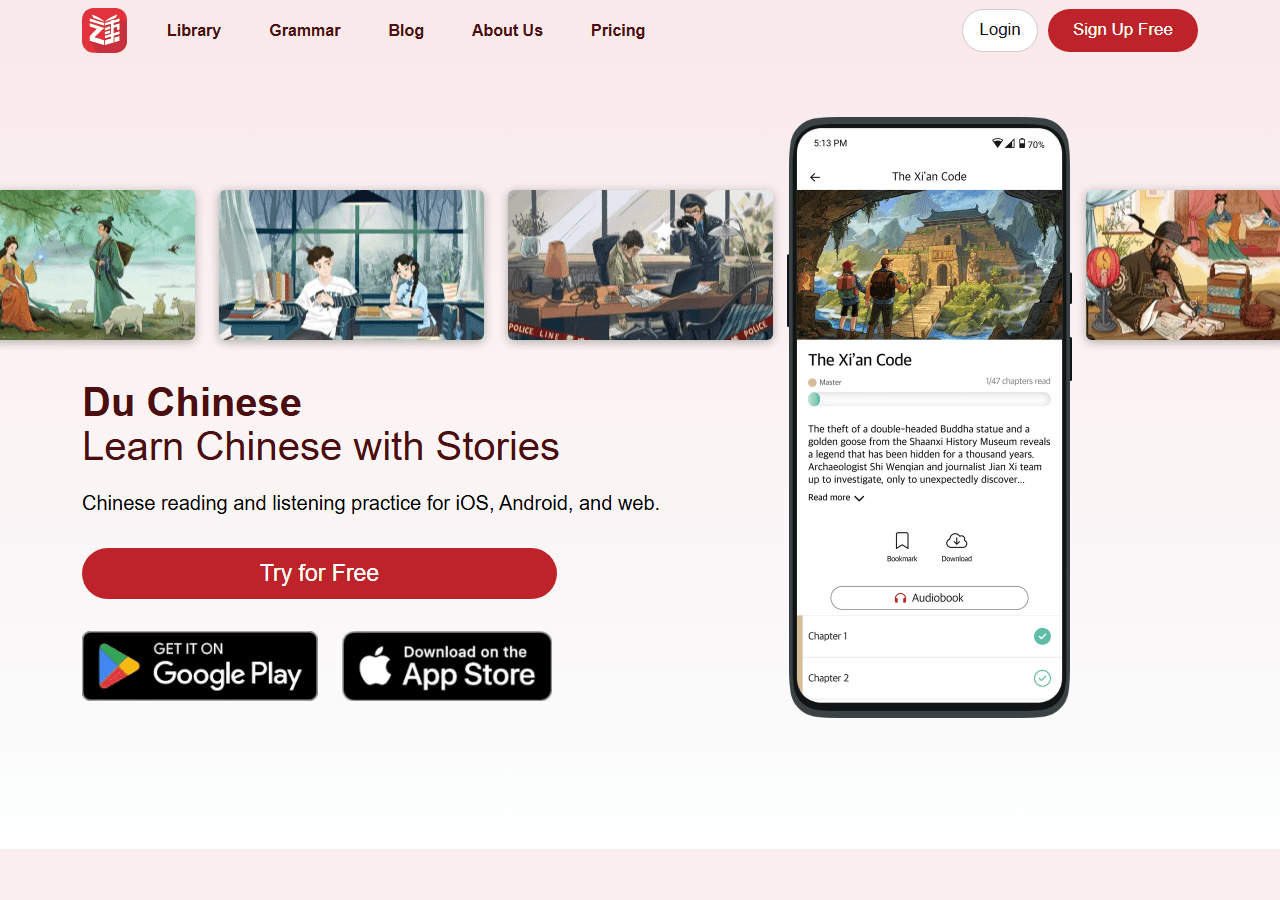
First, the mechanics. Du Chinese is a subscription app with a big library of short lessons: a text of a few hundred characters, line by line, with tap-to-reveal definitions, audio, and a toggle in settings that switches character display to Traditional.
Flip that toggle and the entire app renders in Traditional. It works, it’s genuinely convenient, and if you’ve read any r/ChineseLanguage thread on this topic, Du Chinese with the toggle is the community’s default answer, for reasons that made sense to me by day three: it’s the biggest readable library you can point at a Traditional learner today.
But I want to make a distinction that took me the full two weeks to articulate, and it’s this: Du Chinese is not graded books. It’s graded lessons.
Each piece is short, a few minutes of reading, designed to be consumed as one unit, complete with a little quiz at the end. You read a lesson about ordering coffee or a dialogue about renting an apartment, and you’re done.
There’s no plot carrying across a hundred pages, no chapter-end pull, no “I need to know what happens to this character.”
That matters more than I expected. The kitchen table experiment worked, I’m convinced, because of the book-shaped things.
Sitting down with a story that continues from last night created a pull that a lesson list never did. With Du Chinese, I read competently and consistently, but it always felt like studying.
Nice studying, low-friction studying, studying I’d actually do in a waiting room, but studying. With the paperbacks, some nights we kept reading past the point of good sense because the story was going somewhere.
That’s the difference between a reading habit and a lesson habit, and the research people cite about extensive reading is really about the first thing.
Second issue: the vocabulary framing. Even with the Traditional toggle on, the content is written for a Mainland audience and graded against HSK.
So you’re reading Traditional characters, good, but the word choices, the pinyin defaults, the cultural framing, all lean Mainland. The characters are Taiwan’s; the language underneath often isn’t.
It’s exactly the same conversion problem I described with converted books, just in app form. For character-recognition practice in Traditional, it’s excellent.
For Taiwan-specific vocabulary and framing, it’s neutral at best.
Third, and this is just honest: it’s a subscription. The books we bought are ours.
The Du Chinese library is rented, and if you stop paying, your reading habit stops with it. I’m not anti-subscription, I recommend plenty of apps elsewhere on this site.
But when the alternative is owning a physical book you’ll keep forever, the subscription math feels different for a reading habit specifically. Books don’t lapse.
So here’s where I landed after two weeks of using all three: Du Chinese with the Traditional toggle is the best supplement on this list and the worst main method. It fills the gaps between books.
It gives you something to read on the bus. Its library is deep enough that you can find short content at almost any level, which matters enormously when, as established, the Traditional book shelf is thin.
Used that way, as the thing that keeps you reading on the days the book stays on the shelf, it earned its subscription fee for me and I kept it.
But if I had to hand a new Traditional learner one item from this article, it wouldn’t be the app. It would be a paperback, with the Traditional SKU confirmed twice, and a bookmark.
The app gets you reading. The book makes you a reader.
I didn’t expect to come out of this experiment sounding like my grandmother, a woman who distrusted screens on principle, but two weeks at a kitchen table will do things to you.
News apps, Journey to the West, and what's Simplified-only

The Chairman’s Bao offers a Traditional toggle over at their site, and I want to be fair to it, because it’s a real option. It’s just not a graded reader in the sense this article is about.
It’s news. Graded news, sure, with difficulty bands and vocab glosses and all that, but reading a 300-word article about a panda born at the Taipei Zoo is a completely different activity from reading a 40-page novella where a character you’ve spent three chapters with finally gets what’s coming to them.
News is episodic. Novellas compound.
With a novella, by page 20 you’re not looking things up anymore because you already know who’s who and what they want. With news, every article is a cold start.
Both are useful, but if you’re trying to build reading stamina in Traditional, the novella is the thing. The Chairman’s Bao is a supplement, not the main course.
Then there’s Imagin8’s Journey to the West. This one deserves its own paragraph because it’s genuinely impressive: the full saga, graded, with a Traditional track.
Sun Wukong causing problems, chapter after chapter, at reading levels that don’t require you to already be a scholar. And here’s my honest take after flipping through enough of it to form an opinion: it’s great, and I’d still tell most beginners not to start there.
It’s long. It’s a saga.
The vocabulary you need includes a lot of monks, demons, celestial bureaucracy, and monkey business that doesn’t exactly transfer to reading a menu in Taichung. If you’ve already read a few level 1 books and you want a project, a big sweeping project that will take months, Journey to the West Traditional is honestly a beautiful thing to commit to.
But it’s not a first book, and treating it like one is how people quit. Buy it after you’ve finished two or three shorter things, not before.
Now the warnings, because this section earns its keep.
Sinolingua Graded Chinese Reader: Simplified-only. You’ll see these recommended all over the place in “best graded readers” lists, and half those lists never mention the character issue. The Sinolingua print readers, the ones with the yellow-and-red covers, are Simplified.
There is no Traditional SKU hiding behind the paperback listing. If a blogger recommends them for Traditional learners without a caveat, close the tab, because they either didn’t check or didn’t care.
Either way, the rest of the list is suspect.
“Same story, different characters” is not the same book. This is the trap I fell into myself, so I get it. You read The Little Prince in Simplified last year, you see the Mandarin Companion Breakthrough version, and your brain goes “I know this story, it’ll be easy.”
Except 帮 doesn’t look like 幫, and 后 doesn’t look like 後, and your reading speed drops by half while your eyes relearn everything. It’s not starting from zero, but it’s also not a freebie.
If a title only exists in Simplified, it’s not a Traditional graded reader, period. That’s why this article isn’t just a copy of every “best Chinese graded readers” list with a disclaimer stapled on.
And the big one, the structural truth: there is no honest TOCFL-graded fiction ladder. Simplified learners get entire bookshelves of HSK-graded novels, comedy, romance, mystery, whole series stacked into a nice staircase from beginner to comfortable reader. Traditional learners get a shelf, singular, with gaps between the rungs.
You can absolutely climb it. You’ll just occasionally be stuck between “I’ve finished this level” and “the next thing is a bit of a jump.”
That’s not a reason to give up on reading in Traditional. It’s a reason to plan around it, which is what the next section is for.
How to pick a level
Here’s the single most useful thing I can tell you, and it’s not a character count.
Stay between 95 and 98 percent known words. That’s the zone where you’re reading, actually reading, and the unknown words arrive slowly enough that you can either guess them from context or look up two or three per page without it turning into a vocab drill.
Above 98 percent and the book is too easy, which is fine for a lazy Sunday but won’t move you. Below 95 and you’re not reading anymore, you’re decoding, and decoding is exhausting and doesn’t build fluency.
I hit that wall with one of the Du Chinese lessons mid-way through our two weeks, where I counted eleven unknown words in a single paragraph and just closed the app out of spite.
How do you know you’re in the zone? Sample a page. Actually sample it.
Most sellers give you a preview, and Du Chinese gives you free lessons. Read one full page, cold, no dictionary.
Tick off every word you don’t know. If you’re ticking two or three words, buy the book.
If you’re ticking ten, drop a level. It takes ninety seconds and it’s more accurate than any label on any cover.
Because here’s the thing about character counts: they’re a starting point, not a TOCFL score. Mandarin Companion Level 1 is 300 unique characters, and Talk Taiwanese Mandarin Level 1 is also 300 unique characters, and those two “300s” are not the same experience.
Different words made from the same characters, different grammar patterns showing up, different densities of proper nouns. The count on the back of the book tells you roughly how big the toolbox is.
It does not tell you whether the author is mean with it or generous. Only the sample page tells you that.
So my process, which I recommend stealing:
1. Pick the level that matches where you think you are. 2. Sample a page honestly, no dictionary, no charity. 3. If you’re between 95 and 98 percent known, start reading. 4. If not, adjust. Up or down. There’s no prize for struggling.
One more note for the paper books specifically: the Traditional SKUs have less inventory everywhere, so if you’re buying physical copies, buy the whole level you think you’ll want in one order. Waiting two weeks between book one and book two kills momentum, and momentum is most of what a graded reader has going for it.
What I liked, and what wore me down
What I liked
The good stuff first, and it’s genuinely good.
Reading in Traditional finally felt normal. This is the whole point and it actually worked. Around day four or five, something clicked where 說 stopped looking like a stranger and started looking like the word I already knew.
My brain had been keeping Traditional in a separate mental drawer, and two weeks of daily reading pulled it into the main one. That’s not nothing.
That’s the actual outcome I wanted going in.
The Taiwan-flavoured content was the highlight. The Abby books especially. Reading about night markets and grandmothers and the general texture of Taiwanese life, in the characters Taiwan actually uses, felt coherent in a way that reading a Western novel reset in Chengdu does not.
If your reason for learning Traditional is Taiwan, this content is doing double duty: reading practice and cultural calibration at the same time.
Paper beat the screen for retention, for me. The Mandarin Companion paperback was my favourite object of the whole experiment. Something about pages and no notifications and no toggle.
Your mileage may vary, I know people who love reading on their phone and I’m not going to pretend my preference is a law of nature.
What wore me down
Now the wearing-down part.
The gaps between levels are real. I mentioned the missing ladder above, and living it is more annoying than reading about it. Finishing a 300-character book and looking around for the next step in Traditional, the answer is “well, there’s 450,” and 450 is a bigger jump than the numbers suggest, because unique characters don’t scale linearly with comfort.
Looking things up in a paperback is slow. Beautiful object, no built-in dictionary. I did the finger-in-the-page, grab-the-phone, look it up, put the phone down, forget why I picked up the phone routine more times than I can count.
It’s a minor tax, but it’s a tax on every unknown word, and it adds up over a session.
Two weeks is not long enough to say anything about the long term. I can tell you what the first two weeks are like. They’re good!
But I can’t tell you whether the Mandarin Companion Traditional series holds up as a complete path, because it ends, and what’s after it is thinner than what my Simplified-reading friends have waiting for them. That’s just the honest shape of the thing.
Who this is for / who should skip
This is for you if you’re learning Traditional because of Taiwan, or Hong Kong-adjacent reading goals, or pure preference, and you’re past the “learning the characters” stage and into the “using the characters” stage. If you’ve got a few hundred characters down and you’re tired of flashcards and you want the feeling of reading something real, a graded reader is the cheapest, most direct route to that feeling, and the Traditional shelf, thin as it is, has enough to get you started.
It’s also for you if you’re the type who finds one good book and rereads it. In a thin market, rereaders win, because you can squeeze a 300-character book three or four times and still be in that 95–98 percent zone on pass two.
Skip it if you’re brand new and still confusing 個 with 各. Reading before you have a base just produces frustration; do lessons first, build a couple hundred characters, then come back.
Also skip the paper books specifically if you can’t tolerate a slow lookup, and go straight to Du Chinese with the Traditional toggle, because a tap-to-define will save your sanity. And honestly, skip the whole category if your goal is Simplified fluency and you were only considering Traditional out of guilt or curiosity.
The Simplified shelf is ten times deeper. If Simplified is your actual destination, read Simplified.
Life’s short.
There’s also a middle case worth naming: you already read Simplified comfortably and you’re adding Traditional. That was closest to my situation, and the graded-reader method works well for it, but go in expecting the first week to feel worse than your Simplified reading, not better.
The knowledge transfers; the visual recognition doesn’t, not instantly.
Pros and cons
Pros
- Reading is the fastest way I know to make characters feel like language instead of wallpaper
- Mandarin Companion Traditional exists in both ebook and paperback, and a real book in your hands is a genuine motivator
- The Abby/Talk Taiwanese Mandarin books give you actual Taiwan content in the actual Taiwan script
- Du Chinese gives you a Traditional toggle with a tap-to-define dictionary, which is the gentlest possible on-ramp
- The whole method is cheap relative to almost anything else in language learning
- Works for Simplified readers converting over, which is a surprisingly common situation
Cons
- The Traditional shelf is a fraction of the Simplified shelf, and no one in publishing seems to be in a hurry to fix that
- No L3 from Mandarin Companion means the ladder has a hard stop
- No honest TOCFL-graded fiction ladder, so level jumps between books are uneven
- Character counts on covers are a rough guide at best; you have to sample pages yourself
- Some vocab in Du Chinese still reads as HSK/Mainland-framed even when the display is Traditional
- Ranking blogs almost never mention the Abby books, so you have to go looking for the one publisher that actually writes about Taiwan
- A certain unnamed series of yellow-and-red Sinolingua readers will be recommended to you constantly, and they’re Simplified-only, and that’s annoying
What we'd use with it
A graded reader shouldn’t be your only tool, mostly because it can’t be. Here’s the stack that made sense after two weeks.
For characters themselves, Yak Cards are what I’d pair with the reading, because every unknown word you meet in a book becomes a card, and reading gives you the context that makes the card stick. The loop is: meet the word in the story, card it, see it again three pages later and actually recognize it.
That second moment is the entire payoff of the method.
For apps, Du Chinese itself is the natural companion to the paper books: short lessons for weekday commutes, paper novellas for weekend sessions. And if you’re still in the phonics-and-foundations stage in any language, our English lessons run 139 lessons from the very beginning, starting at Lesson 1, built on the same belief that structured early reps beat random exposure.
For honest app assessments, including which gamified owls I’d never recommend for Chinese, the reviews section and the Duolingo review are there, plus the best language learning apps roundup and our general how to learn a language guide for the bigger picture of where reading fits in a full routine.
If you want more graded reading options beyond the ones I lived with, the Graded Chinese Readers catalog indexes a huge number of series, just triple-check the character set before you buy anything, because the Simplified assumption runs deep in that catalog too.
What others are saying
Zhong Chinese covers the Traditional graded reader space and is worth a read for a second opinion on which series exist, though I’d apply the usual caution about whether every recommendation has a Traditional SKU behind it.
And for unfiltered user experience, the r/ChineseLanguage thread on graded readers with Traditional characters and this Language Learning Stack Exchange question are where the Du Chinese toggle got its reputation as the default answer. People just want to read, and the app with the toggle wins by default when the print shelf is thin.
FAQ
Prices, plan names, and features below are as of September 2026.
Do Traditional graded readers exist at all?
Yes, but fewer than you’d hope. Mandarin Companion publishes Traditional editions in both ebook and paperback, Talk Taiwanese Mandarin has a small Traditional catalog, and apps like Du Chinese and The Chairman’s Bao have Traditional display toggles.
What doesn’t exist is a deep, continuous fiction ladder like Simplified readers get. You’ll find good books; you won’t find a full staircase.
Are Mandarin Companion books available in Traditional characters?
Yes, for the series, in both formats. Breakthrough is 150 unique characters, Level 1 is 300, Level 2 is 450.
There’s no Level 3 in Traditional, and at least one Breakthrough title was missing a Traditional edition at one point, so always check the individual product page for the Traditional SKU before ordering.
The Simplified listing sitting next to it is not the same book.
Can I just read the Simplified edition if the story is the same?
You can, but you’re not getting Traditional reading practice, and your eyes won’t get the reps they need. Same story, different script, different training.
If your goal is Traditional, read Traditional, even if it means a thinner selection and the occasional level gap.
Is Du Chinese a good replacement for a paper graded reader?
It’s a good companion, not a full replacement. The Traditional toggle works well, the tap-to-define dictionary is lovely, and it’s what most of Reddit recommends for a reason.
But the lessons are short and newsy-ish rather than being long-form stories, and the vocab can still feel HSK/Mainland-framed even in Traditional display. Use both if you can.
What level should I start at?
Whichever one passes the sample-page test. Read a page cold, count unknown words.
Two or three unknown words per page means buy it. Ten means drop a level.
The character count on the cover is a rough guide, not a promise, and the same count from two different publishers can feel completely different.
Is there a TOCFL-graded fiction series?
Not really, and that’s the structural gap. TOCFL levels exist as a test framework, but nobody has built the kind of TOCFL-graded novel shelf that mirrors the HSK-graded Simplified shelves.
Publishers grade by unique character count instead, which is related but not the same thing. Sample pages remain your best defence.
Is Sinolingua Graded Chinese Reader okay for Traditional?
No. It’s Simplified-only. It gets recommended constantly in general graded reader lists, often without the caveat, so if you see it in a Traditional round-up, treat the rest of that list with suspicion.
After two weeks
So, where did two weeks at the kitchen table actually leave me?
Reading Traditional got easier. Noticeably, measurably easier.
Words that used to require a half-second of decoding now arrive as words. That happened in two weeks with maybe forty minutes a day, which is not a heroic time commitment, it’s just consistency plus material at the right level.
The method works. That part isn’t in question.
The shelf is the problem, and it’s a manageable one if you go in knowing the shape of it. Mandarin Companion Traditional, checked SKU by SKU.
The Abby books for the Taiwan soul. Du Chinese with the toggle for daily volume.
Something long like Journey to the West waiting in the wings for when you’re ready for a project, and nothing from the Simplified-only shelf, no matter how often a blog tells you the story is the same.
The score is what I said at the top and I’ll stand behind it: as a method, graded reading in Traditional is a 7 out of 10. The method itself deserves more; the market around it drags it down.
You’re doing the best version of reading practice that exists, with a thinner catalogue and a missing rung or two in the ladder. If you pick the right SKUs and sample your pages, it’s absolutely worth your time and money.
If you go in expecting the Simplified experience with different strokes, you’ll be disappointed.
7 out of 10 Yaks