



I’ve been staring at the same stack of thin paperbacks on my kitchen table for two weeks now, and I have some thoughts. A friend thinks I’ve lost it a bit.
There I am, morning coffee going cold, running my finger under lines of Simplified Chinese characters like some kind of detective who forgot he doesn’t read Chinese. Except, well, now I kind of do.
A little. At a very controlled vocabulary level, which is exactly the point.
So here’s what happened. I decided to spend two weeks actually reading Simplified Chinese graded readers instead of just knowing about them, which is what I’d been doing for the better part of a year.
I know, I know. Everyone with a blog and a copy of Anki has opinions about graded readers.
But there’s a difference between having opinions about a treadmill and actually running on it, and I wanted to close that gap at least once so I could talk about these things honestly.
The short version: graded readers for Simplified Chinese are genuinely good, and the shelf is deeper than I expected. This isn’t like some languages where you get one skinny reader, one out-of-print thing from 1997, and then nothing until native novels.
Chinese has real options at multiple levels, from multiple publishers, in print and in apps. The long version is the rest of this piece, because “the shelf is deep” doesn’t help you figure out what to actually buy.
What I read, specifically: a Mandarin Companion Breakthrough level book (the one we actually finished, more on that in a bit), a Chinese Breeze Level 1, and a bunch of newbie-level stories in Du Chinese on my phone. I read them at the kitchen table, mostly mornings and the odd evening, sometimes with tea, sometimes with the cat eyeing me like I owe him something.
No lab coats were involved. This is one guy in Ontario with two weeks of kitchen-table evidence and a decent memory for what frustrated him.
Why reading, though? Because I’d hit that wall every Chinese learner knows.
You finish your app streaks, you’ve got a few hundred characters vaguely in your head, and then someone hands you an actual Chinese text and your brain just slides off it. Flashcards teach you words.
Reading teaches you to read, which is a different muscle and one that, in my experience, apps like Duolingo don’t really train. I wrote about that in my Duolingo review, and it keeps being true: you can streak your way to a number and still not be able to read a paragraph.
So I went looking for the bridge between “I know 300 characters” and “I can read a book,” and graded readers are that bridge. Two weeks in, I’m convinced.
Not convinced they’re magic, I’ll get into the stuff that wore me down later, but convinced enough that they’ve earned a permanent spot in my routine.
The method itself gets a strong score from me. It’s cheap or free depending on what you pick, it scales, and it works.
8 out of 10 Yaks



Now let me actually earn that.
What a graded reader is (and the 95% rule)
If you’ve never used one, a graded reader is a book written deliberately within a limited vocabulary. The publisher picks a word count, say 300 unique characters, and writes an entire story using only those characters (plus, usually, a small number of proper nouns for names).
The result is a book you can actually finish at a stage when every real Chinese book would bury you.
This is different from a textbook, which teaches and drills. A graded reader doesn’t teach you much that’s new.
Its job is to give you massive exposure to stuff you mostly already know, so that recognition turns into fluency of reading. You know how you can “know” a word on a flashcard but stumble on it in a sentence?
Reading a lot of sentences fixes that. Slowly.
Annoyingly. But it fixes it.
The one rule that matters more than any publisher or brand: stay in the 95 to 98 percent known-words range. If you know roughly 95 out of every 100 words on the page, you can read smoothly, guess the rest from context, and actually enjoy yourself. If you’re down at 85 or 90 percent, you’re not reading anymore, you’re decoding, and it’s exhausting.
I did a session like that on purpose with a book above my level and I lasted about twenty minutes before I wanted to do anything else. Anything.
The flip side: if you’re at 99 or 100 percent known words, the book is too easy and you’re not learning much. Comfortable, but spinning your wheels.
The sweet spot is that band where you’re cruising with the occasional speed bump.
Here’s the practical move, and I did this with every book before committing: sample a page before you buy or commit. Pick a random page from the middle of the book, not the first page, because openings are easy everywhere. Read it.
Count how many words you genuinely don’t know. More than a handful of unknowns per line and you should drop a level.
Almost none across the whole page and you should go up one.
The character and word counts publishers put on their covers, things like “150 unique characters” or “300-word level,” are useful starting points, but that’s all they are. Starting points.
Two books at “the same level” can feel completely different depending on how densely they pack those words and how much they repeat. Your own sampling beats the label on the back every time.
One more thing worth saying: character counts and word counts aren’t the same thing. A book with 300 unique characters contains way more than 300 unique words, because characters combine.
Publishers are a bit loose about which number they’re advertising, which is another reason the sample-a-page test exists. Trust the page, not the label.
How we read for two weeks
The setup was simple on purpose. Kitchen table, mornings before the day got going, about thirty to forty-five minutes a session.

Sometimes a second shorter session in the evening when the cat wasn’t sitting on the book. I kept a little notebook for characters that kept tripping me, but I wasn’t allowed to stop and make flashcards mid-read, that was the rule I set for myself, because the whole point was volume and flow, not perfection.
I picked three things to cover the main formats:
- A Mandarin Companion Breakthrough book, print, 150 unique characters, their original mystery line
- A Chinese Breeze Level 1, print, 300 controlled words, a little longer
- Du Chinese newbie stories on my phone, for the app side of the comparison
I wanted one book that was almost certainly too easy, one that was in the sweet spot, and an app to see whether phone reading even counts as reading. (Spoiler from two weeks out: it counts, but it’s a different animal.
I’ll get there.)
The Breakthrough book is the one we finished. “We” is generous, a friend read along for a few evenings and then drifted back to their own books, but for a stretch there it was a two-person book club with a 150-character vocabulary ceiling, and honestly, it was kind of great.
The book took me maybe four sittings. That’s the entire pitch of graded readers in one sentence: I finished a book in Chinese.
Not a chapter. A book.
Cover to cover. There’s a jolt of “oh, this is possible” that comes with that which no amount of app XP has ever produced for me.
The Chinese Breeze book went slower, because it’s longer and sits right at the edge of my comfort zone, which is where it should be. The Du Chinese stories filled gaps: waiting rooms, the couch, one regrettable attempt while walking that ended with me nearly collecting a mailbox with my hip.
What surprised me most across the two weeks is how fast the “reading is exhausting” feeling fades. The first three days were rough, my eyes kept wanting to phonetically sound everything out like a kid with pinyin training wheels.
By the end of week one I was recognizing chunks, 词 groups, as shapes rather than assembled parts. By week two I’d stopped translating in my head for the easy book entirely.
I don’t want to oversell two weeks, but the slope of improvement was steeper than I expected, and I say that as someone who’s been around the language-learning block enough times to be cynical about steep claims.
Mandarin Companion (and the missing Level 3)

Let’s talk about the one that gets recommended most, because it gets recommended most for a reason.
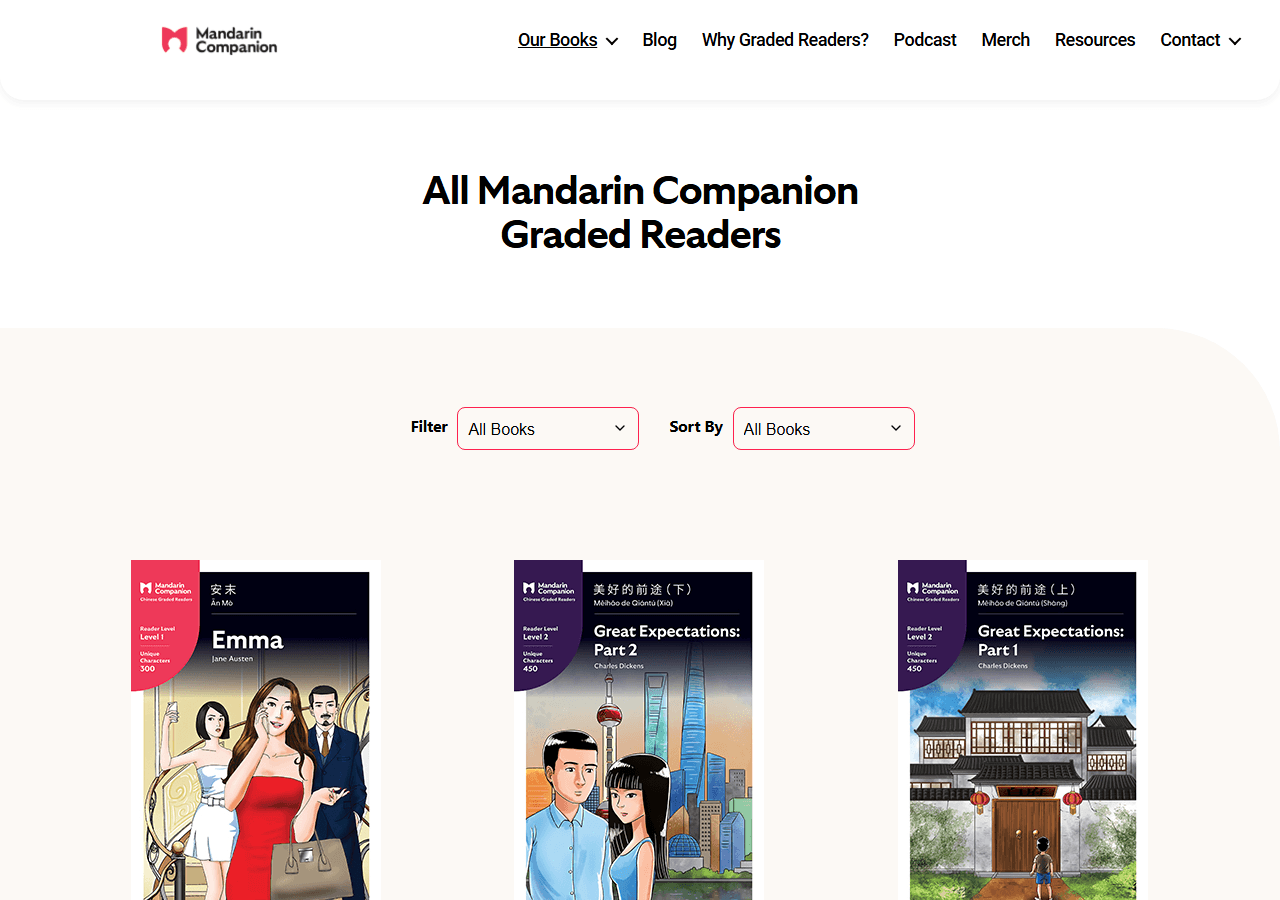
Mandarin Companion is the American-run series that basically set the modern standard for Chinese graded readers. Their gimmick, and I mean that affectionately, is taking Western classics and resetting them in China with Chinese characters.
The Sixty-Year Dream is Dream of the Red Chamber-adjacent. The Monkey King is, well, obvious.
Their Breakthrough line also has original mystery stories at the 150-character level, which is what I read, and those exist because classic public-domain plots are hard to pull off at 150 characters.
The levels work like this:
- Breakthrough: 150 unique characters. Very short books, heavily recycled vocabulary. Where I started, and where you should too if you’re post-HSK 1-ish.
- Level 1: 300 unique characters. The classic adaptations live here.
- Level 2: 450 unique characters. Longer, more plot.
- Level 3: doesn’t exist. As of July 2026, Mandarin Companion has not published a Level 3. There is no Level 3. If you see someone online recommending “Mandarin Companion Level 3,” they’re either predicting the future or copying an old wishlist. The ceiling is Level 2.
That missing Level 3 matters for planning. If you start with Mandarin Companion and love them, and you probably will, you’ll eventually outgrow the series and need to jump to something else.
It’s a great ladder with a missing top rung. More on where you jump when we get to Sinolingua and Chinese Breeze.
Design-wise, one detail I want to flag because it’s genuinely good pedagogy: the footnotes. Mandarin Companion does not put pinyin over every line.
Instead, key words get a footnote at the bottom of the page with pinyin and English. That’s it.
This sounds small and it is not. Pinyin over every line is a crutch your eye uses whether you want it to or not, I’ve caught myself reading the pinyin and barely seeing the characters.
Footnotes force you to read the characters and only drop down when you’re actually stuck. It’s the difference between training wheels and a hand on the back of the seat.
And the plot quality. This is where Mandarin Companion earns its reputation as the gold standard, and I want to be clear that I’m not saying that as marketing shorthand.
Most graded readers read like they were written to hit a vocabulary list, because they were. The Breakthrough mystery I read had an actual plot with actual stakes, an old man with a missing something and a grudge and a reveal that, okay, wouldn’t survive contact with a real crime novel, but which worked at my reading level.
I wanted to know what happened. That’s the whole ballgame.
Finishing a book is easy when you want to know what happens next. It’s impossible when you don’t.
One honest caveat: Mandarin Companion books are not aligned to the HSK lists. Their levels are their own system, 150/300/450. In practice, Breakthrough sits roughly around HSK 1–2 territory and Level 1 around HSK 2–3, but they didn’t build the books from the HSK vocabulary, so don’t expect clean correspondence.
If you’re the type who wants a reader that maps exactly onto “I just passed HSK 2, give me the HSK 2 book,” this series will frustrate your filing system. If you just want good books at a sane difficulty curve, it won’t bother you at all.
Price-wise they’re not cheap per book, they’re proper little paperbacks with nice covers, and the page count per dollar is lower than Chinese Breeze. You’re paying for the writing quality, and after two weeks I think that’s a fair trade, but I’d be lying if I said I didn’t wince a bit at checkout.
Buy one Breakthrough first and see if the format clicks for you before buying the set.
Chinese Breeze
If Mandarin Companion is the boutique option, Chinese Breeze is the volume play, and I mean that as a compliment.
Chinese Breeze (汉语风) is a series out of Beijing that’s been around long enough that a lot of university Chinese programs just… have shelves of it. It’s Simplified only, which is fine for this article since that’s what we’re doing here, but worth knowing if you’re eyeing Traditional materials, which is a whole separate conversation I’m deliberately not having in this piece.
The level structure is the cleanest in the business:
- Level 1: 300 controlled words
- Level 2: 500 controlled words
- Level 3: 750 controlled words
- Level 4: 1,100 controlled words
Four levels, published. Now, you will find older marketing material floating around, some of it still on retail listings, claiming Chinese Breeze has 8 levels going up to 4,500 words.
I want to be gentle but firm about this: that’s overclaiming. The published series you can actually buy is the four levels above.
Don’t plan a multi-year reading program around levels 5 through 8, because you’ll be waiting a long time. I checked.
The waiting is the problem.
What the four real levels get you is range. This is Chinese Breeze’s genuine advantage over Mandarin Companion: the ladder goes higher.
Where Mandarin Companion stops at 450 characters, Chinese Breeze keeps climbing to 1,100 controlled words, which is getting you into genuinely intermediate territory, comfortably past HSK 3 and into HSK 4-ish reading. If you’re planning a reading habit that lasts more than a year, Chinese Breeze is the series that grows with you further.
The books themselves are leaner than Mandarin Companion’s. The writing is more functional.
My Level 1 book had a decent little plot, I won’t pretend it was literature, but it moved, and the vocabulary recycling was aggressive in the good way, you meet the core words of the book so many times that by the halfway point they’re yours. The genre spread across the series is decent: mysteries, romances, some stories with a wuxia flavour at the higher levels, etc. Nothing I’d describe as a page-turner for its own sake, but plenty readable.
One genuinely nice thing about the current second edition: each book has a QR code for MP3 audio. Scan it, get the recordings, listen while following the text or review on a walk. The recordings aren’t glamorous, but audio bundled with a reader is a big deal, because listening and reading the same story doubles the exposure and fixes pronunciation issues you didn’t know you had.
I ended up doing one full listen-through of my Breeze book after finishing it and caught myself misreading a couple of characters the whole time. Humbling.
Useful.
A practical note on buying: the old official site, chinesebreeze.net, 500’d on me when I checked during this pass. Dead or dying.
So you’ll likely be buying through retailers or the HSK Story guide linked above, which tracks the levels and where to get them. The series has been through multiple editions at this point, so if you’re buying second-hand or from a marketplace seller, double-check you’re getting the edition you expect.
The second edition with the QR audio is the one you want.
How does it feel against Mandarin Companion head to head? After two weeks with both: Mandarin Companion writes better books.
Chinese Breeze gives you more ladder. At the low end, I’d give the edge to Mandarin Companion, the Breakthrough mysteries are just more fun than anything at Breeze Level 1 that I read.
From about Level 2 up, Chinese Breeze is carrying more of the load simply because Mandarin Companion tapped out at 450 characters. If I were building a shelf from scratch: one or two Mandarin Companion books to get hooked, then Chinese Breeze for the climb.
The price is the other argument for Breeze. Per book it’s noticeably cheaper than Mandarin Companion, and the books, while shorter on charm, are longer on content relative to cost.
If you’re a “buy six books and get to work” person, and after two weeks I’m becoming one, Breeze is the budget-friendly bulk buy.
One last level-matching note: Chinese Breeze Level 1 at 300 controlled words sits right where Mandarin Companion Level 1 lives at 300 unique characters. Close enough that you can cross over between the two series around that mark without much pain.
I did exactly that over my two weeks and the transition was smooth, which is not something you can say when hopping between most publishers’ levels. Credit where due: the 300-word band is a well-served neighbourhood in Simplified, and these two series both live there and both do it well.
Sinolingua Graded Chinese Reader vs Rainbow Bridge
Here’s where I lost a weekend, and I want to save you the same one. Sinolingua puts out graded readers, and if you go shopping you’ll see two names that sound like the same product: Graded Chinese Reader and Rainbow Bridge.
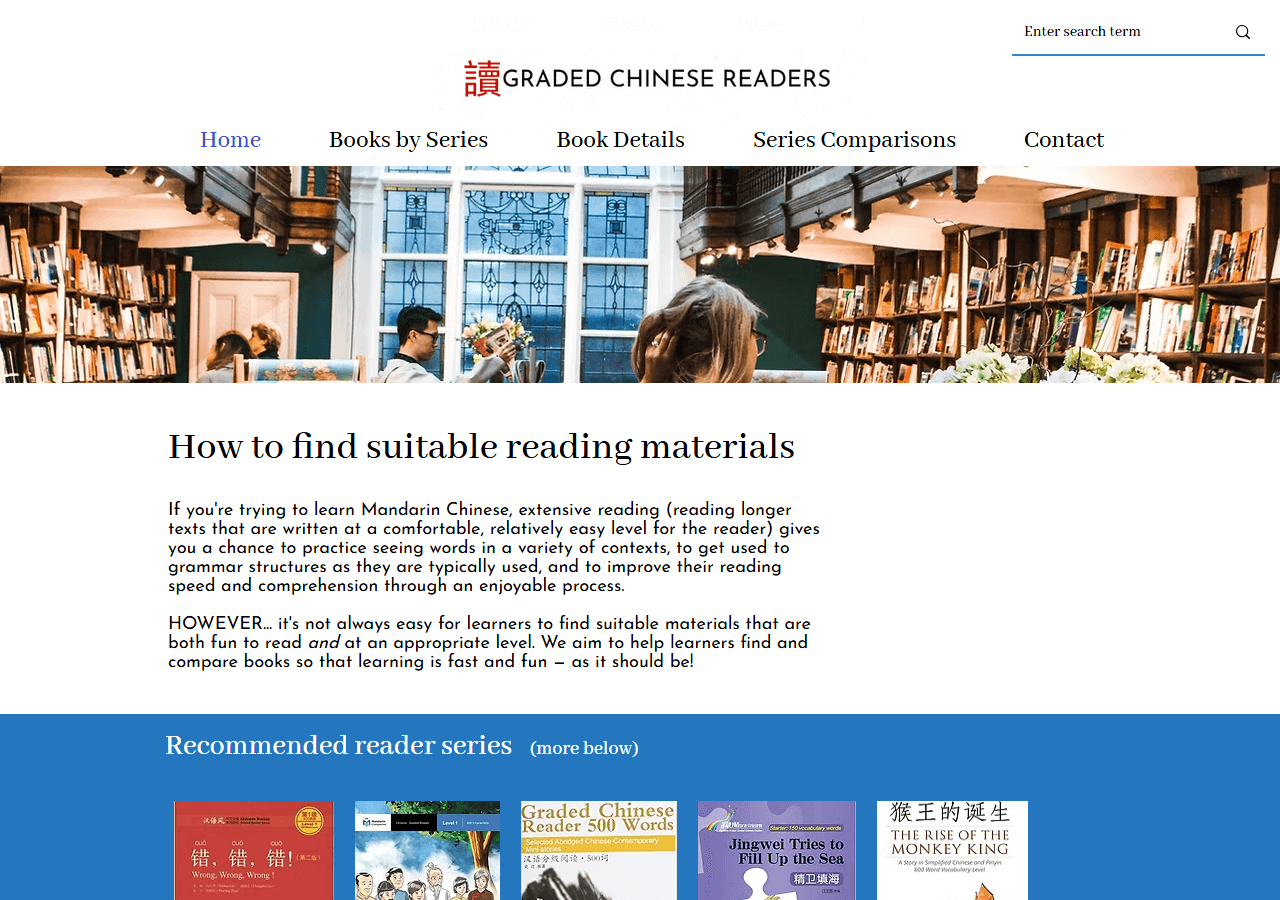
They’re not the same thing, and most retail listings mash them together like they’re interchangeable.
The Sinolingua Graded Chinese Reader series (edited by Shi Jin) is abridged PRC fiction. These are real short stories and novellas from actual Chinese writers, trimmed down and vocabulary-controlled into a 500 to 3,000 word ladder.
That’s the appeal and the catch: you get genuine literary flavour, sentences that feel written rather than assembled, but the tone skews older and more formal than a Mandarin Companion mystery set in modern Shanghai.
Full pinyin, too. Every line.
Some people love that. I found it a crutch I couldn’t stop leaning on — my eyes kept sliding up to the romanization like it was a subtitles track I hadn’t asked for.
If pinyin-over-everything works for you, this series is honestly better built for it than most. If you’re trying to wean off pinyin, the layout fights you.
Rainbow Bridge is a different Sinolingua product, and it’s mostly legends and folklore — 白蛇传 type material, classic stories retold at controlled levels. It’s a fine series.
It is not the Shi Jin readers. If a listing says “Sinolingua Chinese reader, 500 words” and shows a folk-tale cover while the description quotes the fiction anthology, you’re looking at a seller who doesn’t know what they’re shipping.
Check which series you’re actually buying before you click.
For our two weeks, I took a mid-level Graded Chinese Reader off the shelf and lasted about four pages before hopping to the dictionary more than the 95% rule allows. That’s a level problem, not a quality problem.
At the right rung, this series is one of the only ways to read “real” Chinese fiction while your vocabulary is still growing. The stories have literary weight.
I just wouldn’t start here.
Verdict: a strong second or third series once Mandarin Companion or Chinese Breeze has you comfortable at 450+ characters. Not a starting point, and definitely not the place to learn what Sinolingua actually publishes.
Du Chinese vs a book
I’d been using Du Chinese on and off for months before this experiment, so when I included it in the two weeks, I had a hunch about what would happen: I’d read more, finish less, and feel weirdly productive the whole time.

Correct on all three.
Du Chinese gives you commute-sized stories with tap-to-lookup, per-line pinyin you can toggle, and native audio. The Newbie tier is genuinely good — short, silly little narratives that respect the 95% rule without feeling like they were written by a committee.
You can burn through three stories on a streetcar ride and feel like a genius.
But it’s not a book. A Mandarin Companion or Chinese Breeze title is 40 to 80 pages of continuous narrative with a plot you have to hold in your head across chapters.
That’s a different cognitive muscle. With Du Chinese, each story resets.
Character A disappears after 300 characters of text; you never have to remember who she was or why she lied about the dog. That tracking — who did what to whom, four chapters ago — is a huge part of what reading practice actually trains.
So the honest framing: Du Chinese is a supplement, and a great one. It’s the thing you do on the bus when a paperback is impractical.
It’s the thing you do on days you’re too tired for a paper book. The tap lookup is dangerous if you abuse it (tapping every third word turns reading into flashcards with extra steps), but if you discipline yourself to only tap the words that break comprehension, it’s the fastest safety net in the ecosystem.
What I did for the two weeks, and what I’d do again: paper book at the kitchen table for the real session, Du Chinese for dead time. One doesn’t replace the other.
I’ve written more about how I stack tools like this in how to learn a language, and Du Chinese earns its slot there.
News, Olly, and what not to buy

A few things I checked so you don’t have to.
The Chairman’s Bao. It’s a graded news service, and it’s decent at what it does, but it’s not a reader in the novel sense. News articles are short, dense with proper nouns, and every story is a one-off.
If your goal is extensive reading — flowing through pages of connected narrative — news is a different diet entirely. Great as a third leg.
Not a substitute for the fiction shelf. Worth knowing the difference before you subscribe, and you can read more in the graded-reader space on their blog.
Olly Richards. If you’ve learned Spanish, you’ve probably seen Olly’s Short Stories series everywhere. Here’s the thing: there is no comparable Chinese Short Stories print series from him right now.
His name comes up constantly in “best Chinese readers” searches because his method — graded stories at controlled levels — is the whole reason people go looking for readers in the first place. He’s a ranking voice, not a must-buy Chinese book brand.
Don’t put his Spanish covers in your cart hoping they’ll teach you characters. Several roundups seem to assume a Chinese series exists.
I couldn’t find one that matches.
Random Amazon “HSK readers.” There’s a flood of cheap, print-on-demand HSK-branded story collections that are machine-adjacent at best. The vocabulary control is theoretical, the stories are joyless, and a couple I sampled blew past the 95% rule on page one.
The established series above exist for a reason. Stick to them.
Anything that claims to teach you to read through pinyin alone. No. Next.
How to pick a level
This is the part people overthink, so let me make it boring and repeatable.
The rule: stay at 95 to 98 percent known words. Below 95%, you’re not reading, you’re decoding. Your brain can’t hold the plot AND look up words AND keep the sentence grammar in the air at the same time.
The story collapses and you quit by Thursday.
How to actually apply it:
1. Pick a candidate book or story. 2. Open to a random page in the middle. Middles are honest. Front pages are always easier. 3. Read it. Count every word you don’t know, or just gut-check it: did you stumble more than a couple times per paragraph? 4. Two or fewer unknowns per paragraph, keep going. Five or more, drop a level. No shame, no drama.
The publisher’s character and word counts are starting points, not gospel. Mandarin Companion’s Breakthrough is 150 unique characters, Level 1 is 300, Level 2 is 450.
Chinese Breeze runs 300, 500, 750, and 1,100 controlled words across its four published levels. Those numbers tell you the ladder’s shape, not where YOU sit on it.
A 300-character book where you know 250 of them reads harder than a 450-character book where you know 440. Always sample the page.
One more thing: the gap between “I recognize this character” and “I know this word” is where people fool themselves. 你 and 好 separately won’t save you when 你好 shows up embedded in a sentence you’ve never seen. Test with full words in context, not flashcard recognition.
If you’re using Yak Cards for vocab, this is exactly why the cards drill words in sentences and not lone characters.
What I liked, and what wore me down
What I liked
What worked, honestly, most of it. Graded reading is the first thing I’ve done in Chinese where the difficulty curve felt fair.
Flashcard apps have this nasty habit of being easy-easy-easy-why-is-everything-on-fire (looking at you, Duolingo). A well-matched graded reader is just… readable.
Two weeks in, I finished the Chinese Breeze Level 1 and immediately started another one. That’s the behaviour you want from a method.
The feeling of finishing an actual book in Chinese — a whole book, cover to cover, in characters — is worth the price of admission on its own. It’s a psychological milestone that no streak icon replicates.
What wore me down
What wore me down:
- Dictionary friction. Even at 96% comprehension, that 4% sends you to Pleco constantly. Paper books have no tap lookup, and my phone sitting next to the book is its own distraction machine.
- Vocabulary mismatch. Graded series control vocab to their own lists, not to what YOU know. Mandarin Companion isn’t HSK-aligned, which I actually respect creatively, but it means the unknown words are scattered randomly rather than clustered at the edges of your HSK level.
- Plateau impatience. The jump from Breakthrough (150 characters) to Level 2 (450) is bigger than the ladder implies. I wanted a rung that isn’t there yet.
- Series fatigue. After ten days of mysteries where someone loses something and a plucky protagonist finds it, I was craving anything with an actual adult plot. The simplified-story ceiling is real and you feel it.
None of these broke the method for me. All of them are worth knowing going in.
Who this is for / who should skip
This is for you if:
- You’ve got roughly 150 to 500 characters under your belt and flashcards are losing their charm
- You want reading speed, not just reading ability — the flow state matters to you
- You like finishing things. A book has an ending. A deck doesn’t.
- You’re learning Simplified (the shelf is genuinely deep — this is the one script where the print ecosystem feels mature)
Skip it (or defer it) if:
- You’re under 100 characters. Below that there’s no reader that hits 95% and you’ll just be angry at paper.
- You mainly want speaking. Reading builds vocabulary that eventually helps speaking, but the transfer is slow and indirect.
- You’re studying Traditional. Don’t buy Simplified readers and fight the character variants — that’s a different shelf and a different article.
- You can’t tolerate simple plots. This is a you-problem and I share it, but know yourself.
If you’re earlier than “reading books” and still figuring out the whole landscape, my best language learning apps piece is the better starting point, and the full reviews section has the long version of everything I’ve tested.
Pros and cons
Pros
- Difficulty control is unmatched — 95%+ comprehension means you actually finish things
- The Simplified shelf is deep: real series, real levels, real physical books
- Mandarin Companion plot quality is the gold standard of the genre
- Finishing a book in Chinese is a legitimate confidence event
- Works on paper, so zero screen time if you want it
Cons
- Vocabulary lists are series-specific, not aligned to your HSK deck
- Paper means dictionary friction (Pleco will be open constantly)
- Plot ceiling is low at the early levels; embrace the missing dog
- Full-pinyin layouts can become a permanent crutch
- Gaps in the ladder exist (cough, Mandarin Companion Level 3)
What we'd use with it
Nothing on the reading shelf stands alone, and I wouldn’t ask it to. Here’s the stack that made the two weeks actually work:
- Pleco (or your dictionary of choice) as the constant companion. Non-negotiable for paper readers.
- Du Chinese for commute reading and dead time — same method, smaller doses, tap lookup as a safety net.
- Yak Cards for the words that came up twice in one book. If I hit a word repeatedly mid-story, it graduated to my deck that night. That’s the cleanest intake filter I’ve found: the book itself tells you what’s worth memorizing.
- An audio option. Chinese Breeze’s second edition has QR-linked MP3, and listening after reading the chapter glued the sounds to the characters. Do the read-then-listen pass. It takes ten extra minutes and it’s the best value in the whole routine.
And a plug for the other side of this site: if you’re a Chinese speaker working on English instead, we’ve got 139 lessons built on the same philosophy, starting at Lesson 1. Same rules, other direction.
What others are saying
I’m one guy at a kitchen table, so here’s the wider room on Chinese graded readers:
- Literate Languages runs a broad comparison of the major series with a decent level-by-level breakdown.
- Coco Chinese covers the big names with a learner’s perspective on where to start.
- FluentU has a long list-format roundup — filter for the print series, since they also push their own video content.
- Hanyu Tales breaks down readers with an emphasis on the extensive reading method itself.
- GoEast writes from a school’s perspective, which is useful for level placement.
- StoryLearning is Olly Richards’ take on Mandarin readers — good on method, remember there’s no Chinese Short Stories print series.
- The Chairman’s Bao covers readers from the news-reading side of the fence.
- HSK Story on Mandarin Companion does a deep dive on that series specifically.
- HSK Story on Chinese Breeze does the same for Chinese Breeze, including the level structure.
FAQ
Prices, plan names, and features below are as of September 2026.
What level graded reader should I start with?
Sample a middle page and count unknowns. If you’re stumbling more than twice per paragraph, drop a level.
Mandarin Companion Breakthrough (150 unique characters) is the lowest honest entry point in print. Don’t buy based on the character count alone — buy based on your own sample read.
Is Mandarin Companion coming out with a Level 3?
Not as of July 2026. Their published levels are Breakthrough (150 characters), Level 1 (300), and Level 2 (450).
Anything claiming a Level 3 exists is wrong or selling you something else. After Level 2, you bridge to Chinese Breeze 750/1,100 or the Sinolingua Graded Chinese Reader series.
Does Chinese Breeze go up to 4,500 words?
No. Older marketing claimed eight levels up to 4,500 words, but four levels are actually published: 300, 500, 750, and 1,100 controlled words. Simplified only.
Don’t buy based on levels that never shipped.
Pinyin on every line: help or crutch?
Both, depending on your discipline. Sinolingua’s Graded Chinese Reader prints full pinyin; Mandarin Companion only footnotes pinyin plus English on key words.
If you’re still pinyin-dependent, the footnotes force you to read characters first. If you’re past that, full pinyin is harmless.
Know which reader you are.
Du Chinese or a paper reader?
Both, if you can. Du Chinese for commutes and tired evenings, paper for real sessions.
Du Chinese can’t replace the 40–80 page continuous narrative that builds reading stamina and plot-tracking. It’s the snack, not the meal.
Is The Chairman's Bao a graded reader?
It’s graded news. Different format, different skill.
Useful alongside novels, not instead of them.
Do graded readers work without flashcards?
They work better with a thin layer of them. Let the book decide what you memorize: anything that shows up twice goes in the deck.
That’s maybe five words a week — sustainable, and far better than pre-memorizing 500 characters before you’re allowed to enjoy a story.
After two weeks
The kitchen table is cleared, the books are back on the shelf, and I’ve started a second Chinese Breeze title anyway, which tells you most of what you need to know.
What two weeks of graded reading did that apps hadn’t: it made Chinese feel like a language instead of a curriculum. Flashcards and lessons hand you particles and pieces.
A story makes you hold a whole sentence, then a paragraph, then a chapter, and then — and this is the part nothing else produced — it makes you want to know what happens next. That pull is the engine.
Everything else is just keeping the engine fed.
The Simplified shelf deserves its reputation. Mandarin Companion writes stories you’d almost read in English, Chinese Breeze gives you a clean four-level ladder, Sinolingua’s Graded Chinese Reader hands you real fiction once you’re tall enough, and Du Chinese covers the gaps in your day.
The Traditional side has nothing this deep, which isn’t this article’s problem, but it’s worth knowing the asymmetry exists.
Is it perfect? No. The vocabulary control doesn’t match your personal deck, the plots at low levels are what they are, and the paper-dictionary friction is real.
But it’s the first method where I never once had to talk myself into the next session. Two weeks, every day, no streak counter required.
That, more than any test score, is the review.
If you’re sitting on 150+ characters and wondering whether reading “real books” is a you-thing yet: sample a page, count your unknowns, and go from there.
8 out of 10 Yaks