



A friend of mine has been on Duolingo for years. They mention the streak the way other people mention step counts.
I finally downloaded it so I’d have an opinion that wasn’t secondhand. Phone, sofa, tea going cold. Spanish, because that’s the course people point at when they want to defend the app. We used it for about two weeks for this review. Spanish most days. A few lessons of Japanese so I could feel a thinner course next to the flagship. Not a lab study. Two weeks of real use, phone first, then the laptop once the phone started cutting me off.
The short lessons explain the downloads. You can finish one while the kettle boils. The owl is a pest. You pick up words.
4 out of 10 Yaks



I also spent those two weeks getting good at tapping tiles, and I stayed useless at producing a sentence if anyone was waiting for one. Duolingo is still free in the way that counts. You can start a course and learn real vocabulary without paying. That part is uncommon for language software.
I still wouldn’t pick this as my main tool. The energy bar, the ads, the missing grammar, and the way the numbers go up while your mouth stays quiet all stacked up. I came out of it respecting the habit machinery more than I like the app.
If you want a wider comparison, our best language learning apps roundup covers the field, and the reviews section has more like this one.
What Duolingo is
Duolingo is a language app built like a mobile game. You move down a linear path of short lessons.
Each lesson mixes a few exercise types: translate a sentence, tap words into order, listen and type what you heard, match a picture to a word, or read a sentence into the mic. Right answers give you points. Wrong answers come back around before the lesson ends. A green owl named Duo celebrates streaks and, if you stop showing up, sends notifications that read like a disappointed roommate.
The company is big, publicly traded, and loud about their learning research. They claim the Spanish and French courses can get you to solid reading and listening levels if you finish them.
They also run a blog that’s better than most app blogs, and a podcast worth listening to even if you never touch the exercises. The series is being sunset, but the archive is still up.
There are three paid shapes around the free course. Free is the whole curriculum plus ads plus an energy limit on mobile. Super removes ads and those limits. Max adds AI extras: a video call with a cartoon teenager named Lily, roleplay scenes, and an “Explain My Answer” button. Prices later. They bounce around by country and by whatever test group the app thinks you belong to.
Duolingo is not a textbook. There’s no chapter on the preterite, and no grammar syllabus you can point at. It’s exposure plus repetition, with game mechanics glued on. That mix builds vocabulary and a bit of reading instinct. It does much less for everything else, which is the part I kept bumping into.
How we used Duolingo for two weeks
Two weeks, Spanish, most days. Phone on the sofa at first, because that’s how people open this thing. Then the browser on a laptop in the kitchen after the phone version started stopping me mid-lesson.
I did one lesson the first night to see what it felt like. The next day I did a few more.
By the end of the first week I had a streak going and a daily goal set, and I noticed the shift everyone warns you about.
I wasn’t deciding to practice Spanish. I was protecting a number.
I did a lesson late one night with a toothbrush in the other hand. The owl would have been proud. I was less proud.

A streak freeze showed up as an offer. That’s an item that keeps the streak alive if you miss a day, paid for with gems, the app’s pretend money. I hovered over it longer than I want to admit. Buying permission to skip tomorrow, from a cartoon bird, is a weird place to find yourself at forty.
We opened Japanese for a handful of lessons, not to learn Japanese in two weeks. Same owl, same ding sounds, much less behind it. Spanish feels paved. Japanese felt like spotting characters more than writing them.
A friend asked me, mid-week, to say something in Spanish. I had a streak. I had done the food unit.
I had nothing. Not a greeting, not a sentence about water, which is a word the app loves.
I did know manzana extremely well. Limited practical value, unless you live next to an orchard.
That blank is what I keep coming back to. The tiles were going well. Talking was not. We keep our own Spanish materials on the learn Spanish page, and I kept comparing as I went. That’s the lens for everything below.
How a Duolingo lesson works
The home screen is a path. You start at the top and go down.
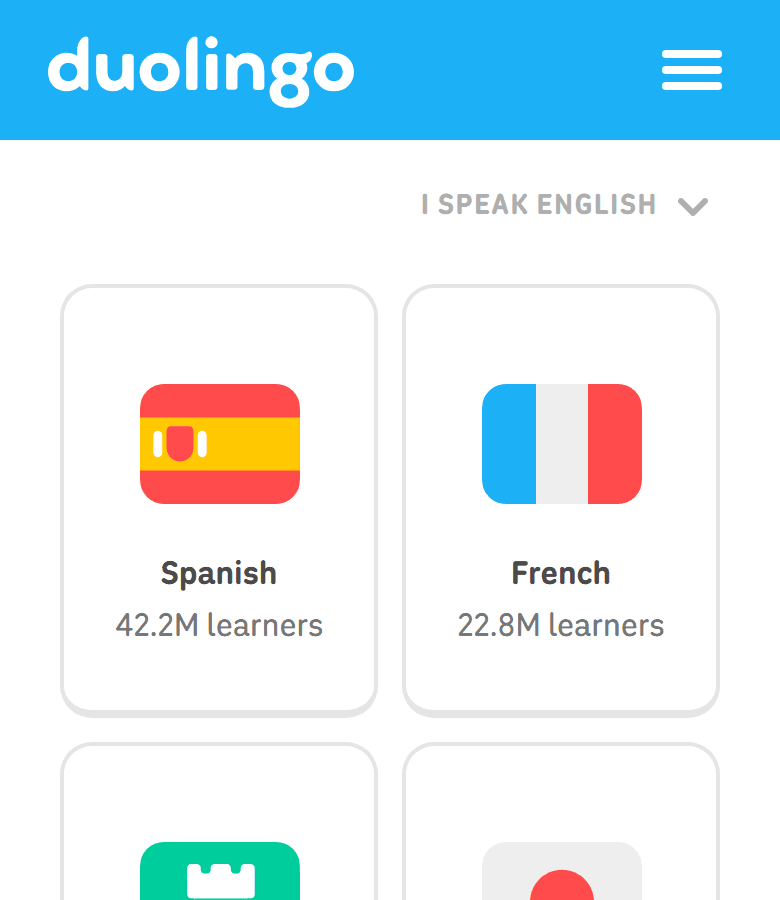
Units have themes (food, greetings, later some past-tense stuff). Inside each unit are bite-sized lessons, checkpoint reviews, and the occasional story or speaking practice if your language has those. A lesson takes three to five minutes. Maybe a dozen quick exercises:
- Match pairs (Spanish word to English word).
- Translate into English.
- Translate into Spanish, usually by tapping word tiles rather than typing.
- Listen and pick or type what you heard.
- Read a sentence into the mic.
- Fill in a blank.
You can tap any word in a sentence during review and get a little translation popup. That tap-for-gloss is the nicest piece of the interface. You’re never fully stuck, and your thumb starts hunting words instead of skipping them.
Feedback is instant. Ding for right, thud for wrong, and misses return before the lesson ends so you can’t fail and wander off. That loop is why the app is sticky. It’s also why you can finish a session and feel like you did something even if you mostly recognized tiles you’d seen yesterday.
What’s missing is explanation. If one sentence uses está and the last one used es, the app does not stop to tell you those are two different “to be” verbs, which is one of the famous Spanish trip-ups. It shows you more sentences and trusts repetition. Sometimes that sorts itself out. Sometimes you walk around with two mysterious verbs and a vague itch.
The path is linear. You can jump ahead with tests if you already know material, which is useful. You can’t easily pull one weak topic out and grind it. If you’re weak on numbers, you get numbers when the path serves numbers. Some people like having no decisions.
I felt like I was on a tour bus.
Comfortable, and you stop where the bus stops.
We build our own language courses with actual explanations, so this was the gap I kept hitting. Duolingo bets on repetition. I kept wanting two sentences of grammar. Your patience for that gap will decide a lot about whether this app feels clever or hollow.
Streaks, XP, leagues, and the owl
The retention system has a few hooks. The streak: days in a row. XP: points per lesson, easy to inflate with timed practice. Leagues: weekly leaderboards against a few dozen strangers.
The streak is the one that works on you. After a handful of days I wasn’t choosing to practice. I was defending the counter. Miss a day and a visible number drops. Same psychology as a fitness ring. It works on adults. It worked on me, which I find slightly embarrassing and also unsurprising.
Leagues are dumber. You’re ranked by weekly XP. XP is not learning. The fastest way to farm it is easy practice on stuff you already know. I caught myself reviewing unit-one words (the, cat, water) because it was quick and clean, while new material sat there. The number went up. The Spanish did not.
Miss a day and Duo starts appearing in notifications. Playful-mournful. “These reminders don’t seem to be working.” I know it’s a push notification. It still pokes a low, annoying nerve.
This machinery is why people stick with Duolingo, and sticking with something is half of language learning. If guilt and streaks get someone to open an app for months, that’s months of contact they might not have had. I still think the leash became the activity. Some evenings I was practicing the streak.
If habits are the part you care about, our how to learn a language guide is the longer version of that argument. Apps help. The app is not the method.
Energy, ads, and the free-tier wall
For years the free tier used hearts. Five of them. You lost one per mistake. Empty hearts meant wait, watch an ad, practice, or pay. Annoying, with a kind of logic: mistakes cost you.
In 2025, on mobile, they switched to energy. You get a pool of about 25. Every exercise spends energy, including the ones you get right. A lesson costs roughly 10. Two lessons, maybe a squeezed third, then the bar is empty and the app offers you a menu: wait for a refill, watch an ad for a trickle, spend gems, or buy Super.

I was mid-lesson, in a listening drill I was enjoying, and the bar died. Gray overlay. The app suggested I’d earned a break.
I had not earned a break. I had hit the sales pitch.
Momentum interrupted, upgrade offered. That is the product now, on a phone, if you aren’t paying.
The workaround is the desktop. In the browser at duolingo.com, energy mostly didn’t bite us the way it did on the phone. Sessions ran longer. If you’re staying free, do the serious sitting-down practice on a laptop and keep the phone for a quick top-up.
Ads sit between lessons on free. Short, skippable-ish, and after two weeks I could hum one of them. They also make the free experience feel slower than the lessons themselves are. Nothing makes a subscription sound reasonable like the tenth ad for a mobile game.
The free tier is still usable, with caveats. Gems from lessons can refill energy. Practice sessions can too. Desktop stretches it. You’re still getting a real course with friction bolted on. The leash got shorter this year, and long-time free users are loud about it. I’ll get to that in “What others are saying.”
One smaller irritation: the old in-lesson discussion threads are gone. I wanted to know why one noun took el and the next took la, and there was nowhere in the app to ask. You get the ding or the thud, and then you’re on your own.
Free vs Super vs Max

Prices swing by country, platform, and test group. These are the US-ish ranges we saw quoted and the shape of the ladder.
Free
Full course content, ads, energy limits on mobile. All the lessons live here. Duolingo still gives away the curriculum. I don’t want that to get lost under the complaining.
Super
Roughly $13 a month, or around $96 a year (closer to $8 a month if you pay annually). Family plan around $120 a year for up to six people, which is a decent split if you can find five other people who will open it. Students sometimes get a Super discount worth checking if you have a school email.
Max
Around $30 a month or roughly $168 a year. On top of Super you get the AI bits: Video Call with Lily (a moody cartoon teenager; closer to a conversation than anything else in the app, and still not a person), Roleplay, and Explain My Answer. Explain My Answer looks like it’s drifting toward more users, which would be a good move.
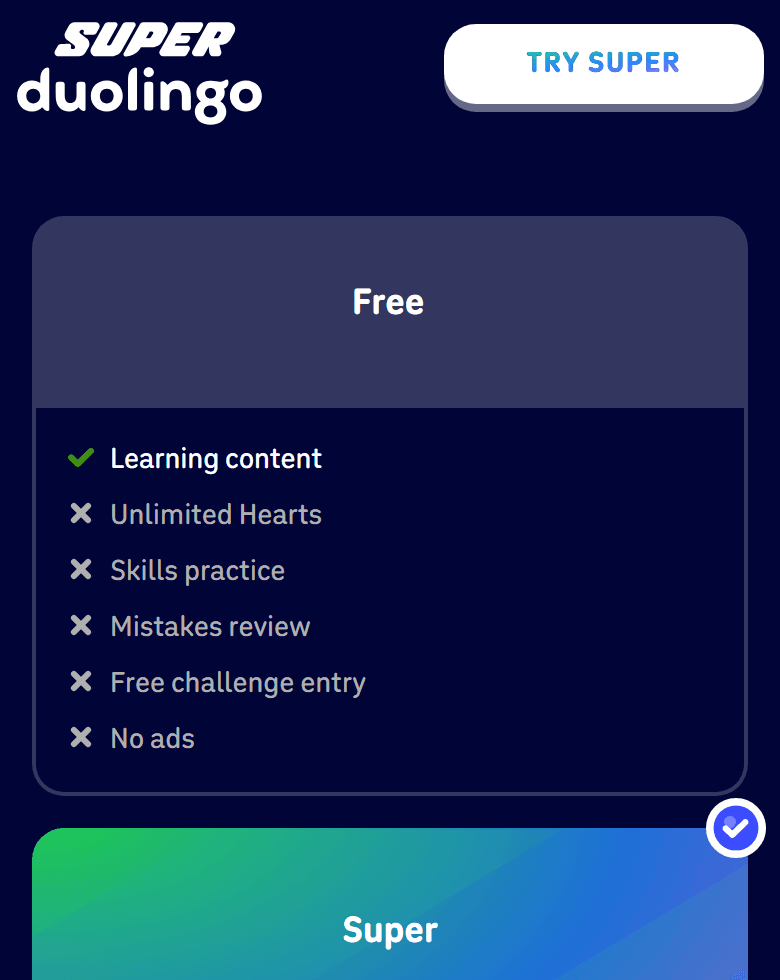
What Super buys: no ads, no energy limits, a few extras like unlimited legendary lessons. The teaching does not change. You are paying to remove walls the same company put in the free tier. That’s a valid business, and it’s slightly gross. Their Super comparison page, when I grabbed it, still listed “Unlimited Hearts.” The phone app meters energy now. Even the sales page is a beat behind the leash.
If you use the app daily on a phone and energy wrecks the session, Super is comfort money. If you’re on a desktop doing a short evening block, you may never need it.
Max is a hard sell. $168 a year sits in the same budget as a stack of lessons with a human tutor on italki, and a human is better at the thing learners need: someone answering back. We compare that mix in the best apps roundup.
Two-week take on the ladder: free is a real product with a shorter leash than it used to have. Super is comfort. Max is interesting tech priced like tutors don’t exist.
Is it expensive? The free course is cheap in cash and expensive in interruption. Super at about $96 a year is not a lot next to Babbel, and it is a lot for taking down a wall they built. I would not call Super a scam. I would call it a tax on using the phone. Max at $168 a year is tutor money. I would not pay Max. I might pay Super if I lived on the phone and the energy bar made me angry every night. After two weeks, I did not.
If what you want is vocabulary that sticks without a subscription, we make Yak Cards for that. I’d say that. I’m the yak.
What I liked about Duolingo, and what wore me down
What I liked
A few things I would keep, even with the grumbling.
- Tap-for-translation. Thumb finds the word. No extra tab.
- Stories in Spanish. The only hours I forgot I was doing a lesson.
- The lessons themselves are still free. That’s uncommon.
- Five minutes is a real length of time, not a slogan. The ding is sticky for a reason.
What wore me down
This stuff showed up every night.
- The energy bar cutting a lesson I was already doing correctly.
- Ads after every block.
- One accepted translation, so a fine sentence still thudded.
- The gap between a high streak and a sentence I could say out loud.
- Super does not fix the teaching. It only stops the app from interrupting you.
Duolingo horror stories, and the people it works for

The horror story
The two-week freeze was not unique.
I’ve heard the same story from people with a one-year streak, a two-year streak, a number so high it became the point.
Two years of opening the app every day. Two years of keeping the owl happy.
Then someone asked them a question in the language and they had nothing.
All they got good at was keeping the streak alive.
A 10-year Duolingo review thread is full of that: long-timers who got excellent at Duolingo. They did not get excellent at speaking.
That is the horror story. Not that the app is fake.
That it lets you feel like a student while you practice being a student.
A thread on the hearts-to-energy switch is angrier and smaller: free mobile got worse, the push to pay got louder, the leash got shorter.
When it works
Success, when it shows up, is quieter.
Someone uses it as the five-minute door, then talks to a person, or reads, or moves.
I’ve also heard from people who credit the owl with getting them through the first month they would have quit. That’s real. PCMag’s 5 stars is that door.
The people who only have the door, two years later, are the ones posting that they still cannot speak.
Grammar, one right answer, and tap-to-translate
Duolingo mostly teaches by feel. See a pattern, copy the pattern, get the ding. Nobody sits you down and says this is how Spanish verb endings work.
A lot of grammar can soak in that way. I still had moments where I wanted the rule. Estoy cansado is fine and soy cansado isn’t, and I wanted someone to say so in a sentence. The app’s answer is more examples until your brain gives up and accepts it. Slow, and itchy if you’re the sort of person who wants the why.
“Explain My Answer” used to sit behind Max. It writes a short AI explanation when you miss something. Decent when it appears. Patchy. I never fully mapped when it showed up.
The bigger irritation is one accepted answer. The app often has a single translation in its head. You render Yo bebo agua as “I’m drinking water” and it wanted “I drink water,” you get dinged, even though both are fine. You can report it. Sometimes they fix it. In two weeks I hit this plenty in Spanish, and more often in the thinner course. It trains you to guess what the software wants, which is a different skill from Spanish.
Tap-to-translate is the opposite. Any word, tap, gloss (cansado, tired). No extra tab. When I didn’t know a word, my thumb found it. I wish more apps did this. Duolingo’s version got out of the way.
Grammar teaching: thin. Word lookups: excellent. You’ll want a real grammar source next to this eventually.
Weird sentences
The memes are accurate.
In two weeks of Spanish I translated bears drinking beer, a duck asking for directions, and a listening item about a spider wearing shoes.
I replayed the spider one because I assumed I’d misheard.
Spider. Shoes.
Weird sentences do force you to read. If every line is “the man eats bread,” your brain pattern-matches and checks out. “The bear drinks beer” makes you slow down. They’re also probably easier to generate and harder to sleepwalk through. Charming for a few days. Then it’s wallpaper. And the vocabulary you’re drilling is sometimes not the vocabulary you need. I could name several farm animals in Spanish before I could order lunch with any confidence. Priorities, Duo.
Speaking and listening
Speaking in the free app is read-aloud. The app shows a sentence. You say it. It checks pronunciation. That’s the whole trick. You will never be surprised by a reply, because there isn’t one.

It’s fine at what it does. The speech check caught my mumbled Spanish and made me try again. It forced my mouth to move, which is more than a lot of apps manage. You leave able to recite sentences that were handed to you. Reciting is not talking.
The friend-asks-you-to-say-something freeze showed up inside two weeks. I could say ¿Dónde está la biblioteca? on cue. A question from a person in the room produced nothing. Duolingo trains recognition and repetition. People want answers.
Listening is stronger. Type-what-you-hear drills plus the stories (next section) give your ears something to do. Audio is clean. Speakers go at a learnable speed. Replay is right there. For beginner ear training I don’t have a complaint.
The closer-to-talking option is Max: Video Call with Lily. Nearer to a conversation than the mic drills. Still an AI with a script-adjacent brain, and it costs real money.
Stories and the podcast
Duolingo Stories are short dialogues with little comprehension checks. They were the best thing in the app for me. Back-and-forth. Occasional jokes that seem on purpose. The only lessons where I forgot I was doing a lesson.
Very few languages have them. Spanish and French have a pile. Our thinner course had none. If you’re in Spanish or French, don’t skip the stories. They’re tucked into the path and easy to scroll past. They did more for my listening than a stack of tap-the-word drills.
Same with the Duolingo podcast. Real stories, easy-ish Spanish, English narration woven through. Aimed at learners, produced like audio journalism instead of homework. There’s a French one in the same format. They’re sunsetting the series now; the old episodes are still there.
Spanish and French again. Norwegian, Hungarian, a lot of the catalogue: no podcast, probably no stories, and the app shrinks to its basic drills. The gap between flagship and everything else is the fact I wish I’d known more sharply before I started poking around.
Spanish vs thinner courses
We spent most of the two weeks in Spanish and dipped into Japanese on purpose. The difference is not subtle.
Spanish is a flagship. Long path. Stories. Podcast. Lots of audio. Years of polish. It feels like a product a team cared about. Japanese, in the slice we saw, felt thinner. Shorter runway. No stories, no podcast, fewer exercise types.
Newer courses are often largely machine-built, and you can feel that too: sentences that are technically fine and nobody would say. Little gaps between lessons. A shakiness the old flagship paths don’t have. The thinner slice still functions. It doesn’t feel like anyone spent years on it.
Duolingo has been racing to add languages, and that math only works if machines do a lot of the building. Fine as a business move. If you’re choosing a language, check the course list and see whether yours is a flagship or the long tail. Our language courses page is the wider version of that shopping problem.
If you’re learning Spanish specifically, the learn Spanish guide puts this app among the other things you should be using, which is how I’d treat Duolingo anyway.
Who Duolingo is for
I’d still hand this to a few people, with a warning label.
Total beginners who know zero words and need a friendly front door. Five minutes, low shame. People who have quit every other method and need a streak to bully them into opening something. Showing up is a real problem. Duolingo is good at that one problem.
Casual hobbyists with no deadline. Travel curiosity. Dead time on a commute. Spanish or French, where the extra material exists. Kids, maybe, if a grown-up is steering and nobody thinks the owl is a teacher.
If that’s you, download it. It’s free. You lose some ads and some dignity.
Who should skip it
Anyone who needs to talk soon. Job, move, trip in a few months. Duolingo will get you recognizing. Recognizing is not speaking.
People who need rules written down. If a missing explanation makes you anxious, this will starve you. Babbel or a textbook will treat you better. Anyone past beginner. The early path is boring if you already have a base, and the later path thins out.
If your language is in the AI-built long tail, know what you’re getting: a skinnier, shakier version of the Spanish experience. If you already know you get weird about streaks and leaderboards, this app is aimed at that nerve. I say that as someone who did a lesson with a toothbrush in my hand.
Pros and cons
Pros
- Free course content you can use without paying
- Streaks will get you to open the app
- Tap-a-word-for-a-translation is excellent
- Stories and the podcast (Spanish and French) are the good parts
- Lessons fit in a few minutes
- Huge language list if you accept uneven quality
Cons
- Energy on mobile throttles free users, including when you’re right
- Grammar teaching is basically absent
- One-accepted-answer grading marks fine sentences wrong
- Speaking is read-aloud, not conversation
- Flagship courses and the rest of the catalogue are different products
- Newer courses can feel machine-written
- XP and leagues reward grinding old material
- You can keep a streak and still freeze when a person talks to you
- Ads and upgrade nags after lessons
- Super does not buy better teaching
That last pair is why I landed at 4. The free curriculum is real. The way the app treats that curriculum, on a phone, in 2026, wore me down.
What we’d use instead, or with it
Don’t use Duolingo alone. I wouldn’t.
Keep it, if you keep it, as the five-minute opener. Streak, warm-up, then leave. Add grammar. Babbel explains things. Structured lessons, dialogues that sound closer to humans. It costs money. It teaches.
Add talking. Pimsleur gets you speaking out loud from the start, which is useful if you’re shy or you have commute time. Better: a tutor on italki, even once a week. A person answering you changes the whole project.
Duolingo plus a weekly tutor is a combo I can respect. Duolingo plus nothing is how you get good at Duolingo.
Add vocab on purpose. Anki is the classic: spaced repetition, ugly, effective. We also make Yak Cards, pre-made decks so you aren’t building cards at 11 p.m. Either way, get words into a review system that isn’t competing with a league.
The best language learning apps roundup compares those options with less of my owl-grumbling, and how to learn a language is the method version. If you’re learning English rather than Spanish, we have 139 free English lessons.
Lesson 1 of 139 is sitting there. No energy bar.
What others are saying
We weren’t the only ones poking this owl. The room is split, and a lot of people like it more than I do.
Tech reviewers and casual users tend to like it. People who wanted a course, or who stuck around for years, are tired. Our 4/10 is me after two weeks, not a panel average. PCMag can keep the 5. I wouldn’t.
FAQ
Prices, plan names, and features below are as of September 2026.
Is Duolingo free?
Yes. Courses are free with ads and the energy limit on mobile. You can learn real content without paying. Paid tiers remove friction. They don’t add a secret better curriculum.
Can you become fluent with Duolingo?
No. Flagship courses can build a beginner, maybe low-intermediate, base for reading and listening if you put in serious hours. Fluency needs conversation and a lot of native input. Use it as one tool if you use it at all.
Is Super worth it?
If you live on the phone and energy wrecks your sessions, Super is comfort, roughly $13 a month or around $96 a year. If you’re fine on desktop or you only dabble, skip it. Same lessons.
What’s the difference between Super and Max?
Super: no ads, no energy limits. Max: AI extras (Lily video call, Roleplay, Explain My Answer). Max is about $30 a month or $168 a year. That’s a lot for cartoon chat when a tutor can cost less.
Why does energy drain when I get answers right?
Because energy (rolled out in 2025 on mobile) meters how much you can play, not how many mistakes you make. Hearts only drained on errors. Energy caps everyone. Desktop is often kinder.
Which languages are best on Duolingo?
Spanish and French, by a wide margin. Longest paths, stories, podcasts. A few others are stronger than the tail. The long tail is thinner and more machine-built.
Why does it mark a correct answer wrong?
Usually one accepted translation. Yours is fine. Theirs is in the key. You can report it. Old habit. Still annoying.
Does the streak matter?
For opening the app, yes. For learning, a long streak of lazy lessons teaches less than a shorter stretch of focused work plus talking. Don’t let the number become the job.
Can kids use it?
Yes. Short lessons, owl, points. The family plan (~$120 a year for six people) makes sense if people in the house are using it. Steer them toward stories if the language has them, and don’t treat a streak as a report card.
Is Duolingo or Babbel better?
Babbel teaches better. Duolingo is free and better at nagging you. I would rather pay Babbel than live in the owl’s energy system. Some people run both: Duo for the daily poke, Babbel for the lesson that explains something.
After two weeks with Duolingo
I finished this stretch able to read simple Spanish sentences and name a worrying number of animals. I could not produce a sentence when a friend looked at me and waited.
The stories were the good hours. The energy bar was the hour I wanted to throw the phone. I’ll keep the podcast. I will not be defending a streak for a company that charges me to finish a lesson I was already doing correctly.
4 out of 10 Yaks