


I’m cheap about subscriptions. That’s the honest place to start.
I have a mental list of apps that quietly drink from my bank account every month, and I guard it like a raccoon guards garbage. So when I decided to actually review Babbel for Yak Yacker, I went into it expecting to be annoyed.
Annoyed at the paywall, annoyed at the upsells, annoyed at whatever cartoon owl competitor had trained me to expect language learning to feel like a slot machine.
I paid for Babbel, used it for about two weeks, mostly on the Spanish (Mexico) track, and I didn’t hate it. That surprised me more than anything.
I’ve been yacking about language apps for long enough that the whole category has a certain smell to me, and Babbel smelled different. Less confetti.
More homework.
Let me back up. I’m in Ontario, I’m forty, and my Spanish is what I’d call “restaurant functional.”
I can order food, apologize, and count to a number high enough to be useless. But when a server replies with an actual sentence at actual speed, I smile like a golden retriever and reach for the English.
That gap, between tourist phrases and real listening, is exactly the gap Babbel claims to close. So that’s what I tested.
For two weeks I did a lesson most days at the kitchen table with my coffee before the day started eating itself. Ten to fifteen minutes.
That was the whole commitment. And because I don’t think you can review the deep end of a pool without also poking the shallow end, I also opened the Turkish and Danish courses a few times each, just to see what a “thin” Babbel language feels like.
It feels thin. We’ll get there.
A quick word on who this review is for. If you’re comparing apps, I’ve already done the free-and-chaotic one; my Duolingo review sits at 4 out of 10 Yaks and I stand by it.
Babbel is a different animal. It’s the paid, serious, dialogue-first cousin, and it earns a very different score.
If you want the whole field, my best language learning apps roundup covers it, and there’s a longer list of language courses on the site too.
Also, full disclosure in the Yak Yacker spirit: I make Yak Cards, my own language product. I’ll try to be fair to Babbel anyway, and I’ll tell you when I’m biased.
Biased people who tell you they’re biased are still biased, but at least you can price it in.
So. Two weeks, one kitchen table, one café scene I’ll get to later, two thin courses, and one pricing page I read more carefully than most contracts I’ve signed.
This is what I found.
7 out of 10 Yaks



What Babbel is
Babbel is a paid language learning app, German in origin, built around short lessons with real dialogues, real grammar explanations, and native-speaker audio. Fourteen languages as of this writing.
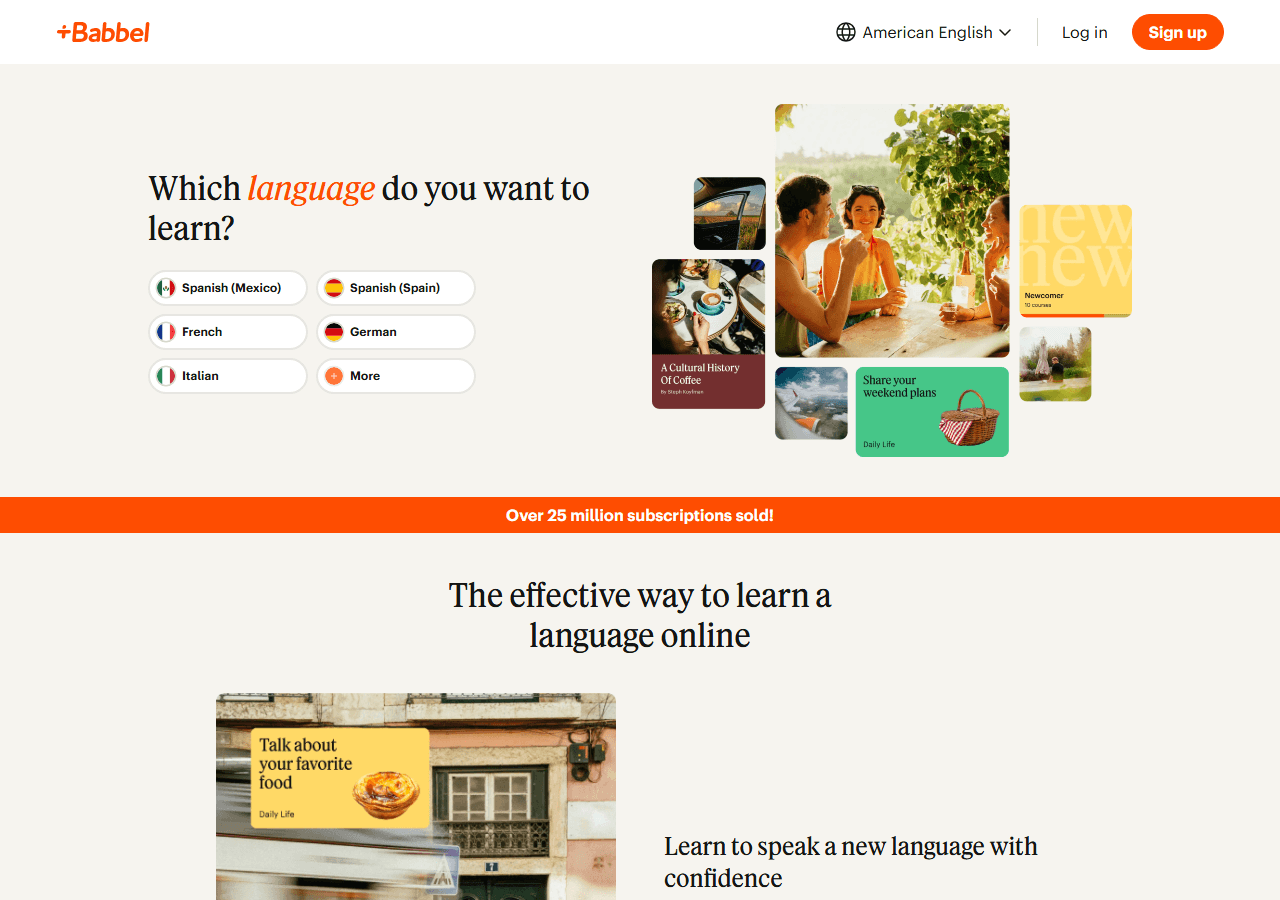
The core pitch is simple: instead of gamifying you into a streak, Babbel teaches you the way a slightly strict tutor would. Here’s a conversation two people would actually have.
Here’s why the verb changed. Now say it out loud.
Now review it tomorrow, because you will forget it.
It’s a subscription, and it’s a real one. There’s no meaningful free tier, which I’ll get into in detail later.
You can try the first lesson or two of a course for free, and then the paywall arrives like a waiter with the dessert menu. You can look at the whole thing yourself at babbel.com, but fair warning: babbel.com/pricing 404s, which is genuinely funny for a company this size.
The actual pricing lives at my.babbel.com/en/prices, and I’ll walk you through it in the pricing section.
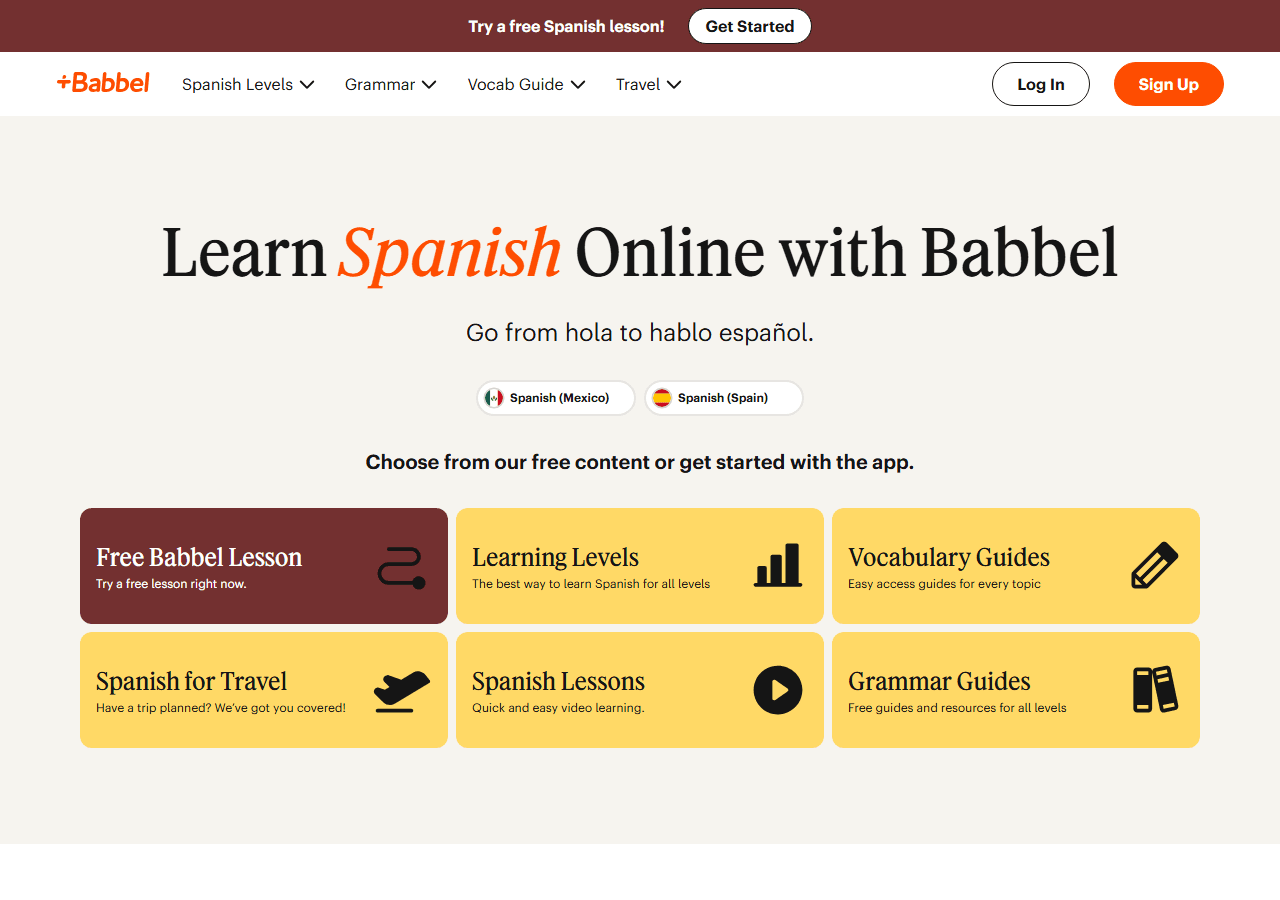
The languages split into two camps. The flagship four are Spanish, French, German, and Italian, with deep, polished courses that go roughly to B1 on the CEFR scale.
The rest are thinner: Danish, Norwegian, Indonesian, Turkish, and so on, playable but short. And a note for the Asia-curious: there’s no Japanese, no Korean, no Mandarin, no Arabic, no Hindi.
If that’s your target, Babbel isn’t your app, and no amount of wishing changes the catalogue.
One more housekeeping note, because I’ve seen confusion about it: current individual plans include all languages. There was an era when a subscription locked you to one language, and you’ll still see old reviews claiming that.
It’s stale. Your sub gets you the whole buffet, which matters a lot if, like me, you can’t resist poking Danish at 11 p.m.
How we used Babbel for two weeks
Two weeks isn’t a study. I want to be clear about that.
This was a kitchen-table experiment, not a lab. But it was an honest one, and I’ll tell you exactly what we did.
I picked Spanish, and specifically the Spanish (Mexico) track, because that’s the Spanish that’s actually useful to me. I live in Ontario.

Nobody around here is asking for Castilian vocabulary. Babbel keeps Spain Spanish and Mexico Spanish as separate tracks, which sounds great until you use it.
The kitchen table routine went like this: coffee, phone propped against the fruit bowl, one lesson, done. Most days that was 10 to 15 minutes, and the app wasn’t lying about that number the way some apps lie about it.
A Babbel lesson genuinely ends. There’s a little summary screen, a “you did X words” screen, and it hands your morning back to you.
I’ve used apps where “one quick lesson” turns into forty minutes of gamified churn, and I appreciated that Babbel respected the exit.
I took the placement test first instead of grinding from zero, and it slotted me into early A2, which flattered me slightly and was roughly right. From there I worked forward through dialogue lessons, doing the speak-aloud bits even though I felt ridiculous, and letting the Review Manager queue up my mistakes.
More on both of those later.
Now, the café scene. Week two, I’m at a local place, and I decide to test the Mexico-Spanish track the way it’s meant to be used.
I order in Spanish. Full sentence, side-of-the-morning energy.
And it worked! The server understood me, I understood her reply, small victory, internal fireworks.
Then I got home and did the next lesson, and something felt off. The audio voices had changed character.
Some vocabulary I was being taught skewed European. And sure enough, when I went looking, I confirmed what other learners had also run into: the Latin American Spanish track apparently funnels you into the Spain Spanish material after the A1 level.
I noticed the shift myself before I read a word about it. The accent in my head wobbled like a tire needing rebalancing.
It’s not a dealbreaker, vosotros isn’t going to kill a Canadian, but if you specifically chose the Mexico track for a reason, know that the fork in the road rejoins earlier than you’d hope.
Alongside the Spanish, I did a handful of lessons each in Turkish and Danish. Why those two?
Because they’re exactly the kind of language people get romantic about on a Sunday night. “I’ll learn Danish!”
Sure you will, champ. Let’s see what Babbel actually gives you.
I’ll cover the full verdict in the languages section, but the short version: a short runway. You can land, you can’t take a long trip.
Total damage: fourteen days, maybe ten minutes a day on Spanish, plus a few scattered sessions of Turkish and Danish tourism. That’s the sample.
Small, but real, and every observation below comes from actually tapping the buttons myself.
How a Babbel lesson works
A Babbel lesson is built around a dialogue. Real people, or at least real recorded voices, having a conversation a real human might have: ordering, small talk, asking directions, making a doctor’s appointment.
You listen. Then the lesson dissects it.
You tap through the lines, match words to meanings, fill gaps in the dialogue, and rebuild sentences from chunks.
The grammar explanations happen inline, in plain English, in little pop-up boxes. When the Spanish suddenly says “me gusta” instead of “yo gusto,” a box appears and tells you why, briefly, like a friend leaning over your shoulder at a movie.
This is the single biggest structural difference between Babbel and the free gamified apps, and I’ll dedicate a whole section to it.
Lessons end with speaking exercises. The app plays a line, you say it into your phone’s mic, and the speech recognition decides whether you passed.
Sometimes it’s a supportive coach. Sometimes it’s a border guard.
We’ll get there.
Every lesson feeds the Review Manager, Babbel’s spaced-repetition system, which resurfaces vocabulary you’ve learned right before you’d forget it. I’d honestly call the Review Manager the load-bearing wall of the whole product.
The lessons introduce; the Review Manager keeps. Anyone who’s ever “learned” 500 words and retained 40 knows which half of that equation actually matters.
There are also games and podcasts. The games are skippable and I mostly skipped them; they felt like someone in a meeting said “we need fun” and this was the fun that was ordered.
The podcasts are fine but pitched above true beginners. If you’re in week one of Spanish, the podcast is like being handed a novel in week three of phonics.
Come back later.
The whole thing tracks roughly to the CEFR ladder, A1, A2, B1. Babbel is upfront that its ceiling is around B1, and in my experience that’s accurate, maybe even generous in the listening department.
It is not a C1 machine and doesn’t pretend to be. I respect a product that knows where it ends.
Grammar pop-ups and the Review Manager
Let me talk about the pop-ups, because they’re the thing I didn’t know I wanted.
I came to Babbel straight off Duolingo, where my experience was essentially “match the tiles until the owl is happy.” Duolingo’s philosophy, roughly, is figure it out from patterns.
Babbel’s philosophy is: here’s the pattern, and here’s the rule behind it, in three sentences of English. When I hit an odd construction in the Spanish dialogues, a box would explain it, I’d nod, and I’d move on with actual understanding instead of vibes.
Does it always work? No. Some pop-ups are clearer than others, and a couple of times I read one twice and still squinted.
But the ratio of explained-to-unexplained is night and day compared to the free stuff. You’re paying for the why.
That’s the product in one sentence.
The Review Manager is the other half of the value. It’s a spaced-repetition flashcard system built into the app: it tracks the vocabulary from your lessons and schedules reviews at intervals, tomorrow, in three days, in a week, whatever the algorithm decides you need.
You don’t have to build anything or configure anything. It just accumulates your words and quizzes you at the moment you’re most likely to forget them.
As someone who’s spent years with Anki, the gold standard of spaced repetition, I’ll say this: Babbel’s Review Manager is less powerful and about 90% less fiddly. Anki is a spreadsheet engine that becomes a lifestyle.
Babbel’s version is a vending machine. For most people, the vending machine is the right answer.
I’ll admit my bias here: spaced repetition is also the entire premise of my own product, Yak Cards, so of course I think review is the part that sticks. But that’s exactly why I can vouch for it.
The lesson gives you the warm feeling of learning. The Review Manager is what makes the learning survive until Thursday.
If you use Babbel and skip the Review Manager, you’ve bought a treadmill and used it as a coat rack.
Speech recognition and the AI partner
The speak-aloud exercises deserve their own confession session.

Most of the time, the speech recognition was fine. I’d say my line, the app would nod, we’d move on.
But there were sessions where it became a negotiation. I’d say a phrase, it would reject me.
I’d say it again, more carefully, rejected. I’d say it a third time in my best approximation of a telenovela actor, rejected.
Then I’d mutter something lazy and half-hearted on attempt four and it would pass me with a gold star. I have no idea what it wanted.
Neither, I suspect, did it.
The inconsistency cuts both ways. Sometimes too strict, sometimes way too soft.
I once got a pass on a line I coughed through, which is not confidence-inspiring. The speech recognition is a nice feature that would be a better feature if it were calibrated.
Treat it as a nudge to actually speak out loud, not as a real pronunciation coach. The nudge itself is valuable; I promise you that saying the words out loud at your kitchen table, feeling dumb for ten seconds, is worth more than a perfect green checkmark.
Then there’s the AI conversation partner, which is what remains of Babbel’s live-tutoring era. Babbel Live, the actual human-teacher classes for individuals, ended July 1, 2025.
It’s gone. If you see an old review talking about booking live classes, that review is describing a museum piece.
What’s left is an AI chat partner you can practice typing and speaking with.
I used it a handful of times. It’s fine.
It responds, it keeps the conversation moving, it doesn’t judge you for asking where the bathroom is for the third time. It’s a decent pressure-free environment for stringing sentences together, and for A1-to-A2 learners, stringing sentences together is the scary part.
But it’s an AI chatbot. It has the conversational warmth of an AI chatbot and occasionally the comprehension of one.
Useful tool, not a tutor.
If you genuinely want humans, that’s a different product category. I’d point you toward a tutor marketplace like italki rather than pretending Babbel replaces that.
It doesn’t, and post-Live, it isn’t trying to.
Languages: flagship vs thin
Fourteen languages, two very different experiences.
The flagship courses are Spanish, French, German, and Italian. These are deep, mature, and clearly where Babbel has spent its money.

The Spanish course, even accounting for the Mexico/Spain funnel issue, has an enormous amount of material, real progression, and enough grammar scaffolding to get you to B1-ish competence if you actually finish it. If your target language is one of these four, Babbel is a legitimate choice, and for Spanish specifically you can poke the course structure at babbel.com/learn-spanish.
I’m also slowly building out my own Spanish hub for the other side of your learning life, the part that happens outside any app.
Then there’s the thin tier, and this is where I did my due diligence with Turkish and Danish.
Here’s the Turkish experience. I did a few lessons, genuinely enjoyed them, learned to say hello and count and ask a basic question, and then I scrolled the course menu and saw the end of the road.
It arrived fast. The runway is short.
You’ll take off, reach a modest altitude, and the lessons stop. It’s not a bad course, it’s a small one.
Danish was the same shape: well-made within its borders, and the borders are close.
There’s nothing dishonest about this. Babbel doesn’t claim Turkish gets you to B1.
But I want you to walk in with correct expectations, because I’ve watched people buy a subscription for a thin language thinking they’re getting the Spanish experience in a different accent. They are not.
If your heart is set on Turkish, Danish, Norwegian, or Indonesian, do the free first lesson, scroll the full course list inside the app before paying, and see whether the runway is long enough for your plans.
And once more for the back row: no Japanese, no Korean, no Mandarin, no Arabic, no Hindi. Not thin.
Absent.
The good news, again, is that your subscription includes all fourteen languages, so if you’re doing Spanish and get a Sunday-night itch to try Italian, it’s there. That’s exactly how I ended up in Danish at all, and I don’t regret the visit, I just wouldn’t move there.
Free vs paid vs lifetime
Okay. Pricing.
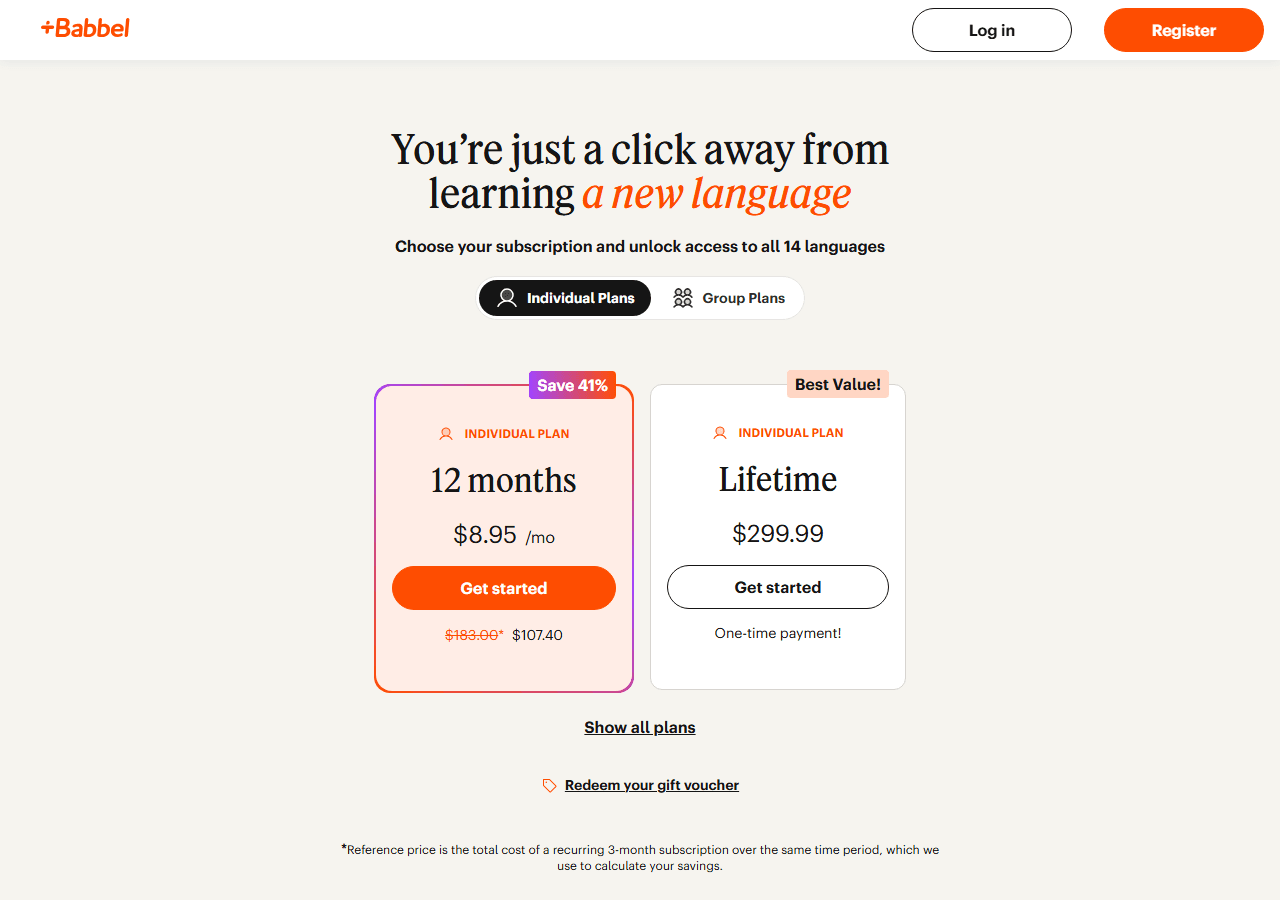
I read my.babbel.com/en/prices more carefully than I read my car insurance renewal, so here’s what it actually says, US prices as of September 2026.
First, the free tier: there basically isn’t one. You get the first lesson or two of a course, which is a trial wearing a free tier’s clothes.
That’s it. There’s no playable free tree the way there is with Duolingo.
Whether that’s a flaw or a virtue depends on you. I lean toward virtue, because “free” is how apps justify making the product about you instead of for you, but your mileage may vary.
My full comparison lives in the Duolingo review if you want the head-to-head.
Free
First lesson or two of a course. That’s the whole free path.
Paid
3, 6, or 12 months. The annual is the one that makes sense: $8.95 a month, $107.40 billed up front.
Lifetime
$299.99 list. Wait for a $169–$199 sale unless you enjoy overpaying on day one.
No energy bar, no hearts, no pretend-free tree.
The 12-month plan is displayed against a crossed-out $183, which is marketing. The $107 is real.
Street sales on lifetime routinely drop it to $169–$199 if you have patience.
There’s also a group plan, up to six people, around $12.75/month on the annual length, which is worth knowing about if you can conscript friends.
Is it expensive? Honest answer: the annual price is about $107, which is less than most people spend on coffee for a quarter, and it’s dramatically cheaper than a tutor, a class, or a flight to Mexico City.
Per lesson, it’s pennies. Per result, it depends entirely on whether you show up.
A $107 subscription you use for two weeks costs $107 for two weeks. The price is fine.
The commitment is the expensive part.
The lifetime question is the one I get most, and my take is: buy lifetime only during a sale, and only if you’re a serial language dabbler. If you’re focused on Spanish, the annual plan is plenty; you’ll either outgrow Babbel’s B1 ceiling before the lifetime pays for itself, or you’ll quit, and lifetime subscriptions are priced by the seller, who has done this math.
But if you’re the kind of person who will genuinely bounce between Spanish, Italian, and German over five years, a $169 lifetime sale is honestly a good deal. It’s two years of annual pricing for infinite years.
Just don’t buy lifetime at $299.99 on day one. That’s buying the all-you-can-eat buffet before knowing if you’re hungry.
One thing I’ll say in Babbel’s defence: there’s no energy bar, no hearts, no wait-for-your-lives-to-regenerate mechanics, no Super-tier upsell maze. “Super” is not a Babbel product; that’s the other guys.
What you pay for is the whole machine, and the machine doesn’t nag you mid-lesson to spend more. After reviewing apps that monetize frustration, I can’t overstate how much this improved my mood.
My usual advice applies: an app is the vehicle, not the driver. If you want the full map of how to actually learn a language, that’s my how to learn a language guide, and if English is your target instead, I’ve written 139 free English lessons, starting with Lesson 1.
Yack, then pay. Or pay, then yack.
Just make sure the yacking happens.
That’s the money picture. Next: what I genuinely liked after two weeks, and what started wearing me down.
What I liked about Babbel, and what wore me down
What I liked
Let’s start with the good, because there’s real good here.
The lessons are built around dialogue you’d actually use. Not “the owl is on the horse” stuff.
Within the first week I could order food, ask for directions, and handle the basic “sorry, my Spanish is bad, please slow down” exchange that honestly covers 80% of tourist conversations. The phrases felt like things a person would say, which sounds like a low bar until you’ve used enough apps to know it isn’t.
The grammar explanations are the other thing I’d keep. Little pop-ups in English that explain why the sentence works the way it does.
If you’re the kind of person who needs the why, this is the whole reason to pay. If you’re not, it’s a mildly interesting footnote and Duolingo is free.
And the Review Manager. I’ll talk more about it below, but it’s the one part of Babbel I still think about now that the sub is off.
It’s spaced repetition done properly, and it’s the difference between “I did a lesson” and “I remember something.”
What wore me down
The drills get dull. There, I said it.
The dialogues are good; the exercise wheel you spin after each dialogue, matching words to pictures, typing translations, filling blanks, is beige. It’s effective beige, mostly.
But around day nine I started watching the clock.
The games are skippable and I skipped them. The podcasts exist but they’re aimed way above a true beginner’s head, like being handed a novel two weeks into learning the alphabet.
And the speech recognition, which I’ll get to, is the single most frustrating feature in the app, which is a competitive category.
None of this broke the experience. But by the end of two weeks I was doing lessons out of discipline rather than curiosity, and an app that can’t keep me curious past day twelve has a ceiling of its own.
Babbel horror stories, and the people it works for
The horror story
No true horror stories from me, but let’s cover the things that go wrong for people, because they go wrong in predictable ways.
The big one: the subscription that won’t die. Not because Babbel is sneaky about it, but because people delete the app and assume that cancels the sub.
It does not. Deleting the app never cancels anything, at Babbel or anywhere.
If you subscribed through the App Store, cancel in the App Store. Through Google Play, cancel in Google Play.
If you bought directly on babbel.com, you cancel in your account settings, and Babbel has a straightforward cancellation guide for exactly this. Took me ninety seconds.
The other classic is the old “one language per subscription” complaint. That was true once.
It isn’t anymore, and you’ll still see angry forum posts about it from years back. Every current individual plan includes all 14 languages.
If you read a review claiming otherwise, check the date.
The one that’s legitimately still a complaint: the auto-renewal at full price. Your $8.95/month year rolls over and suddenly you’re on a pricier renewal than you remember agreeing to.
Set a calendar reminder for week 50 of any annual sub, for any company. This is just adulting with subscriptions.
When it works
Who does it work for? In two weeks I’d say: people who want structure, don’t mind paying, and need grammar explained rather than absorbed.
If you already bounced off a free streak app and want the why, this is the graduation step. Babbel is the app you graduate to, not the one you graduate from.
Who Babbel is for
Short version: beginners to low-intermediate learners who want to pay once and be taken seriously.
Slightly longer version. Babbel is for you if:
- You’ve tried a free app, felt the fun, and then realized you couldn’t actually explain anything you’d “learned”
- You want the grammar why in plain English
- You have 10–15 minutes a day and want those minutes to count
- You’re heading somewhere specific and want survival dialogue, not a gamified habit
- You like a clear path from A1 toward B1 without assembling your own curriculum
If you’re learning Spanish, French, German, or Italian, you’re getting Babbel at full strength. Those four are the flagship courses and it shows in the depth and polish.
Who should skip it
Equally short list.
Skip Babbel if you want Japanese, Korean, Mandarin, Arabic, or Hindi. It doesn’t have them.
That’s not a knock, it’s just the catalogue. Check our language courses coverage for what does serve those languages.
Skip it if you’re already B1 or above. Babbel tops out around A2–B1, and pushing past that with more Babbel is like trying to leave the shallow end of a pool that doesn’t have a deep end.
Skip it if you need free. Babbel has first lessons free and almost nothing else.
There’s no usable free path. If free is the constraint, Duolingo exists, and our complaints about it are on record (it got 4 Yaks from us, and we stand by that), but free is free.
Skip it if you wanted live classes. Babbel Live for individuals ended July 1, 2025.
It’s gone. What’s left is an AI conversation partner, which is a different product wearing a similar hat.
If human teachers are what you’re after, look at tutor platforms in our best language apps roundup instead.
Pros and cons
Pros
- Real-life dialogue, taught in usable chunks
- Grammar pop-ups in English that explain the why
- Native-speaker audio throughout
- 10–15 minute lessons that fit an actual adult day
- The Review Manager is genuinely good spaced repetition
- Placement test so you don’t start from “hola” if you’re past it
- All 14 languages on any individual plan
- CEFR-structured path, A1 to roughly B1
Cons
- Drills get repetitive by week two
- Speech recognition is inconsistent, sometimes strict, sometimes asleep
- Ceiling around A2–B1. No C1, don’t ask
- Practically no free content
- Podcasts too hard for beginners
- Spain vs. Mexico Spanish tracks merge awkwardly after A1
- No Asian or Arabic-script languages at all
- Live classes are dead; the AI partner is a consolation prize
What we'd use instead or with it
I’d never use Babbel alone, and honestly I’d never use any app alone. Two weeks in, here’s the stack I’d actually build.
Babbel plus Anki. The Review Manager is good, but Anki is the industrial version. If you’re serious, move your stubborn vocabulary into Anki decks and let Babbel handle dialogue and grammar.
Overkill for a two-week trip. Exactly right for a year of learning.
Babbel plus italki. If talking to humans is the goal, and it should eventually be, nothing in an app replaces a tutor. Babbel gets you to roughly A2 with confidence; a tutor turns that into speech.
We don’t have an italki review live yet, so see the apps roundup for where it fits.
Pimsleur instead, if you’re audio-first. Pimsleur is all speaking, all listening, no screens required. If you learn in the car or on walks, it beats Babbel’s format.
If you learn by reading and want the grammar explained, Babbel wins.
Yak Cards with it. Yes, our own product, and yes I’m biased, but I’m biased for a reason. Yak Cards are compact phrase cards built around the situations Babbel teaches, so you can reinforce the same material away from a screen.
Babbel gives you the lesson; the cards keep it in your pocket. That pairing worked better for me than Babbel’s in-app games did.
And if you’re learning English rather than Spanish, we’ve got 139 free English lessons here, starting with Lesson 1. Free beats $8.95 a month when it’s sitting right there.
For the broader “how do I actually learn a language” question, our how to learn a language guide covers what apps can and can’t do, and where Babbel fits in a real plan. The short version: apps are the gym membership, not the trainer.
What others are saying
I checked what other reviewers landed on, partly to see if my two weeks matched anyone else’s longer runs. Mostly, yes.
One thing I’d wave a small flag at: Babbel’s famous “92% efficacy” stat gets quoted in a lot of write-ups. It’s a company-funded study from 2016. I’m not calling it fake, I’m saying I wouldn’t put my own money on a casino’s own audit. My two weeks suggested “useful,” not “92% of anything.”
FAQ
Prices, plan names, and features below are as of September 2026.
Is Babbel free?
The first lesson of each course is free. After that, it’s a subscription.
There’s no usable free tier.
Is Babbel Live still a thing?
No. Live classes for individuals ended July 1, 2025. The AI conversation partner is what remains.
How much does Babbel cost?
Current US pricing from Babbel’s own pricing page: 3 months at $15.25/month, 6 months at $13.45/month, 12 months at $8.95/month ($107.40 billed up front), lifetime at $299.99 list and frequently on sale for $169–$199.
Is the Babbel lifetime worth it?
Only if you’ll study for more than about 18 months or want multiple languages. At a $199 sale price it pays for itself inside two years of annual subs.
If your realistic commitment is one trip to Mexico, buy three months and move on.
Babbel vs. Duolingo?
We gave Duolingo 4 out of 10. Babbel is the paid, serious sibling: real grammar explanations, real dialogue, no gamified nonsense, but no free path either.
Duolingo for free fun, Babbel for actual learning. Neither gets you to fluency alone, and our full reviews cover the differences in detail.
Can you get fluent with Babbel?
No. Ceiling is roughly B1 on the flagship languages. Past that you need conversation with humans and real input.
How do I cancel Babbel?
Cancel wherever you bought it: App Store, Google Play, or your account on babbel.com. Deleting the app does nothing.
If you bought directly from Babbel, there’s a 14-day withdrawal window. The old 20-day money-back guarantee is gone.
Do all Babbel plans include all languages?
Yes, on current individual plans. The old one-language-per-subscription setup is long dead.
Is Babbel good for Spanish?
Yes, it’s one of the flagship four. Just know the Mexico track reportedly folds into the Spain track after A1, and I noticed the shift in vocabulary and accents myself.
Check the Spanish course page or our own Spanish guide.
Does Babbel have Japanese?
No. No Japanese, Korean, Mandarin, Arabic, or Hindi. Fourteen languages, mostly European.
After two weeks with Babbel
So where does that leave us?
Babbel is the rare app I’d pay for and still complain about. The lessons are well built, the grammar explanations earn their keep, and the Review Manager is the best single feature in the product.
It got me from essentially nothing to functioning tourist Spanish in two weeks of 10-minute sessions, and that’s a real result, not a marketing claim.
But the drills go stale, the speech recognition is moody, the ceiling is A2–B1 no matter how long you stare at it, and the fun parts (games, podcasts) range from skippable to misaimed. It’s a textbook: an excellent, well-organized textbook that occasionally buzzes at you.
My honest recommendation: if you’re a beginner in Spanish, French, German, or Italian, and you want structure more than you want free, Babbel is worth the annual price. Skip the monthly plans, they’re a bad rate.
Grab it on sale if you can, stack it with a tutor or Yak Cards or Anki for reinforcement, and leave it behind when you hit B1.
If you want free, or you want Japanese, or you’re already conversational: wrong door, no shame, the apps roundup has your answer.
7 out of 10 Yaks
Solid teaching, real structure, honest ceiling, boring drills. Two weeks in, I learned Spanish and learned what I’d buy instead.
Both were worth the subscription.