


I’ve been yacking about language apps on this site for a few years now, and every so often I get asked the same question in slightly different words: “What’s the one that actually makes you talk?” And the honest answer, the one I keep landing on, is Pimsleur.
Not because it’s the most fun, not because it’s the prettiest, and definitely not because it’s cheap. Because it’s the one that grabs you by the collar and makes you say sentences out loud, in a real accent, before you can even read the word for “bread.”
So this past stretch, I finally did the thing properly. Two full weeks of Pimsleur Spanish (Latin American), one lesson a day, the way the method says you’re supposed to do it.
Thirty minutes of audio, mostly while walking around my Ontario neighbourhood with one earbud in, sometimes while doing dishes or pretending the stove needed scrubbing. I even cheated once, on day four I think, and did a second lesson back to back in the kitchen, just to see whether my brain would hold onto it.
Spoiler: it did not, and I’ll get into that.
Let me set expectations before we yack any further. This is not a lab study.
This is me, a phone, a pair of earbuds, and a lot of sidewalk. I’m 40, I’m Canadian, and I’ve got opinions about language apps the way some people have opinions about hockey referees.
I’ve used Duolingo, I’ve written about it here, and I’ve got a whole reviews section if you want to see what else I’ve poked at. Pimsleur is a different animal, and it deserves its own honest yack.
6 out of 10 Yaks



That’s a good score, not a great one. It’s the score for a method that genuinely works for what it claims to do, building spoken basics and a decent accent, while being boring enough that you need real discipline to survive five levels of it.
It’s also the score for a product whose pricing looks simple on the surface and gets weird fast once you start comparing audio-only to Premium to All Access to lifetime to CDs. We’ll get there.
Trust me, there’s a spreadsheet happening in my head and it’s not pretty.
The thing about Pimsleur is that it’s old. Not old like “a 2015 app with skeuomorphic design” old.
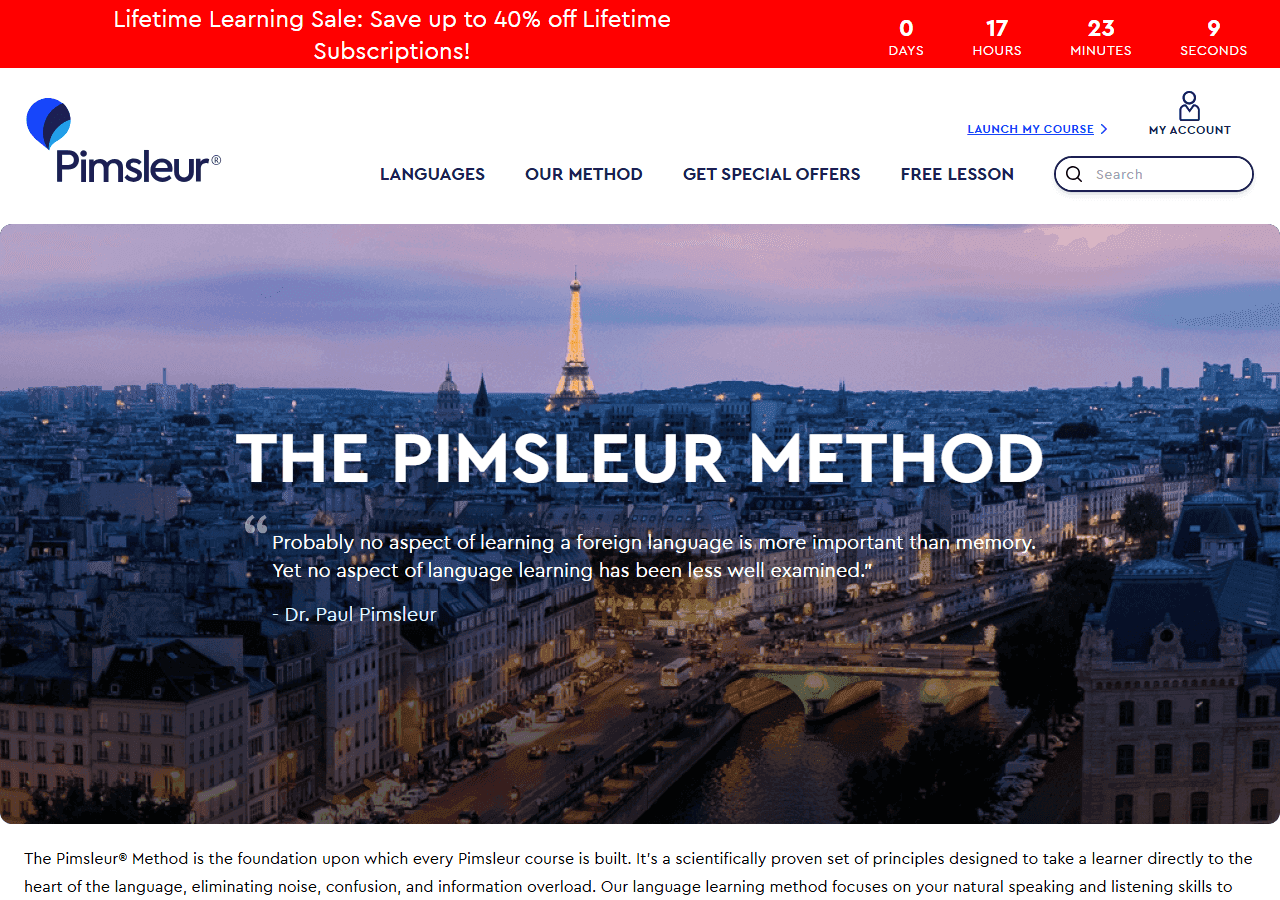
Old like “developed by a linguist in the 1960s who studied how memory decays” old. Paul Pimsleur built this thing around graduated interval recall, which is a fancy way of saying the audio asks you a word right when you’re about to forget it.
The company has kept the core method almost untouched for decades, slapped an app on top, added some extras of varying quality, and charged accordingly. And weirdly, the stubbornness is the point.
When everything else in this space gamifies itself into a slot machine, Pimsleur is just a voice in your ear saying “How do you say…” and then going quiet, waiting for you to fill the pause.
That pause is the whole product. We’ll talk about it a lot.
Anyway. Two weeks.
Let me get into it.
What Pimsleur actually is
Pimsleur is an audio-based language course. That’s the core of it and always has been.
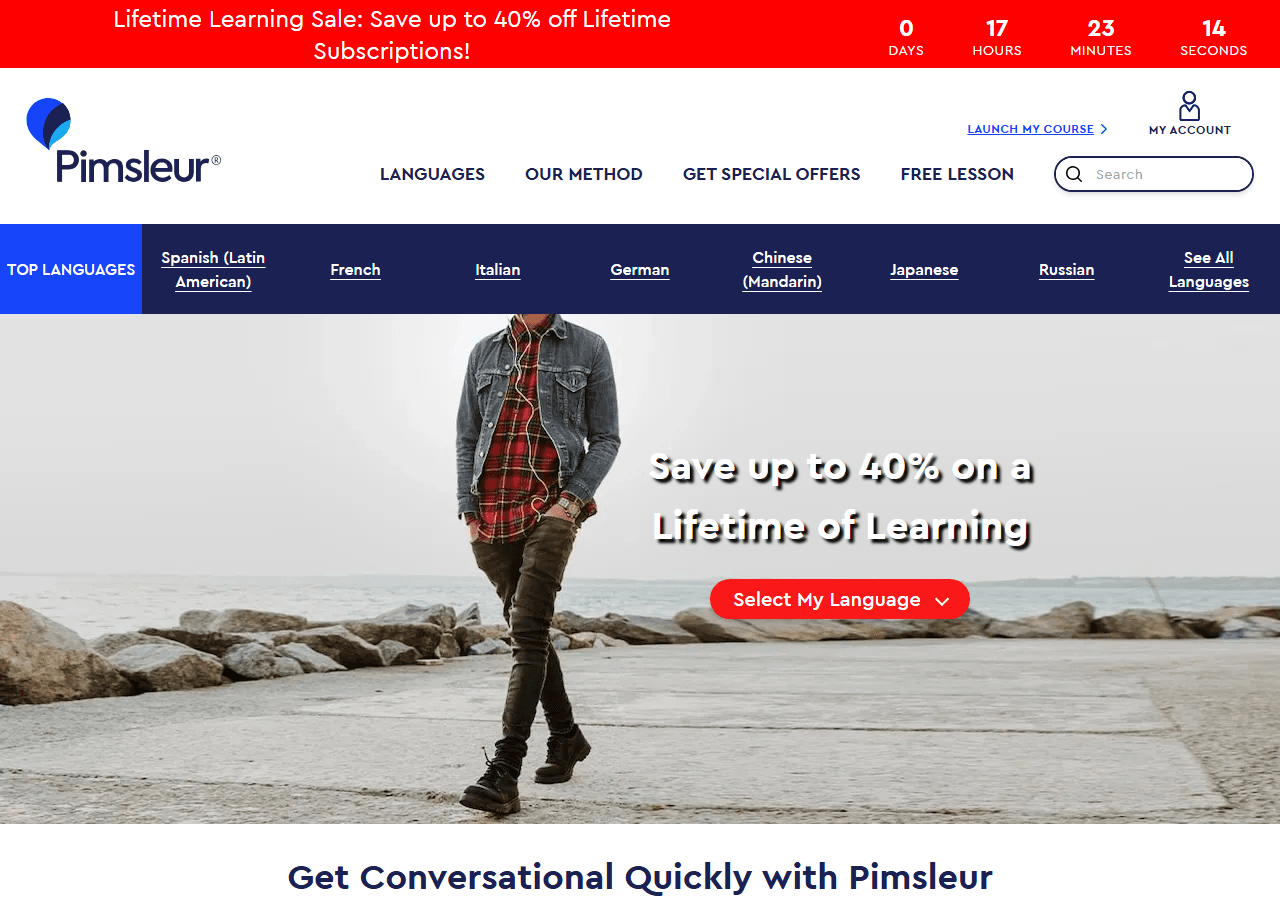
Each lesson is 30 minutes, you listen, a narrator speaks English prompts, native speakers respond in the target language, and you’re expected to speak out loud during the built-in pauses. There’s no typing unless you go looking for it, no cartoon characters, no streaks screaming at you, no hearts running out.
Just audio, and you, and your mouth.
The method rests on a few deliberate choices:
- Graduated interval recall. Words come back at spaced intervals, timed roughly to when you’d naturally start forgetting them. You say “buenos días” early in the lesson, then it resurfaces later, then again tomorrow. You don’t memorize a list. The list kind of memorizes you.
- A tiny core vocabulary, on purpose. The flagships, like Spanish, run five levels of 30 lessons each. That’s roughly 75 hours of audio, and the vocabulary is intentionally small. Pimsleur’s argument is that a few hundred words used automatically beats a few thousand words you have to think about.
- No grammar lessons, and they boast about it. This is official positioning, not an oversight. You absorb patterns from the dialogues and the prompts. Nobody ever says “this is the preterite tense.” You just start saying things that happen to be grammatically correct because you’ve heard the shape of them enough times.
- You speak before you read. Reading lessons exist, tucked at the end, but the design assumes you’ll produce practical spoken lines before you can decode a menu. It’s the exact opposite of how most of us suffered through high school French.
That last point deserves a little airtime because it’s what makes Pimsleur feel strange at first. You spend your first days confidently saying things like “Buenos tardes, señora. ¿Dónde está la calle Ocho?” and you could not read a street sign if your life depended on it.
It’s a weird, backwards feeling. It’s also, apparently, how humans mostly acquire language, and Pimsleur leaned into it back when everyone else was handing out verb charts.
The other thing worth knowing upfront: Pimsleur is famously, aggressively unglamorous. The dialogues are polite to the point of being fake.
Everyone is asking about dinner and drinks and where things are with a formality that feels like a 1970s textbook. Nobody in a Pimsleur lesson has ever been hungover or mildly annoyed at a bus driver.
Boring is half the brand, and I mean that as a neutral observation, not a slam. It shapes who this thing works for, which we’ll get to later.
One more framing note. Pimsleur sells subscriptions, lifetime packages, and physical CDs.
Yes, CDs. In the current year.
They still exist, they cost more, and there’s a weird collector’s-item vibe to the whole thing. I’ll break down all of it in the pricing section because that’s where Pimsleur gets messy.
How we used it for two weeks
Here’s the honest play-by-play. One lesson a day for two weeks, Spanish (Latin American), Level 1, starting at lesson 1 like a normal person.
The app on my phone, earbuds in, and I did my best to follow the “one lesson per day, don’t binge” rule that Pimsleur itself pushes.

Most days this happened on a walk. There’s a loop near me that takes about 40 minutes if I’m ambling, and a 30-minute lesson fits into it with room left over for standing awkwardly at a crosswalk while saying “Mucho gusto” at nobody.
That’s the natural habitat of Pimsleur: hands-free, legs moving, eyes free to watch for cars. If you can walk and chew gum, you can do Pimsleur.
If you need to look at a screen to feel like you’re learning, this will feel like radio homework.
A few lessons happened in the kitchen. Dishes, counters, the usual.
Kitchen Pimsleur works fine except for one hazard: the pause where you’re supposed to speak. Out on the walk, I’d fill the pause without thinking, talking to the sidewalk like a person with a Bluetooth headset and an important call.
At the sink, with both hands in dishwater, I noticed I’d sometimes just… listen to the pause pass. Bad student.
The pauses only work if you actually open your mouth, and there’s something about doing chores that lets you slip into passive listening mode. Walking kept me honest.
Scrubbing did not.
Now, the cheat. Day four, feeling cocky because lesson 3 had gone smoothly, I did two lessons back to back while cooking.
Lesson 4, then lesson 5, same evening, no break. Here’s what happened: the second lesson went in noticeably worse.
Not catastrophically, but the recall prompts in lesson 5 kept landing on words from lesson 4 that had already started sliding, and I was fumbling things I’d nailed that morning. The next day, day five, when lesson 5’s material came back for review, the bits from the doubled-up session were mushier than the bits I’d done once, properly, the day before.
I want to be careful here. This is one guy, one kitchen, one evening.
It’s not evidence, it’s an anecdote. But it lines up exactly with what Pimsleur tells you to do, which is one lesson a day and let sleep do its work.
The spaced repetition is built around daily cycling, and stacking lessons back to back seems to gum up the schedule the method depends on. I stopped cheating after that.
One lesson, one day, done. The method knows what it is.
I’m the one who thought I was special.
The other detail worth reporting: I never did a lesson sitting still. Not once.
Every time I considered doing one on the couch, some part of me resisted, and I think I understand why. Sitting with Pimsleur makes the pauses feel like waiting.
You sit there, the silence stretches, and your hand creeps toward your phone to check something. Walking turns the pauses into a rhythm instead of dead air.
That’s my two-week finding on usability and I’d bet real money it generalizes: this is a product for people in motion.
How a 30-minute lesson actually works
Since the lesson is the entire product, let me take one apart.
You hit play. A narrator greets you, then two native speakers run a short dialogue in Spanish at conversational speed.
You understand nothing. That’s fine, that’s the design.
Then the narrator breaks it down. “Listen to this phrase,” and a speaker says a chunk slowly.
Then you get the pause: the narrator says “Say…” in English, gives you a beat or two of silence, and you say it out loud in Spanish. Then the native speaker says it, and you get to hear how wrong you were.
Then it starts weaving. The narrator introduces a word or two at a time, always with a little hook.
There’s a trick where they tell you a Spanish word sounds like part of an English phrase, or they spell out a sound (“the ‘t’ in Spanish is soft, like in ‘butter'”). You repeat in chunks, then the chunks get longer, then the narrator starts asking you to combine things in ways you haven’t literally drilled.
That’s the moment the method shows its teeth. When the prompt is “Ask if she wants to drink something” and you assemble a sentence you were never explicitly taught, and it comes out right, that’s a small genuine high.
It happens earlier than you’d expect, around lesson 3 or 4.
The dialogue from the start of the lesson comes back at the end, and this time you understand it. It’s a cheap trick and it works on me every single time.
There’s something deeply satisfying about 30 minutes ago that was noise, and now it’s meaning.
Scattered throughout, the recall prompts fire. A word you learned 10 minutes ago comes back.
A word from yesterday’s lesson gets slipped in. The narrator asks you something and the pause waits.
This is the graduated interval stuff doing its job, and within a lesson you can feel it working. You can also feel it when you skipped a day, which I did once, on day 9.
The lesson after a skipped day is noticeably rougher. The method does not forgive laziness, it just quietly makes the next session harder.
At the end of each lesson there’s a short reading segment in the app, where you look at the words you’ve been saying and finally see how they’re written. Honestly, these felt like a formality.
By the time you read “buenas noches,” you’ve said it 40 times. The reading lesson is just meeting the spelling afterward, like being introduced to someone whose voice you already know from the phone.
Is it fun? No. Is it effective?
For producing spoken phrases with a decent accent, yes, at a rate that surprised me. Is 30 minutes a day a big ask?
Sort of. It’s one TV episode.
But it’s one TV episode of the same show, every day, where nothing explodes and everyone orders dinner politely.
Speaking, the vocab ceiling, and the no-grammar thing
Here’s what two weeks actually got me, concretely.

I can say a stack of practical lines, automatically. Greetings, asking where things are, saying what I want to drink, ordering dinner, the polite small-talk essentials.
If you dropped me in a taco place in Guadalajara tomorrow, I could function at the counter for about 90 seconds before the conversation outran me. That’s a real 90 seconds though.
Not “I know some words” 90 seconds. Actual sentences, coming out with an accent that a Spanish-speaking friend of mine described as “annoyingly decent for two weeks.”
The pronunciation is the standout. Because you repeat after native speakers constantly, and because the course slows sounds down and tells you how they’re made, the accent sticks in a way that reading-based apps never managed for me.
I’ve hit the point where my mouth makes Spanish vowels without me thinking about vowels at all. That’s Pimsleur’s doing and I’ll give it full credit.
The vocabulary ceiling is real though, and it’s by design. Two weeks in, I’m pretty sure I know fewer than 80 words.
Maybe fewer. Pimsleur runs lean on purpose, drilling a small set until it’s automatic rather than spraying you with volume.
The trade is: those 80 words are bulletproof. The other trade is: you will finish a level and realize you can’t talk about your job, your weekend, or anything that happened yesterday.
The tense coverage comes slowly, spread across the levels, absorbed rather than taught.
Which brings us to the no-grammar boast. Pimsleur officially markets that it doesn’t teach grammar, and for the first week I was on board.
You just start saying things correctly. Somewhere in week two I hit the wall every Pimsleur user hits: I wanted to say something the dialogues hadn’t shown me, and I had no machinery to build it.
I knew words, but I didn’t know how the language bent. No rules to lean on, because none were ever given.
The absorbed patterns carry you exactly as far as they carry you, and then you’re standing at the edge of what you’ve heard.
The official claim is conversational in 30 days. Two weeks is halfway, so let me report from the midpoint: I’m not conversational, but I’m speaking, and those are different things and I want to be fair about the gap.
Also worth noting, from what I’ve seen around me: people who did Duolingo for ages and never said a word can actually open their mouth after a Pimsleur level. That’s the product working.
Meanwhile, people who finish all five levels of Spanish still come out needing more, more vocab, more listening, more actual conversation. Pimsleur is a foundation, not a destination, and both of those facts are true at once.
App vs CDs vs Premium extras
Pimsleur comes in a few flavors and it’s worth knowing what you’re actually paying for.
The app subscription is the normal way in. You get the audio lessons, lesson syncing across devices, and depending on your tier, the extra features.
The app itself is fine. It’s not beautiful, but it plays the lessons, tracks where you are, and gets out of the way, which is honestly all you want.
The Premium tier adds what they call extras: Voice Coach, which scores your pronunciation, flashcards, a Speak Easy feature for playing with the dialogues, speed controls, and so on. Here’s my blunt take after living in the app for two weeks: they’re toys.
Voice Coach is finicky with background noise, which is a problem for a product whose whole habitat is walks and kitchens. The flashcards are fine and unnecessary, the method already drills you.
Speak Easy is kind of neat for about four minutes. None of it is why you’d buy Pimsleur, and I’d be surprised if anyone uses the extras past week two.
The audio method is the product. Everything else is garnish on a dish that didn’t need garnish.
The CDs still exist. This genuinely delights me. Simon & Schuster still sells boxed CD sets, and they cost meaningfully more than the digital equivalent.
We’re talking hundreds of dollars for what is, functionally, the same audio files with worse pause-button ergonomics. If you have a CD player in your car and a deep distrust of subscriptions, I guess?
There’s also a third path nobody talks about enough, which I’ll flag here and expand on in pricing: a lot of libraries carry Pimsleur, digitally even, through apps like Libby. The library can hand you the exact same audio for free.
I’m Canadian, so I checked my local library’s catalogue and yep, there it was, sitting smugly beside the DVD box sets. Undercutting a 60-year-old course with the library card your taxes already paid for is extremely on brand for this country.
So the practical ranking goes: app subscription for basically everyone, Premium only if the price gap to it is trivial, CDs for a very specific kind of person I’ve maybe met twice.
Languages: flagship vs one thin level
Pimsleur covers a lot of languages, but not equally, and this matters a lot for choosing it.
The flagships, like Spanish, get the full five levels of 30 lessons each. That’s roughly 75 hours of audio, a real course with a long runway.
Spanish, French, German, Italian, and a few other heavy hitters sit in this tier. If you’re learning one of these, you’re getting the actual complete method as designed.
Then there’s the long tail. Plenty of languages get one level, audio-only, 30 lessons and done.
That’s not a course exactly, it’s a strong start with a hard stop. If your target language lives in that tier, you need to know going in that Pimsleur will take you through tourist-plus territory and then leave you at the bus stop.
One level will genuinely get you speaking basics with a good accent. It will not make you conversational in the language, whatever the marketing implies, because there isn’t enough material for that.
The wrinkle is the All Access subscription, which we’re about to cover in pricing. It covers 50-plus languages, and since it costs barely more than Premium for a single language, it quietly changes the math if there’s any chance you’ll touch a second language, even casually.
I sat there on the couch with my phone doing that exact comparison, staring at the two subscription buttons, and I’ll tell you how I reasoned it out below.
If Spanish is your target, by the way, I keep a whole pile of Spanish material here, and the broader language courses shelf has the rest of the catalogue if you’re going off-menu.
Pricing: audio, Premium, All Access, lifetime, and whether this is expensive
Alright, the messy part. Pimsleur’s pricing in US dollars, roughly, because prices shuffle around more than they should:
Audio
About $14.95/month, one language. Just the lessons.
Premium
About $19.95/month, one language. Lessons plus the extra features we already established are toys.
All Access
About $20.95/month, 50-plus languages, and you can add extra user profiles. A dollar more than Premium buys the entire catalogue.
The honest option if you already know that’s all you want.
Read those again, because the gap between Premium and All Access is a dollar. One dollar.

If you have even a passing “maybe I’d also poke at some Japanese” thought in the back of your head, All Access is the sane plan and Premium is basically a rounding error away from being a bad decision. The audio-only tier at $14.95 is the honest option for people who know exactly what they want and want nothing else, and honestly, given that the audio is the entire product, it’s not a bad pick.
But a dollar for 49 more languages is the least difficult upsell in the industry.
There’s a 7-day free trial, though be aware it’s often audio-only, so if you trial it and find it bare-bones, that’s why. There’s also a 30-day money-back guarantee, which they’ve apparently honoured for decades, old-school-style, no interrogation.
That takes a lot of the risk out of a first month.
Then there’s the lifetime stuff, still sold, and this is where it gets spicy:
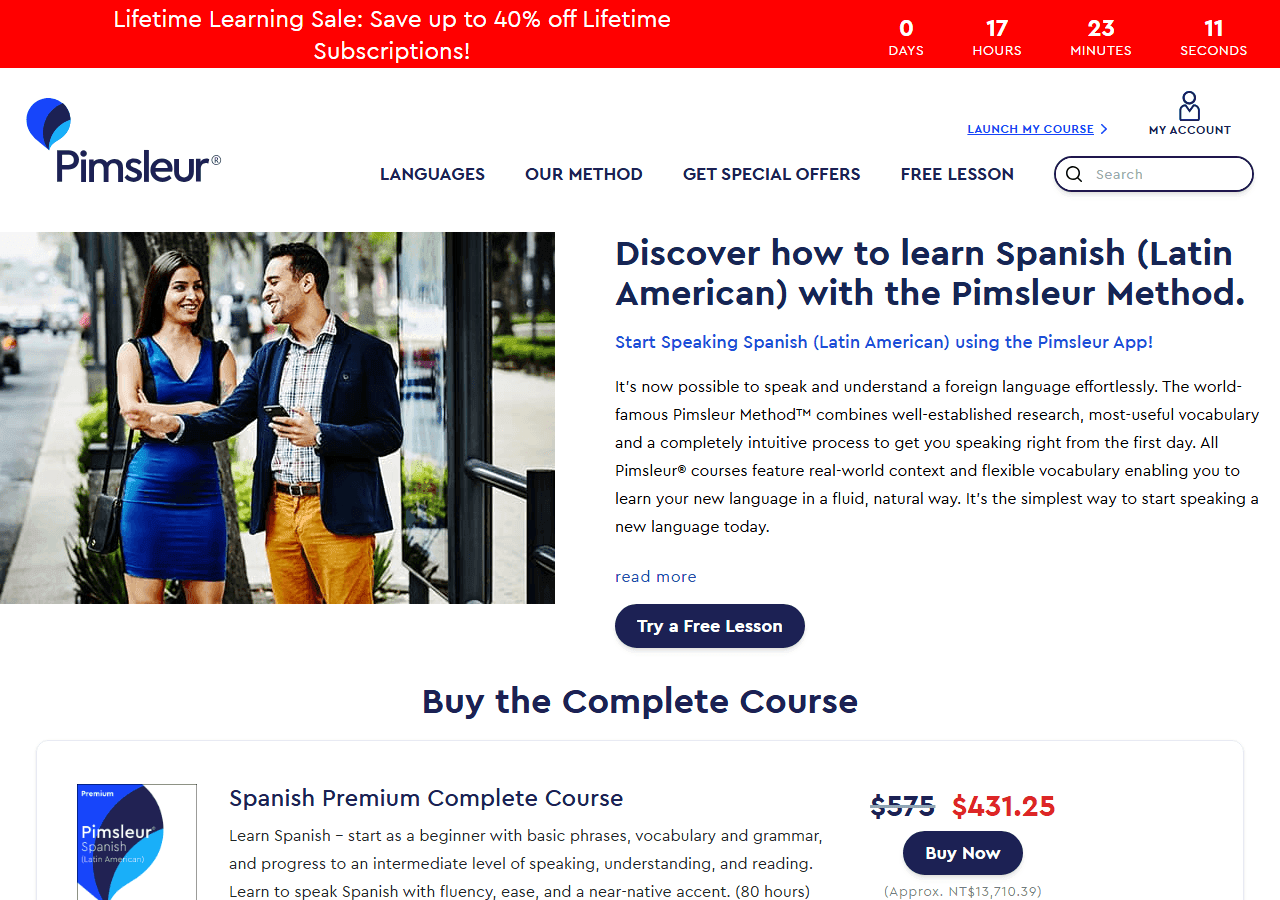
- Spanish Premium complete, all five levels, lifetime: $575 list, and it floats around $431 on sale.
- All Access lifetime, everything, forever: $798 list, drops to roughly $479 on sale.
- Single level Premium lifetime: about $150, around $112 on sale.
Look at those numbers for a second. All Access lifetime at $479 is barely more than one language’s lifetime at $431, and it’s every language Pimsleur will ever add.
The single-language lifetime pricing is almost indefensible by comparison. If you’re a lifetime buyer, buy the whole shelf or don’t buy at all.
And the CDs. The Level 1 French CD set runs about $345.
For level one. Of the CDs.
I don’t have a joke that’s funnier than the price itself, so I’ll just leave it sitting there.
Is Pimsleur expensive? Here’s my honest math.
At the subscription tier, no. Twenty bucks a month is less than most streaming bundles and it’s the productive one. If you do one level in a month and cancel, that’s 30 hours of effective speaking practice for $21, which is absurd value against any tutor, and I say that as someone who generally likes tutors.
The lifetime prices only make sense if you’re a genuine multi-year, multi-language person, and at that point the $479 sale price on All Access lifetime is actually reasonable. Where Pimsleur becomes expensive is if you buy single-language lifetime at full price, or if you buy CDs, or if you subscribe for years at $20.95 doing one language slowly.
Then you’re paying real money for a drip.
And the library. I keep coming back to it because it’s the best-kept boring secret in this whole ecosystem: many libraries give you Pimsleur for free.
Check before you buy. If your library has it, the entire pricing section above becomes a suggestion rather than a rule.
That’s the money picture. Six out of ten Yaks so far, and we’re not done yet.
Next up: what I liked, what wore me down, and who should run screaming from this thing.
What I liked about Pimsleur, and what wore me down
What I liked
The honest answer to “what did I like” is: the walking. Two weeks in, the pattern was obvious.
Days I took the lesson on a walk, it landed. Days I sat at the kitchen table with the phone in front of me, the pauses felt like waiting for a bus that’s late, and my mind wandered into the fridge.
That’s not a small thing. Most language apps demand your eyeballs.
Pimsleur wants your ears and your mouth, and your hands are free to fold laundry or steer a shopping cart. For anyone with a commute or a dog, that’s the whole pitch, and it delivers on it.
The second thing I liked: the speaking order is right. You produce practical sentences early.
“Where is the hotel,” “I’d like something to drink,” “I’m hungry.” I could say a drink-and-dinner sentence before I could read a menu, which sounds backwards but is actually the correct order for a talking animal.
Reading is easier to add later than the reverse.
Third: pronunciation. The native speakers, the constant choral repetition, the way they break words into chunks and rebuild them, it sticks.
My friend who took a call in Spanish mid-experiment said my accent was “annoyingly good for two weeks.” Best compliment I got all month.
What wore me down
What wore me down? The vocab ceiling.
Pimsleur keeps the core vocabulary tiny on purpose, and by day ten I could feel it. I wasn’t learning new words so much as re-saying the same forty sentences with slightly different confidence.
Fine for a month. Deadening for two.
Also the dialogues. Polite, formal, occasionally fake.
Nobody warns you that the default register sounds like you’re a travelling insurance salesman from 1994. “Disculpe, señor” everywhere.
Useful scaffolding, weird destination.
And it’s boring. This is not a bug, it’s half the brand, and I half respect it.
But by lesson eleven I had to negotiate with myself to press play. The method works; the vibe is oatmeal.
Horror stories, and who it works for
The horror story
I don’t have horror stories in the billing-nightmare sense, but the internet does, and the pattern is consistent: people buy the lifetime or CD sets, use them for a month, and the money is gone into the couch. Pimsleur has a 30-day money-back guarantee, which is genuinely decent, but you have to actually use the refund window instead of “next week for sure.”
The subtler horror story is the completionist one. Someone grinds all five levels, 150 lessons, 75 hours, feels accomplished, then freezes at a real bakery counter because the cashier talked fast and used words outside the deck.
Duo users do this too, but Pimsleur finishers are more surprised by it, because they did speak out loud the whole time. The gap between “spoke in the pauses” and “held a conversation” is real, and Pimsleur’s marketing does not oversell it exactly, but it leans on it.
When it works
Who it works for: people who talk to themselves anyway. Commuters, walkers, dishwashers, anyone whose day has dead audio time.
People who specifically need to get their mouth around a language fast for a trip. People who’ve bounced off gamified apps because streaks feel like homework.
Who it's for
- Commuters and walkers. This is the habitat. If your hands are busy but your ears are free, Pimsleur is arguably the best fit in the entire app category.
- People who want to speak before they want to study. You’ll say useful sentences in week one with no grammar tables in sight.
- Learners who’ve bounced off Duolingo because swiping cartoon owls felt like a game with a language attached. Pimsleur is the anti-that.
- Anyone targeting pronunciation early. The audio-first design does this better than almost anything at the price.
- Beginners. The method assumes nothing. If you already have a base, the first level will feel like slow motion.
Who should skip it
- People who need to read and write soon. Menus, signs, texts, emails. Pimsleur gets you speaking way before reading, and some languages ship audio-only, full stop.
- Grammar people. If you want to know why, Pimsleur’s official boast is that it never teaches grammar, and it means it. You’ll infer patterns or you’ll suffer.
- Vocab hunters. If you want breadth, the deliberately tiny core vocabulary will drive you up the wall.
- Anyone who cannot do audio-only for 30 minutes. If sitting still with headphones makes you feral, this is the wrong tool, no matter how good the method is.
- Screen-streak people who need flashing lights and XP. There’s a streak counter in the app and it’s about as motivating as a stamp on a library card.
Pros and cons
Pros
- Genuinely hands-free. The only big method that fits walks, chores, and commutes without cheating.
- You speak real sentences from lesson one, and pronunciation sticks.
- The spaced repetition (graduated interval recall) is doing real work; you can feel old words resurfacing on schedule.
- One lesson a day is a sustainable pace. No decision fatigue.
- 7-day trial and a 30-day money-back guarantee soften the entry.
- Boring in a way that builds a habit, if you can stomach it.
Cons
- Tiny vocabulary by design. The ceiling arrives fast.
- No grammar explanation at all, which works until it doesn’t.
- Reading and writing are afterthoughts (or absent in audio-only languages).
- Some languages get the full five-level flagship; others get one thin level. Russian roulette depending on your target.
- Premium extras are toys. Voice Coach, flashcards, Speak Easy: decoration.
- The 30-days-to-conversational claim is doing some heavy lifting.
What we'd use instead or with it
Nothing replaces Pimsleur’s core trick, so I wouldn’t replace it for a commuter. I’d pair it.
The obvious combo is Pimsleur audio for the mouth plus a reading/writing app for the eyes. Duo handles the gamified alphabet-and-script side decently, and we’ve written that up in our Duolingo review.
Duo people who couldn’t produce a sentence get talking after a Pimsleur level, and Pimsleur people who couldn’t read get un-illiterate. They cover each other’s weakest limb.
If I were building a Spanish stack from scratch on a budget, it’d be Pimsleur at the base for speaking rhythm, a free or cheap reader for actual text, and conversation practice once the sentences come out on their own. Our full best language learning apps breakdown does the comparison properly, and there’s a general method guide if you want the philosophy without the brands.
For Spanish specifically, we keep a whole learn Spanish section fed with what actually worked. And once you’ve got a toe-hold of words, our Yak Cards are the retention layer, spaced repetition you control, which fixes exactly the thing Pimsleur refuses to do: grow your vocabulary.
If you’re course-shopping across languages, the language courses shelf has the rest of the store.
What others are saying
The consensus out there is remarkably consistent with what we found, which is either reassuring or suspicious.
Nobody out there claims it makes you fluent, and neither do we.
FAQ
Prices, plan names, and features below are as of September 2026.
Is there a free trial?
Yes, 7 days, and it’s often limited to the audio-only tier, which is actually the correct way to trial it, because the audio is the product. Try it on a walk, not at a desk.
Between the trial and the 30-day money-back guarantee, you can find out if you’re a Pimsleur person without paying for the discovery.
All Access or Premium?
All Access, if there’s any chance you’ll touch a second language. Premium is one language with the extra toys for about $19.95/month, and All Access, all 50+ languages, is $20.95.
That’s a dollar. If you’re 100% locked on one language forever, audio-only at $14.95 is the honest buy, since the Premium extras are decoration.
Otherwise All Access is the only sane plan.
Do people still buy the CDs?
They exist, and they cost more, sometimes a lot more. A Level 1 French CD set runs around $345, which is a time capsule with a price tag.
There’s a nostalgic argument and a resale argument, and no other arguments. The app does everything the CDs do with less shelf space.
Pimsleur or Duolingo?
Different machines. Duolingo is a visual, gamified habit-builder with shallow speaking.
Pimsleur is an audio method that gets your mouth moving and your vocabulary barely moving. Duo builds the streak; Pimsleur builds the sentence.
If you can only pick one and your goal is talking, Pimsleur. We go deeper in the Duolingo review.
Will I be conversational in 30 days, like they claim?
You’ll be able to say polite, practical things and understand slow, polite replies. That is a form of conversational, the way a tricycle is a form of transport.
We did not become fluent in two weeks, and 30 days of one level won’t get you there either. Finishers still need more input, more vocabulary, and real humans.
What the claim does have going for it: after a level, people who previously couldn’t produce a sentence can, which is more than some apps manage in a year.
Can I cancel the subscription?
Yes, cancel anytime through your account settings, and the 30-day money-back guarantee covers the early bail-out. Just don’t buy the lifetime tier as a motivational strategy.
That’s where the couch money goes to die.
After two weeks: our Pimsleur verdict
6 out of 10 Yaks
What earns the six: it does the one thing almost no other app does, hands-free spoken production, and it does it well. Two weeks of walking and kitchen Spanish got me saying full sentences with an accent that annoyed my friend, and the daily 30-minute rhythm is the rare language habit that doesn’t demand willpower or a screen.
The trial and refund policy are honest. The core method is sixty years of audio-course craft and it shows.
What holds it back from more: the vocabulary ceiling you hit by week two, zero grammar, reading as an afterthought, the uneven language catalog (flagship Spanish versus one-level everyone-else), and Premium extras that feel like the free toy in the cereal box. It’s also boring, deliberately, and boring has a real dropout cost no matter how sound the pedagogy is.
The right frame is this: Pimsleur isn’t a language course, it’s a speaking habit with a language attached. If your life has audio-shaped holes, walks, commutes, dishes, fill them with this and it’s worth every dollar of the monthly tier.
If you learn by reading, want breadth, or need grammar to feel oriented, it’ll feel like a very well-produced bottleneck.
Our advice for the curious: do the 7-day trial on actual walks, not at a desk, subscribe monthly rather than committing hundreds to lifetime, and bolt on a reader and some Yak Cards for vocabulary growth. Keep browsing the reviews shelf if Spanish isn’t your target, and if English is the language you’re after, our own course starts at Lesson 1 of 139.
Two weeks, thirty minutes a day, and I can order dinner in Spanish with a decent accent and a small vocabulary. That’s a 6 out of 10 Yaks product that knows exactly what it is.