



A friend and I did something slightly ridiculous this winter: we spent two weeks shopping for a human being.
Specifically, a Spanish tutor. We’d been duo-ing our way through apps for months and the honest truth is I could recognize the word for “horse” but I could not order a coffee in Mexico City without sweating through my shirt.
Apps are great for input. They are terrible at one specific thing: making you open your mouth and produce Spanish while a live person waits.
That gap is exactly what a tutor is for, and no streak icon on earth fixes it.
So we trial-shopped. Two discounted trial lessons on italki (one from a “professional” teacher, one from a community tutor), one paid trial on Preply, and we opened accounts on Verbling, Cambly, and Lingoda long enough to poke around the pricing, the booking flows, and the tutor listings.
No lab coats, no spreadsheet with forty columns, no A/B testing. Just two people in Ontario with a shared calendar and a mild fear of speaking bad Spanish out loud, spending real money to see what these platforms actually feel like from the inside.
The short version: live tutors are the single best thing you can spend language-learning money on, and the platform you pick matters way less than the specific tutor you land on. That second part surprised me.
I went in assuming the brands were meaningfully different products. They’re mostly different billing systems wrapped around the same species of human being with a webcam and a lesson plan.
8 out of 10 Yaks



That’s for the category, not for any one site. Actual conversation with an actual person beats every app I’ve yacked about, and the only reason it’s not higher is that the billing models on some of these platforms will occasionally make you feel like you joined a gym in January.
What an online tutor actually is
Strip away the marketing and an online language tutor is a person, on a video call, whose job is to make you talk in a language you don’t yet speak well. That’s it.

Some are certified teachers with lesson plans and homework. Some are patient conversationalists who will let you butcher verb conjugations for an hour and gently correct you.
Both count. Both are valuable.
They’re just different tools.
The platforms in this space are marketplaces, mostly. italki, Preply, and Verbling all work on the same basic model: a big searchable catalog of tutors, each setting their own price, with the platform taking a cut for handling booking, payments, video, and the awkward part where you never have to email a stranger your credit card number.
You browse profiles, watch intro videos, book a trial, and go from there.
Cambly and Lingoda are different animals. Cambly is English-only, on-demand conversation with native speakers, subscription-based.
Lingoda is a proper CEFR-aligned school with group classes, private classes, and certificates, billed monthly. Neither is a marketplace in the italki sense, and I’ll get into why that matters.
What a tutor is not is a magic bullet. If you show up to a lesson with zero vocabulary and no study between sessions, one hour a week won’t carry you.
The stack that actually works, and this came through loud and clear over our two weeks, is a self-study layer (an app, flashcards, whatever) plus one to three tutor hours a week where you force all that passive knowledge out of your face. If you’re below roughly A2, tutors are still useful but you’re mostly paying someone to teach you basics an app could drill for cheaper.
A2 and up is where conversation tutors start printing value.
How we trial-shopped for two weeks
The method, such as it was: we each picked tutors we thought we’d vibe with, booked discounted trials, took notes right after each one while the adrenaline was still fresh, and compared impressions over dinner. We treated it like hiring for a job, because that’s basically what it is.

You’re interviewing someone you’ll hopefully see weekly for months.
Between lessons we kept up the app work, mine being Duolingo and that friend’s being a mix of Duolingo and Babbel, so the tutor sessions were sitting on top of ongoing input rather than being the only thing we did.
We also leaned on the general how-to-learn-a-language approach I yack about elsewhere: input daily, output with humans, don’t skip the boring middle part.
A few things we learned fast:
- The trial lesson is doing double duty. You’re evaluating the tutor, but they’re also evaluating you, placing your level, and figuring out what to do with you. A great trial doesn’t guarantee great ongoing lessons, and a mediocre trial sometimes just means the tutor spent 30 minutes diagnosing instead of teaching.
- Intro videos lie a little. Everyone’s charming for 90 seconds. The real test is how they handle you floundering mid-sentence.
- Two trials with different people is the minimum. Three is better. The difference between our best and worst trial was enormous, and it had nothing to do with price.
italki
italki was where we spent the most time and money, and it’s the one I’d point most people at first.
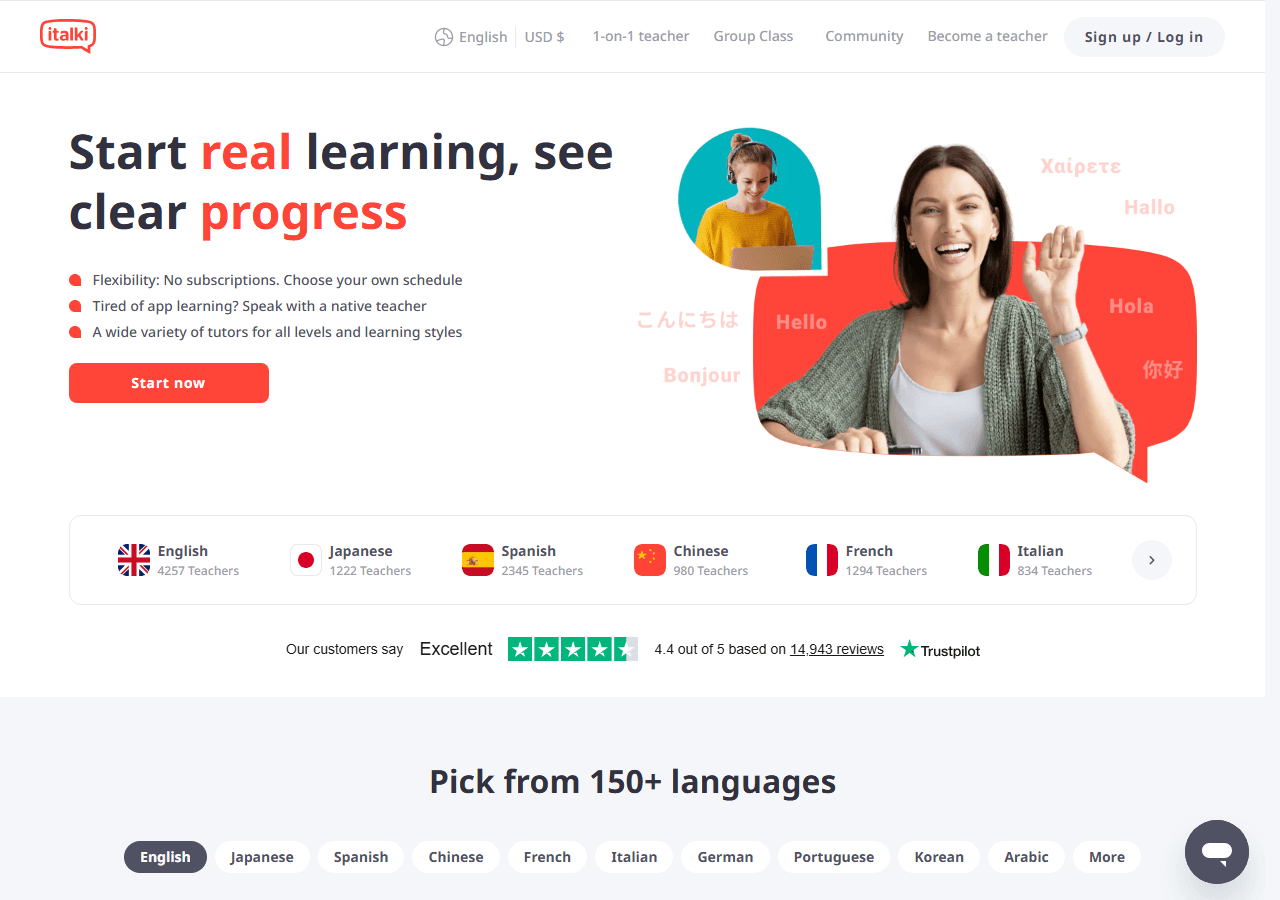
The model is pay-per-lesson. You buy Credits, you spend Credits on lessons, and if you stop buying lessons, you stop spending money.
No subscription, no auto-renew, no monthly bill arriving like a landlord. Tutors set their own prices, which range wildly: roughly $4 to $30 USD an hour depending on the language and the tutor, with the bulk of the Spanish catalog clustering around $10.
You can find cheaper conversation partners and you can find expensive credentialed teachers, and everything in between.
Tutors are sorted into two labels: professional teachers and community tutors. Here’s what I assumed going in, and here’s what turned out to be true.
I assumed “professional” meant better. It means paperwork.
Professional teachers have submitted teaching credentials to italki for verification. Community tutors haven’t, which ranges from “19-year-old polyglot who’s shockingly good at conversation” to “actual trained teacher who couldn’t be bothered with the badge.”
Our two trials were one of each, and honestly the community tutor was better for what we needed, which was low-pressure speaking practice. The professional teacher was more structured, more corrected-every-sentence, which that friend loved and I found mildly soul-crushing.
Both are legitimate styles. Trial-shop.
Trials are discounted, typically 30 minutes, and you generally get a few of them (often three) with different teachers, which is the single smartest feature in this whole space. It acknowledges the true fact that tutor quality is individual.
Cancel within about 24 hours of the lesson, though, and you still pay, which is fair to the tutor who held the slot but stings if you get sick.
Two small print things worth knowing. italki takes roughly a 15% commission from tutors, which is why some teachers gently nudge you toward packages off-platform; that’s your call, but I stayed on-platform for the scheduling and dispute protection. And Credits can lapse after roughly a year of inactivity, so don’t buy a mountain of them during a sale if you might vanish for fourteen months.
Where italki wins: cheapest way to buy consistent speaking volume, especially in the $8-to-$12 band where a huge chunk of Spanish tutors live. Also the best pick for rare languages.
If you want Quechua or Icelandic or Tagalog, italki probably has somebody. I compared it briefly to the app world in my best language learning apps roundup and the price-per-hour of actual human attention on italki is genuinely competitive with what some apps charge for subscription tiers.
Preply
Preply is the one people keep recommending, and I get why. It’s polished.
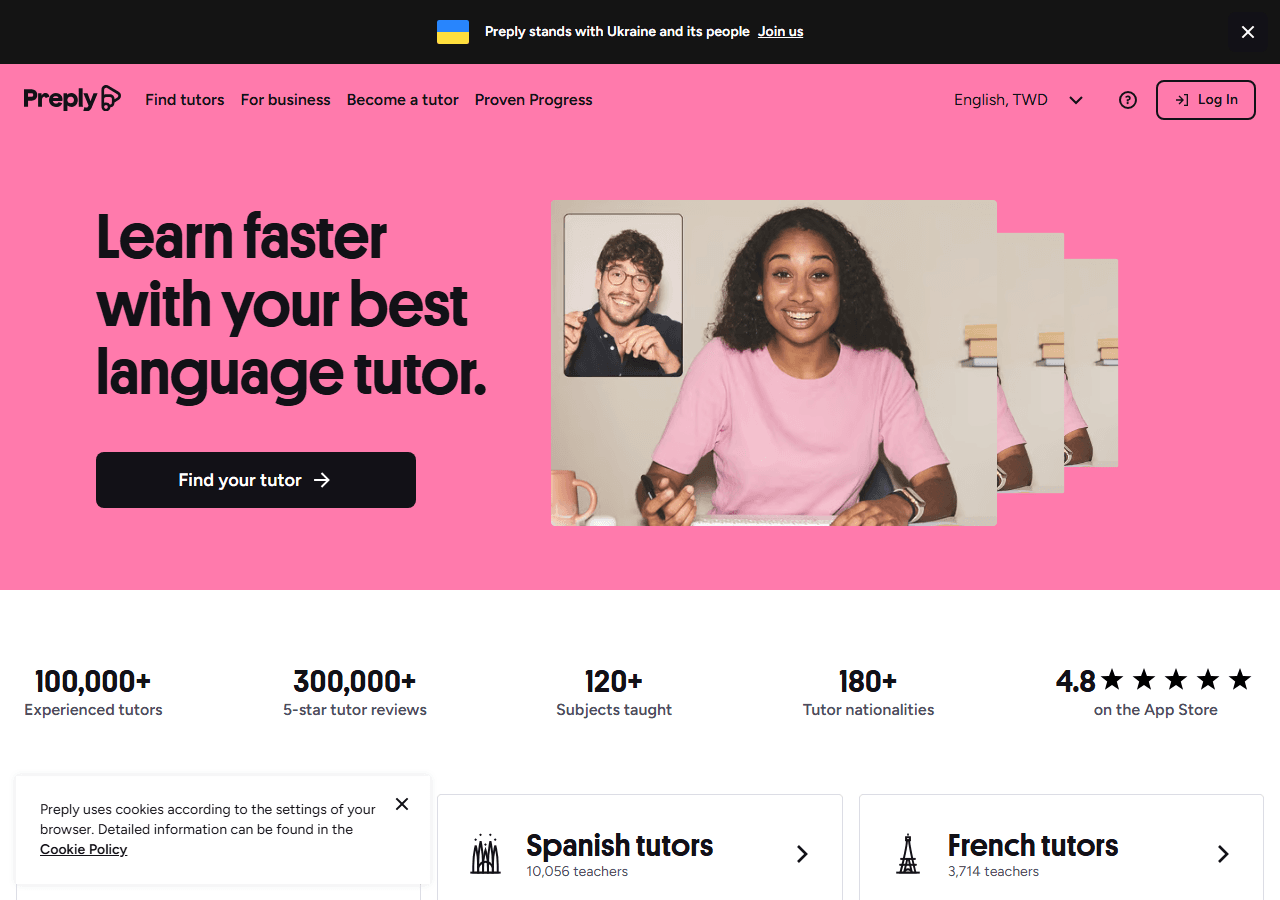
The matching tools are good, the tutor search filters are arguably the best in the business, and the whole product feels like it was designed by people who understand funnels.
But the business model is the thing, and it’s a thing. Here’s how it works: you pay for a trial lesson, and after that you’re enrolled in a lesson subscription that auto-renews every 28 days, usually tied to the specific tutor you trialed, often with a minimum of four lessons per cycle.
That’s roughly $60-plus per month committed to one human being before you’ve really established whether you like them. Tutor prices vary, but $15/hr is a common sight in the Spanish catalog, so a four-lesson cycle lands you around $60.
To Preply’s credit, if the trial goes badly there’s a replacement guarantee: you get a credit back to try another tutor rather than losing the money, though the credit is often capped in ways that matter if you trial someone expensive. So the system is less locked-in than it sounds.
But the whole architecture is built around a weekly bill that makes you show up, and that’s either a feature or a bug depending on who you are.
For that friend, it’s a feature. They are the person who will skip a lesson if skipping is free, and a recurring charge is exactly the cattle prod they need.
I’m the opposite: I resent being auto-billed for anything, and I’d rather pay per lesson and own my own attendance record. We nearly had a fight over this and settled on italki for me and grudging respect for Preply’s model.
One more honest note: because the subscription is usually tutor-locked, switching tutors on Preply is more friction than it should be. You can do it, but you’re reshuffling a billing relationship, not just clicking a new name.
On italki, trying a new tutor is as casual as ordering takeout.
Verbling
Verbling is the one nobody talks about, which is partly why we opened it. It’s a smaller, more curated one-on-one marketplace with a built-in classroom (video, whiteboard, the whole lesson happens on-platform rather than jumping to Zoom), and the tutor pool feels more vetted and less flea-market than italki’s, in a good way.
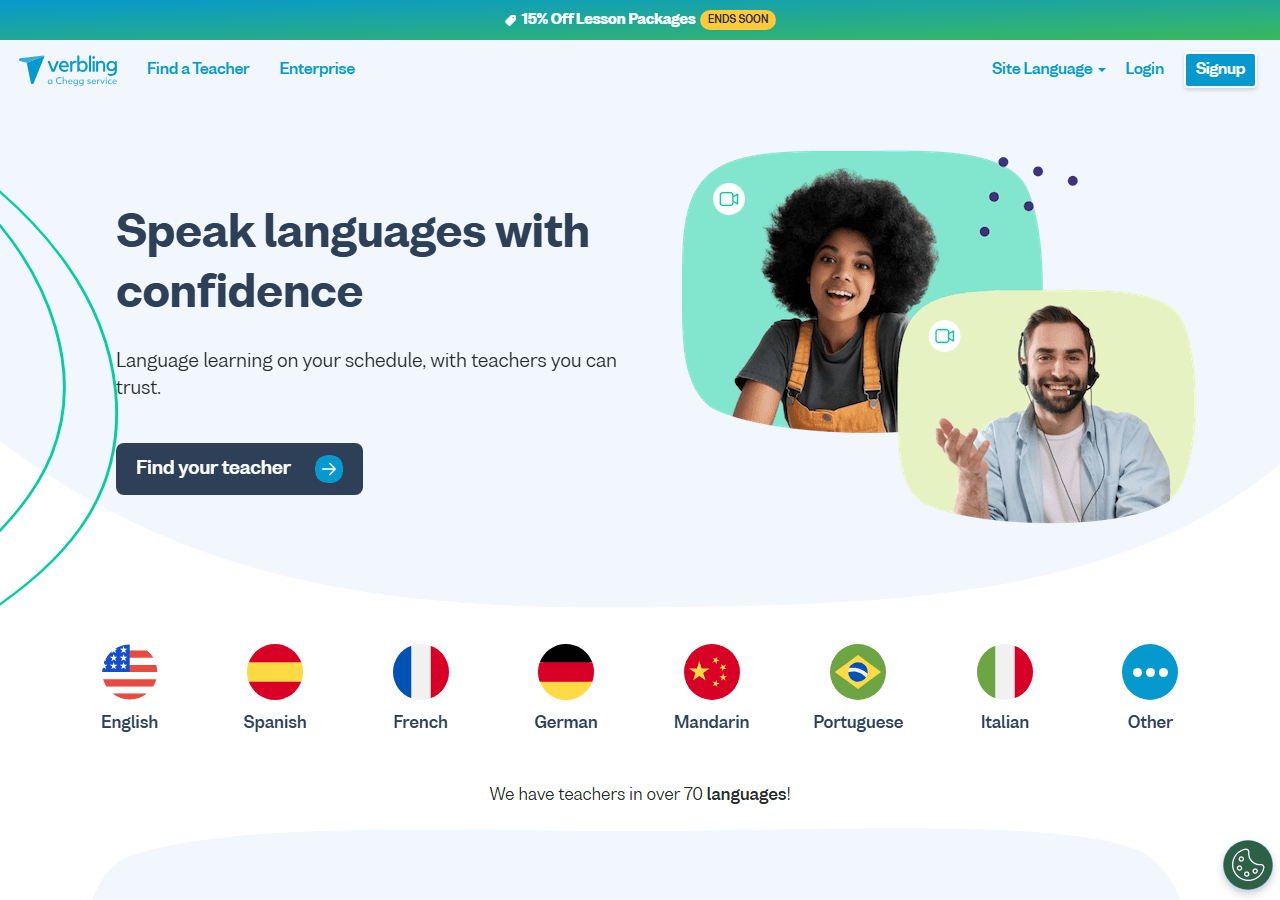
It’s still alive and functioning in 2026, which I mention only because a couple of people asked me if it had shut down or been absorbed somewhere. It hasn’t.
It’s just quiet. Fewer tutors, higher average polish, prices generally sitting above italki’s community band and in the same neighbourhood as Preply’s.
The catch is the same as any curated marketplace: fewer options. When we filtered for Spanish tutors with evening availability in our time zone, the list got thin enough that we didn’t end up booking a trial.
Not because anyone looked bad, but because the specific person-and-schedule combo we wanted wasn’t there that week. That’s the whole trade in miniature.
Curation is comfortable; volume gives you the fit. I’d shortlist Verbling if you’d rather browse 60 good tutors than filter 4,000 mixed ones, or if the built-in classroom appeals because you hate the Zoom shuffle.
Cambly
Cambly gets included in every “best online tutor” listicle, and I want to gently flag why it’s there and why it might not be for you: Cambly is English-only. It is not a multi-language catalog.
If you’re learning Spanish like us, Cambly simply isn’t in the running, and half the comparison articles bury that fact three paragraphs in.
What Cambly actually is: on-demand video conversation with native English speakers, subscription-based. You pay a monthly plan and you can drop into calls essentially whenever, with whoever’s online.
No scheduling, no matching, no lesson plan. It’s the impulse purchase of the tutor world.
For English learners, that’s a genuinely clever product. The psychological barrier to booking a lesson a week in advance is real; the barrier to tapping a button and talking to a friendly stranger right now is much lower.
If your goal is fluency through sheer volume of low-stakes chatting, Cambly’s model is built exactly for that. The flip side is that you get random humans rather than a consistent tutor who knows your weaknesses, and conversation-only means less structured teaching.
We didn’t subscribe, since Spanish, but we know people who swear by it for English. My English lessons cover the free self-study side of that if you want structure to go with the chatting, starting from Lesson 1.
Lingoda
Lingoda is the odd one out in this whole comparison, because it isn’t a marketplace at all. It’s a school.
Structured curriculum aligned to the CEFR levels (A1 through C1), group classes or private classes, real teachers on a schedule, and certificates you can point at if you need proof of level for a visa or an employer.
Billing is 4-week cycles rather than month-to-month in the casual sense, and pricing lives on their pricing page. It’s the most expensive option we looked at, and it should be, because it’s the most school.
You’re not shopping tutors, you’re enrolling in courses.
We didn’t take a Lingoda class, and I’ll be honest about why: it solved a problem we didn’t have. We already had apps covering structure and input, and we wanted speaking volume.
But if you’re starting from zero and want a single organized thing that handles curriculum, homework, and progression instead of you assembling a stack yourself, Lingoda is the most legitimate version of that in this crowd. It’s also the right answer if you specifically need a certificate, since nobody else here issues anything official-ish.
For structure-first learners, I’d compare it against the general language courses approach rather than against italki, because they’re not really playing the same game.
So that’s the field. Two trials down on italki, one on Preply, three more sites poked and prodded.
The rest of this review gets into how to actually choose, what the money looks like side by side, and where things got weird.
How to pick (and how not to)
Here’s my actual process after two weeks of trial-shopping, and I’d run it the same way again.
Pick your goal first. If you want to speak, you need speaking hours, full stop.
No app gives you that in a meaningful way, and I say that as someone who reviews apps for fun. If you’re still grinding through A1, a tutor is a nice-to-have.
Once you’re around A2 or better, conversation tutors start paying for themselves, because you can actually hold a conversation long enough to get reps in.
Then trial-shop. Two or three teachers, minimum, before you commit to anyone.
This is the single biggest thing I learned. The difference between my favourite trial teacher and my least favourite was enormous, and they were both well-reviewed, both ~$11 an hour, both “professional” tier.
One asked me questions, corrected my mistakes gently, and sent notes after. The other spent twenty minutes talking about himself in English and called it immersion.
Same platform, same price band, wildly different product.
What I looked for in a trial, roughly in order:
- Did they make me talk? Target should be me speaking at least half the time. If I did ten minutes of listening to their life story, that’s a hard no.
- Did they correct me? Some teachers never correct because they don’t want a bad review. That’s a paid friend, not a tutor.
- Did they have a plan? Even a loose one. “Next week we’ll do past tense because you butchered it today” is a plan.
- Did they send anything after? Notes, a vocab list, homework. Follow-up is free effort and it tells you a lot.
And how not to pick:
Don’t sort by price and take the cheapest. I get it, $4 an hour is tempting. But at that price you often get new tutors with no rhythm yet, and the good cheap ones get booked solid or raise prices fast.
The sweet spot we found was the $8–$14 band, where teachers have enough reviews to be vetted and haven’t priced themselves into premium territory.
Don’t trust the professional badge as a proxy for quality. It’s paperwork. Certificates, degrees, proof of teaching history.
All fine, all real, and it tells you almost nothing about whether a teacher can actually run a good half hour with a nervous adult who says “uhh” a lot. Some of the best-rated community tutors are natural teachers between other careers.
Some credentialed professionals are genuinely excellent. The badge isn’t the difference.
Don’t pick by profile video alone. Everyone’s video is charming. That’s what the video is for.
Don’t get locked into a subscription because you liked one trial. This is my biggest Preply caution. The trial goes well, the teacher’s great, you commit, and then three weeks later their schedule fills up or you realize Tuesday 7pm is a terrible slot for you, and now you’re paying for lessons you’re rescheduling.
Like the lesson, then think about the billing model.
Pricing compared
Rough numbers from what we actually saw and paid, in USD bands:

italki
Pay-per-lesson with Credits you buy upfront. Tutors set their own prices, and the range is genuinely wide, roughly $4 to $30 an hour, with the big cluster around $10.
Preply
Runs on a subscription. You pay for a trial lesson, and if you continue, you’re auto-renewed every 28 days with a lesson package that’s usually tied to one tutor, often with a minimum of four lessons per cycle.
Verbling
Sits in a similar marketplace shape to italki, pay-per-lesson style, on the pricier side of the mid-range, with a smaller, more curated tutor pool and its own built-in classroom, so you’re not hopping to Zoom. Fewer tutors means less choice, but the floor of quality felt higher on average.
Trials are discounted 30-minute sessions, and you can often grab several with different teachers. There’s no subscription, which is the whole appeal.
Two catches worth knowing: credits can lapse after about a year of inactivity, and if you cancel inside roughly 24 hours before a lesson, you still pay. Also, italki takes around a 15% commission from teachers, which is part of why pricing is all over the place.
Around $15 an hour was the common figure we saw for decent Spanish teachers. The trial replacement guarantee means if the trial goes badly you get a credit toward another one, though it’s often capped, so don’t plan on trialing five teachers on Preply’s dime.
Trial-shopping is structurally Preply’s weak spot.
Cambly is English-only, on-demand, subscription-based. You’re not browsing a catalog of Spanish teachers at various prices; you’re buying access to native English speakers you can call up more or less anytime.
Priced accordingly, like a gym membership for conversation.
Lingoda is a school, not a marketplace. You don’t pick teachers off a shelf; you enroll in structured CEFR-levelled courses, group or private, billed in 4-week blocks, and you can earn certificates along the way.
It’s the most expensive thing on this list per month, and it should be, because it’s a different product.
My honest pricing advice: if your budget is under $20 a week, italki or Verbling pay-per-lesson beats a subscription, because you can dial volume up and down without orphaned lessons. If you need a bill to make you show up, Preply’s structure is the feature, not the bug.
What I liked, and what wore me down
What I liked
What I liked, honestly, was how fast it worked. Two half-hour trials in, I’d spoken more Spanish out loud than in the previous two months of app streaks.
A real person waits for your answer. A real person looks confused when you use the wrong verb, and that little flash of confusion teaches you more than a red X on a screen.
The accountability is built in: there’s a human being on the other end at 7pm, and canceling costs money or awkwardness, so you show up.
I also liked how cheap the floor is. Ten dollars an hour is less than a movie and popcorn in Ontario, and it’s a full hour of personalized attention.
Even at two lessons a week, that’s a coffee-a-day habit, which I already have anyway.
What wore me down
What wore me down: scheduling. Coordinating time zones with tutors in Spain, Mexico, and Argentina, while juggling a work calendar, was more admin than I expected.
The booking interfaces help, but you’re still doing calendar Tetris every week.
Cancellation policies, on every platform, lean tutor-protective. Inside 24 hours and you generally pay anyway.
Fair to the teachers, but it stings when life happens.
And the subscription trap on Preply specifically. I watched the checkout flow, did the math, and closed the tab. 28-day auto-renew with a minimum lesson count, tied to one tutor, after a single paid trial, is a lot of commitment for a first date.
Horror stories, and who tutors work for
The horror story
Let me be fair to the platforms here, because horror stories travel further than boring success stories.
The recurring complaints I’ve seen and heard, and half-believe from my own small sample: teachers who cancel repeatedly and leave you with credits you can’t easily use, subscription renewals that catch people off guard, and the occasional lesson that’s really just a chat with no teaching in it.
None of it is exotic. It’s all the predictable failure mode of marketplaces and subscriptions generally.
The platforms have answers for most of it. Preply’s trial replacement guarantee exists precisely because one trial is a thin signal. italki’s review system is detailed enough that a teacher with 400 reviews is genuinely well-vetted.
Dispute processes exist and apparently work, though I never had to use one, which tells you my two weeks were blessedly boring.
When it works
The honest framing: who it works for. Tutors work for people who show up.
If you’ll actually attend one to three lessons a week, do the ten minutes of homework, and tolerate being bad out loud in front of a stranger, this whole category is absurdly effective. If you won’t, no platform fixes that, and a subscription just converts your optimism into someone else’s revenue.
Apps are more forgiving of flakiness; humans less so. Know which one you are before you pick a billing model.
Who this stack is for, and who should skip
This is for you if:
- You’re A2 or above and want speaking reps, or you’re a motivated beginner who wants a human to un-teach your bad habits early.
- You have $10–$30 a week and one to three predictable free hours.
- You’re okay being bad in front of a stranger. It fades, honestly, by lesson three.
- You want a rare language. This is italki’s superpower: the long tail of languages that no app has ever bothered building a course for.
Skip it (or wait) if:
- You’re still deciding whether you like the language. Go run a free app for a month first, then come back.
- Your schedule is chaos. Pay-per-lesson, or nothing, until your calendar settles. Do not buy a 28-day subscription with a chaotic calendar. I’m begging you.
- You want English specifically. Cambly is genuinely good at on-demand English conversation, but it’s not a multi-language catalog, so just know what you’re shopping for.
- You want structured coursework with certificates rather than conversation practice. That’s Lingoda, and it’s a school, and you should price it as one.
- You can’t tolerate any scheduling admin whatsoever. Fair. Stick to apps for now.
Pros and cons
Pros
- Speaking practice from day one, which apps fundamentally don’t deliver
- Cheaper than anyone expects, especially in the $8–$14 tutor band
- Real-time correction kills fossilized mistakes before they set
- Rare-language coverage is unmatched
- Accountability of a human expecting you at 7pm
Cons
- Quality is per-tutor, not per-brand, so you have to trial-shop
- Scheduling overhead is real
- Cancellation windows are tutor-protective
- Subscription models can trap the flaky
- Trial costs money everywhere; there’s no free tier of humans
What we'd use alongside it
A tutor isn’t a stack by itself, at least not an efficient one. The combo that works is one to three tutor hours a week plus an app or SRS doing the vocabulary and grammar grunt work between lessons.
For the app side, I’ve written full reviews of Duolingo and Babbel, and the short version is that Duolingo keeps you coming back while teaching you less than it feels like, and Babbel teaches you more while feeling more like homework.
Either works as the between-lessons layer; pick based on whether your problem is showing up or substance.
The other thing I’d genuinely add is our own Yak Cards, which are exactly the thing I wished existed mid-trial: prompts and structures to drag into a lesson so you’re not paying a tutor $10 an hour to invent conversation topics. Cheap lesson time is still lesson time.
Spend it talking, not planning what to talk about.
If you’re doing Spanish like we were, our Spanish hub has the full resource rundown, and the how to learn a language guide covers the broader method. For English learners, we’ve got a 139-lesson English course that starts here with Lesson 1, and it pairs nicely with Cambly as the speaking layer.
There’s more in language courses if you want the full library, and the rest of our reviews if you want to go deeper on any single tool.
What others are saying
Since I can only vouch for two weeks of my own life, here’s how other people who’ve spent longer in this category see it:
The consensus across all of them, and my two weeks, is remarkably consistent: italki for flexibility and price, Preply for structure, Verbling for curation, Cambly for on-demand English, Lingoda if you want an actual school.
FAQ
Prices, plan names, and features below are as of September 2026.
Is a professional tutor worth paying more for than a community tutor?
Sometimes. The professional badge means paperwork: certifications, degrees, teaching history.
It screens out the truly unqualified, but it doesn’t guarantee teaching talent. I’d pay a few dollars more for a professional with hundreds of great reviews over a brand-new community tutor, but I’d take a veteran community tutor over a credentialed professional with a mediocre trial every time.
Trial both, decide per-person.
How many lessons a week do I actually need?
One to three, consistently, with an app doing vocab between lessons. One a week works if you actually practice between.
Three is great but burns out fast if your schedule is tight. More than three is usually money better spent elsewhere unless you’re on a deadline.
How much should I expect to pay?
For Spanish specifically, the useful band is roughly $8–$15 an hour on the marketplace platforms. Below that you’re gambling on inexperienced tutors, above it you’re paying for polish that may or may not matter to you.
Budget $20–$40 a week for two lessons and you’re in a very good place.
What if I hate my trial teacher?
Take another trial. This is the whole reason you trial-shop.
On Preply, the replacement guarantee gets you a credit back, often capped, so read the terms. On italki, discounted trials are plentiful, so grab two or three with different teachers from the start.
Can I learn a language with only a tutor and no app?
You can, but you’ll progress slower per dollar. Tutors are for speaking, correction, and motivation.
Apps and SRS are for the rote memorization that humans are overqualified for. Split the labour.
Do tutor credits or subscriptions expire?
Watch this. italki credits can lapse after roughly 12 months of inactivity, and Preply subscriptions renew every 28 days whether you’ve booked lessons or not. Never leave more credit on any platform than you’ll use in a couple of months.
Which platform is best for a total beginner?
italki, with a hand-picked tutor who teaches beginners, or Lingoda if you want a structured curriculum. Absolute beginners get the least from on-demand conversation products like Cambly because they can’t sustain a conversation yet.
After two weeks
So, the wrap-up. Two weeks of trial-shopping, four paid trials, three tabs opened and poked at, and one very firm conclusion: live tutors are the fastest way I’ve found to get a language out of your head and into your mouth.
The platform barely matters. What matters is that you trial two or three teachers, pick a person you’d happily talk to twice a week, pay roughly $10 an hour for the privilege, and stack an app underneath for the memorization work.
That’s the machine. italki does it with the most flexibility and the best prices, Preply does it with structure if a bill is what makes you show up, Verbling does it with a curated smaller pool, Cambly does it on demand for English, and Lingoda does it as an actual school with certificates.
The category is the product; the tutor is the brand.
I went in skeptical that a $10 video call could beat my beloved app streaks. It wasn’t close.
A confused face from a real human in Mexico City taught me more in thirty minutes than a month of green owl guilt.
For speaking, for correction, for the long tail of rare languages, and for pure value per dollar, live tutoring is the best thing in language learning right now.
8 out of 10 Yaks