



I gave HelloTalk two weeks of my life and it gave me one genuinely useful correction, three creepy DMs, and a Mexican guy named Diego who now knows more about Ontario weather than any human should.
That’s the short version. The longer version involves me sitting on my couch in the evening, phone in hand, trying to remember enough high school Spanish to not embarrass myself in front of strangers from three continents.
I’d been hearing about HelloTalk for years. “It’s free,” people said.
“You just talk to real people,” they said. Nobody mentioned the part where a man named Carlos opens with “hola beautiful” at 11 p.m. on a Tuesday and then asks, within two messages, if I have WhatsApp.
I’ll get to Carlos. He gets blocked later in this story.
He earned it.
First, some context. I’m 40, I live in Ontario, and my Spanish sits in that uncomfortable middle zone where I can order food and complain about the cold but I fall apart the moment a native speaker talks at actual speed.
Classic intermediate plateau. I’ve been yacking about language learning for a while now, and I test apps the way other people test recipes: badly at first, then with increasing competence, then with strong opinions.
I already went deep on Duolingo for this site, and that experiment left me with a decent streak habit and a vocabulary full of owls. HelloTalk is a completely different animal.
It’s not a course. There’s no green bird, no XP, no lesson tree.
It’s a language exchange app: you help someone with English, and in return, they help you with whatever you’re learning. It’s the pen pal idea dragged into the phone age, with voice messages, corrections, and a social feed bolted on.
The pitch appealed to me because my problem isn’t vocabulary apps. My problem is that I never speak.
I know the words. I freeze when it’s time to use them.
Two weeks of low-stakes chatting with actual humans sounded like exactly the medicine I needed, or at least a decent excuse to finally stop refreshing the same three websites every evening.
So that’s what this is. A two-week test, phone-first, done by one person on a couch, with all the scientific rigour of a guy deciding what to have for lunch.
I didn’t run a study. I didn’t survey users.
I just used the app the way a normal learner would: messaged partners, sent voice notes, used the correction tools, poked at the Moments feed, sat in a voice room for an evening, and blocked the junk that needed blocking. Some of it worked beautifully.
Some of it made me want to throw my phone into Lake Ontario.
The short version of my verdict: HelloTalk is a genuinely useful tool wrapped in a social app that can’t quite decide if it’s a classroom or a nightclub. When it works, it’s the cheapest Spanish practice on earth.
When it doesn’t, you’re swiping past “hola guapa” messages wondering why a language app needs a report button this much.
My score after two weeks:
6 out of 10 Yaks



Not bad. Not great.
Let me explain how it earned every one of those yaks and lost the other four.
What HelloTalk is
HelloTalk calls itself a language exchange app, and for once the marketing language is accurate. The core idea: you sign up, list the languages you speak and the languages you’re learning, and the app connects you with people who are the mirror image of you.
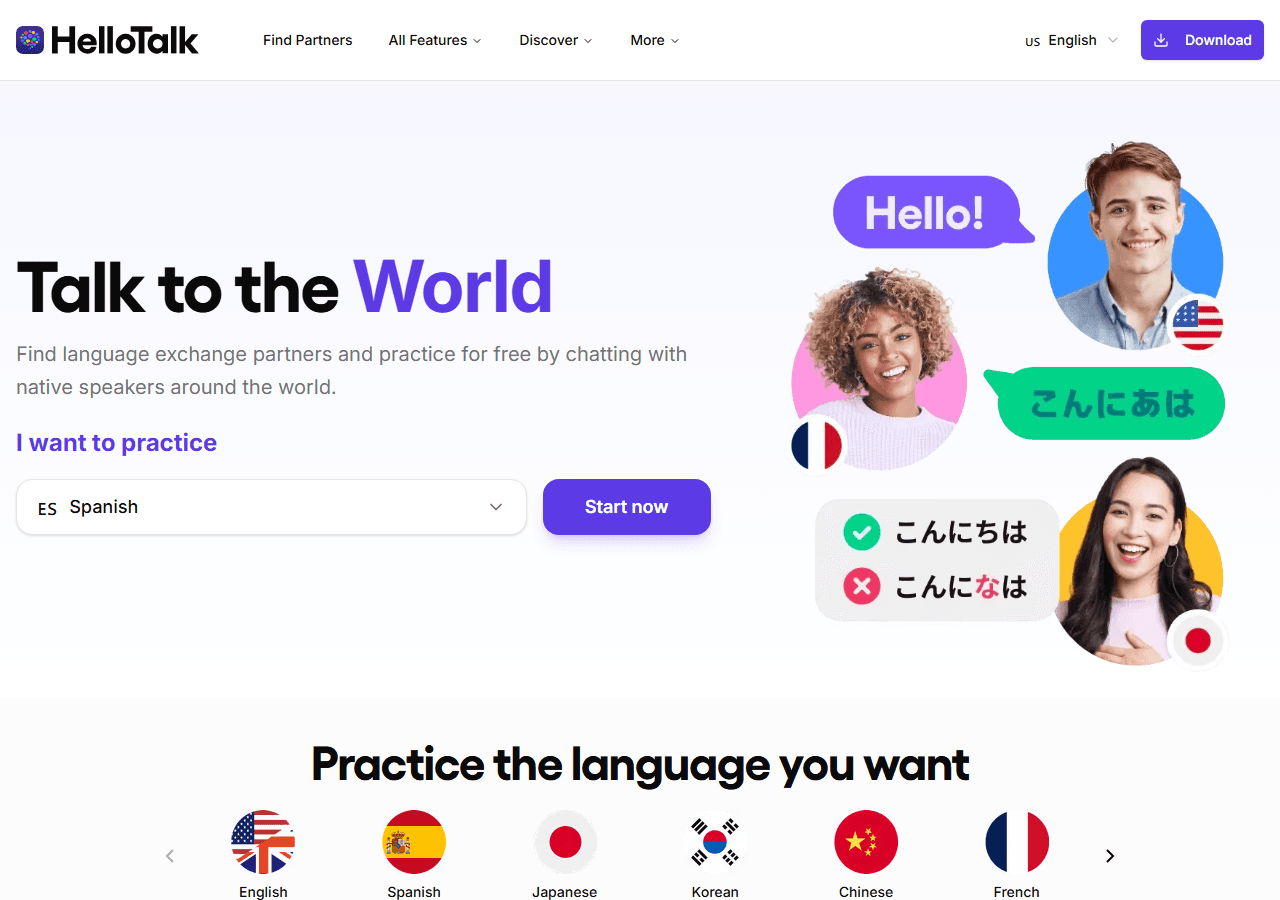
Native Spanish speakers learning English, in my case. You chat, you correct each other’s messages, and everyone walks away slightly less terrible at their target language.
The official numbers as of 2026 are big: 70 million-plus users and 260-plus languages, with the company saying about 90 percent of the core features are free. I can’t verify 70 million of anything, but I can tell you the Spanish-English exchange pool is deep.
I never ran out of people to talk to. Depth was never the problem.
Quality was, sometimes, and we’ll get there.
The app is organized around a few tabs, and knowing them helps everything else make sense:
- Talks: your one-on-one chats with partners. This is where most of the actual language learning happens.
- Moments: a public feed, basically Instagram for language learners. People post about their day, ask grammar questions, share photos of their lunch. You can post in your target language and get corrections from the crowd.
- Search: filters for finding partners. Native language, learning language, country, age range, and so on.
- Learn: extra learning tools like HelloWords, a vocabulary game. Fair warning, a lot of what lives in this tab costs extra money even if you’re already VIP. It’s the upsell inside the upsell.
- Voicerooms: live audio rooms where people take turns speaking. Like a group call with strangers, structured around a language.
What HelloTalk is not: a course. There’s no curriculum, no progression, no “you’re on Unit 4.”
If you show up expecting Duolingo-style structure, you will be lost within an hour. It’s also not a tutor marketplace.
There are no paid teachers here, no professional lessons, no one whose job it is to make sure you improve. If you want that, you’re in the wrong app, and I’ll talk about alternatives near the end of the full review.
Think of it as a room full of people who all want something from each other. The app’s whole bet is that mutual need is a stable foundation for learning.
Two weeks in, my answer is: sometimes, if both people show up, and nobody’s there for the wrong reasons.
How we used it for two weeks
I want to be clear about what this test was, because I read a lot of app reviews that are clearly written by someone who opened the thing once, took screenshots, and formed opinions. I did two weeks.
Daily-ish. Phone only, because that’s how I actually live with apps, and HelloTalk is designed phone-first anyway.

The web version exists but I barely touched it.
Week one was matching and messaging. I set my profile to English native, Spanish learner, and started searching.
The search filters are decent: I could narrow to native Spanish speakers learning English, then pick countries. I ended up talking regularly with five people: Diego from Mexico City, a university student from Bogotá named Valentina, a guy from Madrid named Javier who worked in IT and corrected me with the merciless precision of a man who reviews code for a living, a woman from Buenos Aires who mostly wanted help with English job interviews, and a teenager from Lima I exchanged exactly four messages with before we both silently gave up.
The daily rhythm settled into something like this. Morning: check messages, reply to Valentina, who sent me long voice notes about her week and asked me to correct them.
Lunch: post a Moment in Spanish about whatever was on my mind, usually the weather, because I am Canadian and weather is 40 percent of my personality. Evening: voice messages back and forth with Diego, who spoke slowly for me and laughed kindly at my rolled r’s, which I still cannot do.
“Canadá,” he said once. “You say it like the word is apologizing.”
That’s the thing HelloTalk does that no flashcard app can do: it makes you produce language for a real person who will notice if you don’t. Duolingo lets you fake it forever.
Diego does not. Diego asks follow-up questions.
Week two I branched out. I sat in a voice room for an evening, which deserves its own section.
I pushed more corrections through the Moments feed. I also hit the junk DM problem, which also deserves its own section, and which is the reason my final score has a dent in it.
By the end I had a real feel for the workflow, the tone of the community, and the specific way your heart rate changes when a native speaker sends you a voice note and you know you have to listen to it three times before you understand “how was your day.”
How a HelloTalk exchange actually works
The mechanics of an exchange are simple, and the app mostly stays out of the way, which is one of its better qualities.
You find a partner through Search or they find you. Somebody sends the first message.
From there it’s a chat interface that supports text, voice messages, and calls, plus a few tools that matter. There’s translation built in, so you can tap a message and get a rough English version of the Spanish, or vice versa.
There’s transliteration for languages that need it. There’s a correction tool, which I’ll cover properly in a minute because it’s the best thing in the app.
And there’s the unspoken etiquette that keeps exchanges alive: both languages, both people, roughly balanced effort.
That last part is the whole game. A good exchange is a conversation with a rulebook.
Diego and I settled into a rhythm where I’d write my messages in Spanish and he’d reply in English, and we’d each correct the other’s errors. Some people alternate by message.
Some alternate by topic. Some do ten minutes of each language.
Whatever the system, if one person starts doing all the giving and the other all the taking, the exchange dies, usually within a week. I had that happen twice with people who, it became clear, wanted a free English tutor more than an exchange.
I don’t blame them. English is a valuable language and I’m giving it away on an app like a fool.
But I’m also not doing 45 minutes of unpaid proofreading for a stranger’s cover letter without some Spanish coming back my way.
The best thing I did, protocol-wise, was front-load honesty. First message, I told people my level plainly: intermediate, slow, mistakes guaranteed.
It filtered out the partners who wanted a polished English speaker and attracted the ones who found a wobbly exchange charming or at least tolerable. Nobody expects perfection.
What kills exchanges is silence, awkwardness, and mismatched expectations.
Corrections, Moments, and voice rooms
This is the section where I say the nice things, so let me enjoy it.

The correction tool is the reason to stay on HelloTalk. When your partner makes a mistake, you tap their message, hit correct, and the app shows you their original text and your edited version side by side.
The other person gets a clean, easy-to-read diff of what they wrote and what it should have been. It’s fast, it’s low-ego, and it takes the sting out of being told you’re wrong, because it’s a feature, not a criticism.
The correction I actually remember, two weeks later: I’d written “Estoy estudiando español desde tres años” in a message to Javier. Perfectly understandable, confidently wrong.
Spanish doesn’t use “estar” for that; you use “llevo.” He tapped it, corrected it to “Llevo tres años estudiando español,” and added a one-line note explaining that Spanish measures duration with llevar the way English uses “for.”
It took him maybe fifteen seconds. It fixed a mistake I’d apparently been making for years.
I’ve had paid materials teach me less. That one correction justified a chunk of the app’s existence for me personally.
Now, the honest caveat: correction quality varies wildly. Some partners correct everything, including things that aren’t wrong, including regional preferences dressed up as rules.
Some never correct at all because they’re being polite, or lazy, or they don’t know how to explain their own grammar, which is true of most humans in most languages. The app has also rolled out one-click AI corrections, which are handy when your partner is asleep, and which quietly threaten the whole premise: if a machine can fix my sentence, why am I waiting on a stranger in a different time zone?
My take after two weeks is that AI corrections are good for mechanics and human corrections are good for the things machines don’t catch, like when a sentence is technically correct but makes you sound like a customer service bot.
Moments, the public feed, was better than I expected. I posted short Spanish paragraphs about my day, and strangers corrected them within minutes.
There’s something oddly addictive about posting “hoy hace frío en Ontario” and having a woman from Guadalajara gently fix your grammar for free. It’s also a decent place to find exchange partners, because you can see how people write before you commit to a chat with them.
The feed has the usual social app problems, thirst traps and engagement bait included, but the core function, corrected writing practice from real people, works.
Voice rooms were my week-two adventure. Picture a group audio call with five to fifteen strangers, organized around a theme, in this case a bilingual Spanish-English room.
There’s a queue system, so you raise your hand, wait your turn, and speak for a minute or two while everyone listens. I joined a “Spanish intermediate” room on a Wednesday evening, muted myself for ten minutes to build courage, then took a turn.
I said where I was from, that I’d been studying Spanish for three years, and that the weather was bad, because of course I said that. A woman from Peru told me my Spanish was “muy claro,” very clear, and I rode that compliment for two full days.
It’s genuinely good speaking practice with one catch: the courage requirement. Nobody’s grading you, but everyone’s listening, and the first time you unmute in a room of strangers is a small act of bravery.
Cheaper than a tutor, though. Free, even, and that word does a lot of work in this review.
Safety, DMs, and filtering
Here’s where the dent in the score comes from.

HelloTalk’s own policy forbids using the app for dating. It says so plainly.
Enforcement, in my experience, is inconsistent to generous. In two weeks I received three DMs that were unambiguously not language exchange.
“Hola beautiful.” “You are very pretty, do you have a photo?”
And my favourite, the direct approach: a message that opened in Spanish, complimented my profile picture, and asked if I was single, all before any language had been exchanged in any direction. I reported and blocked all three.
The blocking works fine, the report button is right there, and I never saw any of them again. But the volume is what it is, and if you’re a woman on this app, every review I’ve ever read suggests your experience of this problem is worse than mine, and mine was annoying enough.
The practical survival kit I assembled: keep chats in the app, always. If someone pushes you to WhatsApp within two messages, that’s not a Spanish lesson, that’s a red flag with a data plan.
Report and block without guilt. Block is a normal part of the HelloTalk workflow, not an escalation.
And set your search filters tightly, country, age range, the whole thing, because the tighter your filters, the less junk drifts in. My spam rate dropped noticeably once I stopped appearing in broad searches.
The other safety note is the boring one: you’re talking to strangers on the internet. Don’t share your address, your workplace, your last name, or your regular schedule.
Diego knows my weather. That’s it.
That’s the Diego allowance.
Free vs VIP
Free
Roughly 90 percent of the core features are free, per the company, and my experience backs that up. Chat, voice messages, Moments, corrections, voice rooms: all usable without paying a cent.
VIP
VIP is the paid tier. What it gets you is mainly limits removed and reach extended: more search filters, more matches visibility, the ability to see who viewed your profile, unlimited translations, and a few other perks.
In-app
HelloTalk’s pricing is not publicly listed in a stable way. There’s no public VIP page on their site; it 404s.

If you pay nothing, you will still learn. That’s rare and worth saying clearly.
It’s a convenience upgrade, not a content unlock. The free app is, functionally, the trial.
There’s no VIP free trial to speak of, and honestly, with 90 percent of the core experience free, there doesn’t need to be one.
VIP is sold in-app only, and in-app prices vary by platform and storefront. When I checked on my phone, the in-app screen quoted me the three tiers, monthly, annual, and lifetime, and I’d estimate the monthly option landed in the neighbourhood of ten to fifteen US dollars, with annual somewhere under a hundred and lifetime a couple hundred, but third-party sites list older figures in the seven-dollar range and newer ones higher, so any specific table I printed here would be stale by the time you read it.
Check the in-app purchase screen yourself. That’s the only number that counts.
My take: start free, stay free until the app’s limits are actively annoying you, and only then consider VIP, having checked the live price in your own app store first. I never felt the need to pay during my two weeks, and I say that as someone who paid for other apps in this space without much hesitation.
What I liked about HelloTalk, and what wore me down
What I liked
Let’s start with the good stuff, because there genuinely is some.
The corrections feature is the whole reason I kept the app on my phone. When a partner corrected my Spanish, it showed up inline, right in the chat, and I could see exactly what I’d done wrong.
There’s something about getting fixed in the moment, mid-conversation, that sticks way better than a red mark on a worksheet. I still remember one partner correcting my “estoy cansado” situation because I’d said “soy cansado,” and she explained it in one line with a little emoji and honestly that stuck better than three chapters of any textbook I’ve owned.
The lottery aspect is also a feature, not a bug. Some nights you match with someone who becomes a genuine language partner.
Some nights you get radio silence after two messages. But when it works, you’re talking to a real human who actually wants to help, and that’s something no streak counter can fake.
The free tier is generous too. I yacked about this in the pricing section, but it bears repeating: chat, voice messages, corrections, Moments, voicerooms, all free.
If you’re on the fence, there’s basically no barrier to finding out if language exchange is your thing.
Also, Moments is quietly great for passive practice. Scrolling a feed in Spanish while waiting for coffee is a better use of dead time than most of what I do on my phone, and people correct your posts there too.
What wore me down
Now the wearing-down part, and I’d be yacking dishonestly if I skipped it.
The DM quality problem is real. For every decent conversation, I got at least one opener that had nothing to do with Spanish.
Some were clumsy spam, some were clearly people treating the app like a swiping app, and all of them got the block button. It’s not scary, exactly.
It’s just tiring. You develop a routine: check the profile, check the first message, block if needed, move on.
That routine works, but you shouldn’t need a routine for this.
The churn is the other thing. People vanish.
Mid-conversation, mid-week, mid-sentence. That’s just the nature of free apps with no money on the table, but after the third or fourth partner ghosted, I stopped investing much in any single exchange, which, ironically, made the exchanges worse.
And the Learn tab extras are mostly a funnel. HelloWords and the little lessons are fine, but a lot of it costs extra and it’s not why anyone’s here.
If I wanted a flashcard app, I’d download a flashcard app.
HelloTalk horror stories, and the people it works for
The horror story
Nothing truly horrifying happened to us in two weeks, and I want to be clear about that. No one threatened us, no one was scary.
The worst of it was the spam DMs and a couple of people who clearly weren’t there for Spanish, all handled with the block button in about four seconds.
The horror stories exist, though, and they follow a pattern: someone gets a friendly partner, the chat moves to WhatsApp or Instagram “for convenience,” and then it becomes something else entirely. Romance scam scripts, crypto pitches, or just a person who won’t take a hint.
HelloTalk’s own policy forbids dating, and the app nags you not to move chats off-platform, and enforcement is inconsistent at best. The block button exists for a reason and it’s part of the actual workflow of using this app.
Don’t feel rude using it. Feel efficient.
The golden rule: never take a chat to WhatsApp for “language practice.” If someone can’t practice with you inside an app specifically designed for language practice, the practice was never the point.
When it works
Now, the people it works for. I watched a pattern in my two weeks.
The exchanges that thrived were with people who were already conversational. A friend of mine, solid B1 Spanish, got a great exchange going in days.
She could hold up her end of a voice message, ask follow-up questions, survive a correction. The exchange fed her.
Meanwhile, actual beginners were stalling hard. If you can’t yet form a sentence, you can’t exchange anything.
It’s not a you problem, it’s a structural one. Language exchange assumes you have language to exchange.
That’s why the sweet spot is the intermediate plateau. You know enough to talk, you’re bad enough that talking is still fixing things.
HelloTalk is a fantastic supplement at A2 and above, especially if you’ve stalled after finishing a structured course and need humans to talk to.
Who HelloTalk is for
After two weeks, here’s my honest read on the fit.
HelloTalk is for you if:
- You’re A2 or above and want speaking practice more than lessons
- You’ve hit the intermediate plateau and need real humans to yack with
- You like the social side: scrolling Moments, hopping in a voiceroom, the ambient hum of a language around you
- You’re okay managing DMs with a block-first policy
- You want all of that free
It’s a supplement, and a good one. It’s the thing you add when you’ve got grammar from somewhere else and you need a place to actually use it.
If that’s you, download it today and see who’s out there: HelloTalk.
If you want a structured companion, pair it with a proper course. Our language courses page covers the serious options, and if you’re working on English specifically, our 139-lesson English series starts from zero, so your exchange partners can do what you’re doing, just in the other direction.
Who should skip it
Just as important. Skip HelloTalk if:
- You’re a total beginner. You’ll stall. You’ll open the app, not be able to say anything, and close it. Learn some grammar first, come back at A2.
- You hate managing strangers. If the phrase “block the weird DMs” made your shoulders tense up, this app will exhaust you. It’s a social app, socially.
- You want a curriculum. HelloTalk is not a course, has no path, and will not teach you in order. It’s a room full of people, some wonderful, some spammers.
- You want guaranteed conversation. Free means flaky. People vanish. If you need a tutor who shows up because you paid them, HelloTalk is the wrong shape.
- You’re hoping it’s secretly a dating app. It isn’t one, but some users disagree, and you’ll both be disappointed.
If any of those is you, check our full reviews section, where we’ve tested the structured apps. Duolingo is the classic starting point for beginners, for better and worse.
Pros and cons
Pros
- Corrections inline in chat are genuinely excellent and free
- Huge pool: 70M+ users across 260+ languages, so Spanish partners are easy to find
- Roughly 90% of core features are free, including voicerooms
- Moments gives you a passive feed in your target language
- Voicerooms are a low-pressure way to hear and speak
- Great for the intermediate plateau, where most apps are useless
Cons
- DMs include spam and people treating it like a dating app, and enforcement is inconsistent
- Partner quality is a lottery; churn and ghosting are normal
- Learn extras (like HelloWords) often cost extra and aren’t the draw
- Beginners stall hard; no structure at all
- VIP pricing is confusing and in-app only, with conflicting third-party numbers floating around
What we'd use instead or with it
Nothing replaces HelloTalk entirely, because nothing else is quite the same shape. It’s not a course, and it’s not a tutor marketplace.
It’s a room full of people trading languages. That’s its own category.
So instead of “instead,” think “with.”
The stack I’d actually run: a structured app or course for grammar and order, HelloTalk for humans, and flashcards for vocab. That’s it.
Three things.
If you want the full comparison shopping experience, we keep a rundown of the best language learning apps with everything we’ve actually tested, including paid tutoring options if you’d rather buy a guaranteed hour than win the free lottery.
For Spanish specifically, our learn Spanish section has our full take on getting functional fast. And if you want the yak-first study method behind everything we do here, that’s our how to learn a language guide.
Two quick comparisons people always ask about:
HelloTalk vs Tandem. Tandem is the serious-exchange cousin: cleaner, more focused on matching you with a committed partner, and with a premium tier that gates some features harder. HelloTalk is the social one: Moments, voicerooms, a busier, messier feel.
Tandem feels more like a quiet study partner, HelloTalk feels like a party where everyone’s trading languages. The catch is that both get the same dating-app complaints in their reviews.
Neither has fully solved the “some people are here for the wrong reasons” problem. Pick based on whether you want a feed and voicerooms or a leaner matching experience.
HelloTalk vs italki. Not really a competition. italki is paid lessons with actual teachers: guaranteed hours, professional feedback, money on the table. HelloTalk is free conversation with strangers who are trading, not teaching.
I’d use HelloTalk daily and italki weekly if budget allowed, and HelloTalk alone if it didn’t. If you want tutors, the apps roundup is where we point people for now.
And of course, if you’re yacking with us here at Yak Yacker anyway, our Yak Cards slot into this stack as your vocabulary layer.
What others are saying
We’re not the only ones who spent time with this app. A few takes worth reading:
The pattern across all of them: everyone loves the concept, everyone praises the corrections, and everyone has at least one paragraph about the dating-app problem. That’s HelloTalk.
FAQ
Prices, plan names, and features below are as of September 2026.
Is HelloTalk free?
Mostly, yes. Around 90% of the core features are free: one-on-one chat, voice messages, corrections, Moments, and voicerooms.
VIP removes ads and adds some perks, and the Learn-tab extras like HelloWords sometimes cost extra. You can use HelloTalk seriously without paying a cent, which is more than you can say for most apps in this space.
Start here: HelloTalk.
Is HelloTalk VIP worth it?
For most people, no, not right away. There’s no VIP free trial, but the free app basically is the trial, so use that first.
If you’re a daily user who’s bothered by ads or wants the translation perks, maybe. The pricing is in-app only, and third-party sites list conflicting numbers (we’ve seen older figures around $6.99/month and newer ones around $12.99/month), and prices vary by storefront anyway.
My advice: earn the VIP by using the free version so much you’re annoyed by the ads. That’s a real decision, made on real usage.
Is HelloTalk a dating app?
No, and dating is against the app’s policy. But some users treat it like one, and enforcement is inconsistent, so you’ll run into it.
Block early, block often, and never move a chat to WhatsApp for “practice.” Used that way, it’s a language app with a spam problem, which is a different and more manageable thing.
HelloTalk vs Tandem: which is better?
They’re close cousins. HelloTalk is more social: Moments feed, voicerooms, busier.
Tandem is leaner and more focused on the serious-exchange experience. Both get dating complaints, both are free at the core.
If you love scrolling a feed and dropping into voice rooms, HelloTalk. If you want one committed partner with less noise, Tandem.
Honestly, try both; they’re free.
HelloTalk vs italki: which should I use?
Different tools. italki is paid lessons with teachers: structured, professional, guaranteed.
HelloTalk is free conversation with trade partners: unstructured, hit-or-miss, free. If you can only pick one and you’re A2+, start with HelloTalk since it costs nothing.
Add a paid tutor when you know exactly what you want to fix.
Can beginners use HelloTalk?
They can install it, but most stall. Language exchange assumes you have language to exchange.
Get to roughly A2 somewhere structured first, then bring your shaky sentences to real humans. See Duolingo or our how to learn a language guide for the early stretch.
Is HelloTalk safe?
Reasonably, with basic hygiene. Don’t share your phone number or socials, don’t take chats off-platform, block anything that smells off, and report the worst of it.
We had nothing scary happen in two weeks, just spam that got blocked. The official language exchange blog has safety tips too.
After two weeks with HelloTalk
So that’s HelloTalk. Two weeks, Spanish exchange, one phone, a lot of blocked DMs.
Here’s where I landed. HelloTalk is a genuinely good idea executed by an app that’s a little too social for its own good.
The core loop, trading languages with real humans and getting corrected in the moment, is the single best free way I’ve found to practice speaking. The corrections are the reason to stay.
The DM lottery is the reason you’ll occasionally fantasize about deleting it. Both things are true at once, and I refuse to pretend otherwise.
If you’re at the intermediate plateau, staring at apps that stopped teaching you anything two months ago, download it tonight. Match with someone.
Say something wrong. Get corrected.
That loop, repeated, is how people actually break through. It’s free, it’s on the web as well as mobile, and the worst case is you block a few spammers and learn the word for “blocked” in your target language.
But go in with the right expectations. It’s a supplement, not a course.
It’s a room, not a tutor. It’s a lottery where the prize is a real conversation and the losing tickets are, well, tickets.
Manage the DMs, don’t go to WhatsApp, and bring at least A2-level sentences to trade.
Me, I kept it on my phone. Two weeks of yacking with strangers in Spanish beat two weeks of streak-maintenance on any gamified app I’ve ever used, and one correction about soy cansado is still living rent-free in my head.
That’s more than most apps ever gave me.
If you’re weighing your options, our best language learning apps roundup puts HelloTalk in context against everything else we’ve tested, and the learn Spanish section is there when you’re ready to actually do this thing.
6 out of 10 Yaks