



I’ve been yacking about language apps long enough now that my phone’s home screen looks like a graveyard. Duolingo’s owl sits there with its dead eyes.
Babbel’s there. Anki’s there, dusty and judgmental.
So when it came time to spend two weeks with Memrise, I’ll admit I walked in with a bit of a shrug. Another flashcard app with a cartoon mascot, surely.
Then I opened it on a Tuesday night, half-watching a Leafs game with the sound down, and a real human being said “¡Hola! ¿Qué tal?” to me from a little video window. Not a drawing.
Not a text-to-speech robot doing its best impression of a person. An actual woman in what looked like a kitchen, somewhere in Spain, talking like people talk.
I put down my tea and paid attention, which, if you know me and my attention span during a hockey game, is a small miracle.
That’s the core of what Memrise gets right, and we’ll get into all of it below. But the short version of my two weeks: I liked it more than I expected, got annoyed at it more than I expected, and came away convinced that Memrise in 2026 is actually two different products wearing one name, and one of them isn’t really in the app anymore.
That second part matters a lot if you’re the kind of person who hears “Memrise” and thinks “that app with all the community-made courses for learning Hungarian through Pokémon vocabulary” or whatever. Those days are over, or at least relocated.
So let me back up and set the scene properly.
I’m in Ontario, I’m 40, and I’ve been learning Spanish on and off for years. On-and-off is the honest way to put it.
I’m the guy who can order food in Spanish, understand about half of what the server says back, and then smile and say “gracias” while sweating. My Spanish is functional the way a screen door on a submarine is functional.
So when I test an app, I’m not starting from zero, but I’m also not fooling anyone at a tapas bar.
We used Memrise for about two weeks. Mostly the official Spanish courses, mostly on my phone, mostly in the spaces of a normal life: waiting for coffee to brew, sitting in the parked car outside the grocery store while a friend runs in “for one thing” (forty minutes, always), killing the last ten minutes before bed.
The usual. I also spent an evening on the community courses site, because I’d heard the decks had left the main app in 2024 and I wanted to see what that split actually felt like from the inside.
Spoiler: it feels like a divorce where both exes still use the same last name.
This isn’t a lab study. I didn’t run spreadsheets.
I didn’t test 23 languages across 14 devices. I lived with the thing the way you would, on a phone, in the gaps of a day, and then I yacked about it with my notes app open.
That’s the Yak Yacker way.
Quick orientation for what’s ahead, because this review got long: I’ll cover what Memrise actually is (two products, remember), how the lessons work, the native video stuff, the AI chatbot they call MemBot, the community course split, the pricing maze (which genuinely made me laugh out loud at one point), what I liked, what wore me down, and who this thing is actually for.
By the end you should know whether to download it, ignore it, or point a beginner friend at it.
My verdict, for the people scrolling.
Memrise is a genuinely good phrase-first app for beginners with the best native-speaker video in the business.
Hampered by light-to-no grammar.
A paywall that treats free users like a hallway demo.
A pricing page that changes its mind more often than I change radio stations in the car.
6 out of 10 Yaks



Now let’s get into it.
What Memrise actually is (and why that's confusing)
Here’s the first thing you need to understand, because the App Store listing won’t tell you: Memrise is two products sharing a brand and barely speaking to each other.
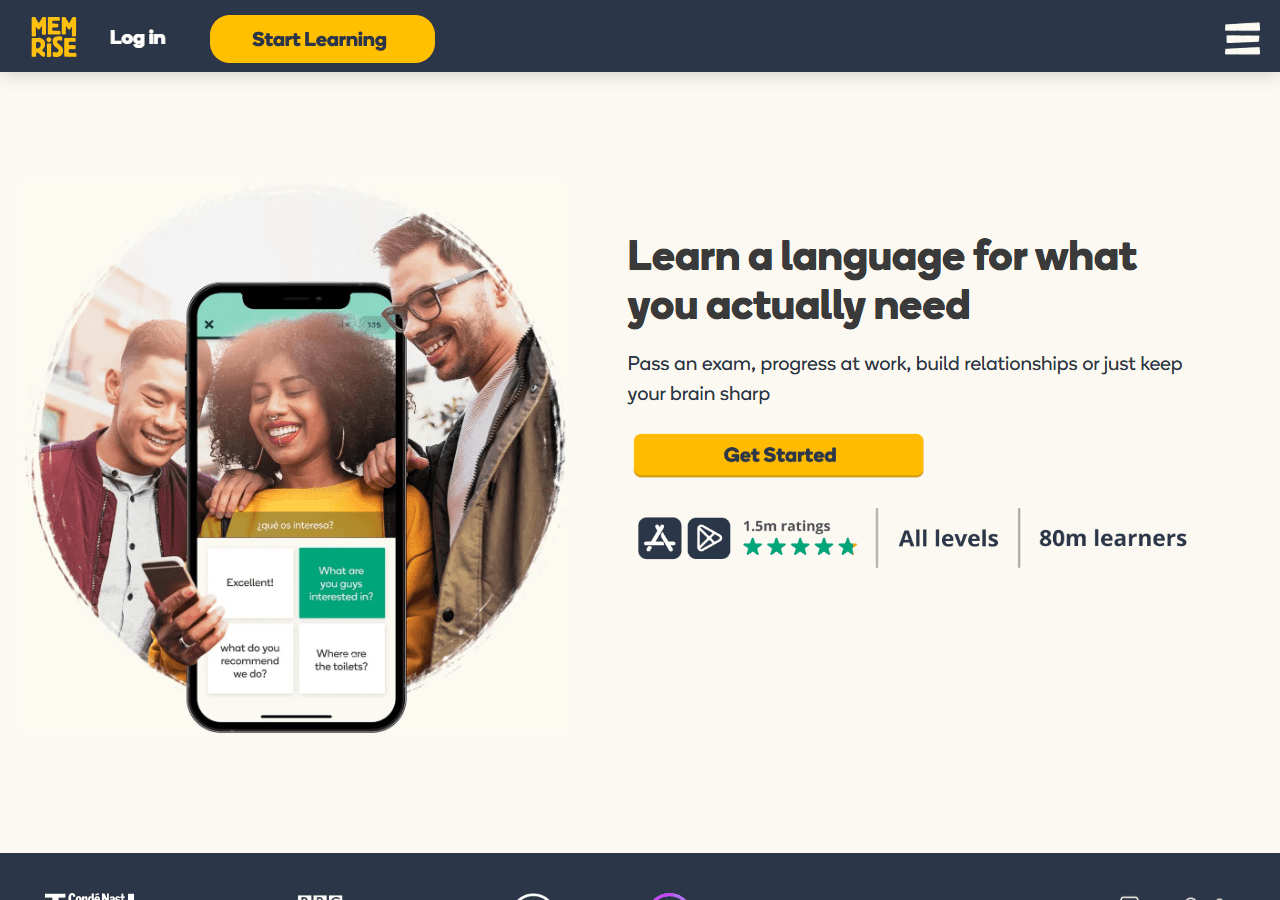
Product one is the official app. You download it, you pick a language, and you get the structured experience: Learn, Immerse, and Communicate sections. Learn is your bread and butter, the actual lessons.
Immerse is native video content. Communicate is where MemBot, their AI chat partner, lives.
The official app has professionally built courses, and the flagship feature is what they call Learn with Locals: short video clips of real native speakers saying real phrases. That kitchen-table woman from my first night?
Learn with Locals. It’s the thing that made me put my tea down, and it’s the thing that still works really well in 2026.
Product two is the community courses, and this is where the story gets sad for a certain kind of user. For years, Memrise was famous for its community-made decks.
Anything you wanted to learn, in any language, someone had probably made a course for it. Rare languages, obscure vocab, weird passion projects.
Then in 2024, Memrise moved all of that off the main app, and it now lives at community-courses.memrise.com. The official app will not show you those decks.
If you open the app expecting to study your community-made Icelandic deck, you’ll find the door bricked over. You have to go to the website, separately, like visiting an old friend who moved out of town.
I’ll talk more about the split in its own section, because it deserves it. But file this away now: if your mental image of Memrise is “the app with the community courses,” that image is out of date, and it’s the single biggest source of bad Memrise reviews online.
People download the app, can’t find the thing they came for, and one-star it. I get it, but it’s also not quite fair to the official app, which is a different animal.
One more confusing thing: nobody, including Memrise it seems, can agree on how many languages the official app teaches. Depending on where you look, you’ll see numbers ranging from about 23 to 35 official languages.
Their about page used to throw around a much bigger number, but that was counting historical community courses, most of which no longer live in the app. So if you’re after a rarer language, check before you subscribe.
It might be there. It might have moved to the community site.
It might be gone. Memrise’s own messaging won’t make it clear, because Memrise’s own messaging can’t make it clear.
If you just want Spanish, the biggest and best-maintained course on the platform is right here: Memrise’s official Spanish course. That’s the one we used, and it’s the best showcase for what the app does well.
How we used it for two weeks
Two weeks, phone-first, mostly in the cracks of the day. Let me paint the picture honestly, because the “how” matters as much as the “what.”
Weekday mornings: Coffee brewing, phone in hand, one lesson while the kettle-adjacent noises happen. Spanish lesson, about five to seven minutes.
This was actually the ideal Memrise use case. Short enough to fit before the coffee finished, long enough to feel like I’d done something.
The streak counter started nagging me by day three, which, if you’ve read my Duolingo review, you know is a mechanic I have complicated feelings about. Memrise’s version is gentler than the owl’s.
It wants you to show up. It doesn’t yet threaten your family.
Sitting in the parked car: A friend does the grocery pickup. I wait in the car.
This became Memrise time. Listening exercises with headphones, native video clips playing, me quietly mouthing “tengo que ir al supermercado” like a man rehearsing an alibi.
The video clips were perfect for this setting, because in the car you’ve got the audio and the mouth-movements and nothing else to look at anyway.
Evenings: This is where I’d do the review sessions. Memrise uses spaced repetition, so words you’ve learned come back at intervals right before you’d forget them.
The app tracks each vocabulary item, and here’s the cute part: each item you’re learning grows a little flower as it moves from “just met” to “learned.” It’s a tiny visual garden of your memory.
I rolled my eyes at it on day one and checked on my flowers on day four like they were actual plants. I’m not proud.
It works.
The community site evening: One Tuesday in week two, after the street had gone quiet, I made tea and opened community-courses.memrise.com on my phone browser. And this is the moment the two-products thing stopped being an abstract fact and became a feeling.
The community site is functional. It works.
But it’s a website with a deck browser, not an app experience. It feels like going to a store that moved from the mall to an industrial unit across town.
Same merchandise, worse lighting, and you have to want to be there.
I poked around a community Spanish deck, found the content genuinely good (community-made Spanish content is a mature genre at this point), and missed the app polish within about ninety seconds. Then I went back to the official app, found my flowers waiting, and understood the whole Memrise situation in my gut instead of just my head.
They didn’t kill the community courses. They evicted them and kept the nice house.
For context on how I judge these things: I’ve spent real time with most of the major apps, and if you want the full lay of the land, my best language learning apps roundup covers the field. And my general approach to not quitting language learning after three weeks is written up in how to learn a language, if you want the philosophy behind the yacking.
Also worth saying: my Spanish is helped along by my own materials, including our Spanish course and the Yak Cards we built, so I’m not a beginner begging the app for mercy. I came in able to test whether Memrise teaches well, not just whether it teaches at all.
How a Memrise lesson actually works
Let me walk you through a lesson, because the structure is where you’ll live or die with this app.
A Memrise lesson opens with a short video clip. A native speaker, usually framed like a video call, talks to the camera and says the phrase you’re about to learn.
Maybe it’s “¿Me pones un café, por favor?” and there’s a person in a real café saying it, with real mouth movements, at real speed. This is the Learn with Locals stuff, and it’s the single best thing in the app.
Real accents, real faces, real pace. Not slowed-down audio recorded by a voice actor in a studio who’s never had a Spanish speaker cut them off mid-sentence.
After the video, the lesson runs you through rounds of exercises: multiple choice questions, listening exercises, typing, and speed rounds where you have to beat the clock. The speed rounds are the stressful bit, in a way I oddly enjoyed.
Nothing like a timer to expose which words you actually know and which ones you’re just recognizing on sight like a celebrity face you can’t name.
Each vocabulary item you encounter is a card in their spaced repetition system. Learn it once, and the app schedules it to come back.
Get it right, the interval stretches. Get it wrong, and it comes back sooner, glaring at you.
And as I mentioned, each item grows that little flower as it progresses. The garden metaphor is doing real work here psychologically.
Watching a word go from seed to full bloom is weirdly satisfying, and I say that as a man whose actual garden is a tribute to neglect.
Here’s what a lesson doesn’t have, though: grammar instruction. Meaningful grammar, anyway.
You’ll learn “soy” and “estoy” as separate items and be trusted to figure out the difference from vibes and repetition. There’s no “the verb ser, and here’s when you use it” moment.
Memrise’s philosophy is that you absorb patterns from exposure, the way you learned your first language. That philosophy works better than you’d think for phrases and travel basics, and it falls apart entirely the moment you try to say anything the app didn’t pre-teach you.
I’ll dig into that in the grammar section.
A typical session is maybe five to ten minutes. The app is designed around short daily bites rather than long study sittings, which suits phone-first learners perfectly and suits desktop language nerds not at all.
Everything about the official app says “you are on a bus” even when you’re not.
Native video, MemBot, and the missing grammar
Three features, three very different stories.

The native video is the star.
I keep coming back to it because it’s the thing that earns Memrise its reputation. Learn with Locals videos are short, they’re real people, and they teach you to hear a language as it’s actually spoken.
Every other app gives you polished studio audio. Memrise gives you a woman in her kitchen, a guy on a street corner, ambient noise and all.
After two weeks, my listening comprehension felt sharper, and I credit the video entirely. Studio Spanish and kitchen-table Spanish are different languages, and Memrise is the only major app that teaches the second one at scale.
This alone justifies the app’s existence. If you’ve ever learned a language from an app, gone to the country, and understood nothing, this feature is aimed directly at your trauma.
MemBot: a patient dummy, not a tutor.
The Communicate section gives you MemBot, an AI chat partner you can type at in your target language. It responds, you continue, theoretically you’re “practicing conversation.”
The honest truth after two weeks: MemBot is a patient dummy. It will chat with you forever, never judge you, never get tired, never sigh at your gendered-noun errors.
As a low-stakes place to type Spanish without fear, it’s genuinely fine. But it doesn’t teach.
It doesn’t correct you with any depth, doesn’t explain why you were wrong, doesn’t push you into structures you don’t know. It’s a sparring partner that lets you win.
Fun for confidence, useless for correction. If you want to actually build conversational skill, a chatbot that forgives everything is a treadmill that adjusts to your walking speed rather than the other way around.
The grammar-shaped hole.
And then there’s the missing grammar. This is my biggest knock against the official app, and it’s not a small one.
Memrise teaches phrases. It teaches them well, with real speakers and smart review scheduling.
But it does not teach you how the language fits together. No conjugation tables, no explanation of tenses, no “here’s why ‘estoy cansado’ and ‘soy cansado’ mean different things and one of them will make a native speaker wince.”
For a beginner wanting travel phrases, this is survivable. You’ll learn “¿Dónde está el baño?” and be able to use it.
For anyone wanting to actually speak the language beyond phrasebook level, Memrise alone will hit a wall, and it’ll hit it around month two or three, when you know 400 words and can’t connect any of them into a sentence you weren’t taught. Memrise’s answer is more exposure.
Sometimes exposure works. Sometimes you just need someone to explain the past tense in eleven sentences.
Memrise will not be that someone.
If grammar-heavy structure is what you’re after, Babbel is the grammar course of the big apps, and Duolingo, for all its sins, at least sprinkles grammar tips along the path. Memrise is the immersion purist of the trio, betting you’ll absorb structure like a child does.
Children, however, have roughly 15,000 hours and no mortgage. I have a commute.
Community decks vs the official app: the split
Let’s talk about the divorce properly, because it defines what Memrise is in 2026.

For most of Memrise’s life, the community courses were half the appeal. The app was a platform: official courses at the top, and below them a whole ecosystem of user-made decks covering everything from French medical vocabulary to conversational Swahili.
People built serious, lovingly maintained courses. Learners built habits around them.
Then 2024 came, and Memrise moved all community courses out of the main app. They still exist, at community-courses.memrise.com, but they’re no longer part of the app experience.
No streaks feeding in, no flowers, no integration with the polished stuff. Separate building, separate life.
From Memrise’s side, I understand the business logic. Community decks are a moderation and maintenance burden, they don’t sell subscriptions, and the company clearly wants to be a modern AI-video-having language app, not a wiki with a mascot.
Fair enough. Companies are allowed to pick a direction.
From the user’s side, it stings, and the sting is proportional to how long you’d been using community courses. If you had a two-year streak on a community-made deck, the deck didn’t die, but your app experience around it did.
And if you’re arriving fresh in 2026 having heard about “that app with all the courses people made,” you’ll download the official app and find a different product than the one you were told about. That’s a bad first impression Memrise fully earned through messy communication.
My evening on the community site confirmed the vibe. The content is there, much of it excellent.
The experience is a browser tab. If you’re motivated and the deck you need lives only there, you’ll be fine, with an emphasis on “if you’re motivated.”
Motivation is the currency of the community site, and the app used to convert motivation for you.
The official app, meanwhile, is the product Memrise wants to be: curated courses, native video, an AI bot, subscription revenue. It’s better than it’s ever been at what it does.
It just does less than it used to, on purpose.
So, rule of thumb for 2026: if you want the polished, video-first beginner course, the official Memrise app is your destination. If you want the wild ecosystem of community decks, it’s the website.
Same name, different doors. Know which one you’re walking through before you pay for anything.
Free vs Pro vs lifetime: the pricing maze

Alright, deep breath. Let’s do money, and let me tell you up front that I opened the plans page on my phone, looked at it for a while, and audibly said “okay” in the tone of a man discovering a second expiry date on his milk.
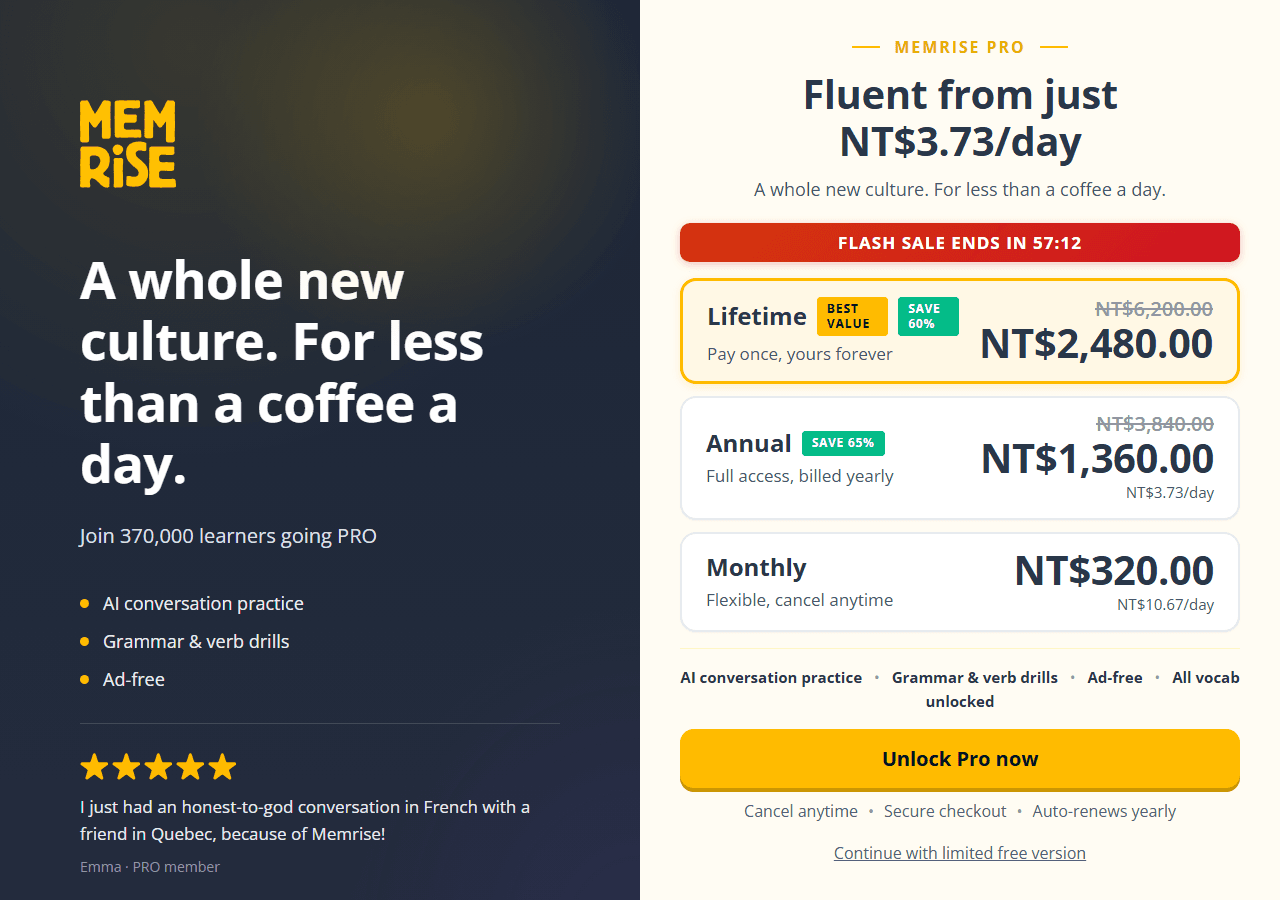
Here’s the shape of it as of early 2026. Prices move around, so treat these as a snapshot and screenshot your own checkout page before you quote me at a dinner party.
The web plans page we loaded showed a flash sale in local currency; the USD in-app snapshot below is the one I’m using for the cards.
Free
The free version of Memrise is a hallway. You get to walk down it, look into some rooms, and try some things.
Pro
Monthly was around $24.99 on the snapshot I saw, which is a tourist price. Annual was around $61.99, and that’s the real adult plan.
Lifetime
And here’s where I laughed out loud. Lifetime was showing around $164.99 on sale, against a list price of $329.99.
Some video clips, some MemBot access, the early parts of courses. Ads arrive.
Offline mode doesn’t. The free tier exists to show you the product and then, politely but firmly, ask you for money.
To be fair, this is the industry standard model, and Duolingo’s free tier is more generous. But let’s not pretend free Memrise is a learning tool for the long haul.
It’s a demo with ads. You’ll get a real feel for whether the video-first style works for you, which has value, and then you’ll hit the meter.
I want to be very clear about the monthly number, because if you search around you’ll find older reviews quoting $7.50 to $9 a month like it’s current. It is not current.
Those numbers are fossils. Monthly pricing has jumped around noticeably.
Nobody sensible pays monthly for a year at these rates. If you’re going to pay for Memrise, annual is the one.
At roughly five bucks a month effective, it’s competitive with the other big apps.
A lifetime subscription, on sale, in an app that has already completely rebuilt itself once under existing lifetime buyers. The community course exodus of 2024?
People who bought “lifetime” access to a platform that included community courses in the app woke up to a platform that no longer did. Their lifetime didn’t change, but the product did.
Lifetime subscriptions are a bet that the company never changes the thing you’re buying. Memrise has already changed it once.
Buy lifetime if you love the app and want the souvenir, but go in with open eyes: “lifetime” means the lifetime of the current product direction, not a legal promise that the features you like will stick around. There’s a discount-shaped dopamine hit and then there’s the fine print, and at Memrise the fine print has teeth.
So the money summary: free is a taste, monthly is a trap for the inattentive, annual is the honest price, and lifetime is a bet on a company that’s already shuffled the deck once. Screenshot your checkout.
Prices vary by platform, by promotion, and possibly by moon phase.
If you want to compare what the other big apps charge and whether they’re worth it, the full apps roundup covers that, and I’ve got a whole set of reviews if you’re comparison shopping.
What I liked about Memrise, and what wore me down
What I liked
Let’s start with the good stuff, because there is genuinely good stuff.
The native video is the thing. It’s not a gimmick and it’s not a stock-footage afterthought.
Every clip is a real person, framed like a cheap Zoom call, talking at you in the language you’re learning. Sometimes it’s scripted.
Sometimes it’s clearly some poor soul in a kitchen saying “¿Dónde está la estación?” for the eleventh take. Either way, your brain does something with a real human face that it simply refuses to do with a cartoon owl or a text-to-speech voice.
You start to catch mouth shapes. You start to notice that this woman says “buenos días” slightly differently than that guy.
That’s the actual skill, and Memrise drills it without making a fuss about it.
The official app also does spacing right, at least at the sentence level. Words I got wrong came back sooner.
Words I nailed faded into the distance and reappeared a few days later like an old friend I’d ghosted. That’s the SRS doing its quiet work, and it works better here than in apps that just shuffle a deck like a bored dealer.
And the pacing. A Memrise lesson takes maybe three to five minutes.
It never asks for a twenty-minute commitment. I did a round while my coffee brewed, another while pretending to listen to a podcast about municipal zoning.
It fits into dead time better than almost anything I’ve used, and I’ve yacked about a lot of these things over on the reviews page.
What wore me down
Now the wearing-down part.
First, the grammar silence. Two weeks of Spanish and I could not tell you why “estoy cansado” and “soy cansado” are different, because Memrise never told me.
It showed me both, presumably hoping I’d absorb the distinction through osmosis. I did not.
I absorbed confusion. If you’re the kind of person who wants a rule, even one rule, Memrise will leave you standing at the altar.
Second, the MCQ fatigue. Multiple choice is the default interaction for a huge chunk of the course, and multiple choice is the laziest way your brain can “know” something.
You recognize the answer. Recognition is not recall.
When I tried to actually produce “¿Puedo pagar con tarjeta?” without four options under it, my mind went white. The typing rounds help, but they’re outnumbered.
Third, the ads on free. I get it, I yack about free tiers constantly, they have to pay for those kitchen videos somehow.
But the ad breaks land with the frequency of radio commercials in 2003 and about half the charm. After day ten I could feel my will to open the app eroding one pre-roll at a time.
Fourth, the app has clearly been rebuilt around its current features, and you can feel the seams. The flower-growing progress thing is cute.
The streaks are streaks. But there’s a sense that the parts that made people love Memrise ten years ago got sanded off in the remodel, and what’s left is polished but narrower than the name suggests.
Memrise horror stories, and the people it works for
The horror story
Every language app has its graveyard of forum posts, and Memrise’s is interesting because the complaints cluster into very specific camps.
Camp one: the lifetime buyers. People who paid for lifetime Pro back when the app was community-deck-centric, and then watched the app get rebuilt underneath them.
Imagine buying a house because of the big backyard, and the developer paves the yard and puts in a parking lot. The house still exists.
The thing you bought it for is under asphalt. That’s the strongest recurring bitterness you’ll find about Memrise, and honestly, it’s earned.
The $164.99 lifetime they sell today is a souvenir of a promise that’s already been broken once.
Camp two: the community course people. If you spent five years building or studying a community deck of, say, Basque verbs, the 2024 move of community courses off to community-courses.memrise.com felt like an eviction.
The decks still exist. They’re just not in the app anymore, which for people who lived in the app is a distinction without a difference.
Some of these folks have migrated to Anki and are never coming back.
Camp three: the grammar people. These are the ones who show up in reviews saying “I finished the whole Spanish course and still can’t conjugate in the past tense.”
That’s not a bug, it’s the design. Memrise teaches phrases, not systems.
But nobody warns you up front, so the disappointment lands like a betrayal instead of a limitation.
When it works
Now, flip it around. Who it works for.
A friend heading to Cancún who wants to survive a week with functional phrases: perfect fit. Absolute beginners: strong fit.
People who froze in high school Spanish because the teacher started with conjugation tables: this is the app that unfreezes you, because you’re saying real things to real faces within five minutes. Aural learners, people who learn best by hearing and mimicking: Memrise is basically built for you.
If your goal is “order food, ask directions, don’t be a totally helpless tourist,” two months of Memrise will get you there with more confidence than most apps twice its price.
Who Memrise is for
After two weeks, I’d put the ideal Memrise user in a pretty tight box.
You should be a beginner. Not “I did a year of Spanish in 2004 and want to reactivate it,” though that works okay-ish, but genuinely new, or new enough that basic phrases still feel like discoveries.
Memrise front-loads survival language with real human speech, and no other mainstream app does that combination as well.
You should want speaking and listening more than reading and writing. The video-first structure means your ears and your mouth are the primary organs.
If your goal is to read novels, this is the wrong tool and you know it already.
You should be okay with phrases-first, rules-later-or-never. If you can accept “this is how they say it” as an answer, Memrise will keep you happy.
If you need “this is why they say it,” you’ll be combing the forums within a week, muttering.
And you should be a phone-first learner. The app is the product.
The community site is a separate thing, the web experience is fine but secondary, and everything about the design says “you, on a bus, for four minutes.”
If that’s you, Memrise is honestly one of the better first apps you can pick, and I’d say that even if it weren’t getting a middling Yak score from me. For the full lay of the land, my best language learning apps roundup covers where it sits against everything else.
Who should skip it
Three groups, no hesitation.
You came for the community decks. Skip. They’re not in the app anymore.
If you’re chasing a specific community course for a rare language, check community-courses.memrise.com and see if it survived the move, but understand you’re using a website that shares a logo with the app, not an app feature. If it’s not there, Anki is where that crowd went, and they seem at peace with it.
You need grammar. Skip. Memrise will not teach you grammar now, and there’s no evidence it plans to start.
Babbel is the grammar course in this space, and I’d point you at my Babbel review if structure is what you’re after. Memrise is the phrasebook with excellent video.
Babbel is the textbook. Different animals.
You’re past beginner. Mostly skip. Once you can hold a slow conversation, the official courses run out of road for you.
The video stays great, but you’ll burn through the useful material and hit the ceiling fast. Intermediate learners should be looking at Anki plus real content, not an app that will spend a week teaching them “una cerveza, por favor.”
Also worth flagging: the official language count is genuinely murky. Depending on where you look you’ll see roughly 23 to 35 official languages, and that old “149 languages” figure floating around comes from the community-deck era and doesn’t reflect what’s actually in the app today.
If you’re learning something rare, verify your language exists in the official app before you build a habit around it.
Pros and cons
Pros
- Native speaker video in every lesson, no cartoons, no robot voices doing cosplay
- Real faces and real accents train your ear faster than anything else at this price
- Genuinely short lessons that fit into dead time
- SRS spacing works; wrong answers come back, right ones fade out
- The best “hear it from a real mouth” experience for beginners, period
- MemBot gives you a pressure-free place to flub sentences out loud
Cons
- Grammar is light to nonexistent; you’ll learn what people say, never why
- Heavy reliance on multiple choice, which trains recognition over recall
- Free tier is a hallway: some video, some bot, ads, no offline downloads
- Community courses are gone from the app, full stop
- Pricing jumps around, especially monthly, and the lifetime price is a loaded question
- Rare languages may simply not exist in the official catalogue
- MemBot is a patient dummy, not a tutor; it won’t correct your grammar either
What we'd use instead or with it
Nothing I yack about exists in a vacuum, so here’s the honest stack.
If you want exactly one app and it’s not Memrise: Duolingo builds the daily habit better, and its free tier is the most generous in the business. I’ve got a full Duolingo review if you want the breakdown, but the short version is Duo is the habit machine and Memrise is the ear trainer.
Duo won’t teach you to understand a real human at conversational speed either, but it’s better at getting you to show up tomorrow.
If you want grammar and a course with a spine: Babbel, as mentioned. It’s the structured counterweight to Memrise’s phrase-first approach.
Some people run both, Memrise for listening, Babbel for rules, and report the combo works. I believe them, though I didn’t run that experiment for this piece.
If you want the serious spaced repetition engine and don’t mind a steeper learning curve: Anki. It’s the SRS that Memrise’s community crowd fled to, and it’s what you graduate to when an app’s ceiling starts pressing against your head.
Anki is free on desktop and Android, ugly as sin, and utterly without opinion about what you should learn. It’s the opposite of Memrise in every way that matters.
Me, if I were restarting learning Spanish from zero tomorrow? I’d probably do Memrise free for the video and the ear training, keep a paper notebook for the grammar questions Memrise refuses to answer, and add Yak Cards for the vocabulary that actually sticks.
Then when Memrise’s ads started to grate, I’d either pay for Pro annual or jump ship, depending on how attached I’d gotten to those kitchen videos.
And if you’re not sure what language you’re even doing yet, the language courses section is where I’d start. Picking the language matters more than picking the app, and I will die on that hill.
What others are saying
I’m not the only one yacking about this app, and the consensus out there is interesting because everyone trips over the same two facts and lands differently.
The pattern across all of them: everyone loves the video, everyone shrugs at the grammar, and everyone has to explain the community course situation, which is the paragraph no Memrise reviewer wanted to write.
FAQ
Prices, plan names, and features below are as of September 2026.
Is Memrise free?
Partly. The free tier gives you a sample of the video, some access to MemBot, and a steady drip of ads.
No offline downloads, and the full official courses sit behind Pro. Think of free as the hallway with all the doors closed.
You can stand in it. You can look at the doors.
Pro is where the actual rooms are.
Is Memrise Pro worth it?
If you’re a beginner committed to a few months of daily use, the annual plan is the only price that makes sense for an adult. At the time I’m writing this, the in-app snapshot showed roughly $61.99 a year against about $24.99 a month, so annual pays for itself inside three months.
The lifetime option, around $164.99 on sale versus a $329.99 list price, is the trickiest call in language app pricing, because lifetime buyers have already watched this app get rebuilt once under their feet. Screenshot the checkout page, prices wander.
What happened to Memrise community courses?
They moved out of the app in 2024 and now live at community-courses.memrise.com, a separate site that shares the brand but not the experience. If you used Memrise for a community deck of a rare language, that’s where you go now.
It’s a website, not an app feature, and I wouldn’t buy a subscription expecting otherwise.
Memrise vs Duolingo: which one?
Duolingo for the free habit and the daily pull. Memrise for native video and training your ear on real humans.
If you’re picking one free app, Duo’s free tier is far more usable. If you’re paying and your priority is understanding actual speech, Memrise earns the money.
Full head-to-head lives in my Duolingo review, and the broader field is in the apps roundup.
Memrise vs Anki: can they replace each other?
No, and they’re barely playing the same sport. Memrise is a guided course with video and a friendly on-ramp.
Anki is a raw spaced repetition engine where you bring your own material or download decks from strangers. Anki is the stronger learning tool; Memrise is the stronger starting experience.
Serious learners often end up on Anki eventually. Beginners almost never start there, and probably shouldn’t.
After two weeks with Memrise
So where does that leave me?
Two weeks in, I can say “¿Dónde está el baño?” to a real human face and understand the answer about sixty percent of the time. That’s not nothing.
That’s more functional Spanish than a month of some other apps got me, and it came from watching people talk, which is the one thing Memrise does better than the whole field.
But I also can’t explain a single grammar rule I’ve implicitly used, I’ve hit the ceiling of what multiple choice can prove about my own knowledge, and I spent more time than I should have wondering whether I’d be the next person to buy a lifetime and watch the app remodel itself around me.
Memrise is a very good phrase video library wearing the outfit of a complete language course. If you want the phrases and the faces, it delivers, honestly and often delightfully.
If you want the system underneath the language, it’ll hand you a flower graphic and change the subject.
For the deeper how-to of building an actual learning routine around any app, my how to learn a language guide is the real playbook. And if Spanish is your target, the Spanish section has you covered past where Memrise lets off.
For English learners, there’s also a full 139-lesson course starting at Lesson 1.
Two weeks, one kitchen full of patient Spanish speakers, and a flower that never quite bloomed. I liked it.
I didn’t love it. I might pay for one year of it, and I’d never pay for a lifetime of it, for reasons that should now be obvious.
6 out of 10 Yaks