



I’ve been yacking about language apps long enough that people assume I’ve tried everything. I mostly have, which is less impressive than it sounds when you consider half of them are the same app wearing a different hat.
Busuu is one of the ones people keep asking about, usually in the same breath as Duolingo, and for a long time my honest answer was “I opened it once in 2020, it asked me to subscribe, and I closed it.”
That’s a bad look for someone who runs a site called Yak Yacker, so I fixed it. A friend and I spent about two weeks with Busuu, mostly in Spanish, mostly on our phones, with one confused evening on the laptop where I tried to figure out why the web version felt like a website from a company that clearly wants you on mobile.
We stayed on the free plan for roughly a day before hitting the paywall where it actually hurts, upgraded to Premium on the website because the app store prices are a scam I refuse to fund, and then settled into a routine of five-minute lessons while waiting for coffee, buses, and that friend to finish getting ready.
I also poked at Korean, because I’m incapable of reviewing one language on a multilingual app without checking whether the other shelves are stocked. Spoiler: the Spanish aisle is Costco, the Korean aisle is a convenience store.
Two things before we start. This is not a lab study.
Nobody paid me, nobody sent a press kit, and the strongest bias I have is that I’ve already reviewed Duolingo and I get cranky when apps copy its worst habits. Second, I used the community features.
I submitted written and spoken prompts and waited, like I’d put a note in a bottle, for a stranger in another country to correct my Spanish. Sometimes the bottle came back.
Sometimes it came back fast and wrong.
If you want the short version: Busuu is a genuinely good Spanish course wearing a mildly annoying gamification costume, the free tier is a tasting menu, and you should buy Premium on the website or not at all. If you want the long version, keep yacking with me.
7 out of 10 Yaks



It’s the best “real course in an app” I’ve used this year, and it still made me sigh out loud at least four times.
What Busuu actually is
Busuu is a language learning app owned by Chegg. It claims around 120 million users, which is a number I take the way I take restaurant capacity signs: technically true, spiritually flexible.
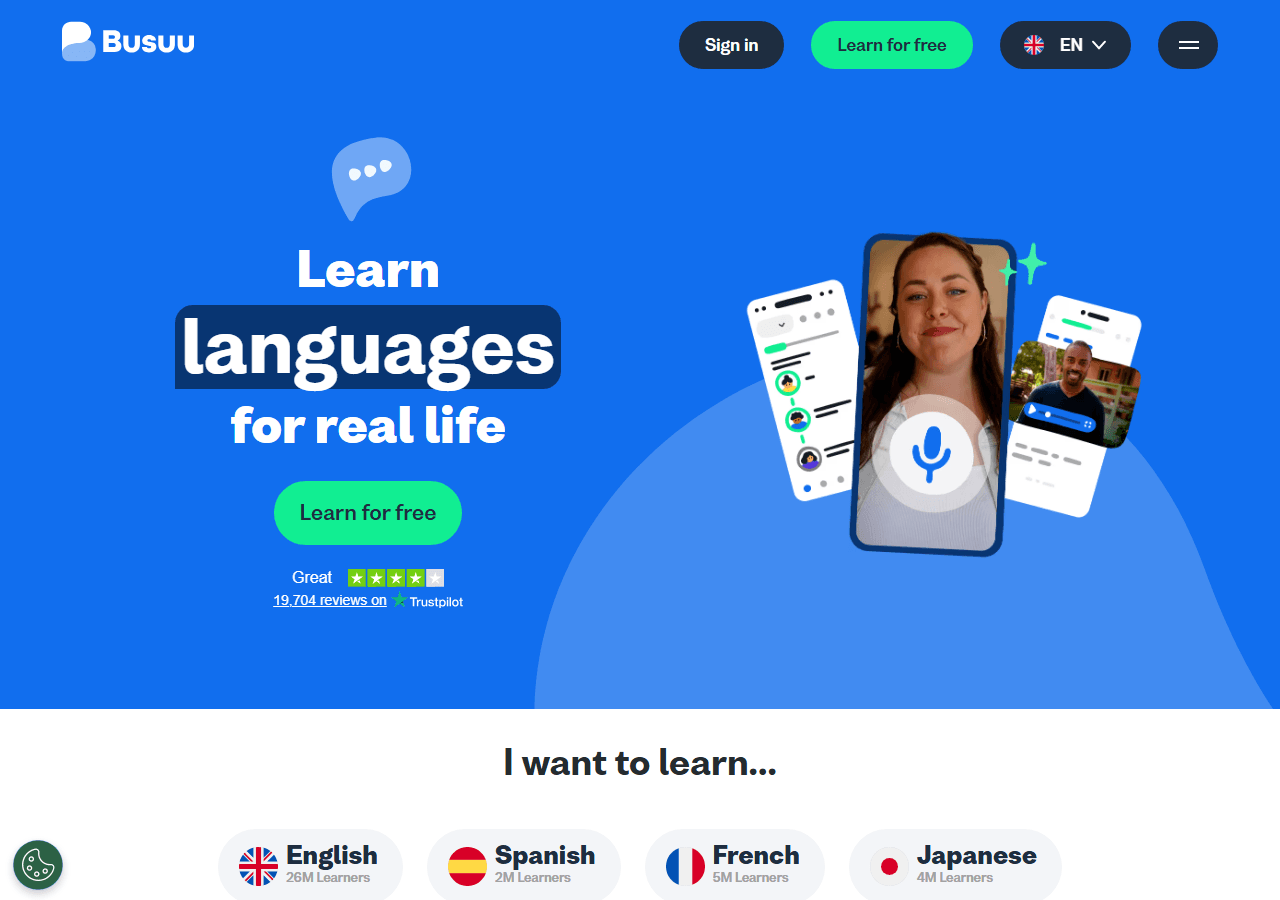
It offers 14 languages, and this matters more than it sounds, because Busuu is not equally good at all of them. It’s a Spanish/French/German/English machine first, and everything else is a smaller commitment.
The big four go up to C1, which is honestly rare in app land. Most apps tap out at B1/B2 and then wave vaguely toward “immersion.”
Most of the other languages on Busuu stop at B2, and some stop earlier. Korean, the one I checked, stops at A2.
That’s not a knock exactly, but if you’re picking Busuu for a language outside the flagship four, you need to know the ceiling before you fall in love.
The pitch is that it’s a proper course, not just a streak game. Lessons have native-speaker video, actual grammar explanations, drills, and then the hook that made Busuu famous: the community.
When you write or speak a prompt, real humans who speak the language natively correct you. You also correct people learning your language, which is the karma economy that keeps the whole thing running.
So it’s a structured course with a human element bolted on. In practice, the human element is about 20% magic and 80% roulette, and I’ll get into that.
But the structure part, the actual lessons, is better than I expected, and it’s the reason the free tier’s limits sting as much as they do.
How we used it for two weeks
The routine, such as it was: that friend and I both ran Spanish, me a bit ahead because I have more time to yack around on apps, them catching up on commutes. Nearly everything happened on our phones.
One lesson is about five minutes, which is the actual unit of modern language learning, and Busuu leans into it. Waiting for the kettle?
Lesson. On the can?
Lesson, obviously. Standing in a Canadian Tire checkout line in small-town Ontario?
Lesson, and also a lesson in patience, but a different kind.
We did the free thing for about a day. A day is all it takes.
You do a couple of lessons, you feel the structure, you start to like it, and then you finish a unit and think “okay, now let me review what I just learned” and Busuu goes “ah, that’s a Premium feature.” The grammar review and vocabulary review sections, which are the parts that turn a five-minute lesson into something your brain actually keeps, are locked behind the paywall.
So are certificates, offline lessons, and the ability to skip content you already know.
The free tier is a teaser. It’s a decent teaser, but you’re not learning a language on it long-term, you’re sampling one.
After a day we paid up.
Here’s the part where I save you money: buy Premium on the website, not in the app. On the site, the 12-month Premium promo we saw was US$72.99 a year (about $6.08 a month), marked down 51% from US$149.88. Premium Plus was US$87.90 a year.
In the app stores, the same thing costs more, because Apple and Google take their cut and Busuu passes it to you. It’s the same account either way.
There is no reason to pay the app store price. None.
Tell your friends.
Also watch the promos. Busuu runs discounts that auto-renew at full price, and if you don’t catch it, you’ll get a renewal charge that feels like a personal insult.
I set a calendar reminder for two days before the renewal like a paranoid person, and I recommend you do the same.
The laptop session was one evening, and it was fine. Everything works on the web, it just feels like an afterthought, because it is one.
Busuu is mobile-first in its soul. More on that when we get to Plus, because some Plus features barely exist on desktop at all.
We also submitted a couple of community prompts, one written, one spoken, and I want to be honest: submitting a recording of yourself speaking Spanish and then just… waiting… for a stranger to judge it is a specific kind of vulnerability. It’s good for you.
It still feels weird. The corrections that came back were mostly useful, with one memorable exception I’ll yack about later.
How a lesson actually works
This is the core loop, and it’s good, so let me walk you through it.
Each lesson runs about five minutes and follows the same skeleton. First, a short video of actual native speakers having an actual conversation at actual speed.
Not actors slowing down for learners, or at least not obviously. In the early Spanish lessons it was two people doing the “hola, ¿qué tal?” dance, and even at A1 level the audio is refreshingly real.
My friend, who has been burned by apps that only teach you robot-slow Spanish, appreciated this immediately.
Then a short grammar note. This is the thing Busuu does that Duolingo famously doesn’t.
Instead of just throwing sentences at you and hoping you reverse-engineer the grammar like some kind of linguistics crime scene investigator, Busuu just… tells you. “Here’s how ser and estar differ.
Here’s why the adjective changed. Here’s the rule.”
It’s a paragraph, sometimes two, with examples. Not a textbook, but a real explanation, written down, that you can read again.
Then the drills. Fill in the blank, pick the right conjugation, reorder words into a sentence, type the translation, listen and repeat.
Standard stuff, well executed, with enough variety that you don’t get the glazed “I’m just tapping shapes” feeling. The audio quality is good and the speakers sound like people, which shouldn’t be a differentiator but is.
And then, occasionally, the community prompt. This is where the lesson pauses and says “now write three sentences about your weekend” or “record yourself ordering breakfast.”
Your answer goes out to native speakers of the language you’re learning, and you get corrections back from real humans. Meanwhile, Busuu also shows you prompts from people learning English, and you can correct them, which is the actual social contract of the app.
You take turns being the student and the teacher.
The pacing is the real strength. Five minutes, one small concept, drilled a few ways, occasionally checked by a human.
Do two or three of those a day and you’re doing maybe fifteen minutes of genuine, structured practice, which is more than most people have done since high school. It’s not a magic amount, but it’s sustainable, and sustainable beats intense every time.
That’s basically the thesis of everything I’ve written at how to learn a language: the app matters less than whether you’re still using it in month four.
My one gripe about the lesson structure itself: the vocabulary bank is smaller than a dedicated flashcard system. Busuu has its own review tool (Premium, naturally), but the total vocab you encounter finishing a level is noticeably less than you’d grind through with a proper spaced repetition setup.
I kept wanting to export words to my own Yak Cards and had to do it manually. If you’re serious, plan on a flashcard system alongside Busuu.
More on that later in the full review.
Community corrections: the good, the weird, the wrong
Let’s talk about the feature Busuu leads with, because it’s genuinely the most interesting thing about the app and also the least predictable.

When you submit a written or spoken prompt, you wait. Sometimes minutes, sometimes hours.
My first written correction came back in about twenty minutes, from a woman in Spain who fixed my adjective agreement, explained why in Spanish, and was kind about it. That correction is now burned into my memory in a way that no drill has ever achieved.
There’s something about a real person taking thirty seconds of their life to fix your sentence that makes it stick. When a native speaker edits your work, it sticks.
When the app gives you a thumbs-up, it does nothing for your brain.
That’s the good version. The weird version: you’ll also get corrections that are just a thumbs-up with no text, which is pleasant and useless.
Thanks, anonymous stranger, for your confidence in me. It’s the language-learning equivalent of a like on a post nobody read.
And then there’s the wrong version. One of my spoken prompts came back with a “correction” that changed my correct sentence into a different, also correct sentence, with no explanation, presented as a fix.
This is the roulette part. Most correctors are great.
Some are native speakers who don’t really know how to explain their own grammar. Some are doing corrections at speed on a bus.
The quality varies wildly and there’s no real quality control, because how would there be? It’s strangers helping strangers for karma points.
The speed varies too. Popular languages get corrections fast because there are tons of native speakers on the other side.
Submit something in a less common language and you might be waiting a long time, staring at your phone like it owes you money.
My advice: use the community features, but treat every correction as a second opinion, not gospel. If a correction contradicts the grammar note in the lesson, trust the lesson and check elsewhere.
And do corrections yourself. It’s genuinely useful for your own understanding of English, it’s the polite thing to do, and it’s the whole reason the system works at all.
Free vs Premium vs Plus: the wall and the tiers

Here’s the layout, because Busuu’s pricing is three doors and only one is labeled honestly.
Free
The teaser. You get the lesson path and that’s mostly it.
Premium
The real course. All the reviews, the certificates, offline mode, lesson skipping, no ads.
Plus
The 12-month Premium Plus promo we saw was US$87.90 a year (about $7.33 a month), or more if you pay month-to-month. It adds the shiny AI stuff: AI Conversations, where you chat with an AI that plays a shopkeeper or a friend; AI pronunciation feedback; and Mistake Repair, which resurfaces your errors.

Ads, which aren’t terrible but exist. No grammar review.
No vocabulary review. No certificates.
No offline downloads. And you can’t skip lessons, which means if you already know some Spanish, you get to grind through “hola” like it’s 2009.
Free Busuu is a tasting menu at a restaurant where the kitchen only starts cooking when you pay.
This is what you’re actually buying when you buy Busuu. The 12-month website promo we saw was US$72.99 a year, marked down from US$149.88.
Not cheap, but reasonable for a full structured course. Again: website, not app store.
The app store markup is pure platform tax. The discount renews at the full price unless you cancel.
Here’s the catch, and it’s a big one if you’re a desktop person: these Plus features are mobile-first to the point of barely existing on the web. Our laptop session made Plus look like a ghost.
If you’re a phone learner, fine. If you want to sit at a computer and study like it’s 2012, Plus is mostly not for you, and honestly, neither is Busuu.
One more thing I need to be careful about: Busuu used to market live tutor sessions, and if you’ve read older reviews, you’ll have seen Live lessons mentioned prominently. That stuff has drifted toward Busuu for Business.
Don’t buy a Busuu subscription expecting to book a human tutor session. If you want a human, get a human separately, and I’ll tell you exactly how in the back half of this review.
And the promo trap deserves a repeat: discounted subscriptions renew at full price automatically. Set a reminder.
I did. My friend mocked me for it.
I remain correct.
Languages: where Busuu is Costco and where it's a convenience store
Spanish, French, German, and English go up to C1. That’s the flagship tier, and the depth shows.
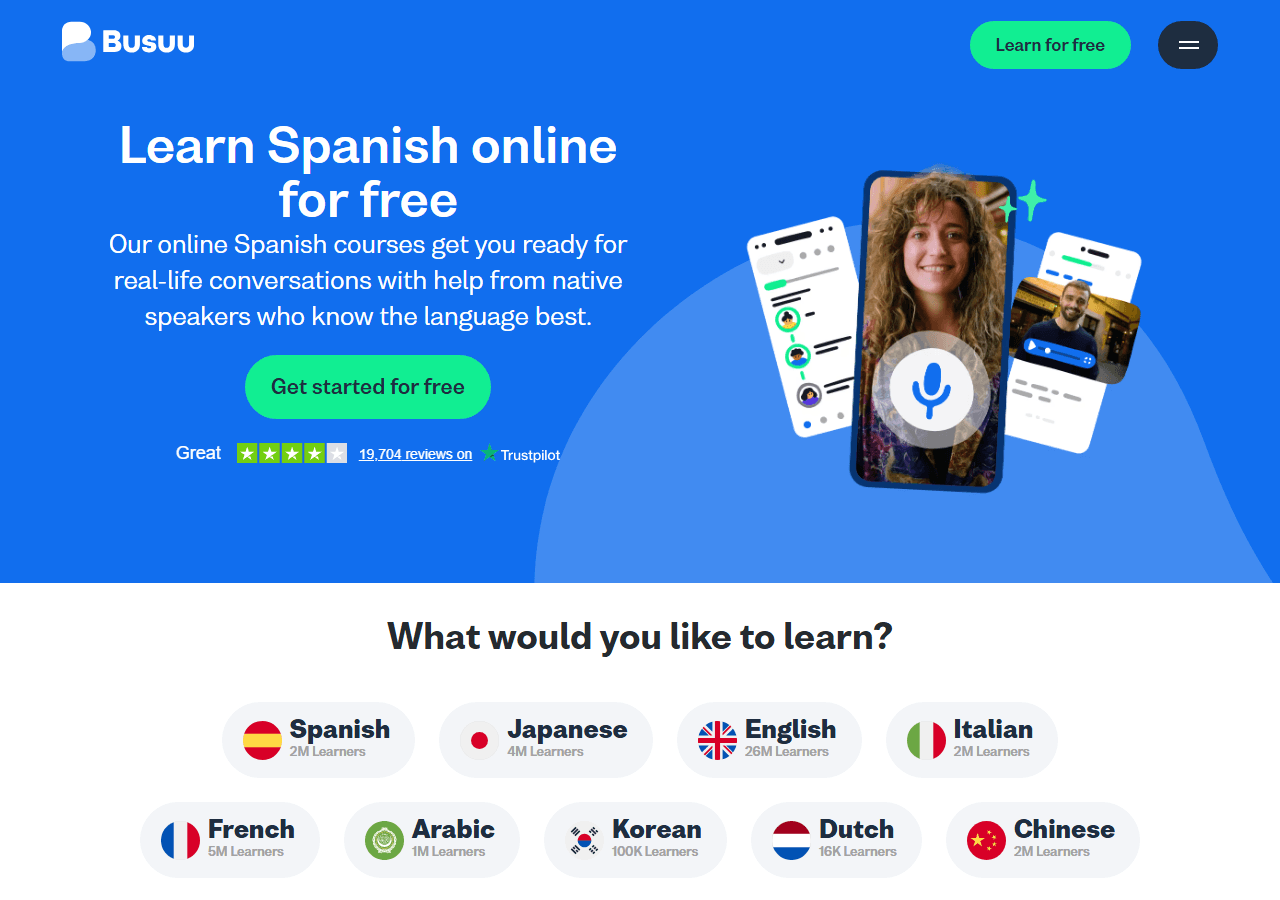
Long paths, lots of lessons, real grammar coverage, plenty of native-speaker video. If you’re learning one of those four, you’re getting a course that can plausibly take you from “I can say hello” to “I can argue about rent in writing.”
Most of the other languages stop at B2, which is still a respectable ceiling, higher than a lot of apps offer. Italian, Portuguese, and the rest of the lineup are real courses, just shorter ones.
And then there’s Korean, which I specifically went and poked, because I don’t trust app makers to be honest about their smallest shelves. Korean on Busuu goes to A2.
A1 to A2. That’s it.
And even that A2 feels thin in places. I did a chunk of the Korean path and the whole time I had the feeling of someone showing me a nicely finished basement in a house that’s mostly unbuilt above it.
What’s there is decently built, same lesson structure, same video approach. There’s just not much of it.
If Korean is your target and you’re starting from zero, Busuu will absolutely get you reading hangul and forming basic sentences, and it’ll do it pleasantly. But you’ll finish the course in a few months and be nowhere near where an app that actually specializes in Korean can take you.
The A2 ceiling is real, and it arrives faster than you’d think.
Same logic applies to picking any language on Busuu: check the ceiling before you commit. The app lists levels per language, and if your target language tops out below where you want to go, plan your exit before you start, not after.
I keep a running list of courses by language over at language courses for exactly this reason, and I’ll be updating it with Busuu’s actual coverage now that I’ve confirmed the Korean situation firsthand.
For the record, the Spanish path is the one we lived on, and it’s the one I can vouch for: Busuu Spanish is a real, deep, C1-reaching course. It’s the product.
Everything else is on a spectrum of “also real” to “convenience store.”
Streaks, leagues, and certificates: the Duo costume
This is the part of the review where I sigh audibly.

Busuu has streaks. Busuu has leagues with leaderboards.
Busuu has little stars and badges and progress celebrations. It didn’t always.
Older Busuu was quieter about this stuff, and at some point someone in a meeting looked at Duolingo’s retention numbers and said “we should have the owl psychology too.” So now it does, and it looks like Duo.
It just looks like Duo. Streak flames, weekly leagues, the works.
I’m on record about my complicated relationship with this stuff in the Duolingo review, so I’ll keep it short: streaks work, in the sense that they get you to open the app, and they don’t work, in the sense that opening the app isn’t the same as learning.
The risk with streak culture is you start doing garbage lessons at 11:47 PM to protect a number. I did this exactly once with Busuu, a sleepy nothing lesson on a Tuesday, and felt like I’d scammed myself.
To Busuu’s credit, the gamification is lighter than Duolingo’s. It’s present rather than aggressive.
The leagues exist but they don’t shout at you with notifications the way the owl does. If you’re streak-motivated, you’ll get your fix; if you find that stuff corrosive, you can mostly ignore it without Busuu guilting you.
Certificates are the other thing, and I want to be very clear about what they are. When you complete a level, Busuu gives you a completion certificate, backed by a big-name test it licenses.
It’s a nice PDF. It looks good pinned to a fridge.
It is not a DELF, a DELE, an official CEFR credential, or anything any employer or university is obligated to care about. When I say “fridge paper,” I mean it as a category: motivating, personal, evidence of effort, worth nothing at a border or a job interview.
Do not buy Busuu for the certificates. Buy it for the course.
The certificates are confetti.
One more practical note: the placement test can dump you too low. A friend took it, placed a level under where they belonged, and spent the first few lessons being re-taught things they knew cold.
If you have any prior exposure to the language, take the placement result as a suggestion and then manually skip ahead once you’re in Premium. Which is, yes, another reason the free tier’s no-skipping rule is obnoxious.
They lock the fix for the placement test’s mistakes behind the paywall. Cute.
That’s the front half of the review: the course, the humans, the pricing trap, the Duo costume. Keep going for the part where I talk about what wore me down, the horror stories, who this app is actually for, and what I’d use instead or alongside it.
What I liked about Busuu, and what wore me down
What I liked
Two weeks is enough time for a honeymoon and the first fight. Both happened.
The good stuff.
The grammar notes are the whole point. This is the single biggest reason someone leaves Duolingo and lands on Busuu. Duo gives you a sentence and hopes you reverse-engineer the rule from vibes.
Busuu just tells you the rule. It’s not a textbook, it’s a short paragraph, usually with a table, and then you drill it.
That’s it. That’s what I wanted.
For a 40-year-old who likes knowing why “me gusta” works the way it does instead of just memorizing that it does, this was a breath of fresh air.
The native-speaker videos are genuinely good. Real people, real faces, talking at a speed you can actually process at your level. Not animated owls, not text-to-speech.
Hearing a human mouth form the words does something for pronunciation that audio drills don’t.
Lessons respect your time. Five minutes is five minutes. You can finish a lesson while your coffee brews.
This matters more than people admit, because the app you’ll actually open beats the “better” app you don’t.
The community corrections, when they land, are magic. More on this below, but a real Spanish speaker fixing your sentence is worth fifty multiple-choice drills.
Progression feels honest. The A1 to B2 ladder is right there. You know where you are.
Duo’s vague crowns never told me anything; Busuu’s CEFR labels at least correspond to something real in the outside world.
What wore me down
What wore me down.
The Duo-ification. Streaks, leagues, stars, hearts-adjacent nonsense. Busuu used to be the serious one, and now the notification drawer nags me like every other app on my phone.
I don’t need a league table to learn the preterite. I need the preterite.
The vocab ceiling. Busuu’s vocabulary bank is fine for the course, but it’s not a real SRS system. If you want retention, you’ll end up in Anki or on our Yak Cards anyway.
Busuu teaches; it doesn’t hammer words into long-term memory with the same ruthlessness a dedicated flashcard system does.
The A2 wall. I poked around in Korean enough to feel it, and it’s real: a lot of languages top out at B2 or lower, Korean at A2. Finish a course, walk into an actual A2 test, and you’ll get humbled.
The course is a foundation, not a finish line.
Ads on free feel punitive. Not “small banner” punitive. “Watch this or wait” punitive.
I get it, the free tier is a teaser, but it’s worth saying plainly.
The promo auto-renew trap. The discount price renews at full price, and it’s on you to remember. Cancel the moment you buy if you’re not sure.
I’ll say this twice in this review because it’s the number one complaint out there.
Horror stories, and who it actually works for
The horror story
The complaints you’ll find if you go looking.
The billing complaints are the loudest. People sign up on a promo, forget, get renewed at full price, and then fight customer support for a refund.
Some get one, some don’t. This is the classic subscription-app playbook and Busuu runs it like everyone else.
The defence: buy on the website (cheaper than the app stores), note your renewal date, and cancel immediately if you’re testing.
The second tier of complaints is the community corrections. Sometimes you wait hours.
Sometimes the “correction” is someone else’s learner who’s worse than you. Sometimes it’s a native speaker who fixes your sentence beautifully and it sticks with you for a week.
It’s a lottery, and the ticket is free.
The third is drift. Features shuffle around, Live tutoring has drifted toward Busuu for Business, the mobile app gets the good stuff (AI Conversations, Mistake Repair) while the website gets the leftovers.
If you’re a desktop learner, you’re the second priority. I used the laptop exactly once in two weeks and didn’t feel like I was missing much, but a web-first person would notice.
And then there’s Chegg. Busuu is owned by Chegg, the homework-help company.
That means corporate parents, metric dashboards, and the kind of product decisions that come from a spreadsheet. It also means ~120 million users and enough money to keep the lights on, which smaller apps can’t promise.
When it works
Who it works for anyway.
Despite all that: people finish Busuu courses. People get to B1 in Spanish on this app and then have real conversations.
The structure works, the grammar notes work, and if you’re a phone-first learner who wants to understand the language rather than just gamify it, this is one of the better builds in the store.
Who Busuu is for
Busuu is for you if:
- You’re a Duolingo graduate who’s realized you can’t explain a single grammar rule after 200 days of streaking
- You want to actually understand the language, not just pattern-match your way through exercises
- You’re phone-first and want 5-minute lessons you’ll genuinely do on a bus
- You’re learning Spanish, French, German, or English, where Busuu goes up to C1 and the courses are properly built
- You like the idea of real humans correcting your writing and speaking
- You want a clear CEFR ladder so you know roughly where you stand
It’s especially good for the anxious self-studier who’s afraid of “doing it wrong.” The lessons tell you what to do, in what order, and why.
That removes a lot of the paralysis that kills language learning in month two.
Who should skip it
- Korean and other thin-course learners. If your language stops at A1–A2, you’ll hit the ceiling fast. I felt it in a week of casual poking. Look at our language courses section for whatever you’re studying before committing.
- Anyone who needs certificates that mean something. Busuu’s certs are fridge paper. Fun, motivational, not DELF, not DELE, not accepted anywhere that matters. If you need an official credential, this isn’t the path.
- Desktop-first learners. The good features are mobile-first. If you hate learning on your phone, half the product is invisible to you.
- People who will buy on the app store. Seriously, don’t. It’s more expensive there. Buy on the website.
- Vocabulary grinders. If your bottleneck is retention and you already have grammar down, a dedicated SRS tool does that job better. Busuu is a course, not a memory system.
- Anyone who wants a live tutor. Live has drifted toward Busuu for Business. If you want a human, italki or similar is the honest answer.
Pros and cons
Pros
- Actual grammar explanations, not vibes-based inference
- Native-speaker video in lessons, not text-to-speech
- 5-minute lessons that fit real life
- CEFR-structured courses (A1–C1 for the flagship languages)
- Community corrections from real speakers when they land
- Premium price is fair if you buy annually on the website (US$72.99/yr on the promo we saw)
- 14 languages with ~120M users, so the community actually exists
Cons
- Free tier is a teaser: ads, no review, no certs, no skipping
- Promo auto-renew billing trap, and app store prices are higher
- Vocab bank is smaller than a dedicated SRS
- Finish A2 in some languages and you can still fail an A2 test
- Korean (and several others) top out early
- Community correction speed and quality are a lottery
- Streaks and leagues are Duo cosplay now
- Certificates don’t count for anything official
- Placement test can dump you too low
- Desktop experience is second fiddle
What we'd use instead, or alongside it
I don’t believe in one-app solutions. Never have.
The honest stack for most people looks like this:
Busuu for the course. Grammar, structure, progression. The skeleton.
Duolingo free for reps. Counterintuitive, but Duo is genuinely good at high-volume, low-stakes repetition. Keep it free, ignore the leagues, use it as a drill machine while Busuu does the teaching.
Babbel if you want one tighter package. Babbel’s course is more traditional and a bit drier, but it’s cohesive in a way Busuu’s buffet isn’t. If you want a single subscription that behaves like a textbook that loves you, that’s the pick.
italki when you need a human. Eventually, you need to talk to a person. If you’ve got a friend who speaks the language, use the friend.
If you don’t, a tutor once a week will do more for your speaking than any app feature ever will. Busuu’s community corrections are great, but they’re corrections, not conversations.
Yak Cards for retention. Our Yak Cards exist because every course app we’ve used, Busuu included, teaches words once and hopes. Hope is not a memory strategy.
If you’re learning Spanish specifically, start with our learn Spanish guide and our broader how to learn a language section. If you’re learning English, we have 139 lessons, starting with Lesson 1.
And the full reviews hub covers the rest of the market.
What others are saying
I’m not the only one yacking about this app. Here’s the wider room:
The consensus across the room: strong courses, real grammar, good flagship languages, annoying monetization, don’t trust the certificates. I don’t think anyone’s wrong.
FAQ
Prices, plan names, and features below are as of September 2026.
Is Busuu actually free?
Technically. The free tier gives you a taste: some lessons, ads, and no access to grammar and vocabulary review, no certificates, no offline downloads, and no skipping ahead.
It’s a demo that markets itself as a free app. Premium is the real course.
Free is the trailer.
What's the difference between Busuu Premium and Plus?
Premium (US$72.99/yr on the 12-month website promo we saw, US$149.88 full) unlocks the real course: review features, no ads, certificates, offline access, and skipping. Plus (US$87.90/yr on that same promo) adds AI Conversations, pronunciation training, and Mistake Repair, and those extras are mobile-first, so web learners don’t get the full value.
If you’re on the fence, Premium is the honest purchase for most people.
Busuu vs. Duolingo: which is better?
Different jobs. Duo is better at volume, gamification, and being free forever.
Busuu is better at actually explaining grammar and structuring progress along CEFR levels. The common path is Duo to build the habit, then Busuu when you want to understand what you’re saying.
Our full Duolingo review covers the other side.
Busuu vs. Babbel?
Babbel is tighter and more traditional, a structured textbook-style course. Busuu is broader, with the community layer and better CEFR reach (up to C1 in the big languages).
If you want one clean course, Babbel. If you want depth plus human feedback, Busuu.
Do Busuu certificates mean anything?
As in, will an employer or school accept them? No. They’re motivational markers aligned to CEFR levels, but they’re not DELF, DELE, or any official credential.
Put it on the fridge, not the résumé.
How do I cancel Busuu?
Through whatever platform you bought it on. If you bought on the website, cancel in your account settings on busuu.com.
If you bought through the App Store or Google Play, cancel through those. Do it the day you buy if you’re on a promo, because the discount renews at full price by default.
This is the trap. Set a reminder.
Is Busuu good for Korean?
For a taste, yes. Korean runs A1 to A2, which means you’ll exhaust the course before you’re conversational.
If Korean is your serious goal, Busuu can be your on-ramp but not your vehicle. Check our language courses coverage for Korean options with more road.
After two weeks
I went in expecting a Duolingo clone with European branding. What I got was a real course with a Duo costume draped over it, and the costume is the worst part.
The grammar notes are the reason to be here. The native-speaker videos are the second reason.
The community corrections, when a real Spanish speaker takes thirty seconds to fix your sentence, are a small piece of magic that none of the big apps have copied well. Two weeks of Premium took me further into actual Spanish comprehension than months of owl-based streak maintenance ever did, and I say that as someone with a documented Duo habit.
But I can’t unsee the monetization. The free tier is bait, the promo auto-renew is a trap, the app store pricing is a tax on the uninformed, and the certificates are confetti.
The streaks and leagues feel like a mid-life crisis, an app that used to know what it was, dressing younger. And the A2 ceiling on the thinner languages means the “14 languages” headline hides a very uneven product.
So: buy Premium, on the website, annually, with a renewal reminder set. Use it for the flagship languages.
Pair it with flashcards and, eventually, a human being. Do that, and Busuu earns its spot.
7 out of 10 Yaks