



I’ve been yakking about Japanese study tools for years now, mostly apps, mostly flashcards, mostly things that beep at you when you get something right. But this past stretch was different.
A friend and I cleared off the kitchen table, poured the tea, and spent about two weeks actually reading Japanese. Not studying it.
Reading it. Graded readers, specifically: the free Tadoku stuff, a stack of ASK/White Rabbit Level 0 and Level 1 samples, and one Satori Reader sample pitched around N4.
Two weeks. Kitchen table.
A lot of tea and one dramatic moment where I almost threw a Level 1 booklet across the room because of a kanji I knew I’d studied. But we’ll get there.
Here’s my honest framing before anything else: this was not a lab study. I didn’t control variables.
I didn’t track reading speed with a stopwatch or log comprehension percentages in a spreadsheet, because I am a person, not a research assistant. A friend and I read, we compared notes, we argued mildly about which level fit whom, and then I wrote it all down.
If you want a full breakdown of the whole graded reader world, we keep a growing library page at our Japanese graded readers hub that this piece feeds into. This article is the kitchen-table version.
The one with tea rings on it.
Some background on where we’re starting from, because it matters. I’m 40, Canadian, and I’ve been at Japanese on and off since my early 30s.
“On and off” is doing a lot of work in that sentence. I’ve done the app circuit.
You can read my Duolingo review if you want the long version, but the short version is that I learned hiragana, some katakana, a pile of vocab, and essentially zero ability to read anything longer than a menu item. That friend is slightly ahead of me on grammar and slightly behind on kanji, which makes us a genuinely annoying pair to study with, because we each think the other one is carrying the team.
What neither of us had ever really done was extensive reading. You know, the thing where you read a lot of easy material and let the language soak in instead of dissecting every sentence like a frog in biology class.
I’d heard about graded readers for years. Japanese has a genuinely weird relationship with reading material, honestly, because the writing system means you can’t just pick up a kids’ book as a beginner.
Japanese children’s books assume you’re a Japanese child, which means you already speak fluent Japanese and you’re just working on the reading part. Adult learners are the reverse: we can sort of parse grammar but we can’t read the script.
Kids’ books are the worst of both worlds for us. So graded readers exist to fill that gap, and fill it they mostly do.
The two weeks went like this: week one was Tadoku, the free stuff, because I refuse to spend money before I know whether a method even works for me. Week two we brought in the ASK/White Rabbit material, Level 0 and Level 1, plus a Satori Reader sample I’d been sitting on.
We read at the table most evenings, maybe 30 to 45 minutes, sometimes longer when a story got good, sometimes shorter when a story was about a vending machine and I could not make myself care.
And look, I’ll spoil the ending a bit: this method works. It’s not flashy.
Nothing beeps. There are no streaks, no leagues, no cartoon owls threatening you.
It’s just you and a page, and somehow that turned out to be the most progress I’ve felt in months. If you want the quick verdict on how graded readers stack up as a method against everything else we’ve yacked about at Yak Yacker, here it is.
8 out of 10 Yaks



Now let’s get into the actual reading.
What a graded reader actually is (and the 95% rule)
Let’s define terms, because “graded reader” gets thrown around loosely and some of what gets sold under that label is… not that.
A graded reader is a story or text written deliberately within a tight vocabulary and grammar band. Not a story written for native speakers and then simplified.
Written from scratch for a learner at a specific level. Every sentence is constructed so the difficulty stays inside the lane.
The vocabulary is counted. The grammar is sequenced.
Someone sat there with a list and made sure this book only contains what a Level 2 learner knows, or is about to know.
That last part matters more than people think. The whole point of a graded reader is volume without struggle.
You’re not supposed to be looking things up every sentence. You’re supposed to read.
The rule of thumb you’ll see everywhere, and the one we actually used at the table, is the 95 to 98 percent rule: you should already know about 95% of the words on the page. Below 95%, you’re not reading, you’re decoding, and it’s exhausting.
At 98%+, it feels almost like reading English, where an unknown word slides past you and you get it from context anyway.
The practical test we landed on: sample a page. Any page, mid-book, not the first page, because first pages are famously easy.
Count roughly how many words you don’t know. One or two on the page?
Buy it. Five or more?
Step down a level. This sounds crude and it is, but it took us about ninety seconds per book and it never steered us wrong.
The other thing you need to know going in: the JLPT level printed on a cover is a starting point, not a promise. Publishers slap “N5” on things the way cereal boxes slap “part of a balanced breakfast” on sugar.
It’s directionally useful and legally vague. Our Level 0 ASK material felt easier than some “N5” things I’ve seen, and the Satori N4 sample had stretches that felt closer to N3.
Trust the page sample over the label. Always.
And then there’s the kanji wall, which deserves its own paragraph because it’s the single biggest emotional event in beginner Japanese reading. Japanese uses three scripts, and kanji, the Chinese characters, are the ones that’ll get you.
You can know a word perfectly by ear and not recognize it on the page because it’s wearing three kanji you’ve never met. This is why furigana exists: little kana printed above the kanji telling you how to read it.
Whether a reader has furigana, and whether you want furigana, is a real buying decision. Some people want training wheels off immediately.
Some people want them on until their legs stop wobbling. A friend and I split exactly down the middle on this, and I’ll get into it when we talk about what we bought.
The point is this: a graded reader handles the kanji question for you, one way or the other. That’s a huge part of what you’re paying for.
The vocabulary control, the grammar band, the furigana decision, all of it engineered so you can just read. It’s the closest thing Japanese has to “pick up an easy book.”
How we read for two weeks
The setup, in full honesty: kitchen table, evenings, tea, one laptop and a stack of printed samples. No kids doing homework beside us, no dramatic vignettes, just two adults with day jobs and a shared spreadsheet of Japanese regrets.

Week one, we went free. Tadoku everything we could reasonably get our hands on, which I’ll cover properly in a second.
The routine was simple: read for 30-ish minutes, don’t look anything up unless it was blocking comprehension entirely, and mark hard spots with a pencil for later. My rule was “if you can follow the story, keep going.”
That friend’s rule was similar but they broke theirs more often and looked things up anyway, then complained that reading felt like work. We are different people.
Week two, we layered in the ASK/White Rabbit material. I want to be precise here because the branding confuses people, myself included for the first day: ASK publishes the Japanese Graded Readers series, Levels 0 through 4, and White Rabbit Press is the distributor you’ll likely buy from in the West, over at White Rabbit Press.
So when I say “ASK/White Rabbit,” I mean the same books: ASK makes them, White Rabbit sells them. Levels 0 and 1 were our lane, with a peek at Level 2 that humbled us both.
We also did one Satori Reader sample, from Satori Reader, pitched around N4, which sat that friend down and reminded them that they are not, in fact, N4 yet. I finished it.
Slowly. With the audio on.
More on that later too.
What surprised me most across both weeks was the shape of the progress. It wasn’t linear.
The first three days felt like trudging through mud, re-reading sentences, second-guessing particle choices I’d “known” for a year. Then around day four or five something shifted, and I don’t want to get mystical about it, but reading got quiet.
The voice in my head translating to English gradually shut up. By the end of week two I was reading Level 1 stories at a pace that would’ve been unthinkable on day one, and I wasn’t consciously aware of getting better.
That’s the entire pitch of graded readers in one anecdote, honestly. You improve at reading by reading, and the grading keeps you in the zone where that’s possible.
What didn’t work: reading when tired. Anything past about 9:30 pm and my kanji recognition just fell apart.
I’d stare at a character I’d read twenty times that week like it was a stranger at a bus stop. So we moved reading earlier, and that fixed it.
If you take one scheduling tip from this article, it’s that: don’t do your reading at the end of the day when your brain is soup.
Free Tadoku first
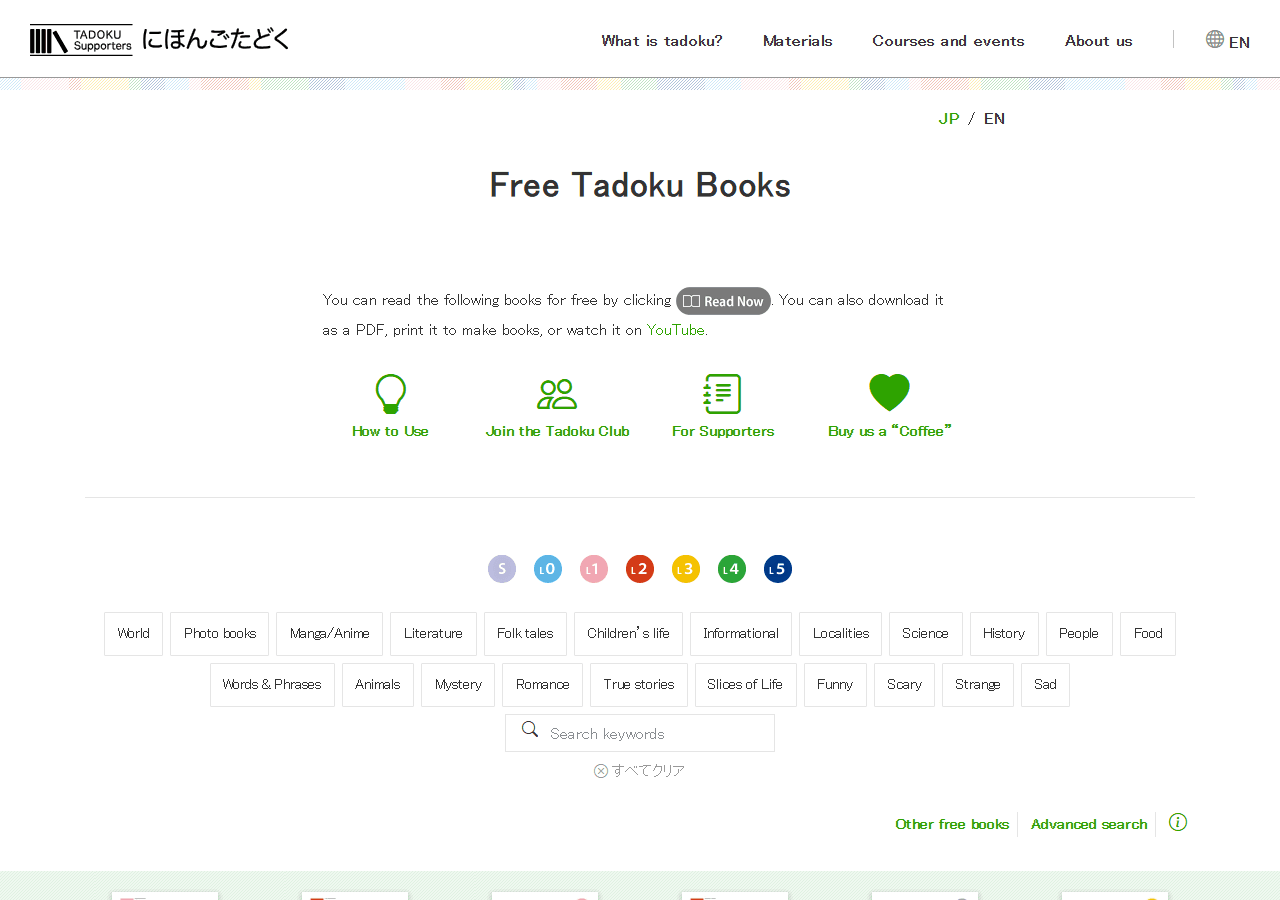
If you’re starting Japanese reading and you’re wondering where to begin, the answer is free, and the answer is Tadoku. 多読, tadoku, means “extensive reading,” and it’s both a method and a community, and the free readers on their site are the honest starting point for this entire endeavour.
Here’s my slightly hot take: do not start by buying anything. I know the ASK books are beautiful.
I know the covers are cute and the physical boxes feel like a treat. I nearly bought Level 2 before week one because the box was navy and I’m a simple man.
But starting Japanese reading by purchasing a graded reader set is like joining a gym by buying the most expensive shoes. It feels like progress and proves nothing.
Tadoku’s free material costs you nothing but humility, which is the correct currency for a beginner anyway. The levels are roughly colour/level banded, and the lowest ones are genuinely, almost embarrassingly easy, and that’s the point.
The Tadoku philosophy says start easier than you think you need. Read fast, don’t look things up, and if a book is too hard, drop it without guilt.
There are no points. Nobody’s grading you.
The only metric is pages turned.
What we found in week one: the easiest Tadoku pieces were pictures with a sentence or two, the kind of thing a proud parent might put on a fridge. My ego said “you’re better than this.”
My actual reading fluency said otherwise, and by the end of the first evening I’d read a dozen of them and was feeling suspiciously good about life. That’s the trick.
Volume plus success breeds momentum, and momentum is the whole game in language learning. I’ve written about this more generally in how to learn a language, but Tadoku is the purest demonstration of it I’ve personally experienced.
The middle Tadoku bands were where the real work happened. Stories a few pages long, simple past-tense narratives, a girl who loses something and finds it, someone gets a cat, a train is late.
Not literature. Not trying to be.
But each one was readable at speed, and reading six in a row did more for my confidence than six months of tapping tiles in an app.
The ceiling is real, though. Tadoku’s free library gets you going and carries you a decent distance, but it thins out at the higher levels.
That’s not a criticism, it’s just the nature of free volunteer-driven material. When you top out, you graduate to the paid spine.
Which brings us to it.
ASK / White Rabbit Levels 0–4

The ASK Japanese Graded Readers series is, in my opinion, the spine of this whole category. Levels 0 through 4, sold through White Rabbit Press, with each level boxed in volumes of a few booklets each.
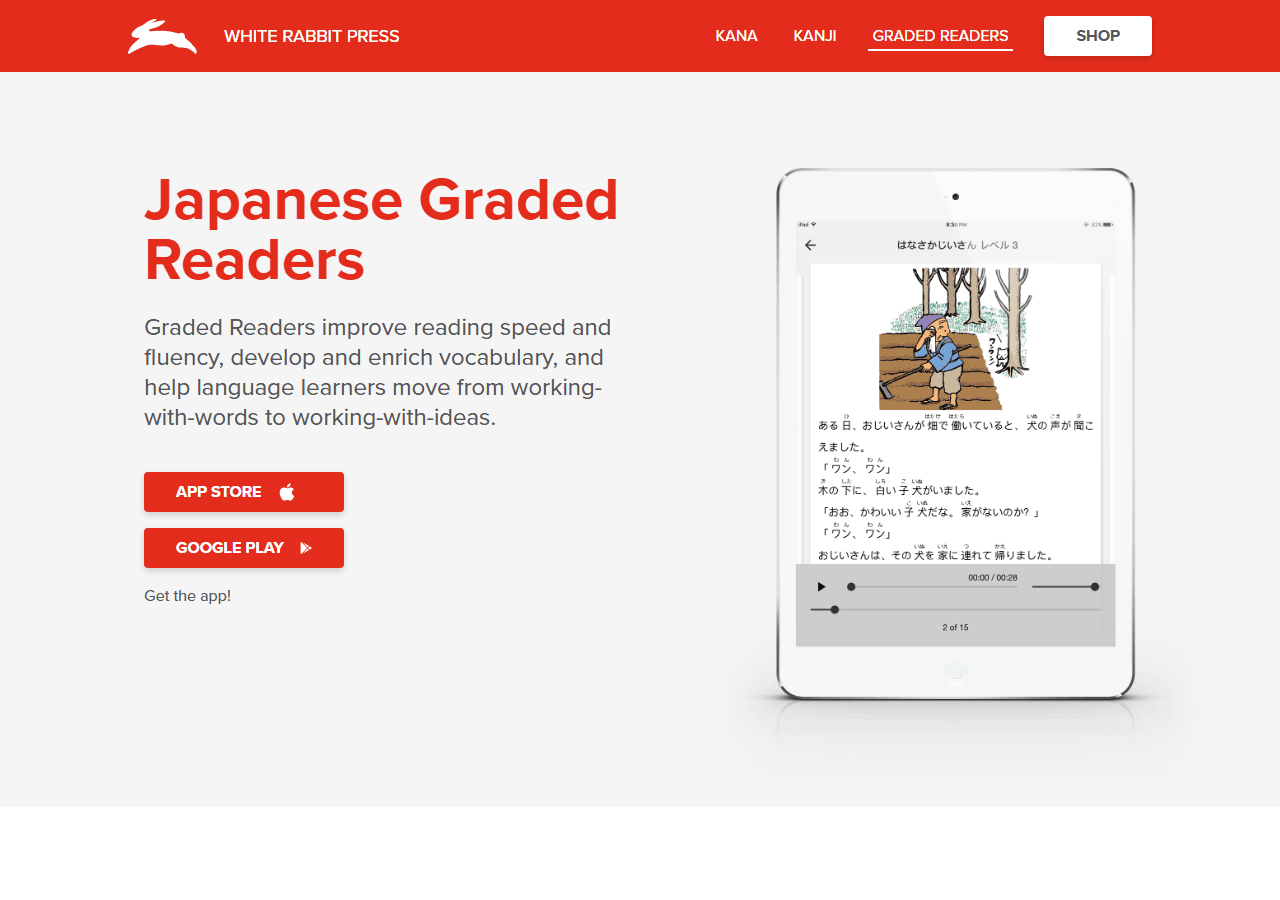
Physically they’re small, thin, extremely portable little books, and there’s something about a physical booklet that made me read more attentatively than I do on a screen. Your mileage may vary, but I want that on the record: the format itself helped me.
Now, one correction that I got wrong myself and want to save you from: Level 5 is not ASK. This is the single most common mix-up in this space. People say “the ASK series goes 0 to 5” and it doesn’t.
Levels 0 through 4 are ASK. Level 5 is published by Taishukan, a different publisher, aimed at a much higher band, near-native-ish bridge material.
I conflated these for a solid day before I caught it. Don’t collapse them into one brand, because if you buy “Level 5” expecting the ASK ladder to just continue gently upward, you’re going to have a bad afternoon.
Level 0 was our warm-up in week two, and it’s honestly delightful. Extremely short stories, sometimes a single spread, extremely controlled vocabulary, furigana on everything.
You can read a whole booklet in ten minutes and feel like a functional human being. If you’re coming fresh off kana and know maybe a hundred words, this is your home.
Level 1 was the sweet spot for both of us, and this is where I want to slow down and talk about what “reading at your level” actually feels like when it’s right. Level 1 stories are a few pages each, simple narratives, everyday settings, and I hit that 96–97% comprehension zone where I’d encounter maybe two or three unknown words per story and absorb them from context without breaking stride.
There was one booklet about someone’s morning routine where I genuinely forgot I was reading Japanese for about thirty seconds. That’s the good stuff.
That’s what two weeks at the table was for.
Level 2 was where that friend and I split. I sampled it and survived with a working dictionary finger hovering over the page.
They sampled it, hit a wall of kanji, and cheerfully declared Level 2 a 2026 problem. Both reactions were correct.
This is the level where furigana starts thinning out in places and where the JLPT label on the packaging begins to feel aspirational rather than descriptive.
Levels 3 and 4 we only eyeballed, and I’ll be honest about that rather than pretending otherwise. Level 3 is heading into solid intermediate territory, longer stories, more adult themes in the literary sense.
Level 4 is bridging toward real native material. I can’t give you a kitchen-table verdict on books I didn’t actually read, so I won’t.
What I can tell you is that the ladder structure is coherent: each level genuinely builds on the last, the vocabulary control is real and not just marketing, and the furigana fades gradually instead of vanishing off a cliff.
On furigana, since I promised: Level 0 and 1 have it throughout, and that was the right call for us. That friend wanted it on everything.
I wanted it on everything too, I just pretended I had opinions about “training the eye.” The furigana-vs-no-furigana question is a buying decision, not a personality test, and there’s no badge of honour in buying above your furigana comfort zone.
I watched that friend drop gracefully back to Level 1 after attempting Level 2 without furigana support, and they read happily for an hour. That’s a win, not a defeat.
Price-wise, the ASK boxes aren’t cheap, and I won’t pretend otherwise. You’re paying for the engineering: the counted vocabulary, the level control, the physical quality.
Whether that’s worth it depends entirely on whether free Tadoku has already proven to you that you’ll actually do this. That’s the order of operations, and I’ll defend it to the end: Tadoku free first, ASK paid second.
Satori Reader (and why it is not N5)
Okay, now the app-shaped exception to everything above: Satori Reader, at satorireader.com. It’s a subscription, not a book.
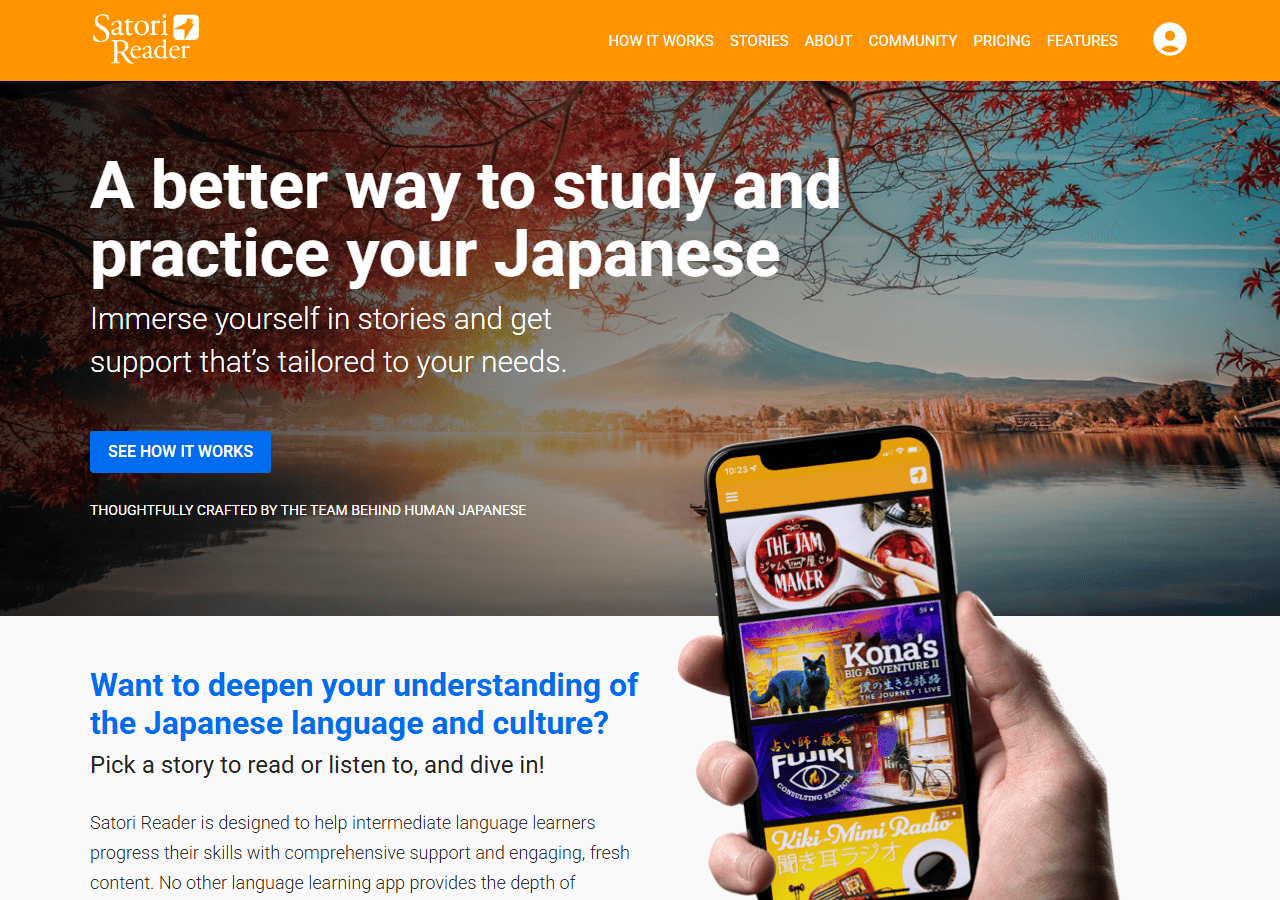
It’s a screen, not paper. And for all that, it was the single most impressive reading tool we touched in two weeks, just not for the reason people hope.
Here’s the correction I most want burned into the internet: Satori Reader is N4 to N3 material. It is not N5.
It is not a first book for absolute beginners. I keep seeing it recommended to fresh-off-the-boat N5 learners, and those people are going to open the app, meet the first story, and quietly close the app forever.
Don’t be that person. Do your Tadoku time, get comfortable at ASK Level 1-ish, and then come here.
Why is it worth coming here at all? Two features, and they’re the whole product: furigana and sentence audio.
The furigana in Satori Reader is tunable. You can show it on everything, hide it on kanji you’ve marked as known, or hide it entirely.
And it learns from you as you go. Compare that to a paper book where the furigana decision was made by the publisher in a meeting you weren’t invited to.
On a paper reader, furigana is a coat you either wear or don’t. On Satori, it’s a thermostat.
The sentence audio is the second half. Every sentence, read aloud, by a human, at natural-but-reasonable speed.
You read, you tap, you hear. My reading and my listening are at wildly different levels, and this stitched them together better than anything else I’ve tried, and I’ve tried most things, Anki included.
Anki taught me to recognize cards. Satori taught me to hear sentences I’d just read, which is a different and weirder and better feeling.
The N4 sample we did was a several-part story with an actual narrative arc, and it was the hardest thing we read all fortnight. But it was hard in the productive way, where the difficulty comes from length and natural phrasing rather than from unknown vocabulary stacked like sandbags.
I’d read a paragraph, tap the audio, re-read while listening, and I could feel the two skills braiding together. It was genuinely good.
That friend tapped out of it halfway and went back to their ASK Level 1 booklets, and honestly, fair. Satori Reader at N4 is still N4, and N4 is a real level that takes real time.
The other thing Satori does, which I didn’t appreciate until I was inside it, is pacing per story with a human narrator and structured series. It’s not a random pile of texts.
There are serialized stories you follow over weeks, which solves the graded reader problem of “I finished the booklet, now what.” The serialization is the retention hook.
I understand completely why people subscribe to this for years.
But the level warning stands. If you’re N5, Satori Reader is not your next step, no matter what a forum post told you.
It’s the step after your next step, and pretending otherwise just costs you a subscription and some confidence. Get the free Tadoku reps, climb the early ASK levels, then come back here with ears ready.
One more honest note before I move on: mixing a screen into a paper routine changed the feel of our two weeks. Paper felt like reading.
Satori felt like studying, in a good way, but still studying. Both belong in the rotation, and if I were building a stack from scratch today, it’d be Tadoku free → ASK paper → Satori as the bridge to real native material.
The order is the product. Anyway, that’s the N4 sample verdict, and it’s a strong one.
Just check your level at the door.
What is *not* a graded reader
Let’s clear some brush before it falls on anyone else.
Nihongo Fun & Easy is not a graded reader. I know it shows up on lists, I know the cover looks friendly, and I know the title sounds like exactly what a tired beginner wants.
But it’s a romaji textbook. Grammar explanations, vocab lists, dialogues with English crutches baked in.
Fine book! Wrong shelf.
If someone sells it to you as a graded reader, they’re rounding up in a way I wouldn’t.
The other trap is subtler: jumping straight to Level 5. Remember, ASK/White Rabbit publish Levels 0 through 4.
Level 5 is published by Taishukan, a different company. When a list lumps “ASK Levels 0–5” together, that’s a small factual lie, and it matters because the person buying L5 expecting the same format gets a surprise.
Taishukan L5 books are bigger, denser, closer to real books for learners. Which is the point of them.
But they are not the same product line, and buying L5 on day one because the cover is cute is how you end up with a $30 paperweight and a bruised ego.
Also not graded readers, while I’m at it: manga (even “easy” manga), children’s picture books, NHK Easy News. All useful, all adjacent, none of them graded.
Children’s books are written for native Japanese kids, which means they assume a spoken vocabulary you don’t have and use childish grammar patterns that are weirdly hard for adults. A graded reader is written for you, the learner, on purpose.
That’s the whole trick.
Olly Intermediate and the missing beginner book

Here’s one that personally annoyed me. Olly Richards’ short-story books exist for Spanish, French, German, and a pile of other languages, and there’s a genuine Beginner edition for most of them.
People see that and assume the same thing exists for Japanese.
It kind of doesn’t. The Japanese Olly book is Intermediate only.
There is no honest Beginner Olly Japanese book in the same sense as the Spanish or French ones. If you’re N5-level and you see “Short Stories in Japanese” with a nice cover, check the level before you buy, because the assumption baked into that book is that you already have a few hundred kanji and decent grammar under you.
It’s a fine book for where it sits. It just doesn’t sit where beginners hope it sits.
I bring this up because the Japanese market has this weird gap where the famous “read stories, learn language” product that works brilliantly for European languages hits the kanji wall and just… stops. Spanish beginner stories work because a beginner can sound out every word.
Japanese beginner stories have to solve the writing system before they solve the story. That’s why ASK charges what it charges, and it’s why free Tadoku exists at all: the scaffolding isn’t optional, it’s the product.
If you’re intermediate and you want the Olly book, go for it, it’s solid. Just don’t hand it to your N5 self and wonder why you’re swimming.
How to pick a level
The 95% rule is the only rule that matters, so I’ll say it again with feeling: stay near 95–98% known words. A page where you miss one or two words is a page you can actually read. A page where you miss ten is a page you’re decoding, and decoding is not reading, it’s homework wearing a book’s clothes.
The practical move: sample a page before you buy anything. ASK and White Rabbit have samples. Tadoku is free so you just read.
Open a page, cover the furigana with your thumb if you’re testing yourself, and count. One or two unknowns, buy it.
Five or more, drop a level. This takes ninety seconds and saves you more money than any discount code ever will.
The JLPT label on the cover is a starting point, not a verdict. Rough mapping: L0–L1 sits around N5 territory, L2–L3 around N4, L4 around N3.
But JLPT levels measure grammar and listening and reading-comprehension-by-exam, and graded readers measure “can you follow this story at speed.” I know people who passed N4 and stalled on L2, and people who never took a test and cruised through L3.
The label gets you into the right aisle. The page sample picks the shelf.
Two more buying decisions that aren’t about your personality:
Furigana or no furigana. ASK gives you furigana (small kana over the kanji) on everything at low levels and tapers it off as you climb. Some learners want it off immediately so the crutch doesn’t fuse to the leg.
Others, me included, want it on, because stopping to look up 読み方 every third line kills the flow that’s the entire point of the method. This is a buying decision, not a moral test.
Pick what keeps you turning pages.
Audio. ASK books come with CDs or downloads depending on edition. Satori Reader has per-sentence audio.
Tadoku is mostly silent. If you’re an audio-first learner, weight that heavily, because reading Japanese without hearing it makes your inner reading voice sound like a robot you invented.
What I liked, and what wore me down
What I liked
Two weeks at the kitchen table. Here’s the honest ledger.
What I liked. The feeling of finishing things. I read whole little stories in Japanese, cover to cover, and finished them.
If you’ve ever bounced off a textbook at chapter four, you know how rare that finishing feeling is. Graded readers are built to be finishable, and it turns out finishing is the whole psychological engine.
I liked that Tadoku cost nothing and got me reading within an hour of finding it. I liked that ASK L0 books are physically small and thin, like little manga-adjacent paperbacks, so they don’t loom.
I liked Satori’s furigana toggle and sentence audio enough that some evenings I used it as listening practice with my eyes closed.
And I liked the kanji wall, weirdly. Not hitting it.
But seeing exactly where it is. With a graded reader, the wall has a door in it, and the door is labeled with a level number.
What wore me down
What wore me down. The kanji wall itself, on days when the door was locked. There were sessions where I “read” a page and understood it, then couldn’t re-read it an hour later without the furigana.
That humbling.
The cost of ASK stings. It’s the paid spine of the method and priced like it.
I understand why, the production is genuinely careful, but a full set from L0 up is a real chunk of money for what are, physically, slim books. Tadoku being free softens this, but the free library is thin at the higher levels and you feel it.
Also: repetition. L0 stories are charming for about four books and then you’ve read your fill of “Tanaka-san goes to the store.”
That’s the nature of the level. It passes.
But I’d be lying if I said I loved every session.
Who this is for / who should skip
This is for you if:
- You’re past the very first hiragana days and want to read, not just study
- You like the idea of finishing things
- You want input that’s actually comprehensible instead of “immersion” that’s just noise with a confident label
- You’re the kind of learner who’ll sample a page before buying (see above, it takes ninety seconds)
Skip it, or at least delay it, if:
- You can’t read kana fluently yet. Fix that first, Duolingo or otherwise. Kana first, always.
- You hate reading in your native language. Graded readers won’t convert you. Try audio or video-first methods instead.
- You want speaking and conversation. Reading builds a quiet foundation, but nobody got conversational from Tanaka-san’s shopping trip.
- You’re a total completionist who’ll buy L0 through L4 on day one. Don’t. Buy one level, read it, reassess. Your future self’s wallet says thanks.
If you’re still shaping your overall method, our how to learn a language guide puts reading in its proper place, and it’s one tool among several, not the whole toolbox.
Pros and cons
Pros
- Comprehensible input that’s actually comprehensible, not aspirational
- Finishable stories, which builds momentum like nothing else I’ve used
- Free on-ramp via Tadoku, so you can test the method for $0
- ASK production quality is real: art, audio, careful leveling
- Satori Reader adds furigana control and per-sentence audio
- The 95% rule makes level-picking objective instead of vibes-based
Cons
- ASK/White Rabbit is expensive for slim physical books
- Free Tadoku thins out at upper levels
- Kanji wall is real and some days it wins
- No true beginner option in the Olly line if that’s what you were hoping for
- Low-level stories get repetitive, that’s just the genre
- Reading alone won’t make you conversational
What we'd use with it
Graded readers work best as part of a stack, not a solo act. Here’s the stack I’d actually run:
Anki for the words that keep showing up. Don’t card every unknown, that defeats the flow.
Card the ones you’ve met three times and still missed. The book is the filter; Anki is the net.
A core app for grammar and daily habit. Our best language learning apps rundown covers the field; you need something feeding you structure while the readers feed you stories.
Yak Cards for vocabulary that refuses to stick. Same logic as Anki but ours, and I’d be a bad owner not to mention them.
Satori Reader as the bridge. When Tadoku runs dry and ASK L4 starts feeling normal, Satori’s N4–N3 material with sentence audio is the natural next room. Some people use it as their primary reader from day one, and it holds up.
Listening. Whatever else you do, pair reading with audio. ASK’s audio, Satori’s audio, anything.
Reading Japanese without hearing it builds a silent vocabulary, and silent vocab is awkward at dinner.
And if reading Japanese has you thinking about your other languages.
Our English lessons run 139 of them.
Starting at Lesson 1.
Same philosophy.
Comprehensible input.
Finishable units.
What others are saying
I’ll be honest about my bias going in: I wanted the free stuff to be enough and the paid stuff to be overpriced. The internet had opinions on both counts.
The pattern across all of it: everyone agrees on ASK quality, everyone quietly admits Tadoku is the right start, and almost nobody warns you clearly that Satori isn’t for absolute beginners. Consider this your warning.
FAQ
Prices, plan names, and features below are as of September 2026.
Do graded readers actually work for Japanese?
For building reading fluency and vocabulary in context, yes, better than anything else I’ve tried at the same price of effort. They won’t teach you grammar from zero and they won’t make you conversational.
They make you a reader. That’s the job and they do it.
What level should I start at?
Sample a page and count unknowns. Aim for 95–98% known words.
If you’re brand new past kana, that’s usually Tadoku’s easiest or ASK Level 0. The JLPT label on the cover is a starting point, not a verdict.
Is Tadoku really free?
Really free. The library is volunteer-built and thinner at the top levels, but the low levels are plentiful and they’re the honest starting point.
Read those before spending a dollar.
ASK or Satori Reader?
Different jobs. ASK is physical books, Levels 0–4, carefully leveled, with audio.
Satori is an app at N4–N3 with furigana control and sentence audio. If you’re N5-level, ASK L0–L1 or Tadoku.
If you’re solidly into N4, Satori becomes very attractive.
Do I need furigana?
At low levels, yes, unless your kanji is already weirdly strong. It’s a buying decision, not a personality test.
Furigana on keeps you flowing; furigana off forces recall. Flow wins early.
Recall can wait.
Are the JLPT labels on graded readers accurate?
Directionally. They get you to the right aisle but individual variance is huge depending on whether your vocab comes from anime, a textbook, or Anki.
Trust the page sample over the label.
Can I skip to Level 5 because I'm motivated?
Motivation dies at 85% comprehension. Level 5 is Taishukan, a separate publisher, and denser than the ASK line.
Earn your way up. The levels are the feature, not an insult.
How many graded readers should I buy at once?
One level’s worth, max. Read it, then decide.
The completionist urge to buy the whole ladder upfront is how graded reader collections become shelf decor.
Is Nihongo Fun & Easy a graded reader?
No. It’s a romaji textbook. Good at what it is, wrong shelf.
If a list tells you otherwise, discount the list.
Manga instead?
Later. Manga assumes native-level spoken vocab and casual contractions that punish learners.
Graded readers first, manga as a reward once you’re climbing through L3–L4.
After two weeks
So where does that leave the method?
Two weeks of reading at the kitchen table moved my reading more than the two months of textbook slogging that preceded it. Not because the stories were brilliant, some of them were actively silly, but because I read them.
Finished them. Understood them at something close to speed.
That’s a different activity from studying, and it builds a different, sturdier kind of knowledge. The kind where you see と思って and just know it instead of excavating it.
The order I’d give anyone: free Tadoku first, no exceptions, it costs nothing and tells you within an hour whether this method sings for you. Then ASK/White Rabbit at whatever level your page sample says, that’s the paid spine and it earns its price.
Satori Reader when you’re solidly N4 and want audio and furigana control. Skip the fake beginner Olly, skip Nihongo Fun & Easy on this shelf, and don’t touch L5 until L4 feels comfortable.
The kanji wall didn’t move in two weeks. But it got a door in it, and the door is labeled, and I know which side of it I’m on.
For a method whose main cost is showing up at a table, that’s a good trade.
Graded readers as a method, with Tadoku first and ASK as the spine:
8 out of 10 Yaks