



I’ve been staring at the same coffee mug for two weeks. That’s not a complaint, it’s a confession.
Somewhere around day four of reading German graded readers at the kitchen table, I stopped noticing the mug, the table, the time of day. I’d open a thin little book, start squinting at words like eigentlich and natürlich, and the next thing I knew my tea was cold and I’d read twelve pages about a man named Dino who can’t hold down a job in Berlin.
That’s the honest version of how this went down. Two weeks, four different reader series, one kitchen table in Ontario, and me alternating between feeling like a language genius and feeling like a fraud who’s been “learning German” for years without ever actually reading a full book in it.
If you’ve ever bought a graded reader on impulse and then let it sit on a shelf while you told yourself you’d get to it, this one’s for you.
Let me back up. Graded readers, for the uninitiated, are books written in deliberately simplified language for learners.
The vocabulary is controlled, the grammar is staged to your level, and the sentences are short enough that you can actually finish a chapter without wanting to lie face-down on the floor. In theory, they’re the bridge between “I can do a Duolingo lesson” and “I can read an actual German novel.”
In practice, they’re a mixed bag, and I think the internet does a genuinely bad job of explaining which mixed bag is which.
So I cleared my schedule, mostly. I kept my usual app habit going, because I’m not a monster and I wasn’t going to break my Duolingo streak for a reading experiment, no matter how noble the cause.
But the core of the two weeks was this: sit at the table, read a graded reader, note what worked and what didn’t, and try to figure out whether graded readers as a method deserve the reputation they have.
The short answer is yes, with a big asterisk. The long answer is everything below.
The setup: one table, four readers, zero lab conditions
Before we get into the individual books, I want to be upfront about what this was. It wasn’t a study.
I didn’t have a control group, I didn’t test my vocabulary before and after, and I didn’t do anything that would survive contact with an actual linguistics researcher. I was a 40-year-old millennial sitting at his kitchen table with a stack of thin books and a mild obsession.
The lineup:
- Café in Berlin by André Klein, the famous cheap one, the one that’s basically the default recommendation if you type “learn German by reading” into a search bar
- One Hueber Lese-Novela, which is a real German classroom reader, the kind actual German teachers assign to actual students
- A Klett sample, Klett being the other heavyweight German educational publisher, with their own graded reader ladder
- Short Stories in German for Beginners by Olly Richards, the polyglot-branded collection that sits somewhere between “course companion” and “airport book”
I read them in roughly that order, though there was overlap, because that’s how real reading works. You finish a chapter of one, get annoyed by a character, pick up the other one.
The kitchen table became a small archaeological site of bookmarks and sticky notes.
Why German? Because it’s the language I’ve been circling for a while now, and because German is honestly one of the better-served languages for graded readers, even if the ecosystem is weirder than it looks from the outside.
There’s a whole hidden world of European classroom publishers making genuinely good readers that the English-language internet barely talks about, and meanwhile the book everyone recommends is a three-dollar Kindle novella. That tension is basically the whole story of this article.
By the end of two weeks, I’d finished one book entirely, gotten a good chunk into three others, and formed opinions that I suspect will annoy at least a couple of blog authors. Good.
Let’s get into it.
8 out of 10 Yaks



That’s the headline score for graded readers as a method, by the way, and I’m putting it up front so you know where this lands. The deduction is mostly about the trap of the cheap first book, which we’ll get to, because it nearly stalled me out and I suspect it stalls out thousands of learners who never write about it.
What a graded reader actually is (and the 95% rule)
Let’s do the quick definition properly, because the term gets used loosely and the looseness matters.
A graded reader is a book written for learners, not adapted from something else. That distinction sounds pedantic but it changes everything.
An adapted reader takes, say, Goethe and sands it down for learners. A graded reader is written from scratch using a controlled vocabulary, usually pegged to a CEFR level, which is that A1 through C2 scale you see on the covers of every language product ever made.
A1 is “I can order a coffee if the barista speaks slowly.” B1 is “I can have an argument about train delays.”
You get the idea.
The point of a graded reader is something reading researchers call extensive reading: lots of input, low dictionary use, reading for the story rather than for the study. The theory is that you acquire vocabulary and grammar patterns from context, the way you acquired your first language, rather than memorizing lists.
It’s the opposite of grinding flashcards, though for what it’s worth, flashcards and graded readers pair surprisingly well, and I’ll say more about that later.
Now, the rule that actually matters, the one I want tattooed somewhere visible: aim for 95–98% known words.
Here’s what that means in practice. Before you commit to a book, sample a page.
A real page, in the middle, not the first page, because first pages are deliberately gentle. Count roughly a hundred words and ask yourself honestly how many you know cold.
Not “recognize vaguely,” know. If you’re at 95 or above, you’re in the sweet spot.
You’ll hit unknown words, but the context will carry you, and the story stays enjoyable. If you’re up around 98, you can read fast and it’ll feel great, though you might be learning slightly less per page.
If you drop below 90, you’re not reading anymore, you’re decoding, and decoding is work, and work is where reading habits go to die.
The 95% rule is why the CEFR label on the cover is a starting point, not a promise. Publishers don’t agree on what A1 means.
One publisher’s A1 assumes you’ve done a 200-hour course. Another publisher’s A1 assumes you can say Guten Tag and that’s about it.
So the label tells you the shelf, but the sample tells you the truth. Sample before you buy.
Every single time. I’ll keep repeating this because it’s the single most useful thing in this whole article.
One more thing worth knowing: German graded readers come in two distinct flavours, and the internet constantly conflates them. There are the learner-market readers, the cheap ebooks and self-published series aimed at casual learners who found them through blogs and YouTube.
And there are the classroom readers, published by big German educational houses like Hueber and Klett, aimed at actual German courses in schools and Goethe Institutes. The classroom stuff is, bluntly, better built.
It has proper leveling ladders, exercises, audio, and decades of pedagogy behind it. It’s also harder to find and slightly less fun to look at.
Keep both flavours in mind as we go, because the best answer for most people is a mix.
How I read for two weeks
The method, such as it was, deserves its own section if only so you can copy the parts that worked.

I read in the mornings, mostly. Coffee, kitchen table, one chapter or roughly ten to fifteen pages, whichever came first.
I set a loose rule: no dictionary on the first pass through a chapter. If I hit an unknown word, I’d underline it lightly and keep going, letting context do its thing.
On the second pass, if the word still mattered, I’d look it up. Maybe one word in twenty actually made it to a lookup.
The rest got absorbed or ignored, which is exactly the ratio you want.
I kept a small notebook beside me, not for full vocabulary harvesting, that would’ve turned reading into studying, but for words that showed up three or four times until I couldn’t avoid them anymore. Those went into my Yak Cards deck later.
Words you meet repeatedly in a story stick differently than words you meet once on a flashcard. I don’t have research for that, I just have the experience of still knowing the word for “landlady” two weeks later because Dino’s landlady was a recurring problem.
Was it two hours a day? No. Some days it was twenty minutes.
One Sunday it was an hour and a half because the Hueber book got genuinely tense, which was not a sentence I expected to type about a language-learning reader. The point is that the format is flexible in a way that, say, a structured course isn’t.
You read as much as you have time for and the book waits patiently.
I also read out loud occasionally, which felt ridiculous and helped more than I expected. German pronunciation has a way of humbling you, and reading dialogue out loud at the kitchen table while nobody’s home is free speaking practice with zero social cost.
The biggest surprise of the two weeks was how much this felt like reading rather than studying. That sounds obvious, but if your whole relationship with German has been apps and lessons, the first time you follow an actual plot in German is a small quiet milestone.
I grinned at the table like an idiot a couple of times. We’ll get to why.
Café in Berlin and the cheap-first-book trap

Let’s talk about Dino.
If you’ve ever searched for German reading material, you’ve encountered Café in Berlin by André Klein. It’s the book.
It’s cheap, it’s on Kindle, it’s the top result, and every listicle on the internet will point you at it within the first three recommendations. The premise is simple: Dino is a young man from Sicily who moves to Berlin with vague plans and no German skills, and each short chapter follows him through a slice of Berlin life, a café job, a landlady, a market, an art gallery.
The chapters are two or three pages each, written in simple present-tense-heavy German, with a glossary after each chapter.
I bought it for about $2.99, which is roughly the price of a mediocre coffee, and here’s the thing I need to say clearly: I finished it. All of it.
That is not nothing. In all my years of “learning German,” Café in Berlin is the first German book I have ever read cover to cover.
The chapters are short enough that there’s never a good excuse to stop. The glossary-per-chapter design means you never leave the page.
The story is slight but it’s charming in a low-stakes way, Dino is a likeable disaster, and the whole thing is engineered to be finishable by someone with maybe a hundred hours of German behind them.
For that, honestly, André Klein deserves credit. The book does exactly what it promises, and at three dollars the value is absurd.
If you are a raw beginner and you want the experience of finishing a German book, buy it tonight.
But. And this is the trap.
Café in Berlin does not climb. It’s a flat line.
It’s written at one level, and it stays at that level for the entire book, because that’s the design: uniform, gentle, finishable. And here’s where I think the internet’s standard advice goes sideways.
Blog after blog, list after list, will tell you that Dino is your ladder into German. Buy book one, then book two, then book three, work your way up the series, and by the end you’ll be reading real German.
It’s the single most repeated claim about graded readers in the German space, and after two weeks with the series, I think it over-sells what the series does.
The Dino series is a sequence of snacks, not a staircase. Each book is roughly the same difficulty.
Reading book two after book one feels comfortable because you already know the vocabulary style and the characters, not because the language has meaningfully stepped up. That’s fine if what you want is pleasant, easy reading, and sometimes that’s exactly what you want.
But if you’re expecting the series to carry you from A1 to A2 to B1 the way a proper course ladder would, you’ll finish several volumes, feel like you’ve been climbing, look back, and realize you’ve been walking on a treadmill. One volume is a snack.
A satisfying snack, at a great price, but a snack.
The trap, then, is this: you buy the cheap famous book because everyone says to, it’s easy enough that you finish it, you feel great, you buy the next one, it’s the same difficulty, and either you drift away because you’re bored, or you keep reading comfortable material for months and mistake comfort for progress.
I nearly fell into the second version. The fix, which took me an embarrassingly long time to arrive at, was to stop treating Dino as a method and start treating it as a single on-ramp, then find books that actually climb.
Which brings us to Hueber.
One small practical note before we move on: because the Dino books are so cheap and so portable, they make excellent second readers, the thing you read on your phone in a waiting room to keep momentum on low-energy days. Finish it, enjoy it, then get off the flat road.
Hueber Lese-Novelas: the readers that actually climb

Here is where I stopped yacking and started paying attention.
Hueber is a major German educational publisher, the kind of company whose products are assigned in classrooms in Munich, Warsaw, São Paulo, and probably Mississauga. Their graded readers, the Lese-Novelas series, are real classroom materials, the honest German equivalent of what French learners get from the French-reader ecosystem: slim little books with proper leveling, structured vocabulary control, illustrations, exercises, and in many cases audio.
They run from A1 up through B1, in genuine bands, where each band is measurably harder than the one before it.
And the difference between these and the learner-market stuff is felt immediately, in your hands and in your eyes.
First, the leveling is real. The A1 book I read was noticeably tighter and simpler than the A2 one I sampled next.
Not “slightly different flavour” different, like between Dino volumes. Actually harder.
More tenses, more subordinate clauses, more assumed vocabulary. When Hueber says a book is a step up, it’s a step up.
That’s what a ladder looks like, and it’s what was missing from the cheap-book ecosystem.
Second, these are plotted in a way that learner-market books usually aren’t. The one I read had an actual story with actual stakes, a small mystery-adjacent plot, characters with motivations, a twist.
I’m not saying it was Effi Briest. I’m saying that at chapter six I wanted to know what happened in chapter seven, which after years of reading “textbook German” felt almost transgressive.
Motivation is half the battle in language learning, and a plot you care about is free motivation.
Third, they’re built for the classroom, which cuts both ways. The good side: careful design, sensible glossaries, comprehension exercises after each chapter if you want them, and an attention span for what a beginner can actually digest.
The bad side: a slightly textbookish tone. These books feel like they were written by a committee of people who care deeply about CEFR alignment, because they were.
The classroom vibe is not a dealbreaker. It’s just worth knowing walking in that you’re reading a textbook citizen, not a novel.
Practical notes for a Canadian like me: Hueber books are a bit harder to get your hands on than a Kindle one-click. You can order them direct from Hueber’s site, and some series are available as ebooks, which is the cheapest and fastest route.
Shipping physical books from Germany to Ontario is possible but slow and a little pricey, so if you can, grab the digital versions. The prices are higher than Dino’s three dollars, more like real book prices, and after two weeks I can tell you they’re worth it, because the thing you’re paying for is the ladder, and the ladder is the thing the cheap books don’t have.
If you take one recommendation from this entire article, it’s this: after you finish your cheap beginner book, your next stop should be a proper classroom reader ladder like Hueber’s. This is the honest German equivalent of the classic French and Spanish reader traditions, and the English-language internet mostly doesn’t know it exists.
Klett: the other ladder, and why the bands don't match
The other heavyweight German educational publisher is Klett, and they have their own graded reader ecosystem with the same classroom DNA: banded levels, controlled vocabulary, exercises, audio, decades of institutional credibility.
I only spent real time with a Klett sample rather than a full book, so I’ll keep this section appropriately humble. But the sample was enough to confirm the important things.
The leveling was real, same as Hueber. The production quality was there.
The story was engaging enough that I was mildly annoyed I didn’t have the full book, which is honestly a good sign.
But here’s the genuinely useful thing I learned, and I learned it the slightly annoying way: Klett’s bands are not interchangeable with Hueber’s. Their A2 is not Hueber’s A2. Their notion of what an A2 learner knows, which grammar points are fair game, how dense the vocabulary gets, is calibrated to their own course line, not to a universal standard, because no universal standard exists at that level of detail.
I made the mistake of assuming that since I was comfortable with a Hueber A1-ish book, a Klett A1 would be a lateral move. It wasn’t.
It was a modest step up in places, and humbling in a couple of chapters.
This isn’t a flaw in either publisher. It’s just the reality of the CEFR: it’s a broad shared framework, not a precise recipe.
Which means the 95% rule from earlier isn’t optional advice, it’s the actual tool you use to navigate between publishers’ ladders. Sample a page from the middle.
Trust the sample over the label. When switching publishers, expect to step down a half-level to land at the same comfort.
If Hueber is your ladder, Klett is a perfectly good second ladder, useful for variety when you want fresh stories at a level you’ve already established. Between the two of them, you can keep a climbing progression going for a long time, which is exactly what a self-learner without a teacher needs: enough runway that you never have to jump from graded German to Goethe cold.
Olly Richards: Short Stories in German for Beginners
The last of the four is the big-name, story-branded one: Short Stories in German for Beginners by Olly Richards, part of his enormous StoryLearning series that covers seemingly every language on earth.
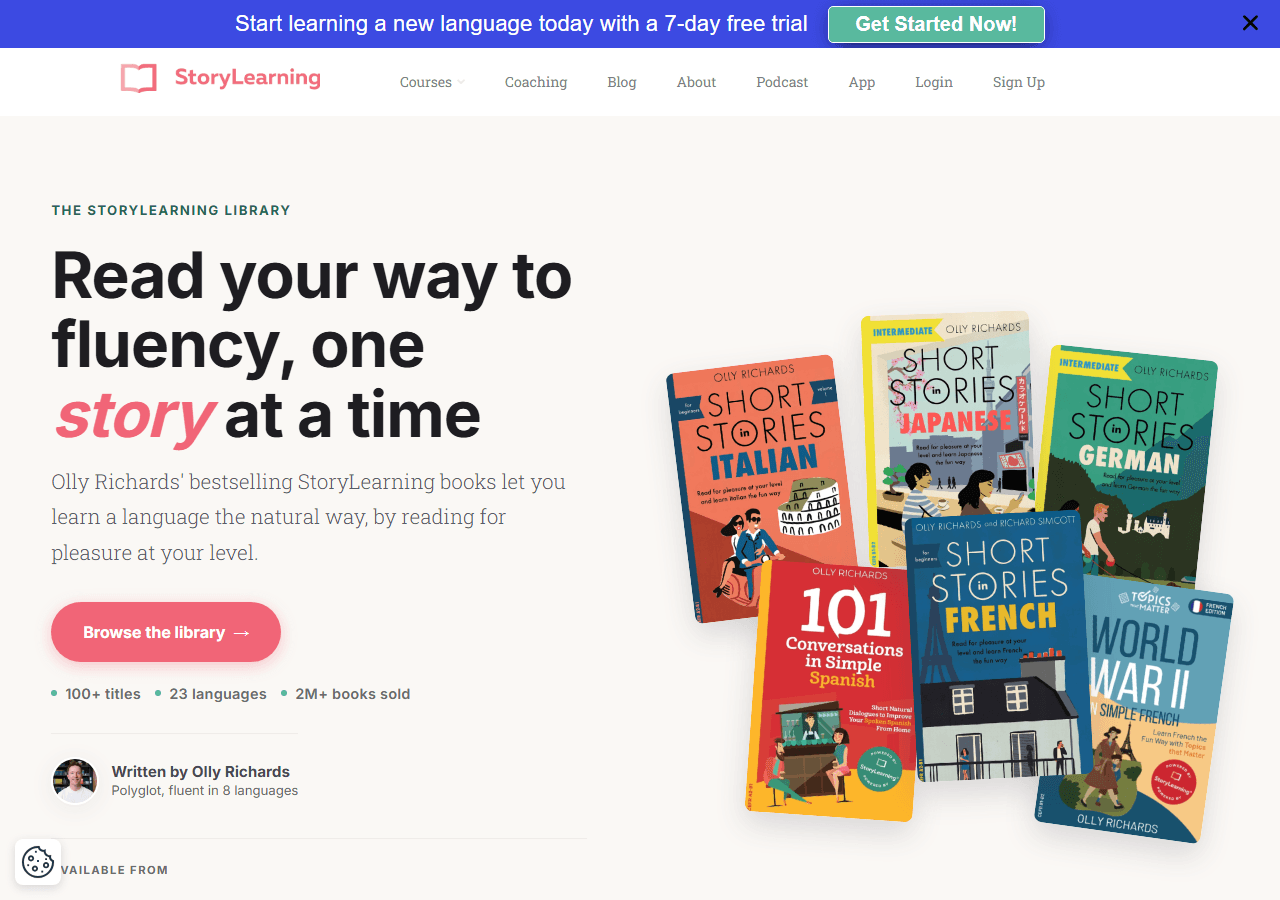
The format: a collection of standalone short stories, each a few pages long, each followed by a vocabulary list and a few comprehension questions. The design philosophy is “compelling input,” which I’m fully on board with, the reading experience should pull you forward, and the book is handsome and modern in a way the classroom readers definitely are not.
It feels like a book you’d see in a bookstore rather than a book you’d be assigned.
Now, the honesty part: this book did not feel like A1 to me, and I say that as someone who read it comfortably. I’d call the actual level A2-ish, maybe A2 creeping toward B1 in the later stories.
The sentences are longer, the vocabulary is broader, and there’s an assumption of grammatical background that a true day-one beginner won’t have. If you are literally starting German, do not make this your first reader, you’ll violate the 95% rule on page one and blame yourself for a problem that’s actually the book’s labeling.
The title says beginners; the book means “beginners who’ve done a few months of work.”
For me, at my level, it was a good fit. The stories are varied, a mix of everyday and slightly unusual scenarios, and a couple of them had genuinely satisfying little turns.
The vocabulary lists after each story are useful without being exhaustive, and the comprehension questions are fine, though I’ll admit I skipped most of them, because once the story has momentum, stopping to answer questions about it feels like interrupting a song to ask about the chords.
There’s also an intermediate sibling in the series, Short Stories in German for Intermediate Learners, which is the right next step if the beginner volume sits comfortably, and honestly the two together form a nicer two-step progression than I expected from a mass-market series.
Not a full ladder like Hueber, but a reasonable pair of footholds.
Where does it fit in the overall picture? I’d call the Olly book the bridge between the learner-market stuff and the classroom stuff.
It’s more ambitious than Dino, better written than it needs to be, and commercially packaged in a way that makes it an easy recommendation for someone who wants to feel like they’re reading real books. It’s not the best-built reader I read these two weeks.
But it might be the most pleasant one, and pleasant matters more than pedagogy people admit, especially in week two when your coffee’s cold and your motivation is thin.
TPRS readers and the DW news bridge
TPRS, if you haven’t run into the acronym, is Teaching Proficiency through Reading and Storytelling. It’s a classroom method where the teacher tells a silly, repetitive story, asks the class endless variations of the same questions, and then hands out short readings built from those exact structures.
German TPRS readers exist. They’re real.
Some are quite good.
The catch is the tone. Everything about them smells like a classroom.
Question prompts in the margins. Little “discuss with a partner” boxes.
Illustrations that look like they were drawn for a Grade 8 social studies handout. If you’re a teacher, that’s not a bug, that’s the whole product.
If you’re a 40-year-old at a kitchen table with a coffee, it reads like homework. I lasted maybe three evenings with a TPRS-style reader before I picked up something with an actual plot instead.
Which isn’t to dismiss them. The repetition genuinely works.
You’ll read the same verbs in slightly different costumes so many times that they stop being vocabulary and start being furniture. But the scaffolding assumes a teacher in the room, and there isn’t one.
My kitchen table is many things, but a German classroom is not one of them.
Then there’s the other thing people recommend as a “reader” that isn’t one: DW Langsam gesprochene Nachrichten. Deutsche Welle’s slowly spoken news.
Every day, world news read at a pace an A2 learner can actually follow, with a transcript.
I want to be precise about this, because people conflate it with graded readers constantly. It’s not a reader.
There’s no plot, no characters, no arc. Wednesday’s episode about a flood in Bavaria does not carry forward into Thursday’s episode about a rail strike.
You don’t build narrative momentum. What it is, and what it’s excellent at, is a bridge.
It’s the thing you graduate onto once graded readers have done their job and you want to find out whether you can handle real German content made for real German adults, just slowed down.
The transcripts mean you can read along, so it scratches the reading itch a bit. But it’s news.
News vocabulary is its own weird dialect of German, heavy on institutions, percentages, and passive constructions. Great for eventually reading a Zeitung.
Useless for learning how a novel flows.
My honest take: keep DW news in your back pocket for month three, not week one. Read something with a story first.
The bridge is for after you’ve crossed some ground on foot.
How to pick a level (the 95% rule, in practice)
Here’s the single most useful thing I can tell you about graded readers, and it took me embarrassingly long to internalize it properly: the CEFR level on the cover is a starting point, not a promise.
The letter on the cover is the publisher’s opinion. Publishers are optimistic creatures.
One publisher’s A1 is another publisher’s A2 in a costume. There is no international bureau certifying that every A1 reader contains the same 600 words.
Hueber’s A1 and Klett’s A1 and whoever-else’s A1 overlap, but they are not interchangeable, and I felt that directly when I bounced between publishers mid-week.
So forget the label and use the actual test: stay near 95 to 98 percent known words. Pick up the book. Open it to a random page in the middle, not the first page, because the first page of any reader is deliberately friendly.
Read it. Count the words you don’t know, roughly.
If you hit an unknown word every two or three lines, you’re in the sweet spot. Your brain can absorb a word from context when it’s one stranger at a party.
If you’re hitting two or three unknowns per line, you’re not reading, you’re decoding, and decoding is exhausting. If you know literally every word, the book is too easy and you’re treading water, which is pleasant for an evening and useless for a fortnight.
The beautiful thing about this test is that it takes ninety seconds and it works on every book from every publisher. I wish someone had handed me this rule before I bought my first reader, because I spent my first week slogging through something labelled A1 that was, for me, decidedly not.
Two more practical notes from the kitchen table:
Don’t switch publishers mid-ladder if you can help it. Because the bands aren’t standardized, hopping from Hueber A1 to Klett A1 to something else A1 means you re-encounter the “where am I actually” question every time. Pick a ladder.
Climb it. Switch when you graduate off the top.
Sample a page before you buy, every time. Most publishers let you peek inside somewhere. If they don’t, that itself is information.
What I liked, and what wore me down
What I liked
What I liked. The biggest thing, and I keep coming back to it: reading feels like something, unlike most beginner activities. When I finished a chapter of Café in Berlin, I had actually read a story in German. Not matched flashcards.
Not tapped the correct picture. Read a story, in a language that two years ago looked like a keyboard malfunction to me.
That feeling is not cosmetic. It’s the thing that keeps you showing up.
Second, the vocabulary recycling is free and invisible. A good reader reintroduces words naturally because the character walks into the same café every chapter. You don’t schedule review.
The story does it for you. Compare that to the spaced-repetition grind of flashcards, which works, but which I resent in a way I’ve never resented a plot.
Third, it’s cheap and offline. The entire two-week experiment cost less than a single month of most subscription apps. No streak anxiety.
No push notifications shaming me at 9pm. Just paper and a pencil, or a cheap ebook.
Fourth, grammar in context quietly works. I never once “studied” the dative during those two weeks, but by the end I was feeling when a sentence needed dem instead of den. Feeling it is not the same as explaining it.
I’d still flunk a grammar quiz. But the instinct formed anyway, which is more than years of declension tables ever gave me.
What wore me down
What wore me down. Honestly? The ceiling. Once you finish a reader, there’s no next chapter.
You start a new book, new characters, new cold open, and the first ten pages are always slightly tedious while you learn who’s who. Books are snacks.
The method is a diet of snacks. I never felt like I was building a cathedral; I felt like I was eating a lot of good tapas.
Also, the vocabulary is narrow. Readers about a young man in Berlin teach you words for coffee, apartments, and awkward dates. I can describe a bad roommate in German with alarming fluency.
Ask me to discuss a tax document and I’d fold like a lawn chair. Reading alone doesn’t round you out.
And pronunciation gets zero attention. You can read silently for two weeks and your mouth learns nothing. German reading pronunciation is actually pretty forgiving once you know the rules, but you still need to hear the language.
My internal narrator had drifted toward some unholy Dutch-adjacent accent by day ten. Pair reading with audio or your speaking will quietly rot.
Who this is for, and who should skip
Graded readers are for you if:
- You’ve got a base of German already, roughly A1 into A2, and you’re tired of apps. This is the natural next step after something like Duolingo has squeezed what it can from you.
- You like reading in your native language. If you’re a reader in English, you’ll be a reader in German. The habit transfers; only the vocabulary doesn’t.
- You want something that works offline, cheaply, without a streak to maintain.
- You learn well from context and get twitchy about memorizing tables.
- You’re intermediate and stuck, because the right reader is honestly the best plateau-breaker there is.
Skip graded readers, or at least delay them, if:
- You’re on day one of German. A pure beginner reader is still a wall of unfamiliar grammar. Get a foundation first, then come back. If you want the shape of a full plan, our how to learn a language guide covers the front end.
- You hate reading. I say this with love: you will not magically become a reader because the book is in German. If reading in English bores you, a German reader bores you in a foreign language. Pick audio or video instead.
- You need structured grammar explanations to feel safe. Readers leave grammar implicit. Some people find that liberating. Others find it like being handed a steering wheel in a car with no dashboard.
- You’re prepping for a specific exam and need test-format practice. Readers build competence, not exam technique.
Pros and cons
Pros
- Real stories, actual reading, from very early on
- Vocabulary recycles naturally through repetition in context
- Cheap. Genuinely cheap, especially the ebooks
- Offline, no streaks, no subscription, no gamified guilt
- Grammar seeps in without drills
- The CEFR ladder gives you a visible sense of progress
Cons
- No speaking or listening component on its own
- Publisher CEFR levels are inconsistent, so level-matching is on you
- Vocabulary is narrow per book
- One reader is a snack, not a system. You need a stack of them
- The gap between the top of the ladder (B1-ish) and real native books is still a canyon
- Easy readers about café-dwelling protagonists get samey
What we'd use with it
A graded reader shouldn’t live alone on your desk. It’s one leg of a stool.
Here’s what I’d put beside it:
Audio, always. Ideally the same content. Café in Berlin and the Olly Richards book both come with audio, and I cannot overstate how much reading-while-listening fixes the pronunciation drift problem.
If your reader has audio, use it from chapter one.
A proper audio course or app for speaking structure. Reading builds input; it does not build the nerve to open your mouth. Babbel handled that side better for me than pure reading ever could.
Our full app comparisons cover the field if Babbel isn’t your flavour.
A small amount of flashcards for the narrow gaps. Heresy, maybe, after I praised natural recycling, but a reader won’t cover numbers, days, or connector words evenly. I pulled unknown words from each chapter into a modest deck.
If you like the format, our Yak Cards approach keeps it lightweight.
DW Langsam gesprochene Nachrichten as your eventual off-ramp. When the top of the reader ladder starts feeling comfortable, that’s your cue. The bridge, remember, is for after.
The broader method, if you want it. This whole experiment sits inside the general framework for how to learn a language. Reading is the input pillar.
It still needs the other pillars.
And for context, more of these experiments live over at the reviews hub, including the full Duolingo writeup if you’re deciding whether to start there before you ever touch a reader.
What others are saying
Since we’re on the internet, and the internet has opinions about German readers:
The pattern across all of it matches what we found at the kitchen table: everyone agrees graded readers work, everyone recommends the same three or four titles, and almost nobody warns you that the famous first one doesn’t actually climb anywhere.
FAQ
Prices, plan names, and features below are as of September 2026.
Do graded readers actually work for learning German?
Yes, with conditions. They work as input: vocabulary and grammar soak in through repetition in context, and that part is real.
What they don’t do is teach you to speak, listen, or write. Two weeks of reading improved my comprehension noticeably and my spoken German not at all.
Use them as one pillar, not the whole house.
Which graded reader should I start with as a total beginner?
If “total” means day one of German, none of them yet. Build a foundation first with an app or course.
If you mean “beginner but past the basics,” Café in Berlin is the standard cheap first step at around $2.99, and that price is exactly why it’s the standard. Just know going in that it’s one rung, not the ladder.
What CEFR level reader should I buy?
Ignore the label and use the 95% rule. Open a middle page and count unknown words.
One stranger every two or three lines means the level fits. The A1 on one publisher’s cover is not sworn to match another publisher’s A1, so test the actual book, not the letter.
Are bilingual or dual-language readers better?
For some people, yes. The German-English side-by-side format removes the friction of looking things up.
The risk is that your eyes keep sliding to the English and you stop actually decoding. I prefer a German-only reader with a dictionary and discipline, but if look-up fatigue is what kills your reading habit, dual-language is a fair trade.
How many graded readers do I need?
More than you think. This was my biggest correction from the two weeks: one reader is a snack, not a method.
The Dino series works if you buy the series. If the goal is to climb from A1 to B1, plan on a stack, probably alternating between series and publishers once you know your level in each one’s bands.
Can I skip readers and just read real German books?
You can, and some stubborn people do, but you’ll be reading at 80% comprehension, which means guessing constantly and burning out. The graded reader exists precisely to bridge that.
The realistic endgame is: readers to B1, DW’s slowly spoken news and easy native content through B1-into-B2, then real books. Skipping the bridge means swimming the canyon.
Do I need to look up every unknown word?
No, and please don’t. If you’re levelled correctly at 95-98% known words, most unknowns resolve themselves from context, and that’s actually where the learning happens.
Look up the word only when the sentence stops making sense without it. Otherwise you turn reading into homework, and homework is what we’re all escaping from.
What about free graded readers?
Free options are thin on the ground compared to, say, free Spanish readers. DW’s free content is the news bridge, not plotted fiction.
Public-domain German fiction is free but ungraded, which is a different sport entirely. The paid readers are cheap enough that I wouldn’t build a strategy around avoiding them.
After two weeks: the verdict
So, two weeks, four different readers, one kitchen table.
The thing I keep coming back to is how ordinary it all felt, and I mean that as high praise. There was no gamification, no confetti, no owl threatening me.
There was just me, a book, a pencil, and the slowly dawning realization somewhere around day nine that I was reading German faster than I had been on day one, without ever having “studied” anything that week. That’s the quiet sell of graded readers.
They don’t feel like studying. They feel like reading, and reading is a thing I already knew how to want to do.
The corrections I’d hand my past self: don’t buy one reader and call it a method, buy the ladder. Don’t trust the CEFR letter on the cover, test the middle page.
Don’t let the blogs oversell Café in Berlin, it’s a fine cheap first snack and it does not climb. And don’t ignore Hueber and Klett just because a tourist-with-a-notebook story outranks a classroom reader in every algorithm on the internet.
The classroom readers are the actual German ladder. The tourist is the appetizer.
What wore me down was real, too. The narrow vocabulary.
The lack of any speaking or listening unless you bring audio yourself. The slight tedium of meeting a new cast of characters every hundred pages.
Graded readers are a pillar, not a building, and anyone selling them as a complete method is selling something.
But as a pillar? Cheap, offline, genuinely pleasant, and measurably effective over a fortnight?
I came in skeptical, having spent my share of months in apps that promise everything, and I came out converted. If you’re past the absolute beginning of German and you’re not reading yet, this is the cheapest big upgrade available to you.
Pick a publisher, sample a page, trust the 95% rule, and buy the stack.
8 out of 10 Yaks