



I’ve bought a lot of French books over the years. Most of them are sitting on a shelf in the living room looking decorative.
A few made it to the kitchen table this spring, which is where the real test happens in this house, because the kitchen table is where I actually read. Couch is for scrolling, bed is for falling asleep with a book on my face, but the kitchen table with a coffee and a dictionary app open is where things get done.
So for about two weeks, that table was covered in graded readers. Four of them, plus some samples.
Easy French Reader by R. de Roussy de Sales, the McGraw Hill one with the greenish cover that’s been in print since roughly forever. A Hachette LFF A2 abridgement of Les Misérables that I ordered partly for the joke of reading Hugo in a format skinnier than a cereal box.
A CLE International sample from their Lectures en français facile line, which is the oldest and fattest FLE catalogue out there. And Olly Richards’ Short Stories in French for Beginners, which I’d heard about from basically everyone and had somehow never actually sat down with.
This was not a lab study. It was me, a table, a lot of coffee, and a French level that I’d honestly describe as “aggressively intermediate, in denial about it.”
Some days I read for twenty minutes. Some days I read for an hour and got annoyed.
I took notes on my phone like some kind of linguistic birdwatcher.
If you’ve never used a graded reader, the pitch is simple: it’s a book written or adapted so that the vocabulary and grammar stay inside a band, usually tied to a CEFR level like A1, A2, or B1. You get a real reading experience, with actual sentences and often an actual plot, at a level you can survive.
It’s the reading equivalent of training wheels that don’t make you look like you’re six. And honestly, of all the things I’ve yacked about for learning French, from apps to courses to my general how to learn a language ramblings, graded readers might be the most quietly effective thing that nobody structures properly.
Two weeks isn’t enough to master anything, but it’s enough to find out which of these books are honest and which ones are lying to you about your level. And one of them is definitely lying.
8 out of 10 Yaks



That’s my score for graded readers as a method, assuming the level is honest and you actually open the book. The “assuming” is doing a lot of work there, as you’ll see.
What a graded reader is (and the 95% rule)
Let’s define terms before we start ranking things.
A graded reader is a book where someone has deliberately controlled the difficulty. Either they wrote it from scratch using a limited vocabulary (Olly Richards, TPRS books), or they took an existing work and cut it down to fit a level (Hachette’s abridged Les Misérables, CLE’s adaptations of Jules Verne).
The point is that a learner at level X can read it without stopping every four words to look something up.
The reason this works is something researchers call comprehensible input, but the practical version is a number: you want to know roughly 95 to 98 percent of the words on the page. At 98%, unknown words are rare enough that you can often guess them from context, and the reading stays flowing.
Drop to 95% and you’re guessing more, working harder, but still functional. Below that, around 90%, you’re not reading anymore.
You’re decoding. It’s homework.
And homework is where French books go to die.
Here’s the thing most people get wrong: the CEFR label on the cover is a starting point, not a promise. Publisher bands are not standardized across houses.
An A2 from one publisher is not the same animal as an A2 from another, and I’ll get into exactly how that bit me later. The only reliable test is to sample a page.
Pick a page in the middle, read it, and count how many words stop you cold. One or two?
Buy the book. Five or more per page?
Put it down and grab the level below, no matter what your ego says. Your ego does not read French.
You do.
That sample-a-page habit saved me from at least two bad purchases during these two weeks, and I’ll die on this hill: it’s the single most useful thing about buying graded readers online, because most listings include a preview or you can find one, and it converts “beginner friendly!” marketing into actual data.
How we read for two weeks
The setup was loose on purpose. I read one book as the spine, which was Easy French Reader, and sampled the others around it.

Mornings before work, mostly, twenty to forty minutes, one coffee. Sometimes in the evening I’d read a chapter of something lighter instead, which is where Olly Richards’ book came in.
On weekends I sat longer and got more ambitious, which is how I ended up attempting the LFF Les Mis abridgement on a Saturday and having opinions about it.
Rules I set for myself:
No dictionary unless I was truly stuck. If I could get the gist of a sentence without knowing one word, I let it go. This is the whole game with graded readers.
The unknown words you tolerate are the ones that quietly become known words. The moment you look everything up, you’re doing flashcards with extra steps, and I already have Yak Cards for that.
Reading aloud sometimes. Not always, because I’m not a monster and there are other humans in this building sometimes. But graded readers are short enough that reading a page out loud doesn’t feel like a performance, and it forces you to actually process the words instead of skimming.
Notes, not lookups. If a word kept appearing and refused to reveal itself, I wrote it on my phone and looked it up later, away from the book. About a dozen words made the list over two weeks.
Most of them I’d learned by the end without ever formally studying them, which is exactly the mechanism graded readers are banking on.
I want to be clear that two weeks of kitchen-table reading is lived experience, not a study. I’m one guy with a moderate French base built from apps and lessons and years of half-commitment.
But that’s actually a useful position, because “does this book help a person like me” is the question most people have, and I can answer it straight.
Easy French Reader

This is the one we finished. Start there, because it’s the headline.
Easy French Reader is part of McGraw Hill’s long-running Easy Reader series, written by R. de Roussy de Sales, and it’s been the default recommendation for beginners for a long time. You’ll notice, if you go reading those “best French books” listicles, that it’s often mentioned in passing and under-explained, a name on a list with no detail.
Meanwhile if you dig into Reddit threads where actual beginners talk about what they used, this book is the spine. People start here.
There’s a reason.
The structure walks you through progressively harder material, and the vocabulary ramp is genuinely slow and honest. That’s the rarest quality in this whole genre.
Most graded readers claim to be for beginners and then hit you with a wall in chapter three. This one earns its “easy” in a way that very few competitors do.
The early sections are well within a true A1–A2 reach, and it builds from there without ever lurching.
The result was the first French book I’ve read cover to cover in years, and honestly one of the few language-learning books I’ve ever finished at all. Finished books matter.
A finished book means the difficulty stayed low enough that you kept showing up, and showing up is ninety percent of the battle. The week I spent in this book, I never once considered quitting it, which sounds like faint praise but is actually the highest praise available in this genre.
Quitting is the default outcome of language books.
What I liked: the slow ramp, the length, the glossary support, and the fact that it’s cheap and easy to find. What wore on me: it’s a bit dry.
It’s a workbook-ish experience in places, very much a product of traditional language publishing, and nobody is going to call it gripping fiction. But gripping is not the job.
The job is reps, and it delivers reps at a level you can sustain.
If you’re starting from near-zero and want one book to buy today, this is the one I’d hand you. Everything else in this article assumes you’ve got some base or builds on what a book like this gives you.
Hachette LFF
Now the interesting one. Hachette’s Lire en Français Facile line, usually just called LFF, runs from A1 up to B2, and they do something the other publishers mostly don’t: they abridge real French literature into levelled versions.
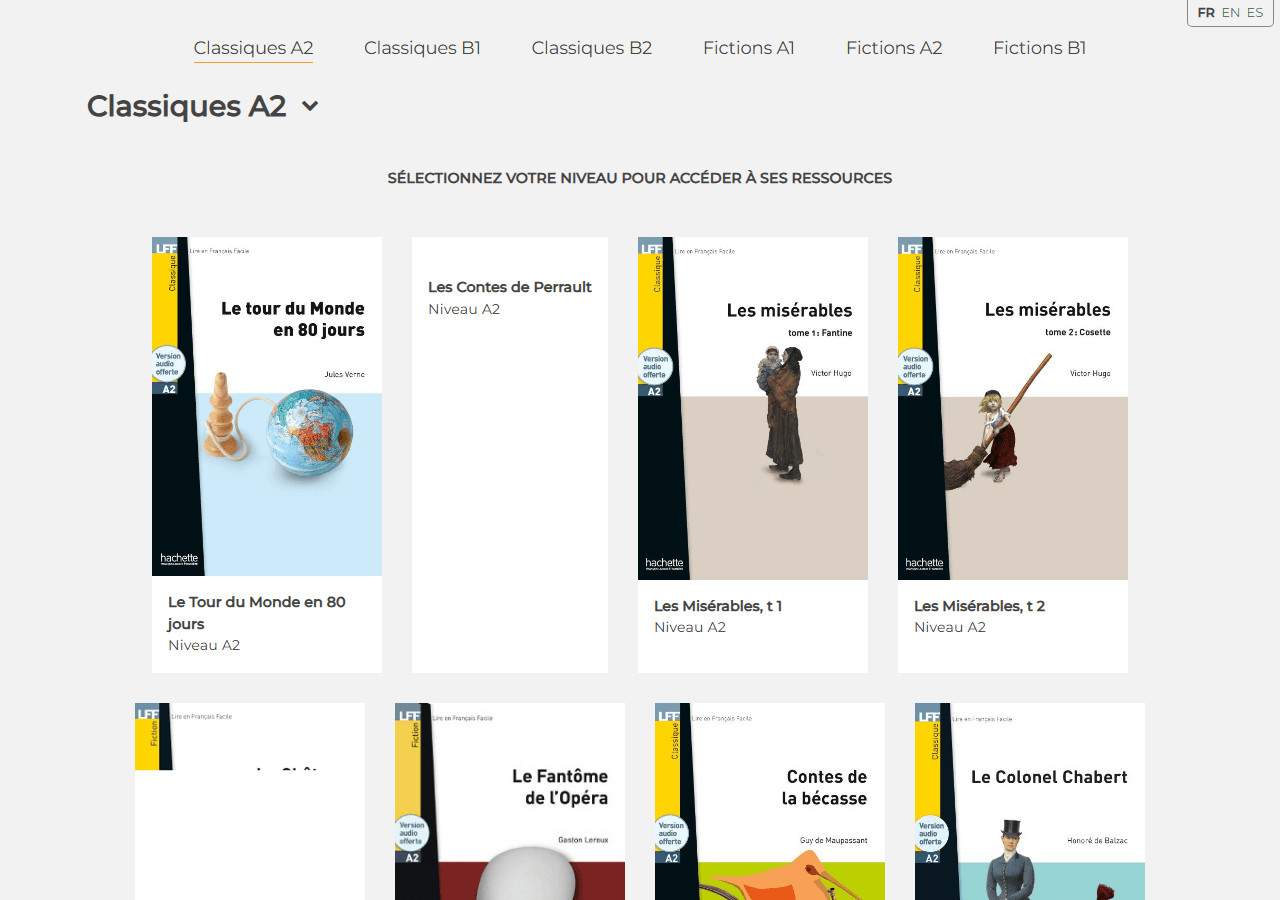
Which is how I ended up with a Les Misérables the size of a pamphlet.
First warning, and it matters: you must get the LFF logo edition, not the actual novel. The listings online are a minefield. If it doesn’t have the LFF branding, you may be buying real Hugo, and real Hugo is several hundred pages of nineteenth-century French that will end your evening fast.
I checked my cart twice. This is a genuinely easy mistake to make.
The A2 Les Misérables splits the story into two parts: Fantine, then Cosette. It’s a real abridgement, not a summary, which is the LFF approach.
You get actual narrative, actual (simplified) Hugo plot, at a controlled A2 vocabulary. Reading it, I kept having this slightly surreal experience of recognizing the story from the musical while processing it in simple French.
Et toi, Fantine energy, but grammatically survivable.
The thing that caught my attention, and the thing you should know if you’re climbing the LFF ladder: the B1 level books start using the passé simple. That’s the literary past tense, the one that doesn’t appear in speech and that most courses don’t teach because you never need it to order a baguette.
It shows up constantly in real French fiction, and LFF introduces it at B1, which is both honest about what real books contain and a wall if you’ve never seen it. If you’re A2 going on B1, budget an afternoon to learn to recognize passé simple forms.
You don’t need to produce them. You need to not panic when il fut shows up and your brain says “that’s not a verb I know.”
One more LFF note: they also publish the Albert et Folio series, which is hugely popular, and which I looked at and immediately recognized as being aimed at kids and teens. Not a knock.
If you’re buying for a young learner, apparently it’s great. But a forty-year-old man reading a detective story about teenagers at a French school is a specific vibe, and I wasn’t the audience.
The literature abridgements are the adult lane.
CLE Lectures en français facile
CLE International is the granddaddy of this space. Their Lectures en français facile collection is the widest FLE (français langue étrangère, French as a foreign language) catalogue in existence, and I mean wide: hundreds of titles, multiple levels, classics and originals.
Two things stood out from my sampling.
First, they have an A1.1 level. That point-one is real and it’s wonderful.
Before A1, after nothing. Most publishers pretend A1 is the floor, but a true day-one beginner still drowns in most A1 books, and CLE acknowledging that with a sub-level is one of the most learner-honest moves in the genre.
If you’re at the “I know bonjour and I’m scared” stage, CLE’s A1.1 shelf is where you start.
Second, most of their titles come with audio, which changes the product completely. A reader with audio is a reader and a listening exercise in one, and for the price difference, which is usually small, it’s a no-brainer.
I listened along on a couple of chapters and it’s the closest thing to how you’d actually want to consume a story in a language.
The title I sampled most was their A1 adaptation of Voyage au centre de la terre, Verne’s Journey to the Centre of the Earth. And this is where I learned the lesson about publisher bands: the CLE A1 was a different experience than I expected from other publishers’ A1s.
CLE’s bands are their own thing, not interchangeable with Hachette’s. Same label, different body.
An A2 from one house can feel like a B1 from another, and the only fix is the sample-a-page rule from earlier. Apply it to every publisher separately, like you’re calibrating each one by hand.
Because you are.
If Hachette LFF is “real literature, abridged,” CLE is “everything, everywhere, with audio.” Between the two of them you can cover most of the classic-literature adaptation space, and the Venn diagram of what they offer barely overlaps.
Olly Richards (and why beginner is a lie)

Okay. The one I have a grudge against, sort of.
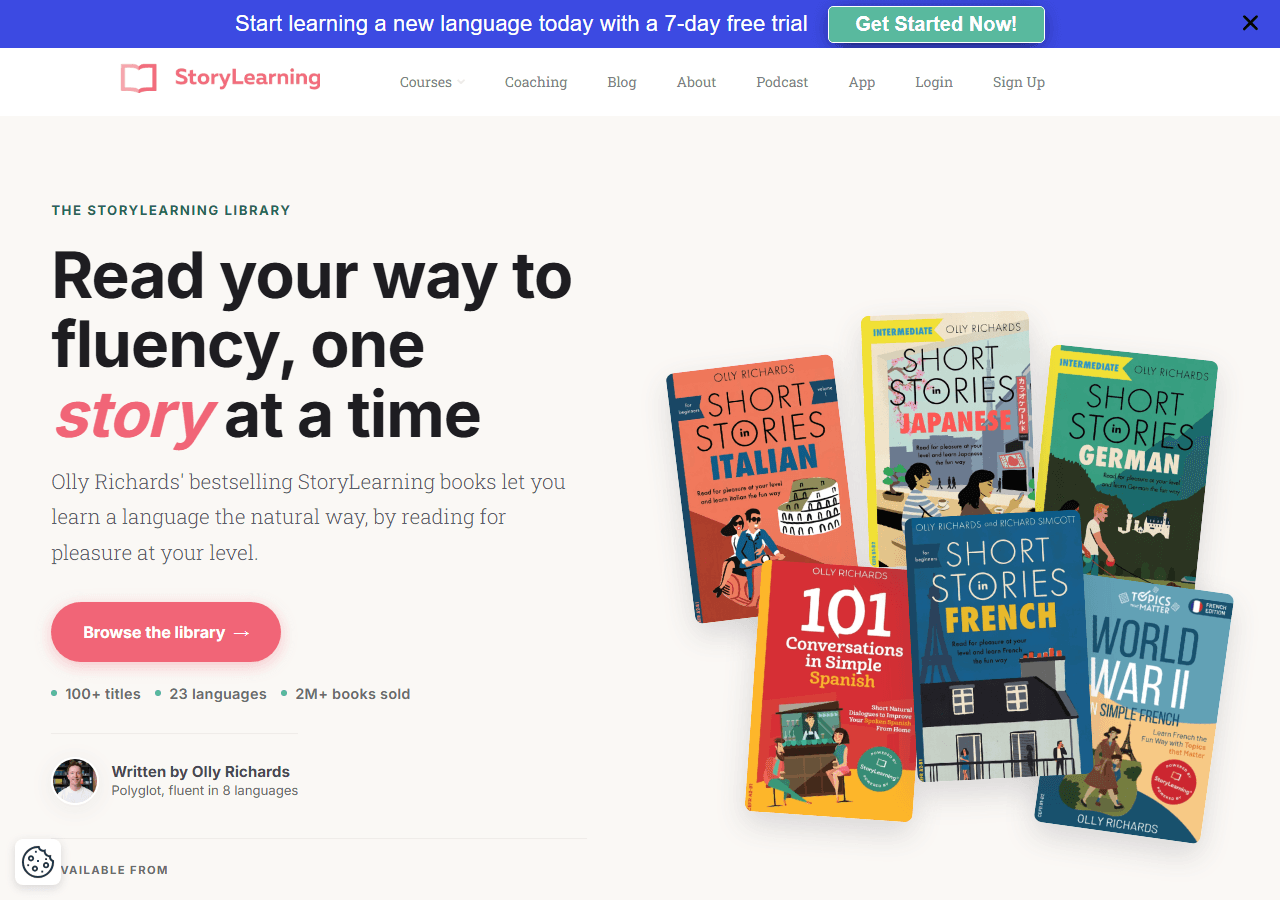
Olly Richards’ Short Stories in French for Beginners is probably the most-marketed graded reader on the internet right now, part of his StoryLearning empire. It’s a handsome book.
Eight-ish stories, each with a chapter-by-chapter structure, vocabulary lists, and comprehension questions after each chapter. The format is genuinely good: short chapters, supports built in, designed for the busy self-learner.
I wanted to love it.
Here’s my problem: “beginner” is a lie. This book is not day-one A1 material, and marketing it that way does people a disservice. Reading it, I’d place it at a solid A2 to B1.
The vocabulary in the first story assumes a base that a true beginner simply doesn’t have, and while the glossaries help, you’re leaning on them hard rather than occasionally. If you’ve finished a course or six months of an app and you have maybe a thousand words, this book works.
If you bought it on day one because the cover said beginner, you’re going to have a bad time and possibly conclude you’re bad at French, which is the worst outcome a language book can produce.
The other thing you start noticing once you’ve read a few of the stories: they often feel translated from English. Which, as I understand it, some of them literally are, the series being adapted across languages with the same story architecture.
Nothing wrong with that commercially, but the French occasionally has that slightly neutral, placeless quality. Nobody’s from anywhere.
The stories could be set in any suburb in any developed country. Compare that with the LFF Les Mis, which is drenched in being French even in its simplified vocabulary, and you feel the difference.
If part of why you’re reading French is to touch the culture, translated-feeling stories give you less of that.
To be fair to the book: once I accepted it was A2–B1 and stopped pretending, I enjoyed it. The chapter-plus-questions format is great for building a habit, the stories are short enough for a coffee sitting, and as a bridge from “I finished a beginner course” to “I can read continuous French,” it does the job well.
There’s also an intermediate sibling volume that sits at B1, and the level split between the two books makes more sense once you realize the “beginner” one was never actually beginner.
So the honest framing: buy it as an A2–B1 reader with good scaffolding, and it’s a solid product, probably the most pleasant classroom-in-a-book of the bunch. Buy it as your first French book and you’ll bounce off it.
The cover is telling you a story, just not the one in the pages.
Mondes en VF, TPRS, and the news bridge
The deeper we got into this, the more I noticed something about most graded readers: they’re flattened. Not just simplified, flattened.
Every sentence gets sanded down to the same smooth A2 shape, and after a while you’re not really reading French, you’re reading French-shaped content. That’s where the next few options come in, and honestly, one of them surprised me.
Mondes en VF: actual novels, just smaller
Didier’s Mondes en VF series is a different animal. These are original A2 to B1 short novels written by francophone authors, not classic literature chopped into beginner chunks.
Nobody abridged Les Misérables to make these. Somebody sat down and wrote a story from scratch for learners, and it shows.
The prose has actual texture. Characters do things you don’t expect.
There’s an author behind it, not just an editor with a red pen and a word list.
Because the vocabulary is still controlled but the storytelling isn’t, they feel less like a reader and more like a real book that happens to be within reach. If you’ve ground through a couple of the classic-abridgement readers and you’re bored of adapting 19th-century plots, Mondes en VF is where I’d point you next.
One small annoyance: the old mondesenvf.fr URL is dead. It 404s.
If you find an old blog post linking there, don’t assume the series is gone. It’s not.
It lives under Didier’s main site now, which is less charming but works fine.
Edi l'éléphant and the TPRS approach
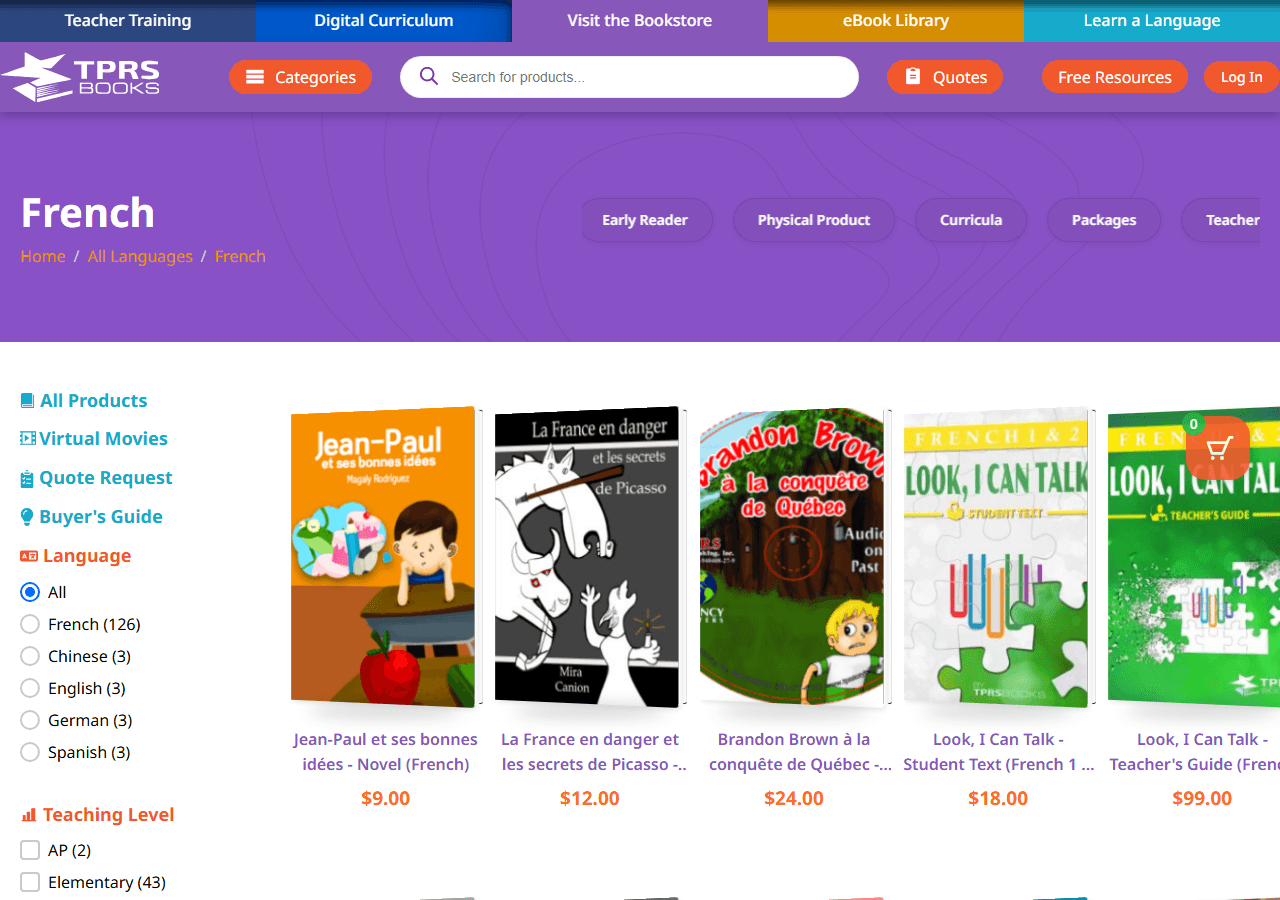
Then there’s TPRS Books’ French section, including Edi l’éléphant. TPRS (Teaching Proficiency through Reading and Storytelling) is a method from the classroom world, and these readers wear that origin openly.
The vocabulary is tiny. Genuinely tiny.
Like, “we will now use forty words for sixty pages” tiny. It’s the closest thing French has to a zero-rung ladder, the book you could open on day one of learning French and actually follow.
The catch is the classroom tone. These read like something a teacher wrote for a Tuesday class, because that’s exactly what happened.
The stories are gentle, repetitive, a bit earnest. If you’re an adult who wants to read about something other than a cartoon elephant’s day, you might find yourself skimming.
But if you’re truly at the start, like week-one start, the repetition is the feature. You see the same structures so many times they stop being vocabulary and start being furniture.
I wouldn’t build a whole learning life on TPRS readers, but as the very first rung, before you can even handle an A1 Hachette book? There’s a place for that.
RFI's Journal en français facile: not a reader, but a bridge
I want to flag this one because every list of graded readers eventually drags it in, and I think that’s slightly wrong. RFI’s Journal en français facile is a free daily news bulletin in simplified French, with transcripts.
It is not a plotted reader. There’s no story, no chapter arc, no “will Fantine survive.”
It’s ten minutes of world news in French you can mostly follow.
But as a bridge between graded readers and real French media, it’s excellent. Once you finish a B1 reader and you’re wondering what’s next, the journal is the answer.
Free, daily, and it never runs out. I’ve tucked it into our graded readers library if you want the direct link.
Just don’t buy it expecting a novel, because it costs nothing and it isn’t one.
How to pick a level (including passé simple)
Here’s the part where everyone gets it wrong, including me, twice.
Ignore the CEFR label, sample a page
The CEFR label on the cover (A1, A2, B1, whatever) is a starting point, not a promise. We established the 95% rule earlier: you want to be reading at 95 to 98% known words.
Below that you’re doing decoding puzzles. Above that, like 99%+, the book is too easy and you’re coasting.
And here’s the thing about publisher bands: they are not interchangeable. CLE’s A1 is not Hachette’s A1.
CLE’s felt a notch denser to us at the same label. So you can’t finish a CLE A1 book and assume every A1 on the shelf is now beneath you.
The only reliable method is the boring one: sample a page. Read one actual page.
Count how many words you have to look up. If it’s more than one or two per line, drop a level.
If it’s zero, go up. The cover tells you where the publisher thinks the book sits.
The page tells you where you sit.
The passé simple tripwire
There’s a specific trap I want to warn you about, and it bit me with the Hachette books. Somewhere around B1, publishers quietly start using the passé simple, the literary past tense.
Il fut. Elle alla.
Ils virent. If you’ve only studied conversational French, you have never seen these forms.
They’re not taught in apps, they don’t appear in dialogue, and your first reaction will be “what dialect is this.”
It’s not a dialect. It’s the tense French literature is written in, and graded reader publishers assume that by B1 you’re ready for it.
The Hachette LFF line does this. One book you’re reading comfortable A2 narrated in passé composé, the next book the same publisher hands you il se leva and expects you to cope.
So before you buy anything at B1, check a random page mid-book for passé simple. If it’s there and you don’t know the tense yet, either learn it first (it’s honestly not hard, the forms are regular-ish and it’s read far more than it’s spoken) or pick a different book.
This single detail is responsible for more abandoned graded readers than difficulty in general, I’d bet money on it.
Le Petit Prince is not a first book
Last thing on levels. Everyone wants Le Petit Prince to be their first French book because it’s short and it has a picture on the cover and it feels like a rite of passage.
It’s B1-ish. Real B1-ish.
The vocabulary is small but the tense is passé simple and the phrasing is poetic and occasionally strange. Read it when you’ve earned it, around the end of an honest A2 or into B1, and it’ll be a lovely milestone.
Read it at A1 and you’ll be translating word by word into English and absorbing nothing. It’s a graduation, not a starting line.
What I liked, and what wore me down
What I liked
Two weeks in, here’s the honest ledger.
What I liked: the finished feeling. I finished Easy French Reader cover to cover, and I haven’t finished a language product in years.
There’s something about a book with an ending that apps just don’t have. Every app review I write has the same complaint, that the app wants you to keep going forever.
A reader ends. You close it.
You did the thing.
I liked how cheap the whole thing was. A couple of these books cost less than one month of Babbel.
I liked reading at the kitchen table instead of staring at a screen, and I liked that vocabulary showed up in context, so words arrived attached to a scene instead of floating on a flashcard like a Yak Card with no story. (Yak Cards are still great, don’t get me wrong.
They’re just better when the card has a memory behind it.)
What wore me down
What wore me down: the flattening. Even in good books, the prose gets samey.
Short sentence, short sentence, short sentence. I missed subordinate clauses.
I missed an author being weird. The Olly book’s translated-from-English plots bugged me more as the weeks went on, because French settings have French details, and when a story could be set anywhere it usually feels like nowhere.
And I got tired of guessing what a publisher’s level label actually meant, because it changed per publisher, per series, sometimes seemingly per printing.
Also, honestly, some days reading was just work. With Duolingo you can tap a screen half-asleep and feel productive.
With a reader you’re either reading or you’re not. There’s no gamified illusion.
Whether that’s a con or the whole point depends on the day you ask me.
Who this is for, and who should skip
Graded readers are for you if you’ve got some French under your belt, maybe an app’s worth, maybe a year of classes, and you want to feel like you’re actually using it. If you’ve never read anything in French beyond menu items and you want that to change, this is the most direct route I know.
If you’re past B1 and reading real French, most of this list is beneath you and you should go read actual books, starting with the Petit Prince milestone and moving on.
Skip graded readers if you’re a true day-one beginner, with one exception. The exception is the TPRS stuff, the tiny-vocab Edi l’éléphant style readers, which are genuinely built for the bottom rung.
But the mainstream readers, even ones labelled “beginner,” mostly assume you know the present tense cold and can recognize the passé composé. If you don’t, spend a month with an app or our general how to learn a language guide first, then come back.
The books will still be here.
Also skip if you hate reading in English. That sounds obvious but people talk themselves into it.
“Maybe reading in French will be different.” It won’t be.
If books aren’t your medium, the medium won’t magically become yours because the language changed. Listening might be, though.
Pros and cons
Pros
- Cheapest serious method per hour that I’ve tested
- A book ends, and finishing something is massively motivating
- Vocabulary in context sticks better than isolated flashcards
- Huge catalogue depth: CLE alone has an enormous FLE range, down to A1.1
- Audio comes with most of them, so you get listening for free
- No subscriptions, no streaks, no gamification guilt
Cons
- Level labels are inconsistent between publishers, so buying blind is risky
- Prose can be flat and repetitive, even in the better books
- The “beginner” label on some popular series is closer to A2 to B1
- Passé simple shows up around B1 with no warning
- Most translated plots feel placeless
- Requires actual focused reading, which some days you will not want to do
What we'd use with it
A graded reader alone won’t carry you, so here’s what I’d pair it with. Keep a small deck of Yak Cards for words you meet while reading, the old look-up-a-word-ten-times problem solved.
One card per word that keeps reappearing, and nothing else, or the deck eats the reading time.
Run a light app alongside it for grammar, because readers teach grammar by immersion, which works slowly and incompletely. Our Duolingo review and Babbel review cover the options, and the app roundup has the fuller list.
Twenty minutes of app, twenty minutes of reader is a better day than forty of either.
If your French is intermediate and you want something similar in English instead, our English lessons start at Lesson 1 and run to 139 lessons, same philosophy: real content, honest levels.
And the main learn French hub plus our graded reader library are where everything French on this site lives.
What others are saying
- LingoBlend sorts graded readers strictly by CEFR level, which is more tidy than the labels deserve, but it’s a decent shopping list if you already know your level.
- LenguaZen covers the intermediate end, including Le Petit Prince, and agrees it’s a milestone rather than a starting point.
- Gnomeville does a publisher-by-publisher breakdown of who’s publishing French graded readers, useful if you want the full catalogue landscape beyond the five or six series anyone actually talks about.
- UKLP picks four for intermediates and lands on the same conclusion we did: the A2-to-B1 stretch is where French graded readers get genuinely good.
- NewsDle looks at the app side of graded reading, which is a different experience than paper, and in my kitchen-table opinion a slightly worse one.
FAQ
Prices, plan names, and features below are as of September 2026.
Do graded readers actually work for learning French?
If the level is honest, yes. Reading at 95 to 98% comprehension gives you repeated exposure to grammar and vocabulary in context, which is basically what fluency is built from.
If the level is too hard, they don’t work, you just decode. The method is only as good as the match between the book and you.
Which graded reader should I start with?
If you have basic French (present tense, some passé composé), Easy French Reader is the classic starting spine, and it’s the one we finished. If you’re truly at zero, the TPRS-style readers like Edi l’éléphant are the only things built for that rung.
If you’re past the basics and bored, jump to Mondes en VF for stories that don’t feel flattened.
Is Olly Richards' Short Stories in French for Beginners really for beginners?
Not day-one beginners. It felt A2 to B1 to us.
If you can already read a simple A2 reader comfortably, it’s a good fit. If you’re brand new, the title will oversell it to you.
Why does my B1 reader have weird verb forms I've never seen?
That’s the passé simple, the literary past tense. Publishers start using it around B1 because that’s the register real French books use.
Learn to recognize it, it takes an afternoon, and it unlocks a whole shelf of literature.
Is Le Petit Prince a beginner book?
No. It’s a B1-ish milestone. Short, yes, but written in passé simple with poetic phrasing.
Save it for when you’ve earned it and it’s wonderful. Rush it and it’s a vocabulary drill.
Are graded readers better than apps?
Different jobs. Apps build and drill foundations efficiently.
Readers turn that foundation into actual reading ability. The best two weeks I’ve spent on French in a long time were app-free, but I couldn’t have done them without the app months that came first.
Pair them.
Do I need the audio, or just the book?
Get the audio if it exists, which is most of the CLE catalogue and much of the Hachette line. Listening while following the text ties the written and spoken word together, and it’s usually free or nearly free with the book.
After two weeks
The kitchen table is cleared off now. Four books read or partially read, one finished cover to cover, a modest stack of Yak Cards, and a French vocabulary that has quietly grown roots instead of just leaves.
Here’s what I actually take away from the two weeks. Graded readers are the cheapest, most honest method in language learning.
There’s no gamification pretending you’re progressing. Either you read the page or you don’t, and either the words come back tomorrow or they don’t.
That honesty is rare, and once you’ve experienced it, the streak-guilt economy of apps feels a bit thin.
The catches are real. Level labels are a mess across publishers, so sample before you buy, always.
Some “beginner” series are intermediate books wearing a friendly title. The prose flattens.
And you have to actually read, with attention, which is a bigger ask than it sounds on a Wednesday night.
But if you’re learning French and you’ve never read a book in it, this is the single highest-value thing you can do next. Not the next app subscription.
A book at the right level, with the 95% rule doing the work, and an ending to finish.
8 out of 10 Yaks