



I’ve bought a lot of language stuff over the years. Apps with streaks, flashcard decks I abandoned in March, a shelf of “complete courses” that all teach you to say el lápiz before you can order a coffee.
So when graded readers came up as a method, I’ll admit I was skeptical. A whole book?
In Spanish? On purpose?
At my level? Sounded like something a very motivated person does, and I am not that person by nature.
I’m a person who reads the first ten pages of a paperback, puts it on the nightstand, and then it becomes furniture.
But the idea kept nagging at me. The pitch is simple: read a book where you already know almost every word, so you’re not decoding, you’re just… reading.
Absorbing. Letting the language happen to you instead of wrestling it to the ground.
Every polyglot on YouTube eventually says some version of “just read, man.” And I figured, fine.
Two weeks. Kitchen table.
A stack of readers from a few different authors, a coffee, a phone with a dictionary app for emergencies. If I hated it, I’d have something to write about anyway.
Here’s the spoiler: I didn’t hate it. Two weeks later I’d finished one book cover to cover, abandoned another one like a bad date, and developed actual opinions about comma placement in Spanish.
My reading speed roughly doubled, which sounds fake but is the boring, measurable truth. I now own opinions about which authors write real beginner Spanish and which ones write “beginner” as a marketing term.
There are feelings.
How I’d score graded readers as a method after those two weeks:
8 out of 10 Yaks



Not perfect. The level-matching problem is real, some books are duller than a Sunday in February, and the whole thing collapses if you pick wrong.
But when the level is honest and the story pulls even slightly, this is the most painless input I’ve found in twenty-odd years of dabbling. Better than most apps, cheaper than most tutors, and you can do it in pyjamas.
This is the piece where I break down what we read, what worked, what didn’t, and how to avoid buying the book that’s about to become your nightstand furniture. If you want the broader picture, our full graded readers library lives over at our graded readers hub, and the rest of our Spanish stuff is at Yak Yacker’s learn Spanish section.
This one is the deep dive: the kitchen-table version.
What a graded reader actually is (and the 95% rule)
Quick definition for anyone who arrived here from a search and is wondering if this is about e-readers. A graded reader is a book, fiction or non-fiction, written on purpose using a limited vocabulary and limited grammar for learners at a specific level.
The author isn’t writing Spanish. They’re writing Spanish for you, where “you” is defined as “someone who knows roughly these 500 words and the present tense.”
That constraint is the entire magic trick. Native books, even kids’ books, are written for natives, which means they use whatever words they want whenever they want.
Ever tried reading El Principito with six months of Duolingo? It’s a humbling experience.
Beautiful book, and roughly 40% of it is a wall. That’s not a you problem, that’s a book problem.
The number that matters is this: you want to be reading text where you know about 95 to 98% of the words. At that ratio, you can move at reading speed, you can guess the stragglers from context, and the occasional unknown word teaches you something instead of stopping you dead.
Below that, you’re not reading. You’re doing vocabulary archaeology with a dictionary as your trowel, and nobody keeps that up.
Here’s the catch, and it’s the one that sank me in week one: the level printed on the cover is a marketing suggestion, not a diagnosis. “Beginner” means whatever the publisher wants it to mean. One author’s beginner book is another author’s low-intermediate book.
I’ll get into the specific offenders below, but internalize this now: the label is the starting point of the conversation, not the conclusion. You test the book.
The book doesn’t test you.
How we read for two weeks
The setup, so you know exactly how unscientific this was. Two weeks of reading at the kitchen table, mostly mornings before the day got going, sometimes evenings when the TV lost the coin toss.

Four sources on the pile:
- Easy Spanish Reader by William T. Tardy, the McGraw Hill classic
- A Paco Ardit / Spanish Novels A1 title
- A Juan Fernández beginner reader
- A sample of Olly Richards’ Short Stories in Spanish from StoryLearning
No timers, no comprehension quizzes, no spreadsheet. I read like a normal person reads: until it got boring, or until the coffee was done.
I tracked roughly how long each session lasted and how many pages I got through, because I’m a nerd, but I didn’t turn the kitchen into a lab. This is a lived-experience review, not a study.
Treat it accordingly.
The honest headline: one of those four books I finished, and finishing it felt good in a way no app lesson has ever felt. One of them I put down in under an hour and it stays down.
The other two sit somewhere in between, and the reasons why are exactly what you’re here for.
Also worth saying: I did all this on top of, not instead of, my normal Spanish routine, which at that point was mostly Duolingo maintenance and some Babbel. Graded readers aren’t a replacement for everything else, they’re the reading leg of the stool.
If you’re still building your base, our how to learn a language guide covers the whole picture. If you want the short version: readers gave me more usable Spanish per hour than the apps did, once the level was right.
Easy Spanish Reader (William T. Tardy / McGraw Hill)
This is the granddaddy. First published decades ago, updated since, McGraw Hill, the whole classroom pedigree.
It’s the book your high school Spanish teacher had thirty copies of in a cupboard, and it’s still everywhere because it works, in its way.
The structure is a ramp, not a novel. It’s split into three parts, and the levels genuinely climb: part one is dead-simple scenes and short readings, part two adds complexity, part three is real-ish literary Spanish.
The vocabulary is controlled and recycled on purpose, so words you meet in chapter two come back in chapter nine until they’re just… yours. That recycling is the thing.
It’s the same logic behind spaced repetition, except the flashcards are wearing a story costume.
What I noticed immediately: it’s more course-like than story-first. This is a book that knows it’s teaching you.
There are exercises. There are comprehension checks.
There’s a faint smell of photocopier about the whole enterprise, even in the current edition. If you want to be swept away by narrative, this is not your book.
If you want a structured ramp with training wheels that come off gradually, it genuinely delivers.
For me, the early sections were almost too easy, which honestly was fine for the first few mornings. Easy builds speed, speed builds confidence, confidence keeps you in the chair.
By part two I was working a bit, in a good way, looking up maybe one word a page. Part three is where it earned its classic status and also where my kitchen-table patience started negotiating.
I read part three at a slower drip, and I don’t feel bad about that. It’s a book you can live in for a while, not one you binge.
Who it’s for: people who like structure and don’t need a plot to keep going. People who want one book to last months rather than a story to finish in a weekend.
It’s also the least scary entry point on this list if you’re brand new, because the early chapters genuinely respect how little you know, which, as you’ll see, is not universal in this genre.
Paco Ardit / Spanish Novels: the one we actually finished

Here’s where the two weeks turned a corner. Paco Ardit runs Spanish Novels, a big ladder of cheap fiction from A1 up through C2, and the whole operation is built around one idea: short chapters, everyday words, an actual story, and a book you can finish.
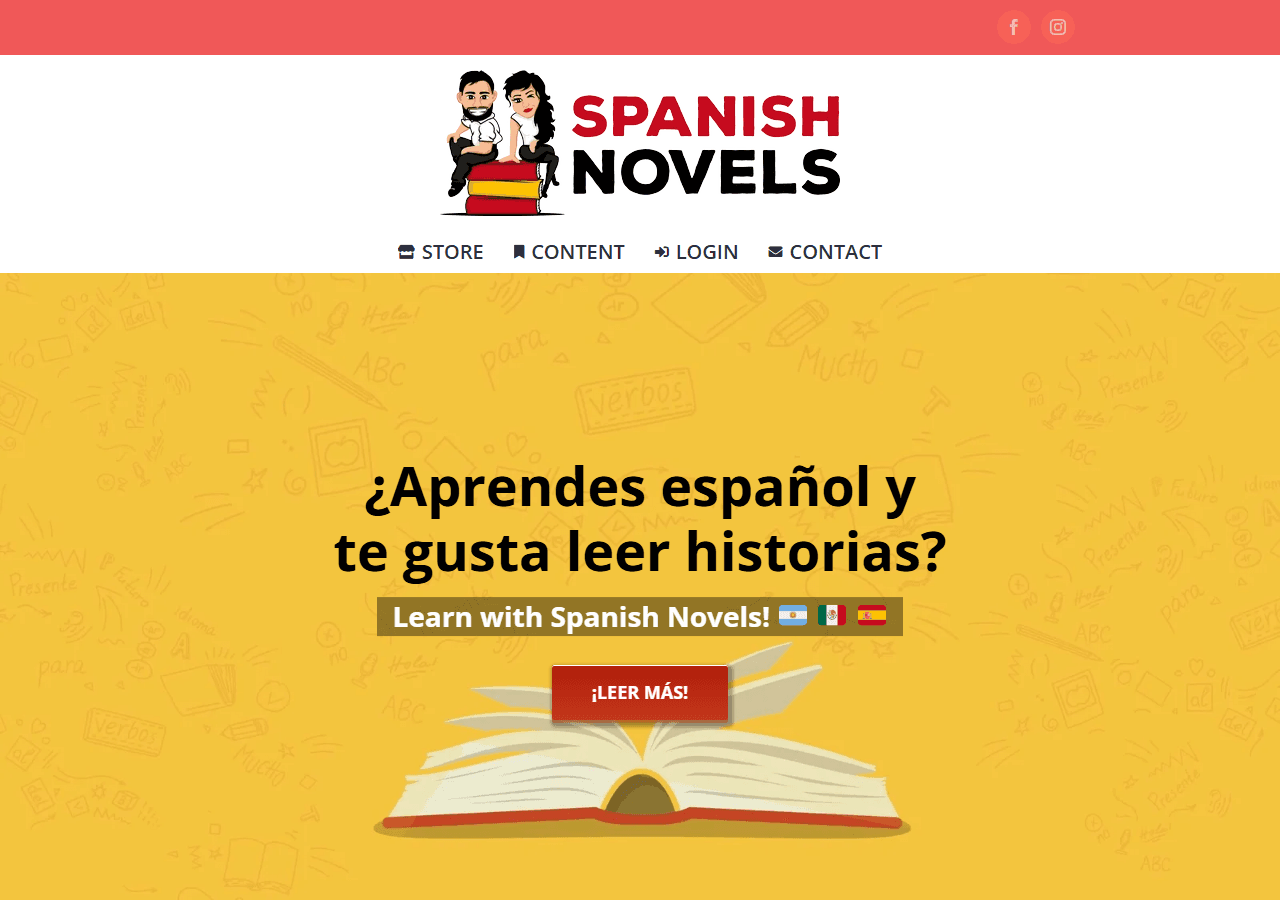
The A1 title I picked had chapters that ran a few pages each, and this matters more than you’d think. Finishing a chapter is a dopamine hit.
Finishing a book is a structural change in how you see yourself. Somewhere in the second week I closed the back cover of the thing and just sat there for a second like, huh.
I read a book in Spanish. Not a passage, not a story in an app, a book.
That feeling is worth real money, and it’s the thing the apps never give you because apps never end.
The stories are not literature. Let’s be clear.
They’re simple plots about ordinary people doing ordinary things, and occasionally you can feel the vocabulary list steering the plot like a kid steering a shopping cart. But “slightly artless story I can actually read” beats “beautiful story I quit on page four” every single day of the week, and twice on Sunday.
Two practical things that make the whole setup work. First, audio: the books come with narration, so you can read along or re-listen while doing dishes, which turns dishwashing into Spanish time at zero extra cost.
Second, the price and the bundles. Individual titles are cheap, and as of September 2026 the bundles I saw were: Beginners at $39, Intermediates at $49, Advanced at $59, or the whole ladder for $99.
That All bundle is genuinely one of the better value propositions in language learning, assuming you actually read them, which is the eternal asterisk on all such bundles. All of it lives at spanishnovels.net.
One big instruction: sample the level before you buy. Ardit’s A1 is honest-A1, which is rare and great, but his ladder is granular enough that you should read the free sample of the exact level you’re considering and see how it sits. The right rung is the one where you’re at that 95–98% comfort zone, flowing along, learning a word a page at most.
If the sample has you reaching for the dictionary every second sentence, drop a rung. There’s no shame in the lower rung.
The lower rung is where the finishing happens.
For my money, this was the best two weeks of reading on the pile. The book I finished was one of his, and the momentum carried over into everything else.
If you only take one recommendation from this piece, it’s this ladder.
Juan Fernández: the Reddit-favourite the blogs skip
Now, an awkward observation from the research side of things: when you read around about Spanish graded readers, Juan Fernández’s name barely shows up in the blog posts. But spend any time on the language-learning subreddits and he comes up constantly, basically the community’s default answer for A1-to-B1 reading.
I trust the forum people over the listicle people here, because the forum people actually read the books and come back to complain about them, which is the most honest data source on the internet.
Fernández writes beginner fiction with a very conversational register. His sentences sound like how people actually talk, which is his whole thing: he’s not just controlling vocabulary, he’s controlling it toward the spoken language.
That’s a real distinction. Some graded readers teach you a slightly bookish Spanish that makes you sound like a small-town newspaper.
Fernández’s stuff reads like dialogue, so the words you absorb are words you can use at a bakery.
For me, his beginner material landed in that sweet spot just above the Ardit A1, harder but still flowing, maybe 96–97% known words. I read a chunk of it over several evenings and it was the most fun reading of the two weeks, the stuff where I forgot I was studying, which is the entire point of the method.
Chapters are short, the tone is warm, and there’s usually a gentle humour running through it that survives even a learner’s reading speed.
The gap in the offering is at the ends of the ladder: he’s strongest in that A1–B1 band and thins out beyond it, so if you’re past intermediate you’ll outgrow him. But for exactly the reader this article is aimed at, someone with a base who wants real reading, he belongs on the pile, blogs or no blogs.
Olly Richards (and why "beginner" is a lie)

Okay. The book that became furniture.
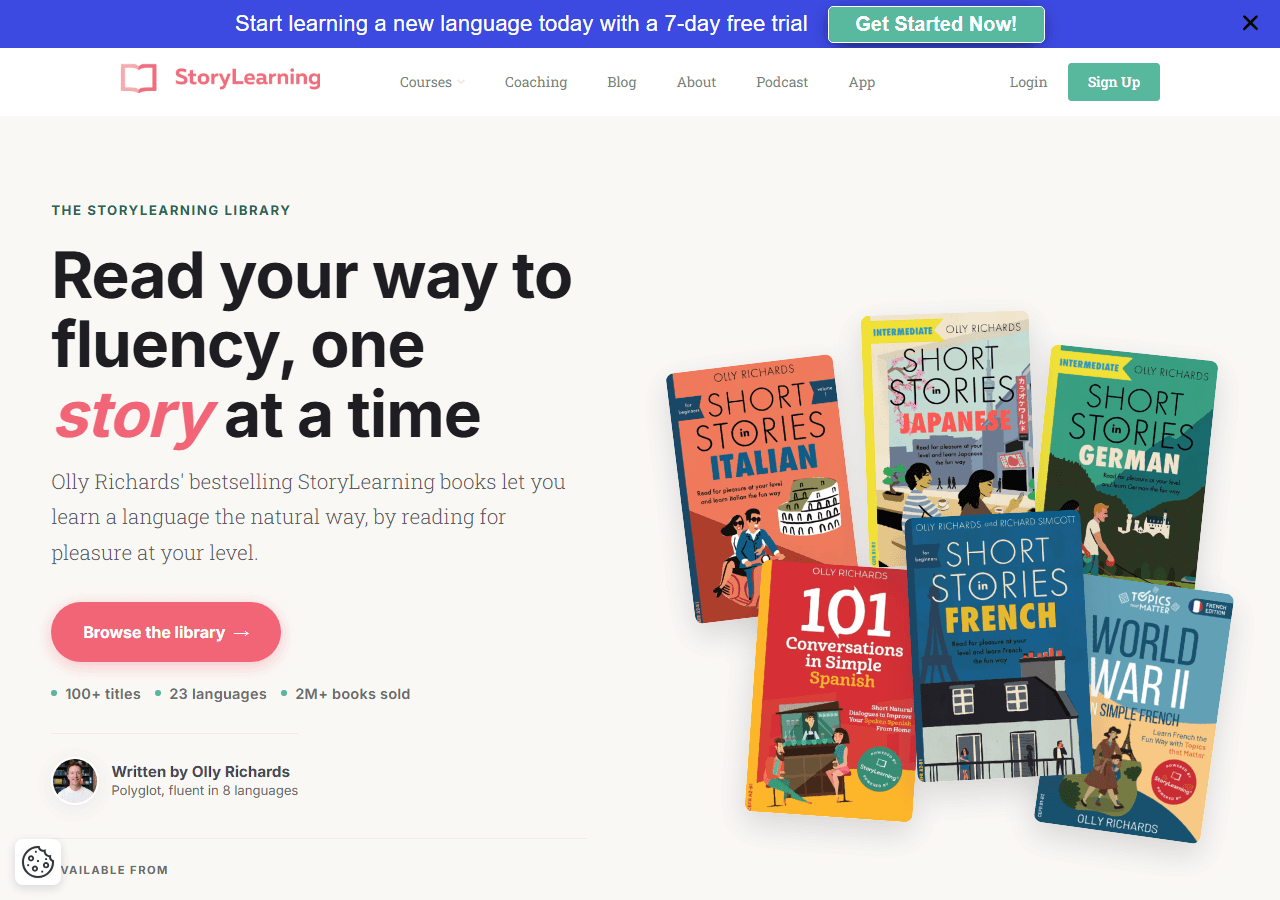
Olly Richards’ Short Stories in Spanish from StoryLearning is probably the most famous graded reader series in the entire space. It’s the one every listicle puts at number one, it’s got a slick brand, a whole method named after it, the works.
You can find it at storylearning.com/books. And it’s good!
That’s the frustrating part. The stories are genuinely well-crafted, more interesting than most of the genre, with real plots and twists and characters.
When I was reading it smoothly, it was some of the best material on the table.
Here’s the problem, and I want to type it in capitals but I’ll restrain myself: the publisher’s “Beginner” level is A2–B1, not day-one A1. The cover says beginner. A human being with two months of Spanish sees the word beginner and buys it.
That human being then opens chapter one and meets page after page of past tenses, subjunctive-ish constructions, and vocabulary that no beginner course has covered. That human being, in this case, was nearly me.
My first session with it was the worst reading hour of the two weeks. I was looking up word after word, losing the thread of the story, re-reading paragraphs, the whole vocabulary-archaeology experience I described earlier.
I clocked maybe 85–90% comprehension, which sounds high and feels terrible. It’s the gap between “reading” and “decoding,” and that gap is where motivation goes to die.
The Reddit consensus, which I found later and which matched my experience exactly: Richards’ books land well after you’ve built a true A1 base, not as your first reader. Which is exactly how they’re designed, to be fair, the level guidance inside the book is more honest than the cover.
But the cover is what’s in the store. And this is the clearest example of the thing I keep hammering: the label is a marketing suggestion.
Test before you commit.
So where does that leave the Richards book? On my nightstand, actually, but in the good way.
I set it aside during the two weeks, built speed on the Ardit and the Fernández, and by the end I could feel the Richards stories coming back into reach. That’s the pattern I’d suggest to anyone: it’s an excellent second reader.
Buy it when you’re solidly past your first one, not before. It’s a bridge from beginner-land toward intermediate, and like El Principito, it works far better as a bridge than as an on-ramp.
TPRS and CVC
TPRS stands for Teaching Proficiency through Reading and Storytelling, and if you went to a school in Ontario anytime in the last twenty years, you may have actually sat through a class built on it without knowing it had a name. It’s Blaine Ray’s baby, and the books, published through TPRS Books, are basically the printed residue of that classroom method.
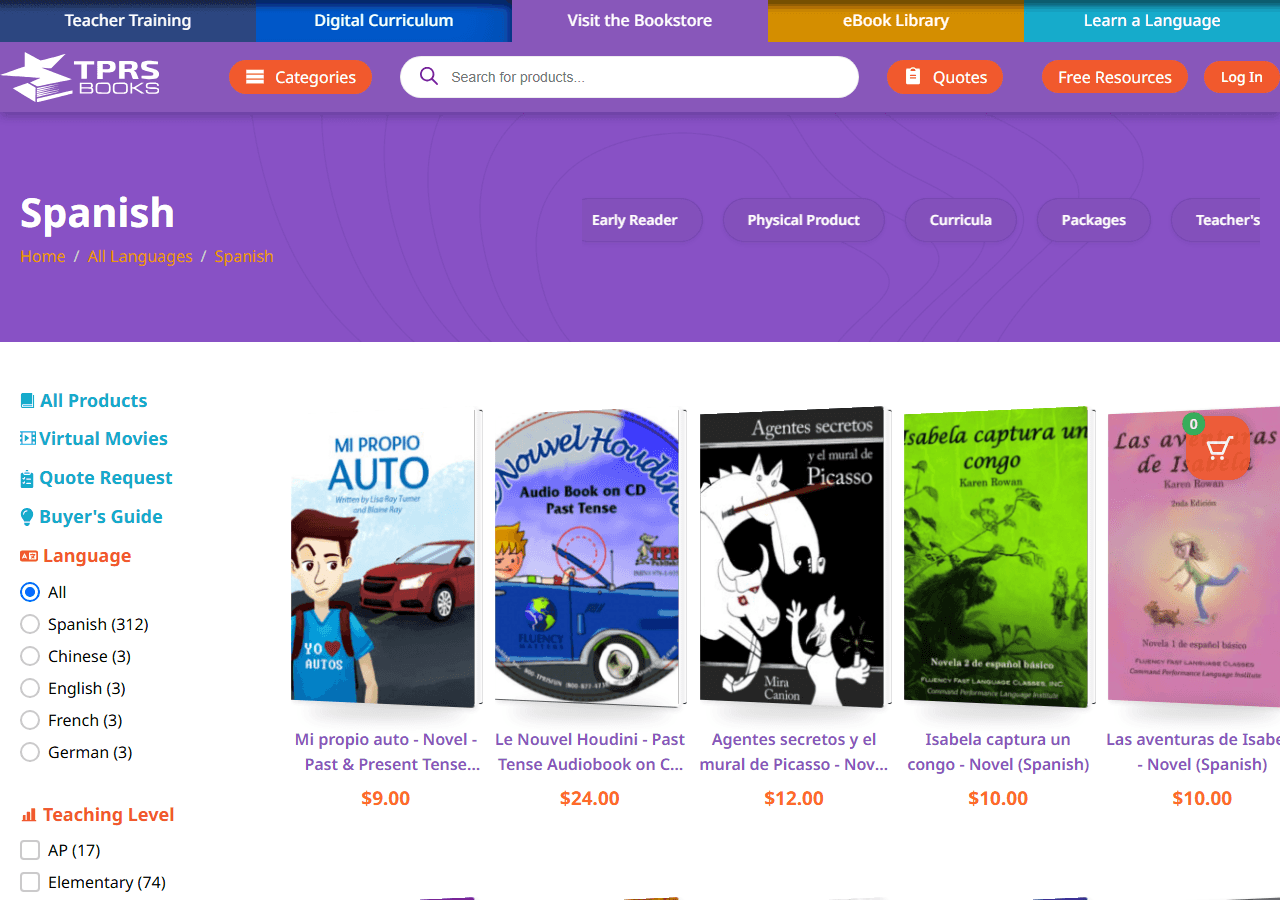
Short, weird little stories with a tiny cast of characters, obsessively recycled vocabulary, and a lot of repetition on purpose.
The idea is sound. You get maybe a hundred words, and you see them so many times, in so many slight variations, that they stop being words you recognize and start being words you own.
That’s the whole pitch, and honestly, it works. By the third chapter of one of the Fluency Matters style readers, I could feel the difference.
Words I’d normally reach a card for were just… there.
The catch is that these are classroom books. They’re written for a teacher to stand in front of fifteen kids and ask circling questions.
“¿El chico quiere un perro o un gato?” and everyone answers in unison. Reading them alone at your kitchen table, you get maybe 70% of the intended experience.
The repetition is still there, the pacing is still there, but the actual interactive part, the part that makes TPRS TPRS, is gone. You’re reading the script of a play with no cast.
The other catch is price and availability. Some of these are cheap paperbacks, some are weirdly expensive for what they are, and a bunch of the Fluency Matters catalogue has licensing that assumes a school is buying it.
If you’re one adult with a phone and a library card, the friction is real. I’d say: if you can find one cheap used copy of a beginner-level TPRS reader, grab it, it’s a genuinely good way to drill high-frequency words in context.
Just don’t build your whole reading life around the method’s leftovers.
CVC Lecturas paso a paso
The Cervantes Institute’s CVC Lecturas paso a paso are the other thing in this bucket. These are the Instituto Cervantes’ free (or nearly free) online graded readings, sorted by level, with a bunch of short texts and comprehension checks.
The catch as of this writing: the old URL I had bookmarked 404s on me, which is very on-brand for institutional web properties. Our graded reader library hub at Yak Yacker still lists them with a working path, so use that if you want them.
They’re worth using when you can get to them. The texts are short, dry in that Spanish-institutional way, and free is free.
They’re a nice palate cleanser between chapters of whatever real book you’re reading, and the paso a paso leveling is honest, which puts them ahead of half the commercial stuff. But they read like what they are: a government language institute’s reading exercises.
Nobody’s staying up late to finish one.
How to pick a level
Here’s the part where I stop reviewing and start preaching, because this is the single decision that determines whether graded readers work for you at all.
Stay near 95–98% known words. That’s the number.
If you’re at 98%, you’re reading, in the real sense, the sense where your brain does what it does in English and just absorbs meaning. If you’re at 95%, you’re working a little but it’s still comfortable.
Below that, you’re not reading, you’re decoding, and you’ll quit by page nine. I know this because I did quit by page nine.
Twice.
The practical version of the rule: open the sample, read the first page, and count. Count how many words you don’t know.
One unknown word on a page of two hundred? You’re at roughly 99.5%, and the level’s actually too easy, which is fine, easy is good.
Ten unknown words? That’s around 95%, right in the pocket.
Twenty-five? Bounce.
Doesn’t matter what the cover says.
Because here’s the thing about the label: “beginner” is a marketing word, not a diagnosis. We covered the Olly Richards thing above, but it’s true across the whole category.
One publisher’s A1 is another publisher’s A2. Paco Ardit’s A1 is genuinely gentle.
Some other books I picked up with a “Beginner” badge assumed I already knew the past tenses, which, in what universe is that day one?
So the sample test is non-negotiable. Every publisher I’ve mentioned either has free samples or a Kindle preview.
Read the actual first page. Your own vocabulary is the only level that exists.
The CEFR label on the back of the book is a suggestion from someone who has never met you.
And when in doubt, go easier. The failure mode of graded reading isn’t reading books that are too easy, it’s grinding through books that are too hard, deciding you’re bad at Spanish, and going back to scrolling your phone.
A book you finish at 98% beats a book you abandon at 90%, every single time. Volume wins.
Which brings me to the next point.
What I liked, and what wore me down
What I liked
Volume, finally. Two weeks of reading meant I actually finished things. Multiple things.
If you’ve spent any time on the app treadmill, you know the strange feeling of day 400 of a streak with nothing finished to show for it. Reading a whole story, even a simple one, even in ninety minutes, is a different psychological animal.
You get the completion feeling. Your brain starts believing you can do this.
Pain-free repetition. Every graded reader is secretly a vocabulary drill wearing a trench coat. You see “quería” forty times in a Paco Ardit book and you never once flashcarded it.
That’s Yak Cards levels of repetition, delivered through a plot instead of through a deck, and it sticks better because there’s a story glued to it.
Grammar by osmosis. Nobody explained the imperfect to me during those two weeks. But after a few hundred pages of characters remembering things and describing their childhoods, the endings stopped being mysterious.
I couldn’t necessarily conjugate on demand, but reading felt like the shapes were pre-familiar. That’s the whole quiet promise of extensive reading, and it’s real.
Cheap, mostly. A Paco Ardit book costs less than a coffee. The bundles make it even cheaper per book.
Two weeks of reading cost me less than one month of most subscriptions I’ve reviewed, and I’ll take that trade any day.
What wore me down
What wore me down.
Boredom. Let’s not pretend otherwise. A1-level fiction is constrained fiction, and constrained fiction is often dull fiction.
There are only so many stories about a man who wants a dog, or a woman who moves to a new city and experiences mild confusion. Some authors make it charming.
Paco Ardit and Juan Fernández mostly do, actually. But some chapters, you’re reading because you’re a language learner, not because you need to know what happens.
Anyone who tells you every graded reader is a page-turner is selling something.
Per-title cost adds up. Individually cheap, collectively not. If you’re buying one reader at a time at $8–15, and you’re finishing one every couple of days because they’re short, congratulations, you’ve reinvented a subscription with extra steps.
Kindle Unlimited helps a lot here, some of these are in it, and the Spanish Novels bundles exist precisely for this problem. But it’s a real thing to plan around.
The ceiling. Graded readers top out. Once you’re comfortable in B2 territory, you’re going to want real books, and the transition can be a wall.
El Principito is the classic bridge, and it works as one, but it is a bridge, not a first book. If your Spanish isn’t at “charming fable with a tenuous grasp of its own vocabulary,” it’ll grind you down.
And native books below that level are rare, which is exactly why the graded ladder exists.
Who this is for, and who should skip
This is for you if:
- You’ve got a base. A real A1, maybe a shaky A2. You know the present tense, you know some high-frequency words, and you’re tired of tapping screens.
- You want reading to become a thing you do, not a thing you study. Graded readers are how readers get built.
- You like the idea of finishing things, and you commute or wait around with a phone in your hand anyway.
- You’re okay being slightly bored sometimes in exchange for steady, compounding progress.
Skip it (or shelf it) if:
- You’re at absolute zero. Day one, no words, nothing. Go get a base first, whether that’s our how to learn a language guide, an app like Duolingo for a month or two, or a Babbel run. Reading at 60% comprehension is not reading, it’s suffering with a book attached.
- You demand literary quality. It’s not here. It’s not supposed to be here. Come back when you’re at B2 and go read real books.
- You can’t tolerate repetition. The method IS repetition. If recycled vocabulary makes you itchy, this whole category will make you miserable, and no level-matching will save you.
Pros and cons
Pros
- Massive reading volume at low frustration, if the level’s right
- Vocabulary and grammar acquired in context, and it actually sticks
- Cheap entry point, especially Spanish Novels and Kindle Unlimited
- Finishable. Completion feelings are rare in language learning, grab them where you can
- Portable. A phone full of readers goes everywhere
- Works as your main input method or as a supplement to anything
Cons
- “Beginner” labels lie. You must sample, always
- Boredom is a structural feature of constrained writing
- Per-title costs compound if you don’t use bundles
- Hard ceiling around B1–B2 before you need real books
- TPRS books are classroom artifacts that lose something without a teacher
- Institutional free stuff (CVC) has uptime problems
What we'd use with it
Graded readers pair beautifully with other stuff, and the honest answer is they work best as one leg of a stool.
Yak Cards are the obvious partner. When a word shows up three times in a reader and I still can’t produce it, that’s a card.
The reader gives you context, the card gives you recall. You can even pull words straight out of what you read that day, which is the least artificial flashcard workflow I’ve ever used, because you’re only reviewing words you’ve already met in a story.
Some structured grammar never hurts either. If you want the full picture of how we’d sequence a self-taught Spanish run, the learn Spanish hub is where we keep it, and graded readers slot in right around the “you have a base, now get input” phase.
And if you’re also teaching or learning English in your house, same logic applies over there. Our English lessons run 139 of them, starting at Lesson 1, and the philosophy is identical: controlled input, honest levels, lots of volume.
The method doesn’t care which language it’s eating.
For more of our honest run-throughs of language tools, the whole reviews section is open.
What others are saying
I’m not the only one who spent time in this pile, obviously. A few other takes worth a read:
The consensus across all of us, as far as I can tell: the method works, the levels are unreliable, and you should sample before you buy. Comforting, in a way. I’m not alone at the kitchen table.
FAQ
Prices, plan names, and features below are as of September 2026.
Do graded readers actually work for learning Spanish?
Yes, with the level caveat. Reading a lot of text you understand at 95–98% is one of the few things in language learning with both a mechanism and a track record.
Volume plus comprehension equals acquired vocabulary and grammar patterns. Read the wrong level and you get nothing but frustration, so the “work” is conditional on honest level-matching.
What level should I start at?
Lower than you think. Sample the first page, count unknown words.
Ten-ish per two hundred is the sweet spot. If you’re torn between two levels, take the easier one.
There is no prize for suffering.
Is Olly Richards actually for beginners?
His “beginner” book is A2–B1 by his own publisher’s scale. Not day one.
Get a real A1 base first, Paco Ardit or Juan Fernández will build it, then the Richards book lands much better. Reddit says the same thing and Reddit is right this time.
Graded readers or flashcards?
Both, and they feed each other. Readers put words in context, cards make them retrievable.
If you force me to pick one, readers, because you get grammar and reading fluency for free alongside the vocabulary. But the combo beats either alone.
How many should I read?
As many as you can finish. The point is volume.
One reader teaches you almost nothing, ten teaches you something, thirty teaches you Spanish. Cheap books and bundles exist to make this possible.
Can I jump to real books after this?
Eventually, yes, but bridge it. Finish the graded ladder around B1–B2, take something like El Principito as a stepping stone, then native books.
Going straight from A2 graded readers to a novel is how people end up quitting at page eleven.
After two weeks
So where did the kitchen table experiment land? Better than I expected, worse than the marketing promises, which is the correct way for everything in language learning to land.
I read every day for two weeks. I finished multiple books.
My passive vocabulary grew in a way I could actually feel, words arriving in my head before I asked for them. My reading speed roughly doubled from the start of the two weeks to the end, which is the least surprising finding in history, since that’s what practice does, but it’s still nice to measure something for once.
Grammar stopped being a list of endings and started being a set of familiar shapes. Nobody taught me that.
I just read past it enough times.
The runners and the also-rans, one more time:
- Easy Spanish Reader was the structured, course-like ramp. Good, a little dry, more classroom than campfire.
- Paco Ardit / Spanish Novels was the volume machine. Cheap, honest levels, short chapters, audio. The workhorse of the two weeks and my default recommendation for anyone past absolute zero. Check the Spanish Novels site and sample your level.
- Juan Fernández was the dark horse. Reddit’s favourite for a reason. Humane A1–B1 content that blogs keep forgetting to mention, and they shouldn’t.
- Olly Richards was the book I wasn’t ready for and would be ready for now. Great, mislabeled, and worth it once you’ve earned it. The full catalogue lives at StoryLearning.
- TPRS and CVC were the classroom and institutional strays. Useful in specific situations, not the spine of anything.
If I were building a reading habit from scratch, knowing what I know now: start with Ardit at whatever level the sample test says, read one book start to finish, bump or drop the level based on how that felt, and keep going until the “beginner” shelves run out. Add cards for words that refuse to stick.
Let boredom happen on the easy days, because easy days are the days your brain is doing the most quiet work.
Is it the funnest way to learn Spanish? Not always.
Is it one of the most effective per dollar and per hour, with the fewest dark patterns and no streak anxiety? Genuinely, yes.
Two weeks of reading did more for my Spanish than the two months of app tapping before it, and I say that as someone who has reviewed a lot of apps in my life.
8 out of 10 Yaks
Two yaks docked for dull chapters and lying labels. Everything else, earned.
Now go sample something before you buy it.