


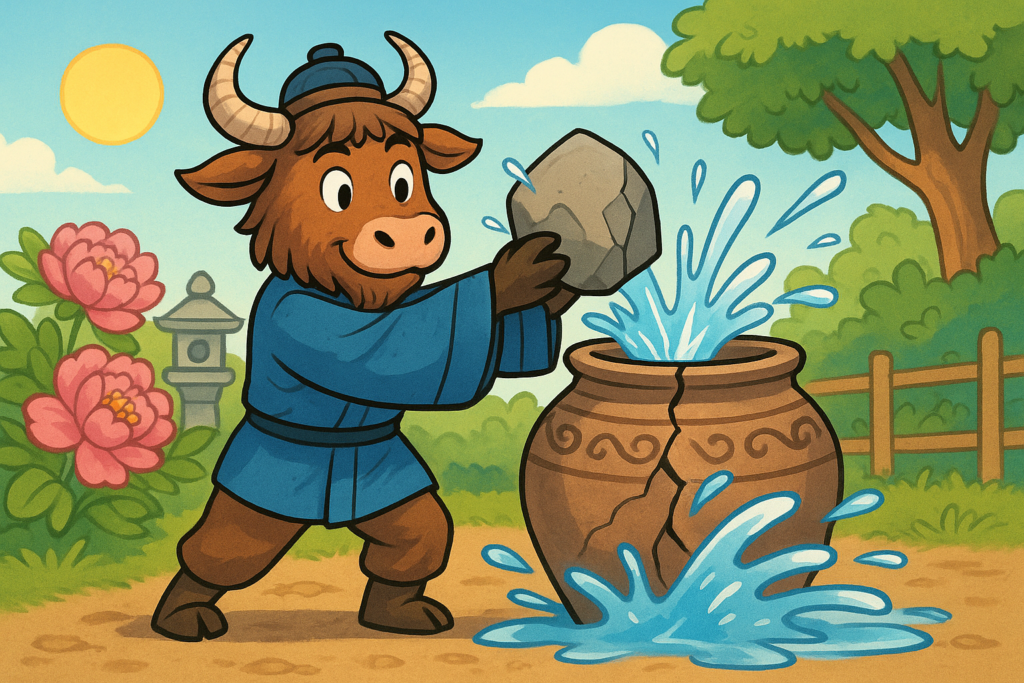
Welcome to the timeless tale of quick thinking and bravery! In this classic Chinese story, a young boy named Sima Guang is playing with his friends when one of them falls into a large water vat. While the other children panic, Sima Guang grabs a rock and smashes the vat, letting the water rush out and saving his friend.
This interactive A1 beginner reader is designed to make learning Traditional Chinese easy and enjoyable. You'll get full story audio, clickable words with instant translations, and helpful lesson notes. Whether you're new to the language or brushing up, this free reading experience brings a celebrated piece of Chinese culture right to your fingertips.
司馬光和朋友一起玩。
他們在玩。
花園裡有一個。
水缸裡有。
一個朋友水缸上。
他水缸裡了!
「」他。
朋友們都。
他們大人。
司馬光沒有。
他大石頭。
他用水缸。
水從水缸裡。
朋友!
「司馬光,你真!」大家說。
Sima Guang and his friends are playing together.
They are playing in the garden.
There is a large water vat in the garden.
The vat is filled with water.
One friend climbs onto the vat.
He falls into the vat!
"Help! Help!" he cries out.
The friends are all scared.
They run to find an adult.
Sima Guang does not run.
He finds a large rock.
He uses the rock to break the vat.
Water flows out of the vat.
The friend gets out!
"Sima Guang, you are amazing!" they all say.
In the story, Sima Guang's friend shouts 「救命!」 (jiù mìng!) - "Help!" This is the most important phrase to know in an emergency. You can use it even at a beginner level.
Another useful phrase is 「小心!」 (xiǎo xīn!) - "Be careful!" or "Watch out!" You might hear this if someone is about to fall.
- 救命 (jiù mìng) - Help!
- 小心 (xiǎo xīn) - Be careful!
- 快點 (kuài diǎn) - Hurry!
The story is full of simple, active verbs that describe what people do. Learning these will help you talk about everyday actions and sudden events.
Notice how the verbs combine with other words to create clear meanings: 爬 (pá) + 到...上 (dào...shàng) = climb onto; 掉 (diào) + 進 (jìn) = fall into.
- 爬 (pá) - to climb
- 掉進 (diào jìn) - to fall into
- 找 (zhǎo) - to look for
- 打破 (dǎ pò) - to break (by hitting)
In Chinese, 了 (le) is often added after a verb to show that an action is finished. This is very common in stories to tell what happened.
For example: '他掉進水缸裡了!' (Tā diào jìn shuǐ gāng lǐ le!) - He fell into the water vat! The 了 at the end adds a sense of 'already happened' and makes the telling feel natural.
- Verb + 了 = action completed
- 他打破了水缸。(Tā dǎ pò le shuǐ gāng.) - He broke the water vat.
- 水從水缸裡流出來了。(Shuǐ cóng shuǐ gāng lǐ liú chūlái le.) - Water flowed out.
- 朋友出來了。(Péngyǒu chūlái le.) - The friend came out.
Now that you know the key words, imagine you're in the garden with Sima Guang. What would you have done? Try retelling the story using at least three of the new verbs.
Don't worry about getting every word perfect. Even a simple sentence like '我找石頭,打破水缸' (Wǒ zhǎo shítou, dǎ pò shuǐ gāng) shows you understand the core idea.
- Use 找 (zhǎo) to say you looked for something.
- Use 打破 (dǎ pò) to describe breaking the vat.
Sima Guang Breaks the Vat comes from the Chinese / idiom story tradition and is best known as a moral anecdote. This Yak Yacker article is an original learner retelling based on Traditional Song-dynasty anecdote; public domain, so the wording here is simplified for modern learners rather than copied from one old edition.
Older printings, translations, and retellings of this story can vary quite a bit. The original audience was usually kids, but this version is adapted for A1 Beginner learners studying Traditional Chinese. Good rescue story; simple action verbs.
If you want to look into the source tradition, start with Wikisource.
If you want to keep going, browse more in our Traditional Chinese section. After that, try 1,000 Traditional Chinese Phrases and Expressions for another useful next step.