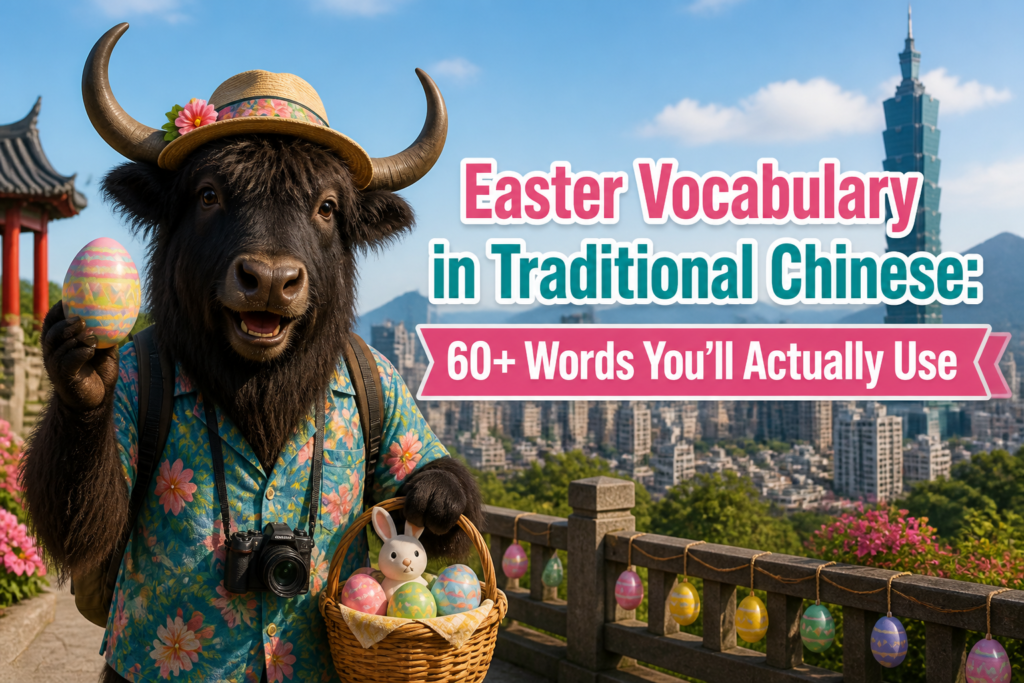
復活節 fùhuójié means Easter, and yes, people in Taiwan do talk about it — mostly in schools, churches, cafés, gift shops, and any place that enjoys a suspicious amount of cute pastel nonsense. If you want to talk about Easter in Traditional Chinese, this guide gives you the words that actually show up in real life, not the dusty dictionary stuff collecting imaginary eggs in a corner.
By the end, you’ll know how to say Easter basics, holiday objects, church words, decorating language, and common phrases you can use in class, conversation, or while explaining why your chocolate egg mysteriously vanished.
復活節不是台灣的大節日,但相關英文和宗教詞彙在學校、教會、國際活動裡都很常見。
Fùhuójié bùshì Táiwān de dà jiérì, dàn xiāngguān Yīngwén hé zōngjiào cíhuì zài xuéxiào, jiàohuì, guójì huódòng lǐ dōu hěn chángjiàn.
Easter is not a major public holiday in Taiwan, but the related vocabulary is common in schools, churches, and international events.
Core Easter Words
Start with the main words. These are the ones you’ll see first, and the ones you’ll actually remember after more than three seconds of “I studied this, right?”
| Traditional Chinese | Pinyin | Meaning | Example (ZH) | Example (Pinyin) | Translation (EN) |
|---|---|---|---|---|---|
| 復活節 | fùhuójié | Easter | 我們學校下週要辦復活節活動。 | Wǒmen xuéxiào xià zhōu yào bàn fùhuójié huódòng. | Our school is going to hold an Easter activity next week. |
| 耶穌 | Yēsū | Jesus | 復活節和耶穌復活有關。 | Fùhuójié hé Yēsū fùhuó yǒu guān. | Easter is related to Jesus’ resurrection. |
| 復活 | fùhuó | resurrection; rise again | 這個詞的意思是復活。 | Zhège cí de yìsi shì fùhuó. | This word means resurrection. |
| 十字架 | shízìjià | cross | 教堂門口有一個十字架。 | Jiàotáng ménkǒu yǒu yí gè shízìjià. | There is a cross at the church entrance. |
| 教堂 | jiàotáng | church | 他們星期天去教堂。 | Tāmen xīngqītiān qù jiàotáng. | They go to church on Sunday. |
| 宗教 | zōngjiào | religion | 這是一個宗教節日。 | Zhè shì yí gè zōngjiào jiérì. | This is a religious holiday. |
| 節日 | jiérì | holiday; festival | 復活節是春天的節日。 | Fùhuójié shì chūntiān de jiérì. | Easter is a spring holiday. |
| 春天 | chūntiān | spring | 復活節通常在春天。 | Fùhuójié tōngcháng zài chūntiān. | Easter usually falls in spring. |
| 星期日 | xīngqīrì | Sunday | 很多人星期日去參加禮拜。 | Hěn duō rén xīngqīrì qù cānjiā lǐbài. | Many people attend worship on Sunday. |
| 禮拜 | lǐbài | worship; church service | 今天早上的禮拜很早。 | Jīntiān zǎoshang de lǐbài hěn zǎo. | This morning’s worship service was early. |
Food, Treats, and Cute Holiday Things
Easter vocabulary gets much easier once food shows up. Suddenly everyone is paying attention. Very suspicious, but effective.
| Traditional Chinese | Pinyin | Meaning | Example (ZH) | Example (Pinyin) | Translation (EN) |
|---|---|---|---|---|---|
| 彩蛋 | cǎidàn | colored egg; Easter egg | 小朋友在草地上找彩蛋。 | Xiǎo péngyǒu zài cǎodì shàng zhǎo cǎidàn. | The children look for Easter eggs on the grass. |
| 雞蛋 | jīdàn | egg | 這些彩蛋是雞蛋做的嗎? | Zhèxiē cǎidàn shì jīdàn zuò de ma? | Are these Easter eggs made from chicken eggs? |
| 巧克力蛋 | qiǎokèlì dàn | chocolate egg | 她收到一顆巧克力蛋。 | Tā shōudào yì kē qiǎokèlì dàn. | She received a chocolate egg. |
| 糖果 | tángguǒ | candy | 小孩最期待糖果。 | Xiǎohái zuì qídài tángguǒ. | Kids look forward to the candy the most. |
| 甜點 | tiándiǎn | dessert | 我們做了很可愛的復活節甜點。 | Wǒmen zuòle hěn kě’ài de fùhuójié tiándiǎn. | We made very cute Easter desserts. |
| 蛋糕 | dàngāo | cake | 她帶了一個復活節蛋糕來。 | Tā dàile yí gè fùhuójié dàngāo lái. | She brought an Easter cake. |
| 點心 | diǎnxīn | snack; treat | 活動結束後有點心可以吃。 | Huódòng jiéshù hòu yǒu diǎnxīn kěyǐ chī. | There are snacks to eat after the activity. |
| 兔子 | tùzi | rabbit | 復活節兔子很受小朋友歡迎。 | Fùhuójié tùzi hěn shòu xiǎopéngyǒu huānyíng. | The Easter bunny is popular with children. |
| 兔耳朵 | tù ěrduo | rabbit ears | 她戴著兔耳朵髮箍。 | Tā dàizhe tù ěrduo fàgū. | She is wearing a rabbit-ear headband. |
| 花圈 | huāquān | flower wreath; floral ring | 教室門上掛著春天花圈。 | Jiàoshì mén shàng guàzhe chūntiān huāquān. | A spring flower wreath hangs on the classroom door. |
| 草地 | cǎodì | grass; lawn | 大家在草地上拍照。 | Dàjiā zài cǎodì shàng pāizhào. | Everyone is taking photos on the grass. |
| 籃子 | lánzi | basket | 孩子提著籃子去找彩蛋。 | Háizi tízhe lánzi qù zhǎo cǎidàn. | The child carries a basket to look for eggs. |
Church And Religious Vocabulary
If you want to talk about Easter in a more religious way, these are the important words. They also help you read signs, school materials, and church event flyers without guessing like a detective with no coffee.
| Traditional Chinese | Pinyin | Meaning | Example (ZH) | Example (Pinyin) | Translation (EN) |
|---|---|---|---|---|---|
| 受難 | shòunàn | suffering; passion | 耶穌的受難故事很有名。 | Yēsū de shòunàn gùshì hěn yǒumíng. | The story of Jesus’ suffering is very famous. |
| 受難日 | shòunànrì | Good Friday | 受難日通常是安靜的一天。 | Shòunànrì tōngcháng shì ānjìng de yì tiān. | Good Friday is usually a quiet day. |
| 聖週 | shèngzhōu | Holy Week | 聖週包括復活節前的重要日子。 | Shèngzhōu bāokuò fùhuójié qián de zhòngyào rìzi. | Holy Week includes the important days before Easter. |
| 復活節主日 | fùhuójié zhǔrì | Easter Sunday | 很多人會在復活節主日去教堂。 | Hěn duō rén huì zài fùhuójié zhǔrì qù jiàotáng. | Many people go to church on Easter Sunday. |
| 禱告 | dǎogào | pray; prayer | 大家一起禱告。 | Dàjiā yìqǐ dǎogào. | Everyone prayed together. |
| 祈禱 | qídǎo | pray; pray for | 她為家人祈禱。 | Tā wèi jiārén qídǎo. | She prays for her family. |
| 信仰 | xìnyǎng | faith; belief | 這是他的宗教信仰。 | Zhè shì tā de zōngjiào xìnyǎng. | This is his religious faith. |
| 福音 | fúyīn | gospel; good news | 教會常常分享福音。 | Jiàohuì chángcháng fēnxiǎng fúyīn. | The church often shares the gospel. |
| 聖經 | Shèngjīng | Bible | 她每天讀聖經。 | Tā měitiān dú Shèngjīng. | She reads the Bible every day. |
| 教會 | jiàohuì | church; congregation | 教會今天有特別活動。 | Jiàohuì jīntiān yǒu tèbié huódòng. | The church has a special event today. |
Decorations, Symbols, And Activities
These words are great for describing Easter games, classroom parties, and decorations. Also useful if someone asks you to “help a little” and then hands you a mountain of pastel craft supplies.
| Traditional Chinese | Pinyin | Meaning | Example (ZH) | Example (Pinyin) | Translation (EN) |
|---|---|---|---|---|---|
| 裝飾 | zhuāngshì | decorate; decoration | 我們一起裝飾教室。 | Wǒmen yìqǐ zhuāngshì jiàoshì. | We decorated the classroom together. |
| 貼紙 | tiēzhǐ | sticker | 孩子們很喜歡彩蛋貼紙。 | Háizimen hěn xǐhuān cǎidàn tiēzhǐ. | The children really like Easter egg stickers. |
| 彩色 | cǎisè | colorful | 這些彩色彩蛋很漂亮。 | Zhèxiē cǎisè cǎidàn hěn piàoliang. | These colorful Easter eggs are beautiful. |
| 粉紅色 | fěnhóngsè | pink | 她穿了一件粉紅色外套。 | Tā chuānle yí jiàn fěnhóngsè wàitào. | She wore a pink jacket. |
| 黃色 | huángsè | yellow | 桌上有黃色彩蛋。 | Zhuō shàng yǒu huángsè cǎidàn. | There are yellow Easter eggs on the table. |
| 綠色 | lǜsè | green | 草地看起來很綠色。 | Cǎodì kàn qǐlái hěn lǜsè. | The lawn looks very green. |
| 手工 | shǒugōng | handcraft; DIY craft | 這是孩子做的手工彩蛋。 | Zhè shì háizi zuò de shǒugōng cǎidàn. | This is a handmade Easter egg. |
| 尋找 | xúnzhǎo | search for; look for | 大家在尋找藏起來的蛋。 | Dàjiā zài xúnzhǎo cáng qǐlái de dàn. | Everyone is looking for the hidden eggs. |
| 藏 | cáng | hide | 老師把彩蛋藏起來了。 | Lǎoshī bǎ cǎidàn cáng qǐlái le. | The teacher hid the Easter eggs. |
| 活動 | huódòng | activity; event | 這個活動很適合小朋友。 | Zhège huódòng hěn shìhé xiǎopéngyǒu. | This activity is suitable for children. |
Useful Easter Phrases
Here are practical phrases you can actually say. No ceremonial grammar robes required.
| Traditional Chinese | Pinyin | Meaning | Example (ZH) | Example (Pinyin) | Translation (EN) |
|---|---|---|---|---|---|
| 復活節快樂! | Fùhuójié kuàilè! | Happy Easter! | 復活節快樂! | Fùhuójié kuàilè! | Happy Easter! |
| 你有找到彩蛋嗎? | Nǐ yǒu zhǎodào cǎidàn ma? | Did you find any Easter eggs? | 你有找到彩蛋嗎? | Nǐ yǒu zhǎodào cǎidàn ma? | Did you find any Easter eggs? |
| 我們一起去找蛋吧。 | Wǒmen yìqǐ qù zhǎo dàn ba. | Let’s go look for eggs together. | 我們一起去找蛋吧。 | Wǒmen yìqǐ qù zhǎo dàn ba. | Let’s go look for eggs together. |
| 這個彩蛋好可愛。 | Zhège cǎidàn hǎo kě’ài. | This egg is so cute. | 這個彩蛋好可愛。 | Zhège cǎidàn hǎo kě’ài. | This egg is so cute. |
| 我喜歡巧克力蛋。 | Wǒ xǐhuān qiǎokèlì dàn. | I like chocolate eggs. | 我喜歡巧克力蛋。 | Wǒ xǐhuān qiǎokèlì dàn. | I like chocolate eggs. |
| 教堂今天有活動。 | Jiàotáng jīntiān yǒu huódòng. | The church has an event today. | 教堂今天有活動。 | Jiàotáng jīntiān yǒu huódòng. | The church has an event today. |
| 大家一起唱歌。 | Dàjiā yìqǐ chànggē. | Everyone sings together. | 大家一起唱歌。 | Dàjiā yìqǐ chànggē. | Everyone sings together. |
| 我們先吃點心。 | Wǒmen xiān chī diǎnxīn. | Let’s eat snacks first. | 我們先吃點心。 | Wǒmen xiān chī diǎnxīn. | Let’s eat snacks first. |
| 這是春天的顏色。 | Zhè shì chūntiān de yánsè. | These are spring colors. | 這是春天的顏色。 | Zhè shì chūntiān de yánsè. | These are spring colors. |
| 我不太懂這個宗教詞彙。 | Wǒ bú tài dǒng zhège zōngjiào cíhuì. | I don’t quite understand this religious vocabulary. | 我不太懂這個宗教詞彙。 | Wǒ bú tài dǒng zhège zōngjiào cíhuì. | I don’t quite understand this religious vocabulary. |
| 請再說一次。 | Qǐng zài shuō yí cì. | Please say it one more time. | 請再說一次。 | Qǐng zài shuō yí cì. | Please say it one more time. |
| 這是我的第一次復活節活動。 | Zhè shì wǒ de dì-yī cì fùhuójié huódòng. | This is my first Easter event. | 這是我的第一次復活節活動。 | Zhè shì wǒ de dì-yī cì fùhuójié huódòng. | This is my first Easter event. |
Quick Grammar And Usage Notes
Here are a few useful details so your sentences sound natural instead of like they were assembled by a very enthusiastic machine.
- 復活節 fùhuójié is the standard word for Easter.
- 彩蛋 cǎidàn can mean “Easter egg,” but in broader media it can also mean a hidden bonus or “secret extra.”
- 禮拜 lǐbài is commonly used in Taiwan for a church service.
- 教會 jiàohuì is common for the church as a community or congregation.
- 週 zhōu and 星期 xīngqī are both used for “week” language. In Taiwan, 星期日 xīngqīrì or 禮拜日 lǐbàirì can both be heard, though 星期日 is very standard.
- 一個 yí gè is the basic measure phrase for many things, including 一個彩蛋 yí gè cǎidàn if you are talking about one egg.
For a boring-but-useful reference on one of these words, try the Ministry of Education’s dictionary entry for 臺灣教育部重編國語辭典修訂本. It is exactly as delightfully unexciting as it sounds, which is perfect.
Common Confusions
| Word | Easy-To-Mix-Up With | Quick Fix |
|---|---|---|
| 復活節 fùhuójié | 復活 fùhuó | 復活節 is the holiday; 復活 is the action or idea of rising again. |
| 教堂 jiàotáng | 教會 jiàohuì | 教堂 is the church building; 教會 is the church community. |
| 彩蛋 cǎidàn | 雞蛋 jīdàn | 彩蛋 is a decorated egg or Easter egg; 雞蛋 is just an egg. |
| 禮拜 lǐbài | 星期 xīngqī | 禮拜 can mean worship service or, in everyday Taiwan speech, week in some contexts; 星期 is the safer general word for day-of-week language. |
| 祈禱 qídǎo | 禱告 dǎogào | Both mean pray; 禱告 is very common in Christian contexts. |
Practice Time
Try these quick drills. No one is watching, which is exactly when learning works best.
- Say “Happy Easter!” in Traditional Chinese: 復活節快樂! Fùhuójié kuàilè!
- Translate: “The children are looking for eggs.” → 小朋友在找蛋。 Xiǎopéngyǒu zài zhǎo dàn.
- Translate: “We are decorating the classroom.” → 我們在裝飾教室。 Wǒmen zài zhuāngshì jiàoshì.
- Fill in the blank: 我們一起去找_____吧。 Wǒmen yìqǐ qù zhǎo _____ ba. Answer: 彩蛋 cǎidàn
- Swap the word: 我喜歡巧克力蛋。 Wǒ xǐhuān qiǎokèlì dàn. Replace 巧克力蛋 with 糖果 tángguǒ.
| Prompt | Your Task | Answer |
|---|---|---|
| 教堂今天有活動。 | Make it past tense. | 教堂今天有活動了。 Jiàotáng jīntiān yǒu huódòng le. |
| 她在找彩蛋。 | Make it negative. | 她沒有在找彩蛋。 Tā méiyǒu zài zhǎo cǎidàn. |
| 大家一起唱歌。 | Add “too” / “also”. | 大家也一起唱歌。 Dàjiā yě yìqǐ chànggē. |
| 這是春天的顏色。 | Make it a question. | 這是春天的顏色嗎? Zhè shì chūntiān de yánsè ma? |
Extra Useful Easter Words
If you want to go beyond the basics, this bigger word set will help you understand signs, activities, and classroom talk. It also helps you hit that magical “I can actually talk about the topic now” moment.
| Traditional Chinese | Pinyin | Meaning | Example (ZH) | Example (Pinyin) | Translation (EN) |
|---|---|---|---|---|---|
| 春季 | chūnjì | spring season | 春季活動很多。 | Chūnjì huódòng hěn duō. | There are many spring activities. |
| 彩繪 | cǎihuì | painted; decorated with color | 我們學彩繪彩蛋。 | Wǒmen xué cǎihuì cǎidàn. | We learned how to paint Easter eggs. |
| 畫筆 | huàbǐ | paintbrush | 請把畫筆拿來。 | Qǐng bǎ huàbǐ nálái. | Please bring the paintbrush. |
| 顏料 | yánliào | paint; pigment | 彩蛋需要很多顏料。 | Cǎidàn xūyào hěn duō yánliào. | Easter eggs need a lot of paint. |
| 色彩 | sècǎi | colors; color palette | 這個活動的色彩很春天。 | Zhège huódòng de sècǎi hěn chūntiān. | The colors of this activity feel very spring-like. |
| 派對 | pàiduì | party | 學校辦了一個復活節派對。 | Xuéxiào bànle yí gè fùhuójié pàiduì. | The school held an Easter party. |
| 遊戲 | yóuxì | game | 找彩蛋是最好玩的遊戲。 | Zhǎo cǎidàn shì zuì hǎowán de yóuxì. | Egg hunting is the most fun game. |
| 獎品 | jiǎngpǐn | prize | 找到最多彩蛋的人有獎品。 | Zhǎodào zuì duō cǎidàn de rén yǒu jiǎngpǐn. | The person who finds the most eggs gets a prize. |
| 禮物 | lǐwù | gift | 我收到一份小禮物。 | Wǒ shōudào yí fèn xiǎo lǐwù. | I received a small gift. |
| 分享 | fēnxiǎng | share | 大家分享糖果和蛋糕。 | Dàjiā fēnxiǎng tángguǒ hé dàngāo. | Everyone shares candy and cake. |
| 聚會 | jùhuì | gathering; get-together | 我們星期天有家庭聚會。 | Wǒmen xīngqītiān yǒu jiātíng jùhuì. | We have a family gathering on Sunday. |
| 家庭 | jiātíng | family | 這是家庭一起參加的活動。 | Zhè shì jiātíng yìqǐ cānjiā de huódòng. | This is an activity for the whole family. |
| 兒童 | értóng | children | 兒童都喜歡找彩蛋。 | Értóng dōu xǐhuān zhǎo cǎidàn. | Children all like looking for eggs. |
| 笑聲 | xiàoshēng | laughter | 教室裡充滿笑聲。 | Jiàoshì lǐ chōngmǎn xiàoshēng. | The classroom is full of laughter. |
| 快樂 | kuàilè | happy | 大家都很快樂。 | Dàjiā dōu hěn kuàilè. | Everyone is very happy. |
| 安靜 | ānjìng | quiet | 受難日通常比較安靜。 | Shòunànrì tōngcháng bǐjiào ānjìng. | Good Friday is usually quieter. |
| 莊重 | zhuāngzhòng | solemn; serious | 這個儀式很莊重。 | Zhège yíshì hěn zhuāngzhòng. | This ceremony is very solemn. |
| 紀念 | jìniàn | commemorate; remember | 我們紀念這一天。 | Wǒmen jìniàn zhè yì tiān. | We commemorate this day. |
| 故事 | gùshì | story | 老師講了復活節故事。 | Lǎoshī jiǎngle fùhuójié gùshì. | The teacher told an Easter story. |
| 傳統 | chuántǒng | tradition | 這是西方的傳統。 | Zhè shì Xīfāng de chuántǒng. | This is a Western tradition. |
| 文化 | wénhuà | culture | 不同文化有不同節日。 | Bùtóng wénhuà yǒu bùtóng jiérì. | Different cultures have different holidays. |
| 學校 | xuéxiào | school | 學校會教這些節日單字。 | Xuéxiào huì jiāo zhèxiē jiérì dānzì. | Schools teach these holiday words. |
| 老師 | lǎoshī | teacher | 老師帶我們做彩蛋。 | Lǎoshī dài wǒmen zuò cǎidàn. | The teacher helped us make Easter eggs. |
| 學生 | xuéshēng | student | 學生都參加了活動。 | Xuéshēng dōu cānjiā le huódòng. | The students all joined the activity. |
| 課堂 | kètáng | classroom; class session | 課堂上學了復活節單字。 | Kètáng shàng xuéle fùhuójié dānzì. | We learned Easter vocabulary in class. |
| 單字 | dānzì | vocabulary word | 這些單字要記住。 | Zhèxiē dānzì yào jìzhù. | You should memorize these words. |
| 英文 | Yīngwén | English | 我們用英文和中文一起學。 | Wǒmen yòng Yīngwén hé Zhōngwén yìqǐ xué. | We study with both English and Chinese. |
If you want more Traditional Chinese practice after Easter vocabulary, the same learning style works well for New Year’s vocabulary in Traditional Chinese and Traditional Chinese food vocabulary. Because apparently holidays are just an excuse to learn more words and then get hungry.
You can also test your progress with the Traditional Chinese vocabulary test or check your level with the Traditional Chinese placement test for TOCFL. If you want the wider language-learning path, the main hub is over at Yak Yacker’s language learning page.
Yak Takeaway
復活節 fùhuójié vocabulary is mostly about eggs, spring colors, church words, and cheerful activities. Learn the core words first — 復活節 fùhuójié, 彩蛋 cǎidàn, 教堂 jiàotáng, 教會 jiàohuì, and 禮拜 lǐbài — and the rest starts to fall into place nicely. Not magically. That would be too easy. But nicely.