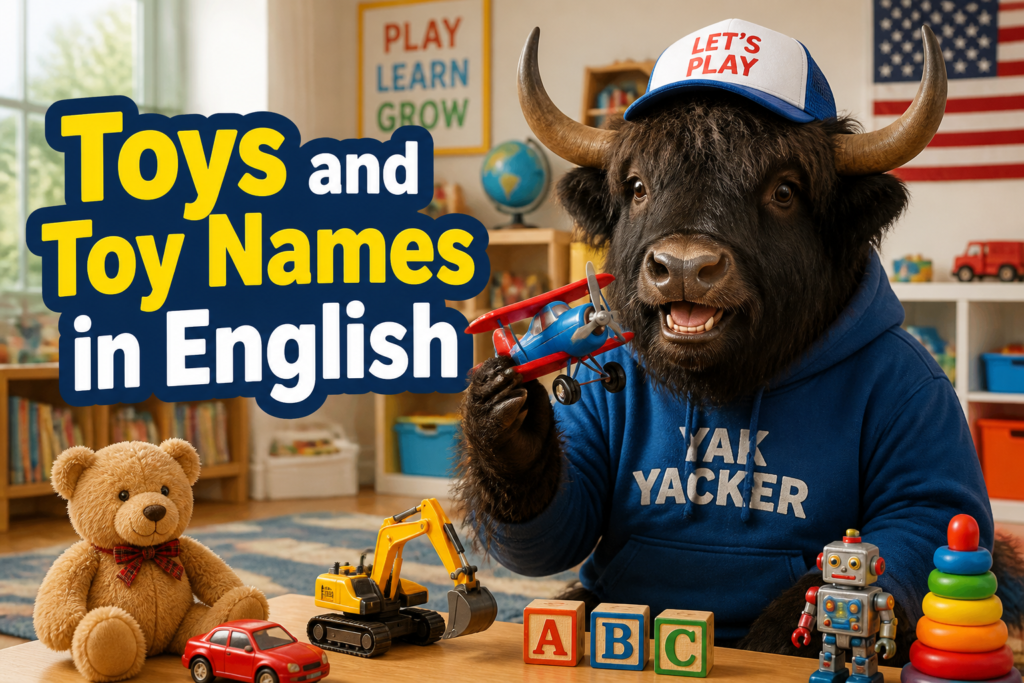
Learning toy names in English is surprisingly useful. Toys show up in real life at home, in stores, at birthday parties, in classrooms, and in conversations with kids. Also, if you can say “toy car” and “building blocks” without panic, congratulations: you are ready for a lot of everyday English.
For the broader learning path, visit our parent guide.
This guide will help you learn common toy vocabulary, simple pronunciation, and real example sentences. You’ll also see a few American and British differences, because English likes to keep learners busy for no good reason.
For a quick reference to English learning levels, you can also check the English Placement Test CEFR and the English Vocabulary Test.
If you want a boring but reliable dictionary check while you study, Cambridge Dictionary has a clear entry for toy.
Common Toys and Toy Names
Here are some of the most useful toy words in English. These are the names you’ll hear in shops, homes, and schools all the time.
| English | Pronunciation | Meaning | Example Sentence | Learner Note |
|---|---|---|---|---|
| toy | toy | something children play with | This store sells toys for children of all ages. | Very common, general word. |
| doll | dahl | a toy that looks like a person, often a girl or baby | My niece sleeps with her doll every night. | Common for children’s toys. |
| action figure | AK-shun FIG-yur | a toy person, often from a movie, comic, or game | He collects superhero action figures. | More common for boys’ toys, but not only. |
| stuffed animal | STUFT AN-uh-muhl | a soft toy shaped like an animal | She has a stuffed bear on her bed. | Very common in American English. |
| plush toy | PLUSH toy | a soft toy made from fabric | That plush toy feels really soft. | More formal than stuffed animal. |
| toy car | toy kar | a small car made for play | He pushed the toy car across the floor. | Simple and useful. |
| truck | truhk | a large vehicle toy or real vehicle | My son loves toy trucks. | In British English, a real truck is often called a lorry. |
| train set | TRAYN set | a group of toy trains and tracks | The train set comes with little bridges and stations. | Common in homes and hobby stores. |
| puzzle | PUHZ-uhl | a game where you fit pieces together | We finished a 500-piece puzzle last weekend. | Can also mean a problem or mystery. |
| jigsaw puzzle | JIG-saw PUHZ-uhl | a puzzle with many pieces that fit together | She is working on a jigsaw puzzle of the ocean. | Common in British English; also understood in American English. |
| building blocks | BUILD-ing bloks | toy pieces used to build things | The toddler stacked the building blocks into a tower. | Great for young children. |
| board game | bord gaym | a game played on a board with pieces or cards | Monopoly is a famous board game. | Not exactly a toy, but very related. |
More Fun Toy Words
| English | Pronunciation | Meaning | Example Sentence | Learner Note |
|---|---|---|---|---|
| ball | bawl | a round toy used for play or sports | The children kicked the ball in the yard. | Very common, very useful. |
| kite | kyte | a toy that flies in the wind | We flew a kite at the beach. | Often used outside. |
| yo-yo | YOH-yoh | a toy on a string that goes up and down | He learned a new trick with his yo-yo. | Stress both syllables equally. |
| top | tahp | a spinning toy | The child spun the top on the table. | Small but classic. |
| jump rope | jump rohp | a rope used for jumping games | The kids skipped rope after school. | In British English, this is often called skipping rope. |
| teddy bear | TED-ee bair | a stuffed bear toy | Her teddy bear has a red ribbon. | Very common and warm-sounding. |
| robot | ROH-bot | a machine or toy shaped like a machine | The robot toy walks and talks. | Used for toys and real machines. |
| drum | drum | a toy musical instrument you hit | He gave the drum a loud tap. | Kids love it. Adults, less so. |
| xylophone | ZY-luh-fone | a toy or musical instrument with bars you hit | The baby hit the xylophone with a stick. | Tricky spelling, easy to hear in context. |
| blocks | bloks | small pieces used for building | The child made a house with the blocks. | Often used in plural. |
| cars and trucks | karz and truhks | small vehicle toys | He keeps his cars and trucks in a box. | Very common phrase for kids’ toys. |
| playset | PLAY-set | a toy set with parts for a scene or activity | She got a kitchen playset for her birthday. | Often sold in stores as a complete set. |
Useful Toy Phrases In Real Life
When people talk about toys, they often use simple shopping, home, and play phrases. These are the ones that show up again and again.
| English | Pronunciation | Meaning | Example Sentence | Learner Note |
|---|---|---|---|---|
| toy store | toy stor | a shop that sells toys | We went to the toy store before the birthday party. | American English. British English often says toy shop. |
| toy aisle | toy eye-uhl | the section in a store where toys are sold | The toy aisle was crowded on Saturday. | Very useful in supermarkets and large stores. |
| toy box | toy boks | a box for storing toys | Please put the blocks back in the toy box. | Common at home and in classrooms. |
| play with | play with | to use a toy for fun | The children played with the train set for hours. | Basic verb pattern: play with + noun. |
| stack the blocks | stak thuh bloks | put blocks one on top of another | The toddler stacked the blocks very carefully. | Great for talking about toddlers. |
| pull it back | pool it bak | move a toy backward before letting it go | Pull the car back, then let it go. | Common with pull-back cars. |
| wind it up | wynd it up | turn a toy mechanism so it works | Wind up the toy and watch it move. | Common with wind-up toys. |
| put it together | put it tuh-GETH-er | assemble pieces into one item | Dad helped me put the puzzle together. | Useful for puzzles and building toys. |
| collect toys | kuh-LEKT toyz | keep toys as a hobby | He collects old toy cars. | Collect is common with hobby toys. |
| outgrow a toy | out-GROH a toy | become too old or big to enjoy a toy | She outgrew her doll collection last year. | Useful for talking about children growing up. |
| a favorite toy | uh FAY-vrit toy | a toy someone likes best | His favorite toy is a red truck. | Very natural, very common. |
| new toy | noo toy | a toy that was just bought or received | The children were excited about their new toys. | Works in gifts, holidays, and birthdays. |
Toy Verbs That Matter
A toy is one thing, but the verb often tells the full story. English loves to sneak the action into the sentence like it owns the place.
| Verb | Pronunciation | Meaning | Example Sentence | Learner Note |
|---|---|---|---|---|
| play | play | use a toy or game for fun | The kids play with toys after lunch. | The most general word. |
| build | bild | make something using pieces | They built a tall tower with blocks. | Very common with blocks and LEGO. |
| collect | kuh-LEKT | gather and keep toys | He collects model cars. | Often for hobbies. |
| trade | trayd | exchange one toy for another | The children traded cards and figures. | Common at school or among friends. |
| share | shair | let someone else use a toy too | It is hard for little kids to share toys. | Very useful in parenting and classroom English. |
| fix | fiks | repair a broken toy | Can you fix my robot toy? | Simple and practical. |
| assemble | uh-SEM-buhl | put parts together | We assembled the playset after dinner. | More formal than put together. |
| move | moov | change position or go around | This toy car moves by itself. | Common in descriptions. |
American And British English: Small But Useful Differences
English speakers often understand each other, but toy vocabulary still has a few differences. Nothing dramatic. Just enough to annoy learners, naturally.
| American English | British English | Meaning | Example |
|---|---|---|---|
| toy store | toy shop | a place that sells toys | We bought the gift at the toy store / toy shop. |
| jump rope | skipping rope | a rope for jumping games | She uses a jump rope / skipping rope at school. |
| stuffed animal | soft toy | a soft toy shaped like an animal | He sleeps with a stuffed animal / soft toy. |
| toy train set | train set | a toy train system and tracks | They set up the train set in the living room. |
| truck | lorry for the real vehicle | a vehicle; also a toy vehicle | The toy truck is on the floor. The real lorry is outside. |
Yak tip: “Toy” is a general word, but English often uses a more specific name when possible: doll, car, train set, puzzle, teddy bear. The more specific you are, the more natural you sound.
Mini Examples In Real Conversations
Here are a few short conversations you might hear when talking about toys.
| Situation | Example | Useful Phrase |
|---|---|---|
| Birthday gift | “What did you get her?” “A doll and a puzzle.” | What did you get her? |
| At the store | “Where are the toys?” “They’re in the toy aisle.” | toy aisle |
| At home | “Please put your cars in the toy box.” | put away / toy box |
| Playtime | “Let’s build a tower with the blocks.” | build a tower |
| Sharing | “Can I play with your train set?” “Sure, but be careful.” | play with |
Quick Pronunciation Help
Some toy words are easy to say. A few are sneaky little troublemakers. Here are the ones worth practicing.
- toy = one clear syllable, like “tɔy” in relaxed speech.
- doll = rhymes with “tall.”
- teddy bear = stress TED-ee, not “teh-DEE.”
- building blocks = clear stress on BUILD and blocks.
- jigsaw puzzle = “JIG-saw PUHZ-uhl.”
- xylophone = “ZY-luh-fone.” Yes, the spelling is a mess. English is committed to the bit.
Common Grammar Patterns With Toy Words
Toy vocabulary often appears in simple but important grammar patterns. These patterns help you sound natural fast.
| Pattern | Meaning | Example | Learner Note |
|---|---|---|---|
| a + toy noun | one item | a doll, a car, a puzzle | Use a before singular countable nouns. |
| some + toys | an unspecified amount | some toys, some blocks, some cars | Often used for plural nouns. |
| play with + toy | use a toy for fun | play with a train set | Very common verb pattern. |
| favorite + toy | the toy liked most | My favorite toy is a teddy bear. | Useful for children and adults. |
| toy + of + noun | a toy version of something | a toy car, a toy robot | Very natural in English. |
Practice Time
Try these quick practice items. No need to be dramatic. Just answer and move on like a confident language learner.
- Choose the correct word: stuffed animal or truck? My little sister sleeps with a soft bear.
- Choose the correct phrase: toy store or toy aisle? I want to buy a gift at the shop.
- Fill in the blank: We built a tower with __________.
- Fill in the blank: He plays __________ his new robot.
- Say it aloud: jigsaw puzzle, building blocks, teddy bear.
- Correct the sentence: She collect toy cars.
Answers: 1) stuffed animal 2) toy store 3) building blocks 4) with 5) practice the stress 6) She collects toy cars.
Common Mistakes And Fixes
- Wrong: “She has many toy.”
Right: “She has many toys.”
Why: Use the plural toys after many. - Wrong: “He plays with the block.”
Right: “He plays with the blocks.”
Why: Children usually have more than one block. - Wrong: “I go to toy shop.”
Right: “I go to a toy shop.”
Why: Singular countable nouns usually need a or the. - Wrong: “My daughter is playing her doll.”
Right: “My daughter is playing with her doll.”
Why: Use play with. - Wrong: “The child have a favorite toy.”
Right: “The child has a favorite toy.”
Why: Subject-verb agreement matters: child has.
Quick Reference Summary
| Category | Useful Words |
|---|---|
| Soft toys | doll, stuffed animal, plush toy, teddy bear |
| Vehicle toys | toy car, truck, train set |
| Learning and building | blocks, building blocks, puzzle, jigsaw puzzle |
| Classic play items | ball, kite, yo-yo, top, jump rope |
| Useful verbs | play with, build, collect, share, fix, assemble |
Yak takeaway: If you can say toy box, stuffed animal, building blocks, and play with, you already have a strong start. Tiny words, big usefulness. That’s the sneaky power of toy English.