This B1 Intermediate retelling of The Golden Age keeps the plot clear for learners while still giving the story some atmosphere and momentum. Long, long ago, the world was a beautiful garden. The sun always shone with a gentle, golden light.
This version is written for English-speaking learners and includes clickable word help inside the story, full story audio, and lesson notes after the reading. It is free to use on Yak Yacker and is designed to feel natural, readable, and manageable in English.
Long, long ago, the world was a beautiful . The sun always shone with a , golden light. There were no cold winters or burning hot summers. The trees gave sweet fruit, the rivers flowed with clear water, and the earth gave everything freely. People lived in and never grew old.
This was the , the first and happiest time for humans. They had no need for houses, because the weather was always . They had no need for work, because the land gave them everything. They danced on the soft grass and sang with the birds. Death was just a peaceful .
In this perfect world, the gods often came down from Mount Olympus to the people. They sat together in the shade of the great oak trees and told stories. The and the mortals were friends, and there was no fear between them.
One day, a young woman named Althea was flowers in a meadow. She looked up and saw a tall, shining figure standing under a tree. It was the goddess Demeter, the protector of the . Althea smiled and bowed her head.
"Good morning, bright goddess," said Althea. "The earth is so today. The wild strawberries are sweeter than ever."
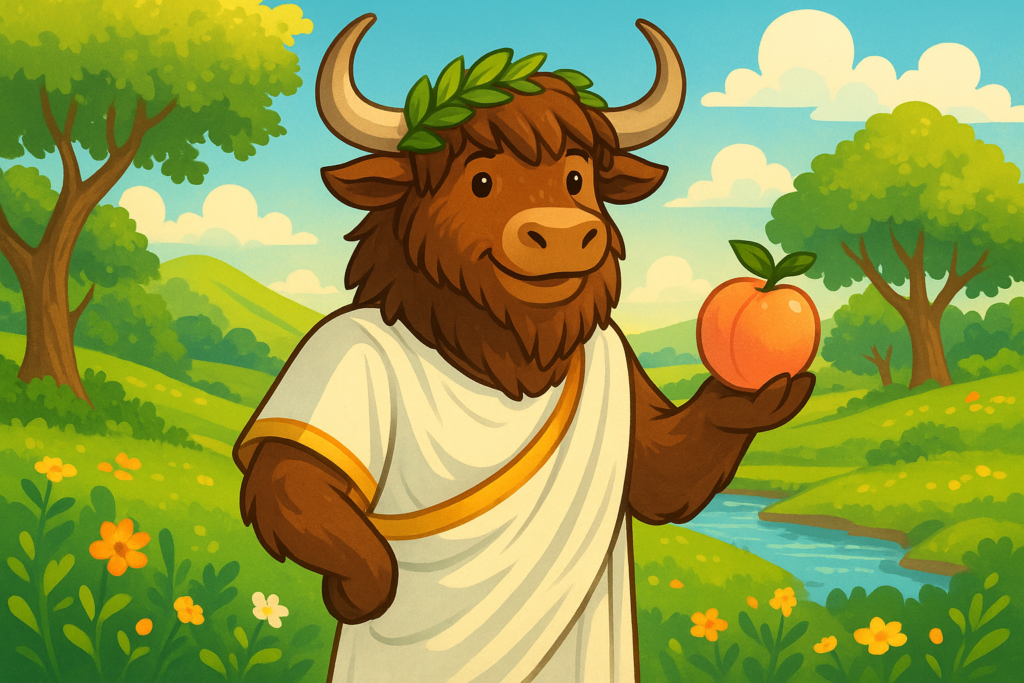
Demeter laughed, a sound like warm rain. "That is because the earth still remembers the old magic, child. Here, this peach." She held out a perfect, golden-pink peach.
Althea took it and bit into the soft fruit. Juice ran down her chin, and she closed her eyes in . "It tastes like sunlight," she said. "Will it always be like this?"
Demeter looked out over the peaceful land. Her smile faded a little. "Nothing gold can stay forever, little one. Even the gods must the laws of time. A change will come, one day."
Althea felt a small , even in the warm sun. "What kind of change, goddess?"
But Demeter only shook her head. "Do not with the future. Enjoy this moment. That is the secret of happiness."
So Althea tried to . She ran back to her family, who were resting under a big fig tree. Her father, a kind man with grey hair that was not from age, smiled at her.
"You have been with the goddess again," he said. "Your eyes are full of ."
"She gave me a peach," said Althea. "But she said something strange… that this time will ."
Her mother stroked her hair. "The gods speak in , my love. For now, the world is good. Let's eat and rest."
That evening, as the sun set in deep gold and pink, the people gathered to tell stories. They spoke of the beginning of the world, of the Titans, and of the great god Zeus who now the sky. They laughed and shared bread that they had not planted.
But high on Olympus, the gods were having a different conversation. Zeus looked down at the happy mortals and felt a strange in his heart.
"They are too ," he said to the other gods. "They do not grow, they do not learn. They are like children who never become adults. Is that truly good?"
Hera, his wife, replied, "But they are happy, my lord. They love us and praise our names. Why it?"
"Because without hard times, they will never know true strength," said Zeus. "They will never , build, or become more than they are now. I will speak with Prometheus. He has ideas for the mortals."
And so, the Golden Age began to end. It did not happen in one day, but slowly, like the light from the sky.
First, the weather changed. A cold wind blew from the north. The people shivered and had to the first simple huts. Then the fruit trees dropped their fruit too early, and the river fish swam deeper. For the first time, people felt hunger.
Althea held her mother's hand as the cold rain fell. "Is this the change the goddess spoke of?" she asked.
"It must be," said her mother, her voice sad but steady. "But we will . We are humans. We can light fires and make warm clothes. We can help each other."
As the years passed, the world became harder. People learned to farm the land, to sew, and to build strong shelters. They grew older and knew pain and sorrow. But they also knew the joy of a newborn child, the pride of a full harvest, and the of love in the cold.
One evening, an old Althea sat by a fire with her grandchildren. They asked her about the old days. "Tell us about the Golden Age, Grandmother," they begged.
"It was beautiful," she said, staring into the flames. "The world was a garden, and we never knew sadness. But I think… this is ."
"Better?" asked a little boy. "But you had no work or pain!"
"Yes," said Althea, smiling a slow smile. "But we also had no goals, no growth. Now, when we eat, we taste the sweetness of our own . When we love, we know how precious it is, because life is short. The gods gave us a hard gift, but a gift all the same."
And the children looked at the , thinking of that long-ago garden, feeling grateful for the warm fire and the stories that made winter evenings bright.
The story paints a picture of a perfect world, then slowly shows it fading. These words and phrases help us feel that change, from easy beauty to hard-won wisdom.
- mild - soft and gentle, not extreme. "The weather was always mild, so no one needed a house."
- generous - giving more than expected. "The earth was so generous, giving fruit freely."
- content - quietly happy with what you have. "Zeus felt they were too content, never wanting more."
- fade - to slowly disappear or lose strength. "Demeter's smile faded as she thought of the future."
- precious - very valuable and worth protecting. "Love feels precious because life is short."
The tale blends past simple and past continuous to set scenes and move the action. Past continuous (was / were + -ing) creates a background, while past simple pushes the story forward.
Try noticing this pattern in your own reading - it's a secret tool for vivid storytelling.
- Background scene: "Althea was picking flowers in a meadow when she saw a shining figure." (ongoing action, then a sudden event)
- Main event: "She looked up and saw Demeter." (completed actions in sequence)
- Atmosphere: "The sun was shining with a gentle, golden light." (continuous to describe the world)
- Tip: Use past continuous for what was happening around the main action to make stories richer.
The writer uses sensory details and comparisons to make the world feel real. Instead of just saying 'it was peaceful,' we get colors, sounds, and feelings.
- Visual: "a perfect, golden-pink peach" - you can almost see it.
- Sound: "Demeter laughed, a sound like warm rain." - a simile that combines touch and hearing.
- Feeling: "Her mother's voice was sad but steady." - two simple adjectives create texture.
- Metaphor: "Your eyes are full of stars." - a poetic way to show wonder, not just tell it.
Althea's journey shows that growth often comes from hardship, and what we work for tastes sweeter. The story invites us to appreciate our own moments of peace and effort.
Now it's your turn. Close your eyes and remember a small, perfect moment from your past. Then, using some of today's vocabulary and the past continuous, write two or three sentences to share its color and feeling.
The Golden Age comes from the Mixed / needs review tradition and is best known as a surrealist film. This Yak Yacker article is an original learner retelling based on 1930 film now public domain in U.S. as of 2026, so the wording here is simplified for modern learners rather than copied from one old edition.
Older printings, translations, and retellings of this story can vary quite a bit. The original audience was usually adult, but this version is adapted for B1 Intermediate learners studying English. Surreal/adult; may not fit language learners unless curated.
If you want to look into the source tradition, start with Duke Center for the Study of the Public Domain.
If you want to keep going, browse more in our English section and review the B1 English Vocabulary List. After that, try English Adjectives and Adverbs for another useful next step.