


Welcome to the lesson notes for A Page of Madness, a B1 intermediate graded reader. As you read, tap any clickable word to see its meaning instantly, and listen to the audio to hear natural English pronunciation.
After reading, work through these lesson notes to build your vocabulary, practice grammar, explore the story's themes, and try a short writing task.
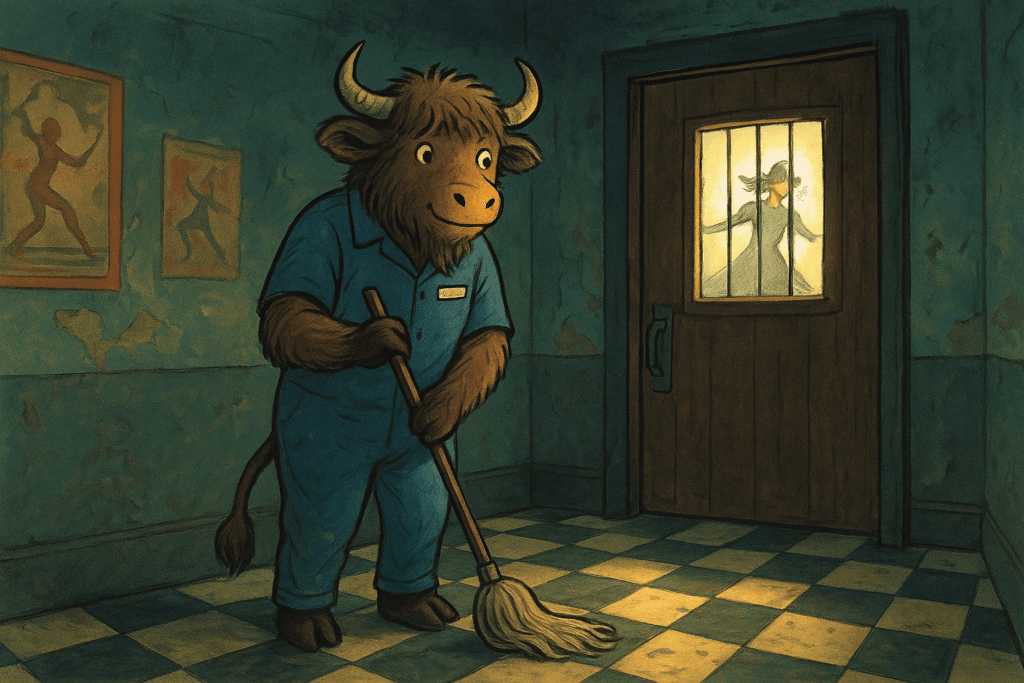
Takeda the long hallway of the every morning.
He was the , a man with eyes.
But Takeda had a . He was not just a janitor.
He had once been a , and later, a .
Now he worked here to be close to someone he .
"Mop the floor more !" a nurse shouted.
Takeda . "Yes, nurse. I'm sorry."
He pushed his mop and bucket past a wooden door.
Inside that room, his wife, Yoshiko, alone.
She in circles, her gray hospital gown flying like a .
Sometimes she laughed. Sometimes she old songs.
Takeda stopped to her through the small window.
"Yoshiko," he . "Do you remember our ?"
But she could not him.
Later that day, a young woman came to .
It was Atsuko, their .
"Father," she said, "the is in two weeks."
Takeda's hands . "I am so proud of you."
"Will Mother be able to come?" Atsuko asked .
He looked at the floor. "I will talk to the ."
The head doctor had a white and kind eyes.
"Sir," Takeda began, "my daughter is getting married. Can my wife ?"
The doctor thought for a . "A short ? Maybe. But you must watch her."
Takeda's heart . "Thank you, doctor!"
The next day, Takeda dressed Yoshiko in a pretty .
He held her hand and her outside.
"Look, Yoshiko! !" he said.
Yoshiko at the pink petals. For a second, her eyes were clear.
"So ," she said. Then she smiled.
Takeda almost cried. "Yes! Do you remember? We walked under these trees long ."
But then a dog , and Yoshiko became afraid.
She and covered her ears.
"No more! No more!" she cried.
Takeda held her . "It's okay. Let's go back."
That night, Takeda had a .
In the dream, the asylum became a circus .
All the patients were happy .
Yoshiko danced on a , and Atsuko threw flowers.
Takeda with a strange feeling.
The next week, the wedding day .
Takeda put on his best suit. He Yoshiko one more time.
"Today our little girl gets married," he said through the door.
Yoshiko did not answer. She was on a piece of paper.
It was a picture of a circus .
Takeda smiled. "I will tomorrow."
He went to the wedding .
Atsuko looked like a . The sun was warm.
And in his heart, Takeda felt a quiet .
Maybe one day, Yoshiko would dance again under the open sky.
The story takes place in an asylum, a hospital for people with mental illness. Takeda works there as a janitor, cleaning the long hallway. Later, he dresses his wife in a kimono and shows her the cherry blossoms. Let's learn these useful words.
- asylum — a hospital for people with mental illness
- janitor — a person whose job is to clean a building
- hallway — a long passage inside a building with doors along it
- kimono — a traditional Japanese robe
- cherry blossoms — small pink flowers on cherry trees
- tightrope — a tightly stretched rope that performers walk on
Notice how the nurse gives a direct command: 'Mop the floor more softly!' This imperative form sounds strong and bossy. Takeda answers politely with 'I'm sorry,' showing respect even to someone rude.
In English, we can make commands softer. 'Please mop the floor more softly' sounds more polite. Adding 'could you' or 'would you' makes it even gentler: 'Could you mop the floor more softly, please?'
- Direct command: 'Mop the floor more softly!' (strong, bossy)
- Polite request: 'Please mop the floor more softly.'
- Gentler request: 'Could you mop the floor more softly, please?'
- Tip: 'more softly' compares actions — the adverb gets 'more' because it is long.
Takeda takes a lowly job just to be near his wife, who does not remember him. He never stops caring for her, even when she cannot respond. The story shows a quiet, patient kind of love.
Hope runs through the whole story. When Yoshiko smiles at the cherry blossoms, Takeda feels joy. At the wedding, he feels 'a quiet hope' that she might one day dance under the open sky again. Hope here is small but strong — it survives sadness.
- Takeda sacrifices his own dreams to stay close to Yoshiko.
- Small moments — a smile, a drawing — can carry great meaning.
- The dream of the circus shows how Takeda remembers happier times.
- Discussion: What does the drawing of the circus tent tell us about Yoshiko?
Takeda keeps hoping even when things are difficult. Now it's your turn. Write three or four sentences about a hope you have for a family member or friend. Use 'I hope...' and try to include two new vocabulary words from this lesson.
- Example: 'I hope my grandmother gets well soon. She loves cherry blossoms, so we will walk in the park together.'
- Read your sentences aloud to practice pronunciation.
- Share your writing with a friend or teacher and ask: 'What is your quiet hope?'
A Page of Madness comes from the Japanese / Japanese silent film tradition and is best known as a silent psychological film. This Yak Yacker article is an original learner retelling based on 1926 film; pre-1931 publication-date basis in U.S., so the wording here is simplified for modern learners rather than copied from one old edition.
Older printings, translations, and retellings of this story can vary quite a bit. The original audience was usually adult, but this version is adapted for B1 Intermediate learners studying English. Very adult/experimental; use only for advanced B1 weird-fiction readers.
If you want to look into the source tradition, start with Wikipedia.
If you want to keep going, browse more in our English section and review the B1 English Vocabulary List. After that, try Best Graded Readers for English for another useful next step.