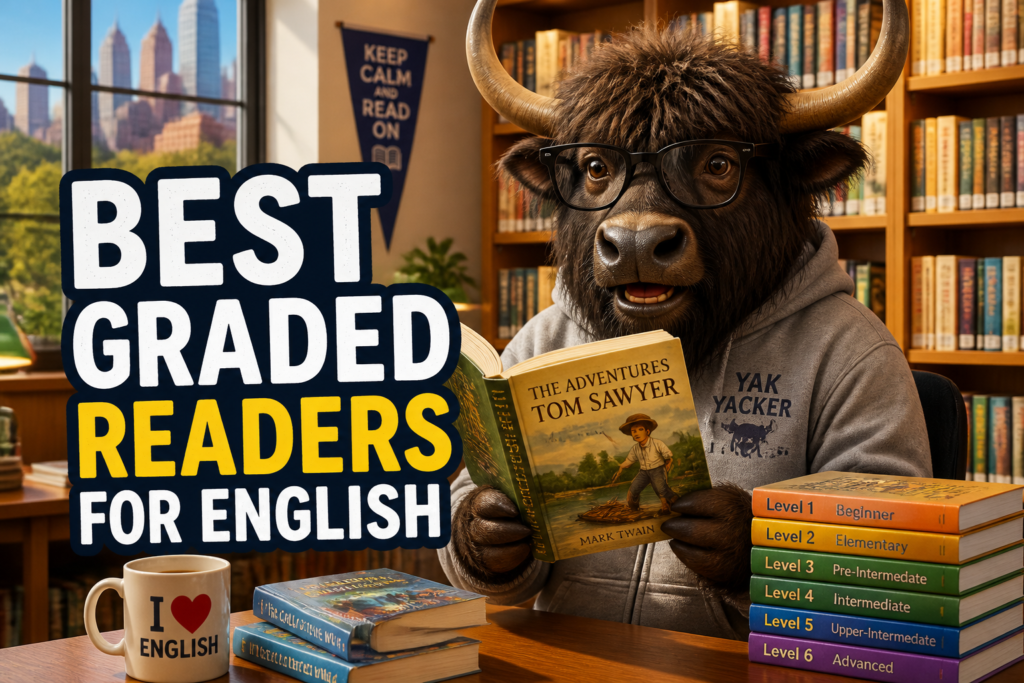
Best Graded Readers for English are the books that make reading feel possible instead of terrifying. Nice little miracle, really.
If you have ever opened a “real” English novel and met a wall of strange words, fast dialogue, and mysterious slang, you already understand the problem. Graded readers solve it by giving you stories and information in English that match your level. You get the fun part of reading without the constant stop-and-google routine.
In simple terms, a graded reader is a book written for English learners. The language is controlled, the vocabulary is easier, and the grammar is chosen carefully. That means you can read more, understand more, and actually finish books instead of staring at page three like it personally insulted you.
One good way to choose your level is to compare it with a placement test. If you want a quick check, try the English Placement Test CEFR. If you want to measure vocabulary growth after reading for a while, the English Vocabulary Test is a helpful follow-up.
For general reading advice and learner-friendly guidance, the British Council’s reading resources are also worth a look. Boring? Yes. Useful? Also yes.
What Graded Readers Are
A graded reader is a book adapted for language learners. It uses a limited range of vocabulary and grammar so the text feels easier to read.
These books are not just “baby books.” They are learning tools. The best graded readers still feel like real stories, real articles, or real nonfiction. The language is simpler, but the reading experience can still be interesting.
- Level-controlled language: the book matches a learner level such as A1, A2, B1, or B2.
- Glossaries: some books explain difficult words on the page or at the back.
- Good pacing: stories move forward without drowning you in unfamiliar words.
- Useful repetition: important vocabulary appears more than once, which helps memory.
The main goal is simple: read more English with less pain. Educational. Mildly comforting. Occasionally thrilling.
Why Graded Readers Work So Well
Graded readers help English learners in a few practical ways.
- They build confidence. You can finish a book and think, “Hey, I understood that.”
- They grow vocabulary naturally. You learn words in context, not as random flashcards from the void.
- They improve grammar awareness. You see useful patterns again and again.
- They train reading speed. You stop translating every sentence in your head.
- They make reading a habit. Shorter, easier books are easier to keep reading every day.
Good graded readers do not make English “fake.” They make English usable.
How To Choose The Best Graded Reader
The “best” graded reader depends on your level, your interests, and how much support you want. A book can be famous and still be the wrong choice if it is too hard, too boring, or both.
| What To Check | Why It Matters | Good Sign |
|---|---|---|
| Level | If the book is too hard, reading becomes exhausting. | You understand most of the page without stopping every line. |
| Topic | Interest keeps you reading. | You actually want to know what happens next. |
| Vocabulary Support | Glossaries and notes help you learn faster. | Difficult words are explained clearly. |
| Length | Shorter books are easier for beginners. | You can finish the book in a reasonable time. |
| Audio | Listening plus reading improves pronunciation and comprehension. | There is a matching audiobook or audio track. |
If you are not sure about your level, start one step below your current level. That sounds humble, but it is smart. Reading should stretch you a little, not drag you into a swamp.
Best Graded Readers For English Learners
Below are practical types of graded readers and the kinds of books that usually work best at different stages. “Best” here means useful, readable, and easy to keep going with.
| Reader Type | Best For | Why It Helps | Example Use |
|---|---|---|---|
| Short fiction graded readers | Beginners and lower intermediate learners | Simple stories make it easier to guess meaning from context. | A mystery, romance, or adventure book at A1–B1 level |
| Classic retellings | Learners who like famous stories | You may already know the plot, so language is easier to follow. | Adapted versions of Robinson Crusoe or Treasure Island |
| Nonfiction graded readers | Students who prefer facts over fiction | Clear structure and real information help reading practice. | Travel, science, history, or culture topics |
| Teen and young adult graded readers | Intermediate learners | Modern themes and natural dialogue keep the language useful. | School life, friendships, sports, or family stories |
| News and article readers | Upper beginner to advanced learners | They teach practical reading for everyday English and current events. | Short news reports with controlled language |
For many learners, fiction is the easiest place to start because story context does a lot of the heavy lifting. Nonfiction can be excellent too, especially if you like facts, but it often has denser vocabulary.
Useful Words And Phrases For Reading Choices
Here are common words and phrases you will see when choosing graded readers or talking about them. These are useful in bookstores, libraries, and online reading lists.
| English | Pronunciation | Meaning | Example Sentence | Learner Note |
|---|---|---|---|---|
| graded reader | GRAY-did REE-der | A book written for language learners at a specific level | I finished my first graded reader last week. | Very common term in English learning. |
| reading level | REE-ding LEV-uhl | The difficulty level of a text | This book is a good reading level for me. | Useful for books, articles, and tests. |
| beginner-friendly | bih-GIN-er FREND-lee | Easy for new learners to use | That website has beginner-friendly stories. | Common and natural. |
| comprehension | kom-pri-HEN-shun | Understanding what you read or hear | Reading helps improve comprehension. | Formal but common in education. |
| vocabulary support | voh-KAB-yuh-lair-ee suh-PORT | Help with word meanings | Look for books with vocabulary support. | Useful phrase in learner materials. |
| plain language | PLAYN LANG-gwij | Simple, clear language without extra complexity | The article uses plain language. | Often used in education and government writing. |
| adapted text | uh-DAP-tid tekst | A text changed to be easier or shorter | This is an adapted text of a classic novel. | Very common in graded reading. |
| audio track | AW-dee-oh trak | A recording you can listen to | The book has an audio track online. | Great for pronunciation practice. |
| glossary | GLAHS-uh-ree | A list of difficult words with explanations | The glossary helped me understand the story. | Check the back of the book. |
| supportive notes | suh-PORT-iv nohts | Extra explanations that help the reader | Supportive notes make the book easier to use. | Useful learner note in many series. |
Helpful Phrases You Will See In Book Descriptions
Book blurbs and online descriptions love certain phrases. Learning them helps you spot the right book faster.
| Phrase | Pronunciation | Meaning | Example Sentence | Learner Note |
|---|---|---|---|---|
| at your level | at yoor LEV-uhl | Suitable for your current English ability | This series is at my level. | Very common in learner publishing. |
| controlled vocabulary | kuhn-TROLD voh-KAB-yuh-lair-ee | A limited set of words chosen for learners | The book uses controlled vocabulary. | Formal but useful. |
| easy-to-read | EE-zee too REED | Simple and not difficult to read | It is an easy-to-read story. | Works for books, signs, and websites. |
| high-interest | HY in-TRUST | Interesting enough to keep attention | I want a high-interest book, not a boring one. | Common in education. |
| lower-level | LOH-er lev-uhl | At a beginner or early stage | I started with a lower-level reader. | Good phrase for choosing material. |
| intermediate learner | in-ter-MEE-dee-it LER-ner | A student between beginner and advanced | This series is great for intermediate learners. | Often used in course descriptions. |
| authentic text | aw-THEN-tik tekst | Real English written for native speakers | Later, I want to read authentic text. | Usually harder than graded readers. |
| step up | step up | Move to a slightly harder level | This book is a good step up from the last one. | Very useful phrase in learning materials. |
| book series | book SEER-eez | Several books connected by style or topic | I like this book series because it is consistent. | Series are great for habit-building. |
| for self-study | for self-STUH-dee | Designed for learning alone | This reader is good for self-study. | Common in course and book descriptions. |
American And British English Notes
Most graded readers are sold internationally, so you may see both American and British English. Neither is “better,” but it helps to know the difference.
| American English | British English | Note |
|---|---|---|
| program | programme | British spelling often adds an extra “me” in some words. |
| favorite | favourite | British spelling often adds a “u.” |
| apartment | flat | Common housing word difference. |
| truck | lorry | Different word for the same vehicle. |
| cookie | biscuit | Different snack word; context matters. |
If a graded reader says it uses “British English,” that usually means spellings, vocabulary, and some expressions follow British usage. The same is true for American English. Reading both is a great way to notice real language differences without turning the whole thing into a grammar quiz nobody asked for.
Best Graded Readers By Level
Here is a practical guide to the kinds of graded readers that usually work best at each stage.
| Level | Best Type Of Reader | What To Look For | Example Goal |
|---|---|---|---|
| A1 | Very short stories, picture-supported readers, simple dialogues | Very clear vocabulary and short sentences | Read a whole book without frustration |
| A2 | Short fiction, everyday-life topics, classic retellings | Some repetition and familiar themes | Understand the main story without heavy translation |
| B1 | Longer stories, nonfiction introductions, teens’ readers | More detail but still controlled language | Read with only occasional dictionary use |
| B2 | Upper-level readers, news-style texts, stronger adaptations | Natural language with fewer supports | Build speed before moving to authentic texts |
As a general rule, choose books where you already understand about 80 to 95 percent of the words. If every page feels like a vocabulary wrestling match, the book is too hard right now.
Top Features Of The Best Graded Readers
- Clear level labels so you can pick the right difficulty quickly.
- Interesting topics such as mystery, travel, sports, history, or daily life.
- Strong story structure with a beginning, middle, and end that keeps moving.
- Useful repetition so key words appear often enough to stick in your memory.
- Short chapters that make the book feel manageable.
- Glossaries or notes for unfamiliar words.
- Audio support for listening practice and pronunciation.
- Clean layout with readable fonts and not too much clutter.
Those details may sound small, but they matter. A readable page is not a luxury. It is the difference between “I can do this” and “I need a nap after page two.”
Common Phrases For Talking About Reading Progress
If you are discussing graded readers with teachers, classmates, or other learners, these phrases will come up a lot.
| Phrase | Pronunciation | Meaning | Example Sentence | Learner Note |
|---|---|---|---|---|
| I finished it. | eye FIN-isht it | You completed the book | I finished it in two days. | Simple and useful. |
| I got the main idea. | eye got thuh MAYN eye-DEE-uh | You understood the general meaning | I did not know every word, but I got the main idea. | Very natural in English learning. |
| I looked up a few words. | eye lookt up uh few wurdz | You checked some word meanings | I looked up a few words, but not many. | “Look up” is a useful phrasal verb. |
| It was a bit too hard. | it wuz uh bit too hard | The text had too much difficulty | That book was a bit too hard for me. | Polite and honest. |
| It was easy to follow. | it wuz EE-zee too FAH-loh | The text was clear and understandable | The story was easy to follow. | Great phrase for reviews. |
| It helped me build confidence. | it helpt mee bild KON-fi-dens | It made you feel more sure of your English | Graded readers helped me build confidence. | Very common learner phrase. |
| I want something more challenging. | eye want SUM-thing mor CHAL-in-jing | You want a harder book | My next reader should be more challenging. | Good for moving up levels. |
| I prefer stories over nonfiction. | eye prih-FUR STAWR-eez oh-ver non-FIK-shun | You like fiction more than factual writing | I prefer stories over nonfiction. | “Over” is natural in this comparison. |
Common Mistakes Learners Make
| Common Mistake | Better Choice | Why |
|---|---|---|
| Choosing a book that is far above your level | Start with an easier level first | You learn faster when you can actually follow the text. |
| Stopping at every unknown word | Try to understand the overall meaning first | Too much dictionary use slows reading and breaks the story. |
| Picking a boring topic because it “looks serious” | Choose a topic you care about | Interest matters more than sounding academic. |
| Reading only one book and then quitting | Read a series or several books at the same level | Repetition builds speed and confidence. |
| Ignoring audio support | Use the audio when possible | Listening helps pronunciation and rhythm. |
| Jumping too quickly to authentic texts | Move up gradually | Stepping up slowly gives you a stronger base. |
One of the biggest learner traps is pride. A book should help you learn, not prove how tough you are. English does not hand out medals for suffering through the wrong level.
How To Use Graded Readers For Real Progress
Reading a graded reader becomes much more useful when you use it actively. Passive reading is fine. Active reading is better.
- Before reading: look at the title, chapter headings, and pictures. Predict the story.
- During reading: underline or note repeated words, not every unknown word.
- After reading: summarize the story in two or three sentences.
- With audio: listen once while reading, then listen again without the text.
- With a notebook: record 5 to 10 useful phrases, not a giant word graveyard.
A small routine works better than an ambitious fantasy routine. Ten minutes a day is better than one heroic weekend followed by three months of nothing.
Quick Vocabulary For Reading And Learning
| English | Pronunciation | Meaning | Example Sentence | Learner Note |
|---|---|---|---|---|
| storyline | STAWR-ee-line | The main plot of a story | The storyline is easy to follow. | Useful for fiction reviews. |
| plot | plot | What happens in a story | The plot gets more interesting near the end. | Very common word. |
| chapter | CHAP-ter | A main section of a book | I read one chapter before bed. | Great for setting reading goals. |
| summary | SUM-uh-ree | A short version of the main points | Can you give me a short summary? | Important for speaking and writing too. |
| context | KON-tekst | The words or situation around something | I guessed the meaning from context. | Key reading skill. |
| meaning | MEE-ning | The idea or message of a word or text | I checked the meaning of the word. | Very basic but essential. |
| progress | PROH-gres | Improvement over time | I can see real progress in my reading. | Notice the stress: PRO-gres. |
| confidence | KON-fi-dens | A feeling that you can do something well | Reading gave me more confidence. | Very useful in learning English. |
Mini Practice: Choose The Better Option
Pick the best choice for each sentence.
- I want a book that is at my level / at my speed.
- This story is easy to follow / chase.
- I understood the main idea / main recipe.
- The book has vocabulary support / vocabulary noise.
- I looked up / down a few words in the glossary.
Answers: at my level, follow, main idea, vocabulary support, up.
Mini Practice: Rewrite The Sentence
Make each sentence a little more natural.
- “I read a book. It was easy.” → I read an easy-to-read book.
- “I understood most of the story.” → I got the main idea of the story.
- “I did not know many words.” → I only looked up a few words.
- “This book is for learners.” → This is a learner-friendly book.
Where Graded Readers Fit In Your English Journey
Graded readers work best when they are part of a wider routine. Reading is powerful, but it becomes even better when you combine it with listening, speaking, vocabulary review, and regular level checks.
If you want to keep building your English, you can move from graded readers to shorter authentic texts, then to articles, essays, and full novels. That path is much easier than jumping straight into “real English” and hoping for the best. Hope is not a reading strategy.
For more learner tools and English practice, visit the Learn English hub and keep exploring at a level that feels challenging but doable.
Yak takeaway: the best graded reader is the one you can enjoy, finish, and learn from — because a book you actually read is worth more than a perfect book you never open.