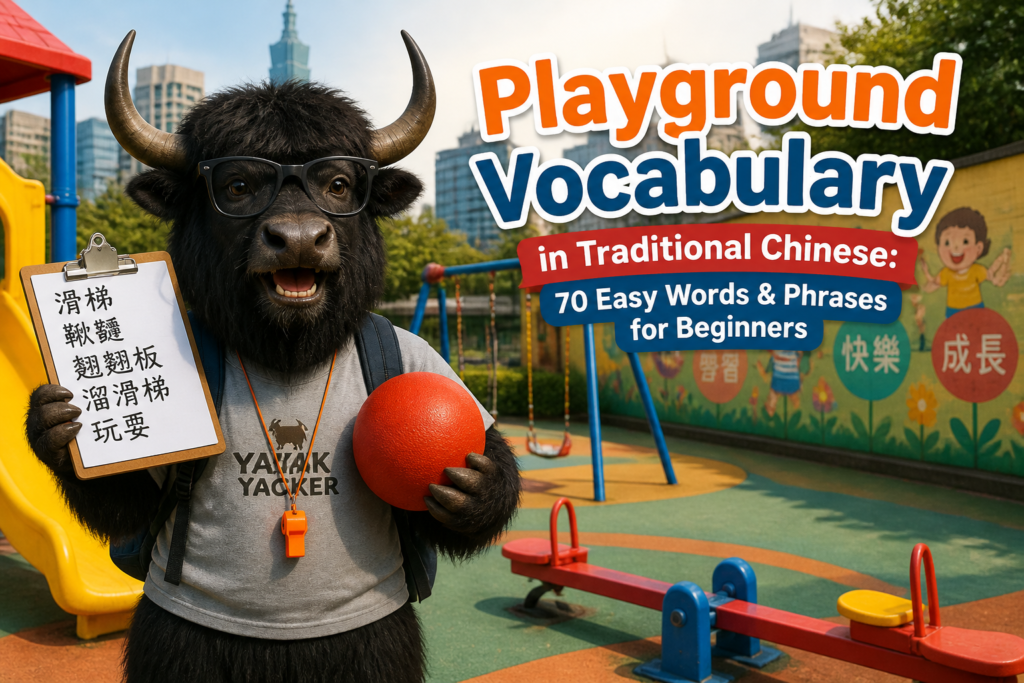
遊樂場詞彙 yóulèchǎng cíhuì — playground vocabulary in Traditional Chinese
For the broader learning path, visit our parent guide.
If you have ever stood near a playground and heard a kid shout something like 我先! wǒ xiān! (“Me first!”), congratulations: you have already met real-life Mandarin. Not fancy textbook Mandarin. The useful kind.
This guide gives you beginner-friendly playground words and phrases in Traditional Chinese, with pinyin and English meanings. The examples use everyday Taiwan-style Mandarin, because children, parents, and teachers in Taiwan do not usually sound like a grammar textbook that fell off a shelf.
By the end, you will know how to talk about swings, slides, climbing, sharing, waiting your turn, and the little playground dramas that somehow always happen near the monkey bars.
小孩的世界很大,語言也很有用。 Xiǎohái de shìjiè hěn dà, yǔyán yě hěn yǒuyòng. Kids’ worlds are big, and their language is useful too.
Useful Playground Words
| Traditional Chinese | Pinyin | Meaning | Example (ZH) | Example (Pinyin) | Translation (EN) |
|---|---|---|---|---|---|
| 遊樂場 | yóulèchǎng | playground | 我們去遊樂場玩。 | Wǒmen qù yóulèchǎng wán. | We go to the playground to play. |
| 公園 | gōngyuán | park | 這個公園有遊樂場。 | Zhège gōngyuán yǒu yóulèchǎng. | This park has a playground. |
| 鞦韆 | qiūqiān | swing | 我想玩鞦韆。 | Wǒ xiǎng wán qiūqiān. | I want to play on the swing. |
| 溜滑梯 | liūhuátī | slide | 小朋友在溜滑梯上排隊。 | Xiǎopéngyǒu zài liūhuátī shàng páiduì. | The children are lining up for the slide. |
| 翹翹板 | qiàoqiàobǎn | seesaw | 兩個人一起玩翹翹板。 | Liǎng gè rén yìqǐ wán qiàoqiàobǎn. | Two people play on the seesaw together. |
| 沙坑 | shākēng | sandpit | 他在沙坑裡堆城堡。 | Tā zài shākēng lǐ duī chéngbǎo. | He builds a castle in the sandpit. |
| 盪鞦韆 | dàng qiūqiān | to swing | 妹妹很會盪鞦韆。 | Mèimei hěn huì dàng qiūqiān. | My younger sister is really good at swinging. |
| 爬 | pá | to climb/crawl | 他想爬上去。 | Tā xiǎng pá shàngqù. | He wants to climb up. |
| 滑 | huá | to slide | 請慢慢滑下來。 | Qǐng mànmàn huá xiàlái. | Please slide down slowly. |
| 跑 | pǎo | to run | 不要在這裡跑。 | Búyào zài zhèlǐ pǎo. | Do not run here. |
| 跳 | tiào | to jump | 你可以跳過來。 | Nǐ kěyǐ tiào guòlái. | You can jump over here. |
| 排隊 | páiduì | to line up | 大家都在排隊。 | Dàjiā dōu zài páiduì. | Everyone is lining up. |
| 等一下 | děng yíxià | wait a moment | 等一下,我還沒準備好。 | Děng yíxià, wǒ hái méi zhǔnbèi hǎo. | Wait a moment, I am not ready yet. |
| 輪流 | lúnliú | take turns | 我們輪流玩。 | Wǒmen lúnliú wán. | We take turns playing. |
| 先 | xiān | first | 你先玩吧。 | Nǐ xiān wán ba. | You play first. |
More Everyday Playground Words
| Traditional Chinese | Pinyin | Meaning | Example (ZH) | Example (Pinyin) | Translation (EN) |
|---|---|---|---|---|---|
| 滑梯 | huátī | slide; ladder/slide structure | 滑梯很高。 | Huátī hěn gāo. | The slide is very tall. |
| 攀爬架 | pānpájià | climbing frame | 孩子們在攀爬架上玩。 | Háizimen zài pānpájià shàng wán. | The kids are playing on the climbing frame. |
| 單槓 | dāngàng | horizontal bar | 他會吊單槓。 | Tā huì diào dāngàng. | He can hang from the bar. |
| 吊 | diào | to hang | 不要一直吊在上面。 | Búyào yìzhí diào zài shàngmiàn. | Do not keep hanging there. |
| 平衡木 | pínghéngmù | balance beam | 我不敢走平衡木。 | Wǒ bù gǎn zǒu pínghéngmù. | I am not brave enough to walk on the balance beam. |
| 秋千架 | qiūqiānjià | swing set | 秋千架上有兩個鞦韆。 | Qiūqiānjià shàng yǒu liǎng ge qiūqiān. | There are two swings on the swing set. |
| 木馬 | mùmǎ | rocking horse | 小小孩喜歡玩木馬。 | Xiǎo xiǎohái xǐhuān wán mùmǎ. | Little children like rocking horses. |
| 沙子 | shāzi | sand | 沙子進到鞋子裡了。 | Shāzi jìn dào xiézi lǐ le. | Sand got into my shoes. |
| 城堡 | chéngbǎo | castle | 我們在沙坑做城堡。 | Wǒmen zài shākēng zuò chéngbǎo. | We make a castle in the sandpit. |
| 球 | qiú | ball | 這裡可以打球嗎? | Zhèlǐ kěyǐ dǎ qiú ma? | Can we play ball here? |
| 風箏 | fēngzhēng | kite | 今天很適合放風箏。 | Jīntiān hěn shìhé fàng fēngzhēng. | Today is great for flying a kite. |
| 盪 | dàng | to swing; to sway | 風把樹葉盪來盪去。 | Fēng bǎ shùyè dàng lái dàng qù. | The wind sways the leaves back and forth. |
| 爬上去 | pá shàngqù | climb up | 你慢慢爬上去。 | Nǐ mànmàn pá shàngqù. | Climb up slowly. |
| 滑下來 | huá xiàlái | slide down | 小朋友一個一個滑下來。 | Xiǎopéngyǒu yí ge yí ge huá xiàlái. | The children slide down one by one. |
| 爬高高 | pá gāogāo | climb high | 不要爬高高,小心喔。 | Búyào pá gāogāo, xiǎoxīn ou. | Do not climb too high, be careful. |
Friendly Playground Phrases
| Traditional Chinese | Pinyin | Meaning | Example (ZH) | Example (Pinyin) | Translation (EN) |
|---|---|---|---|---|---|
| 我可以玩嗎? | Wǒ kěyǐ wán ma? | Can I play? | 我可以玩嗎? | Wǒ kěyǐ wán ma? | Can I play? |
| 輪到我了嗎? | Lún dào wǒ le ma? | Is it my turn? | 輪到我了嗎? | Lún dào wǒ le ma? | Is it my turn? |
| 換你了。 | Huàn nǐ le. | Your turn. | 我玩好了,換你了。 | Wǒ wán hǎo le, huàn nǐ le. | I’m done playing; it’s your turn. |
| 你先。 | Nǐ xiān. | You first. | 你先玩鞦韆。 | Nǐ xiān wán qiūqiān. | You play on the swing first. |
| 一起玩。 | Yìqǐ wán. | Play together. | 我們一起玩吧。 | Wǒmen yìqǐ wán ba. | Let’s play together. |
| 小心一點。 | Xiǎoxīn yìdiǎn. | Be a little careful. | 小心一點,地上很滑。 | Xiǎoxīn yìdiǎn, dìshàng hěn huá. | Be careful, the ground is slippery. |
| 不要推。 | Búyào tuī. | Do not push. | 不要推別人。 | Búyào tuī biérén. | Do not push others. |
| 不要搶。 | Búyào qiǎng. | Do not grab/snatch. | 不要搶,大家輪流。 | Búyào qiǎng, dàjiā lúnliú. | Do not grab; everyone takes turns. |
| 請排隊。 | Qǐng páiduì. | Please line up. | 請排隊等溜滑梯。 | Qǐng páiduì děng liūhuátī. | Please line up to wait for the slide. |
| 我還要再玩一次。 | Wǒ hái yào zài wán yí cì. | I want to play one more time. | 我還要再玩一次鞦韆。 | Wǒ hái yào zài wán yí cì qiūqiān. | I want to play on the swing one more time. |
| 好好玩。 | Hǎohǎo wán. | Super fun | 這個遊樂場很好玩。 | Zhège yóulèchǎng hěn hǎowán. | This playground is super fun. |
| 太高了。 | Tài gāo le. | Too high. | 這個滑梯太高了。 | Zhège huátī tài gāo le. | This slide is too high. |
| 我怕高。 | Wǒ pà gāo. | I am afraid of heights. | 我怕高,所以不敢爬。 | Wǒ pà gāo, suǒyǐ bù gǎn pá. | I am afraid of heights, so I do not dare to climb. |
| 不要用太大力。 | Búyào yòng tài dà lì. | Do not use too much force. | 推鞦韆不要用太大力。 | Tuī qiūqiān búyào yòng tài dà lì. | Do not push the swing too hard. |
| 我們回家吧。 | Wǒmen huíjiā ba. | Let’s go home. | 天黑了,我們回家吧。 | Tiān hēi le, wǒmen huíjiā ba. | It is getting dark; let’s go home. |
Playground Mini Conversations
| Traditional Chinese | Pinyin | English Meaning |
|---|---|---|
| 我可以玩鞦韆嗎? 我可以玩鞦韆嗎? | Wǒ kěyǐ wán qiūqiān ma? | Can I use the swing? |
| 可以,輪到你了。 可以,輪到你了。 | Kěyǐ, lún dào nǐ le. | Yes, it is your turn. |
| 你先玩吧。 你先玩吧。 | Nǐ xiān wán ba. | You play first. |
| 謝謝! 謝謝! | Xièxie! | Thanks! |
| 我們一起玩吧。 我們一起玩吧。 | Wǒmen yìqǐ wán ba. | Let’s play together. |
| 好啊! 好啊! | Hǎo a! | Sure! |
Tiny Grammar Notes That Actually Help
Playground talk is a great place to learn small, useful Mandarin patterns. The language is short, direct, and often a little bossy. That is not rude here. It is just how people keep kids safe.
| Pattern | Meaning | Example (ZH) | Pinyin | English |
|---|---|---|---|---|
| 可以 + verb + 嗎? | Can I…? | 我可以玩嗎? | Wǒ kěyǐ wán ma? | Can I play? |
| 先 + verb | do something first | 你先玩。 | Nǐ xiān wán. | You play first. |
| 輪到 + person + 了 | it is someone’s turn | 輪到我了。 | Lún dào wǒ le. | It is my turn. |
| 不要 + verb | Do not… | 不要推。 | Búyào tuī. | Do not push. |
| 一起 + verb | do together | 我們一起玩。 | Wǒmen yìqǐ wán. | We play together. |
One very common little word is 了 le. In 輪到我了 lún dào wǒ le, it shows a change: it is now my turn. Mandarin likes these tiny status updates. Efficient, a bit dramatic, and very useful.
Also, 吧 ba often softens a sentence. 你先玩吧 Nǐ xiān wán ba sounds friendlier than a cold command. Same meaning, less playground dictator energy.
Useful Safety And Courtesy Phrases
| Traditional Chinese | Pinyin | Meaning | Example (ZH) | Example (Pinyin) | Translation (EN) |
|---|---|---|---|---|---|
| 小心! | Xiǎoxīn! | Careful! | 小心!前面有水。 | Xiǎoxīn! Qiánmiàn yǒu shuǐ. | Careful! There is water ahead. |
| 慢一點。 | Màn yìdiǎn. | Slower. | 慢一點,別跌倒。 | Màn yìdiǎn, bié diēdǎo. | Slower, don’t fall. |
| 別哭。 | Bié kū. | Don’t cry. | 別哭,我幫你。 | Bié kū, wǒ bāng nǐ. | Don’t cry, I’ll help you. |
| 沒事吧? | Méi shì ba? | Are you okay? | 你沒事吧? | Nǐ méi shì ba? | Are you okay? |
| 對不起。 | Duìbùqǐ. | Sorry | 對不起,我不是故意的。 | Duìbùqǐ, wǒ bú shì gùyì de. | Sorry, I did not mean to. |
| 謝謝你。 | Xièxie nǐ. | Thank you | 謝謝你讓我先玩。 | Xièxie nǐ ràng wǒ xiān wán. | Thank you for letting me play first. |
| 請問… | Qǐngwèn… | Excuse me / May I ask… | 請問鞦韆在哪裡? | Qǐngwèn qiūqiān zài nǎlǐ? | Excuse me, where is the swing? |
| 可以借我嗎? | Kěyǐ jiè wǒ ma? | Can I borrow/use it? | 可以借我球嗎? | Kěyǐ jiè wǒ qiú ma? | Can I use the ball? |
在台灣,先學會「排隊」和「輪流」,很多場合都更順。 Zài Táiwān, xiān xuéhuì “páiduì” hé “lúnliú”, hěn duō chǎnghé dōu gèng shùn. In Taiwan, learning “line up” and “take turns” makes many situations smoother.
Common Playground Actions
| Traditional Chinese | Pinyin | Meaning | Example (ZH) | Example (Pinyin) | Translation (EN) |
|---|---|---|---|---|---|
| 推 | tuī | push | 不要推我。 | Búyào tuī wǒ. | Do not push me. |
| 拉 | lā | pull | 請拉住繩子。 | Qǐng lā zhù shéngzi. | Please hold the rope. |
| 抱 | bào | hug; hold | 媽媽抱著小孩。 | Māma bàozhe xiǎohái. | Mom is holding the child. |
| 坐 | zuò | sit | 請坐好。 | Qǐng zuò hǎo. | Please sit properly. |
| 站 | zhàn | stand | 不要站在椅子上。 | Búyào zhàn zài yǐzi shàng. | Do not stand on the chair. |
| 蹲 | dūn | squat | 他蹲在地上看螞蟻。 | Tā dūn zài dìshàng kàn mǎyǐ. | He squats on the ground to watch ants. |
| 爬下來 | pá xiàlái | climb down | 請慢慢爬下來。 | Qǐng mànmàn pá xiàlái. | Please climb down slowly. |
| 跳下來 | tiào xiàlái | jump down | 不要直接跳下來。 | Búyào zhíjiē tiào xiàlái. | Do not jump down directly. |
| 玩 | wán | play | 我們去玩吧。 | Wǒmen qù wán ba. | Let’s go play. |
| 放風箏 | fàng fēngzhēng | fly a kite | 週末去河堤放風箏。 | Zhōumò qù hédī fàng fēngzhēng. | Go fly a kite at the riverside on the weekend. |
Curious Bit: Taiwan Playground Usage
In Taiwan, you will often hear 遊樂場 yóulèchǎng for playground, but also 公園 gōngyuán when people mean the park area with playground equipment. If you want to check a more formal definition, the boring-but-helpful Wikipedia entry on 遊樂場 is a decent start, and yes, it is much less exciting than an actual playground.
Also, some kids’ playgrounds in Taiwan are inside parks, schools, or community spaces. So the exact place matters less than the equipment and the line of children waiting very patiently until they absolutely do not.
Word Families And Related Vocabulary
| Traditional Chinese | Pinyin | Meaning | Example (ZH) | Example (Pinyin) | Translation (EN) |
|---|---|---|---|---|---|
| 兒童 | értóng | children | 這裡是兒童遊樂場。 | Zhèlǐ shì értóng yóulèchǎng. | This is a children’s playground. |
| 家長 | jiāzhǎng | parent/guardian | 家長在旁邊看著。 | Jiāzhǎng zài pángbiān kànzhe. | The parent is watching from the side. |
| 老師 | lǎoshī | teacher | 老師叫大家排隊。 | Lǎoshī jiào dàjiā páiduì. | The teacher tells everyone to line up. |
| 同學 | tóngxué | classmate | 我和同學一起玩。 | Wǒ hé tóngxué yìqǐ wán. | I play with my classmates. |
| 安全 | ānquán | safety | 安全最重要。 | Ānquán zuì zhòngyào. | Safety is the most important. |
| 規則 | guīzé | rule | 這裡的規則很多。 | Zhèlǐ de guīzé hěn duō. | There are many rules here. |
| 時間 | shíjiān | time | 玩遊樂場的時間到了。 | Wán yóulèchǎng de shíjiān dào le. | It is time to play at the playground. |
| 休息 | xiūxí | rest | 先休息一下再玩。 | Xiān xiūxí yíxià zài wán. | Rest a little before playing again. |
If you want to compare playground talk with school break talk or sports talk, these related guides help a lot: recess vocab in Traditional Chinese, sports vocab in Traditional Chinese, and weather vocab in Traditional Chinese. Because weather and playgrounds are secretly best friends. No one wants a rainy slide day.
Practice: Swap The Word
| Pattern | Your Swap | Example | English |
|---|---|---|---|
| 我想玩 ___。 | 鞦韆 | 我想玩鞦韆。 | I want to play on the swing. |
| 請 ___。 | 排隊 | 請排隊。 | Please line up. |
| 不要 ___。 | 推 | 不要推。 | Do not push. |
| 我們一起 ___。 | 玩 | 我們一起玩。 | Let’s play together. |
| 輪到 ___ 了。 | 我 | 輪到我了。 | It is my turn. |
| 你先 ___。 | 玩 | 你先玩。 | You play first. |
Quick Reference Summary
- 遊樂場 yóulèchǎng = playground
- 鞦韆 qiūqiān = swing
- 溜滑梯 liūhuátī = slide
- 排隊 páiduì = line up
- 輪流 lúnliú = take turns
- 小心一點 xiǎoxīn yìdiǎn = be careful
- 不要推 búyào tuī = do not push
- 一起玩 yìqǐ wán = play together
- 輪到我了 lún dào wǒ le = it is my turn
- 你先玩吧 nǐ xiān wán ba = you play first
You do not need 70 different ways to say “swing” to survive a playground conversation. You just need the right few words, plus the magical power of 排隊 páiduì. That one does a lot of work.
For a next step, try the Traditional Chinese vocabulary test or the Traditional Chinese placement test TOCFL. Yak takeaway: playground Mandarin is short, useful, and very good at teaching you how to be polite before somebody steals the slide.