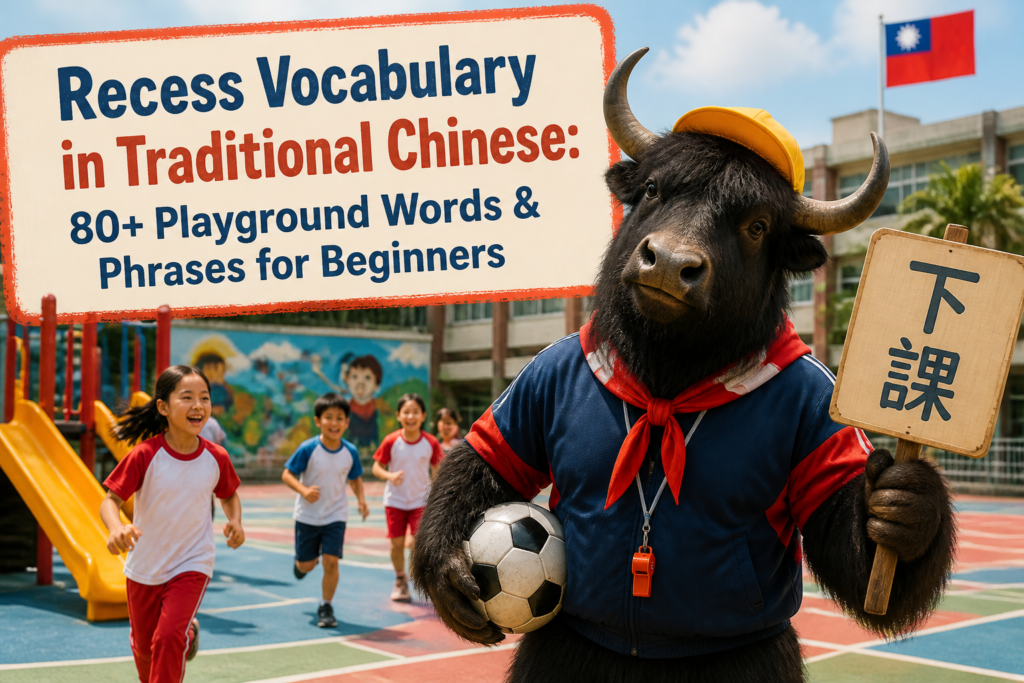
下課時間 xià kè shí jiān means “recess” or “break time,” and in Taiwan it can turn into a tiny chaos festival with basketballs, skipping ropes, snacks, and somebody yelling “等一下!” because no one wants to be the last one chosen for a game.
For the broader learning path, visit our parent guide.
This guide gives you everyday playground and recess vocabulary in Traditional Chinese, with pinyin and simple English meaning. It’s made for beginners, so you can actually use it instead of just admiring the words like they’re museum pieces.
By the end, you’ll know how to talk about recess activities, playground equipment, games, directions, and the little phrases kids really use. If you want a related practice path later, you can also check the Playground Vocabulary in Traditional Chinese guide, the Sports Vocabulary in Traditional Chinese guide, and the Traditional Chinese Basic Words and Phrases page.
For a boring but useful reference on Standard Mandarin pronunciation and word use, see the Mandarin Chinese overview, and for learner testing, the Traditional Chinese Placement Test / TOCFL and Traditional Chinese Vocabulary Test pages are handy too. Yes, language learning can be practical and slightly less painful than group sports.
小提醒 xiǎo tí xǐng: In Taiwan, 下課 xià kè means “class is over” or “break time,” not “get off class” in some mysterious robot way. Context does the heavy lifting here, as usual.
Core Recess Words
| Traditional Chinese | Pinyin | Meaning | Example (ZH) | Example (Pinyin) | Translation (EN) |
|---|---|---|---|---|---|
| 下課 | xià kè | class ends; recess; break time | 下課後我們去操場玩。 | Xià kè hòu wǒmen qù cāo chǎng wán. | After class, we go to the playground. |
| 休息時間 | xiū xí shí jiān | rest time; break time | 現在是休息時間。 | Xiànzài shì xiū xí shí jiān. | Now it is break time. |
| 操場 | cāo chǎng | playground; school field | 操場上有很多學生。 | Cāo chǎng shàng yǒu hěn duō xué shēng. | There are many students on the playground. |
| 遊樂場 | yóu lè chǎng | playground; amusement area | 我們去遊樂場玩滑梯。 | Wǒmen qù yóu lè chǎng wán huá tī. | We go to the playground to play on the slide. |
| 遊戲 | yóu xì | game; play | 這個遊戲很好玩。 | Zhè ge yóu xì hěn hǎo wán. | This game is very fun. |
| 玩 | wán | to play; to have fun | 你想玩什麼? | Nǐ xiǎng wán shén me? | What do you want to play? |
| 排隊 | pái duì | to line up | 大家要排隊。 | Dà jiā yào pái duì. | Everyone needs to line up. |
| 輪流 | lún liú | to take turns | 我們輪流玩鞦韆。 | Wǒmen lún liú wán qiū qiān. | We take turns on the swing. |
| 一起 | yì qǐ | together | 我們一起去玩吧。 | Wǒmen yì qǐ qù wán ba. | Let’s go play together. |
| 等一下 | děng yí xià | wait a moment | 等一下,我還沒準備好。 | Děng yí xià, wǒ hái méi zhǔn bèi hǎo. | Wait a moment, I’m not ready yet. |
| 好玩 | hǎo wán | fun | 這個遊戲很好玩。 | Zhè ge yóu xì hěn hǎo wán. | This game is very fun. |
| 無聊 | wú liáo | bored | 我覺得有點無聊。 | Wǒ jué de yǒu diǎn wú liáo. | I feel a little bored. |
| 朋友 | péng yǒu | friend | 我跟朋友一起玩。 | Wǒ gēn péng yǒu yì qǐ wán. | I play with my friend. |
| 同學 | tóng xué | classmate | 我的同學很會打球。 | Wǒ de tóng xué hěn huì dǎ qiú. | My classmate is really good at ball games. |
| 老師 | lǎo shī | teacher | 老師叫我們不要跑。 | Lǎo shī jiào wǒmen bú yào pǎo. | The teacher told us not to run. |
Playground Equipment
| Traditional Chinese | Pinyin | Meaning | Example (ZH) | Example (Pinyin) | Translation (EN) |
|---|---|---|---|---|---|
| 鞦韆 | qiū qiān | swing | 我想玩鞦韆。 | Wǒ xiǎng wán qiū qiān. | I want to play on the swing. |
| 溜滑梯 | liū huá tī | slide | 小朋友最愛溜滑梯。 | Xiǎo péng yǒu zuì ài liū huá tī. | Children love the slide most. |
| 翹翹板 | qiào qiào bǎn | seesaw | 我們一起玩翹翹板。 | Wǒmen yì qǐ wán qiào qiào bǎn. | We play on the seesaw together. |
| 單槓 | dān gàng | horizontal bar; pull-up bar | 他很喜歡玩單槓。 | Tā hěn xǐ huān wán dān gàng. | He really likes the horizontal bar. |
| 攀爬架 | pān pá jià | climbing frame | 孩子們在攀爬架上爬來爬去。 | Hái zi men zài pān pá jià shàng pá lái pá qù. | The kids climb around on the climbing frame. |
| 沙坑 | shā kēng | sandpit | 沙坑裡有一個桶子。 | Shā kēng lǐ yǒu yí ge tǒng zi. | There is a bucket in the sandpit. |
| 球場 | qiú chǎng | ball court; sports court | 球場上有人打球。 | Qiú chǎng shàng yǒu rén dǎ qiú. | Someone is playing ball on the court. |
| 籃球架 | lán qiú jià | basketball hoop structure | 籃球架旁邊很多人。 | Lán qiú jià páng biān hěn duō rén. | There are many people next to the basketball hoop. |
| 球 | qiú | ball | 你有球嗎? | Nǐ yǒu qiú ma? | Do you have a ball? |
| 跳繩 | tiào shéng | jump rope | 我們一起跳繩吧。 | Wǒmen yì qǐ tiào shéng ba. | Let’s jump rope together. |
| 風箏 | fēng zhēng | kite | 風大的時候很適合放風箏。 | Fēng dà de shí hòu hěn shì hé fàng fēng zhēng. | When the wind is strong, it is good for flying kites. |
| 球拍 | qiú pāi | racket | 我忘了帶球拍。 | Wǒ wàng le dài qiú pāi. | I forgot to bring the racket. |
| 粉筆 | fěn bǐ | chalk | 我們用粉筆畫地圖。 | Wǒmen yòng fěn bǐ huà dì tú. | We use chalk to draw a map. |
Common Games And Actions
| Traditional Chinese | Pinyin | Meaning | Example (ZH) | Example (Pinyin) | Translation (EN) |
|---|---|---|---|---|---|
| 跑步 | pǎo bù | to run | 不要在走廊跑步。 | Bú yào zài zǒu láng pǎo bù. | Do not run in the hallway. |
| 跳 | tiào | to jump | 他會跳很高。 | Tā huì tiào hěn gāo. | He can jump very high. |
| 丟球 | diū qiú | to throw a ball | 我們來丟球。 | Wǒmen lái diū qiú. | Let’s throw the ball. |
| 接球 | jiē qiú | to catch a ball | 你接得到嗎? | Nǐ jiē de dào ma? | Can you catch it? |
| 拍球 | pāi qiú | to dribble; bounce a ball | 我在操場拍球。 | Wǒ zài cāo chǎng pāi qiú. | I am bouncing the ball on the playground. |
| 踢球 | tī qiú | to kick a ball | 他們在操場踢球。 | Tāmen zài cāo chǎng tī qiú. | They are kicking a ball on the playground. |
| 打球 | dǎ qiú | to play ball; to play a ball game | 我們下午打球。 | Wǒmen xià wǔ dǎ qiú. | We play ball in the afternoon. |
| 追 | zhuī | to chase | 他在追我! | Tā zài zhuī wǒ! | He is chasing me! |
| 躲 | duǒ | to hide; to dodge | 快躲起來! | Kuài duǒ qǐ lái! | Hide quickly! |
| 抓人 | zhuā rén | tag; catch people | 我們玩抓人。 | Wǒmen wán zhuā rén. | We play tag. |
| 捉迷藏 | zhuō mí cáng | hide-and-seek | 你會玩捉迷藏嗎? | Nǐ huì wán zhuō mí cáng ma? | Can you play hide-and-seek? |
| 跳房子 | tiào fáng zi | hopscotch | 地上畫了跳房子。 | Dì shàng huà le tiào fáng zi. | Hopscotch was drawn on the ground. |
| 石頭剪刀布 | shí tou jiǎn dāo bù | rock-paper-scissors | 我們先石頭剪刀布。 | Wǒmen xiān shí tou jiǎn dāo bù. | We play rock-paper-scissors first. |
| 猜拳 | cāi quán | to play rock-paper-scissors; to do a hand game | 輸的人要去拿球。 | Shū de rén yào qù ná qiú. | The loser has to go get the ball. |
Useful Recess Phrases You’ll Actually Hear
| Traditional Chinese | Pinyin | Meaning | Example (ZH) | Example (Pinyin) | Translation (EN) |
|---|---|---|---|---|---|
| 可以一起玩嗎? | Kě yǐ yì qǐ wán ma? | Can we play together? | 可以一起玩嗎? | Kě yǐ yì qǐ wán ma? | Can we play together? |
| 輪到我了。 | Lún dào wǒ le. | It’s my turn. | 輪到我了。 | Lún dào wǒ le. | It’s my turn. |
| 換你了。 | Huàn nǐ le. | It’s your turn. | 換你了。 | Huàn nǐ le. | It’s your turn. |
| 再一次。 | Zài yí cì. | One more time. | 再一次,好嗎? | Zài yí cì, hǎo ma? | One more time, okay? |
| 我先。 | Wǒ xiān. | I go first. | 我先滑下去。 | Wǒ xiān huá xià qù. | I will slide down first. |
| 你先。 | Nǐ xiān. | You go first. | 你先排隊。 | Nǐ xiān pái duì. | You line up first. |
| 不要推人。 | Bú yào tuī rén. | Don’t push people. | 不要推人,很危險。 | Bú yào tuī rén, hěn wēi xiǎn. | Don’t push people. It’s dangerous. |
| 小心一點。 | Xiǎo xīn yì diǎn. | Be careful. | 小心一點,地上很滑。 | Xiǎo xīn yì diǎn, dì shàng hěn huá. | Be careful. The ground is slippery. |
| 慢慢來。 | Màn màn lái. | Take it slowly. | 慢慢來,不用急。 | Màn màn lái, bú yòng jí. | Take it slowly. No need to rush. |
| 給我看。 | Gěi wǒ kàn. | Let me see. | 給我看你的新球。 | Gěi wǒ kàn nǐ de xīn qiú. | Let me see your new ball. |
| 借我一下。 | Jiè wǒ yí xià. | Let me borrow it for a moment. | 可以借我一下嗎? | Kě yǐ jiè wǒ yí xià ma? | Can you lend it to me for a moment? |
| 我不會。 | Wǒ bú huì. | I can’t do it; I don’t know how. | 這個我不會。 | Zhè ge wǒ bú huì. | I can’t do this. |
| 我會了! | Wǒ huì le! | I got it! I can do it now! | 我會了!再試一次。 | Wǒ huì le! Zài shì yí cì. | I got it! Let me try again. |
| 真好玩! | Zhēn hǎo wán! | So fun! | 這個遊戲真好玩! | Zhè ge yóu xì zhēn hǎo wán! | This game is so fun! |
Taiwan Usage Notes That Save You From Awkward Moments
操場 cāo chǎng is very common in Taiwan school settings. It usually means the school field or playground area, not necessarily a tiny plastic-slide playground only. So yes, the word is bigger than it looks. Mandarin likes doing that.
下課 xià kè is the natural phrase for “class is over” or “break time.” If you hear 下課十分鐘 xià kè shí fēn zhōng, that means “ten-minute recess.”
玩 wán is extremely useful, but it can cover more than just “play.” In daily speech, it can mean play a game, hang out, or have fun. That flexibility is nice unless you are trying to translate it word-for-word and suddenly your sentence is doing gymnastics.
石頭剪刀布 shí tou jiǎn dāo bù is the standard way to say “rock-paper-scissors.” 猜拳 cāi quán is shorter and more general. Both are used, but the longer one is easier for beginners to recognize.
More Playground Words
| Traditional Chinese | Pinyin | Meaning | Example (ZH) | Example (Pinyin) | Translation (EN) |
|---|---|---|---|---|---|
| 滑梯 | huá tī | slide | 滑梯很高。 | Huá tī hěn gāo. | The slide is high. |
| 樓梯 | lóu tī | stairs | 走樓梯上去。 | Zǒu lóu tī shàng qù. | Go up the stairs. |
| 地上 | dì shàng | on the ground | 地上有粉筆。 | Dì shàng yǒu fěn bǐ. | There is chalk on the ground. |
| 地圖 | dì tú | map | 我們畫了一張地圖。 | Wǒmen huà le yì zhāng dì tú. | We drew a map. |
| 秘密基地 | mì mì jī dì | secret base | 那裡是我們的秘密基地。 | Nà lǐ shì wǒmen de mì mì jī dì. | That is our secret base. |
| 遊樂設施 | yóu lè shè shī | playground equipment | 這個公園的遊樂設施很多。 | Zhè ge gōng yuán de yóu lè shè shī hěn duō. | This park has many playground facilities. |
| 公園 | gōng yuán | park | 我們去公園玩吧。 | Wǒmen qù gōng yuán wán ba. | Let’s go to the park. |
| 校園 | xiào yuán | campus; school grounds | 校園裡很多樹。 | Xiào yuán lǐ hěn duō shù. | There are many trees on campus. |
| 樹下 | shù xià | under the tree | 我們在樹下休息。 | Wǒmen zài shù xià xiū xí. | We rest under the tree. |
| 陰涼處 | yīn liáng chù | shady place | 天太熱了,我們去陰涼處。 | Tiān tài rè le, wǒmen qù yīn liáng chù. | It is too hot. Let’s go to the shady place. |
Simple Recess Directions
| Traditional Chinese | Pinyin | Meaning | Example (ZH) | Example (Pinyin) | Translation (EN) |
|---|---|---|---|---|---|
| 前面 | qián miàn | in front | 球在前面。 | Qiú zài qián miàn. | The ball is in front. |
| 後面 | hòu miàn | behind | 他站在我後面。 | Tā zhàn zài wǒ hòu miàn. | He is standing behind me. |
| 左邊 | zuǒ biān | left side | 左邊有一棵樹。 | Zuǒ biān yǒu yì kē shù. | There is a tree on the left. |
| 右邊 | yòu biān | right side | 右邊是籃球場。 | Yòu biān shì lán qiú chǎng. | The right side is the basketball court. |
| 旁邊 | páng biān | next to; beside | 你站在我旁邊。 | Nǐ zhàn zài wǒ páng biān. | Stand next to me. |
| 裡面 | lǐ miàn | inside | 球在箱子裡面。 | Qiú zài xiāng zi lǐ miàn. | The ball is inside the box. |
| 外面 | wài miàn | outside | 我們在外面玩。 | Wǒmen zài wài miàn wán. | We play outside. |
| 上面 | shàng miàn | on top; above | 書包在桌子上面。 | Shū bāo zài zhuō zi shàng miàn. | The backpack is on top of the desk. |
| 下面 | xià miàn | below; under | 貓在椅子下面。 | Māo zài yǐ zi xià miàn. | The cat is under the chair. |
| 這裡 | zhè lǐ | here | 你來這裡。 | Nǐ lái zhè lǐ. | Come here. |
| 那裡 | nà lǐ | there | 我們去那裡玩。 | Wǒmen qù nà lǐ wán. | We go play there. |
Mini Phrase Patterns
| Pattern | Meaning | Example (ZH) | Pinyin | English |
|---|---|---|---|---|
| 一起 + verb | do something together | 一起玩 | yì qǐ wán | play together |
| 可以 + verb + 嗎? | Can I/you do…? | 可以一起玩嗎? | Kě yǐ yì qǐ wán ma? | Can we play together? |
| 輪到 + person + 了 | it is someone’s turn | 輪到我了 | Lún dào wǒ le | It’s my turn. |
| 不要 + verb | Don’t do… | 不要推人 | Bú yào tuī rén | Don’t push people. |
| 先 + verb | do first | 我先玩 | Wǒ xiān wán | I play first. |
| 再 + number + 次 | one more time / again | 再一次 | Zài yí cì | One more time. |
Quick Practice
- Translate: “It’s my turn.” → 輪到我了 lún dào wǒ le
- Translate: “Let’s play together.” → 我們一起玩吧 wǒmen yì qǐ wán ba
- Translate: “Don’t push people.” → 不要推人 bú yào tuī rén
- Translate: “Wait a moment.” → 等一下 děng yí xià
- Fill in the blank: 我們____去操場。 → 一起 yì qǐ
- Fill in the blank: ____你了。 → 換 huàn
- Fill in the blank: 我____去玩鞦韆。 → 想 xiǎng
- Say it naturally: “Can I borrow this for a moment?” → 可以借我一下嗎? Kě yǐ jiè wǒ yí xià ma?
If you want a bigger test later, the Traditional Chinese Vocabulary Test is a neat way to check whether these words have stuck or are just floating around looking confident.
Common Mistakes And Easy Fixes
| Mistake | Better Choice | Why |
|---|---|---|
| 我玩鞦韆。 | 我想玩鞦韆。 wǒ xiǎng wán qiū qiān | “Want to play” sounds more natural when you are saying what you plan to do. |
| 我去玩一起。 | 我們一起去玩。 wǒmen yì qǐ qù wán | 一起 goes before the action. |
| 不要推我啊! in a flat, angry tone | 不要推我。 bú yào tuī wǒ | Short and clear works well. The meaning is already strong. |
| 我會玩了 used for “I know how to play now” | 我會了 wǒ huì le | 了 shows a new change: now you can do it. |
| 等一等 in every situation | 等一下 děng yí xià | 等一下 is very common in daily speech and sounds natural in casual talk. |
一 yī changes tone in some cases. In 一次 yí cì, it becomes yí because it comes before a fourth-tone word. That little tone change shows up all the time, so yes, Mandarin enjoys surprises.
兩 liǎng is used for counting things like “two swings” or “two classmates.” Example: 兩個朋友 liǎng ge péng yǒu means “two friends.” 二 èr is more like the number itself, such as in phone numbers or simple counting lists.
Useful Word Families
| Traditional Chinese | Pinyin | Meaning | Example (ZH) | Example (Pinyin) | Translation (EN) |
|---|---|---|---|---|---|
| 玩 | wán | play; have fun | 我們去玩吧。 | Wǒmen qù wán ba. | Let’s go play. |
| 玩具 | wán jù | toy | 這是我的玩具。 | Zhè shì wǒ de wán jù. | This is my toy. |
| 玩家 | wán jiā | player; gamer | 他是個很強的玩家。 | Tā shì ge hěn qiáng de wán jiā. | He is a very strong player. |
| 遊戲場 | yóu xì chǎng | play area | 遊戲場裡很多孩子。 | Yóu xì chǎng lǐ hěn duō hái zi. | There are many children in the play area. |
| 玩伴 | wán bàn | playmate | 他是我的玩伴。 | Tā shì wǒ de wán bàn. | He is my playmate. |
Mini Dialogue
我:下課了,我們去操場吧。 Wǒ: Xià kè le, wǒmen qù cāo chǎng ba. Me: Class is over, let’s go to the playground.朋友:可以,一起玩鞦韆嗎? Péng yǒu: Kě yǐ, yì qǐ wán qiū qiān ma? Friend: Sure, can we play on the swing together?我:可以。可是要排隊。 Wǒ: Kě yǐ. Kě shì yào pái duì. Me: Sure. But we need to line up.朋友:好,我先等一下。 Péng yǒu: Hǎo, wǒ xiān děng yí xià. Friend: Okay, I’ll wait a moment first.Quick Reference Summary
- 下課 xià kè = recess; class ends
- 操場 cāo chǎng = playground / school field
- 排隊 pái duì = line up
- 輪流 lún liú = take turns
- 鞦韆 qiū qiān = swing
- 溜滑梯 liū huá tī = slide
- 捉迷藏 zhuō mí cáng = hide-and-seek
- 石頭剪刀布 shí tou jiǎn dāo bù = rock-paper-scissors
- 可以一起玩嗎? Kě yǐ yì qǐ wán ma? = Can we play together?
- 不要推人 Bú yào tuī rén = Don’t push people
Recess words are a great beginner set because they’re short, useful, and easy to practice in real life. If you can say 可以一起玩嗎? Kě yǐ yì qǐ wán ma?, you already sound far more natural than someone who just memorized a dictionary page and hoped for the best.
Yak Takeaway: Learn the actions, learn the playground objects, then memorize a few social phrases like 輪到我了 Lún dào wǒ le and 不要推人 Bú yào tuī rén. That’s enough to survive recess, make friends, and avoid becoming the kid who only says “um… ball?” in Mandarin.