


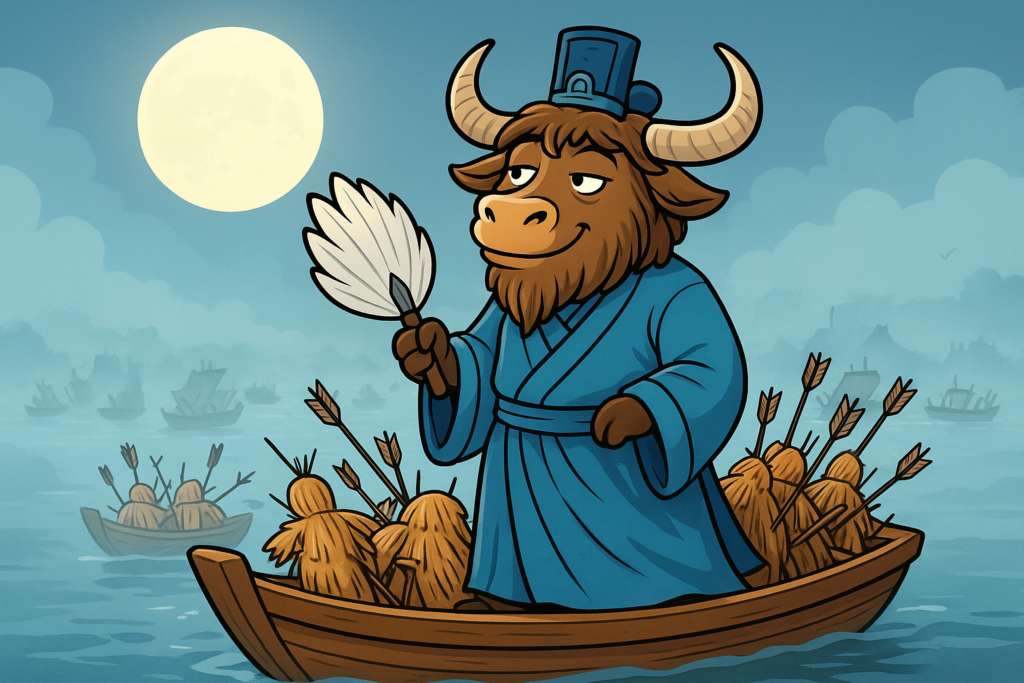
In ancient China, the brilliant strategist Zhuge Liang faced an impossible challenge: produce 100,000 arrows in just three days-or face execution. With no time to manufacture them, he devised a cunning plan, loading boats with straw soldiers and sailing them through thick fog towards the enemy camp. The enemy, unable to see clearly, shot thousands of arrows into the straw, and Zhuge Liang returned victorious with his 'borrowed' arsenal.
This original retelling of the famous Chinese folk story brings the clever stratagem to life for intermediate learners. Every sentence is crafted for B1-level comprehension, with real human audio so you can listen as you read. Click any word to see its meaning, review key vocabulary in the lesson notes, and enjoy a completely free, self-contained reading experience-no app or account required.
三國時代,周瑜是東吳的。他很諸葛亮的。
一天,周瑜對諸葛亮說:「我們需要。請你在。」
諸葛亮,回答:「不用十天,。我願意。」
周瑜聽了,心裡:「這是你自己說的,!」
諸葛亮回到,找來魯肅。他:「請你幫我準備二十條船。」
「每條船上放三十個,還要用把船。記住,一定要!」
魯肅雖然,但還是了。他準備好船和草人,諸葛亮的命令。
第一天過去了,諸葛亮沒有。第二天也一樣。周瑜覺得很。
第三天晚上,,江面上什麼也。諸葛亮對魯肅說:「走吧,我們去。」
他們來到江邊,二十條船。草人立在上面,就像真的。
靠近曹操的。這時,諸葛亮:「大家敲鼓!大聲吶喊!」
頓時,,。曹操的士兵,急忙報告:「敵人來進攻了!」
曹操看不清江面,出戰。他命令:「放箭!向喊聲的方向射!」
萬箭齊發,地射向船上的草人。草人身上箭,就像一樣。
過了一會兒,諸葛亮下令把船。另一面的草人又接住了飛箭。
天亮了,霧也散了。諸葛亮笑著說:「多謝曹丞相的箭!我們回去吧。」
。士兵們一數,草人身上的箭竟然十萬支!
魯肅地對諸葛亮說:「先生真是!你怎麼知道第三天會有呢?」
諸葛亮搖著扇子,輕輕回答:「作為一個將軍,不僅要會打仗,還要懂天氣啊。」
During the Three Kingdoms period, Zhou Yu was the Grand Commander of Eastern Wu. He was very jealous of Zhuge Liang's talent.
One day, Zhou Yu said to Zhuge Liang, "We need 100,000 arrows. Please produce them in ten days."
Zhuge Liang smiled slightly and replied, "No need for ten days, three days are enough. I'm willing to sign a military pledge."
Zhou Yu secretly laughed in his heart: "You said it yourself, don't blame me!"
Zhuge Liang returned to camp and summoned his subordinate Lu Su. He whispered, "Please help me prepare twenty boats."
"Put thirty straw men on each boat, and cover the boats with green cloth. Remember, keep it secret!"
Although Lu Su didn't understand, he did as told. He prepared the boats and straw men and waited for Zhuge Liang's orders.
The first day passed, Zhuge Liang made no move. The second day was the same. Zhou Yu found it very strange.
On the third night, thick fog blanketed the river, and nothing could be seen. Zhuge Liang said to Lu Su, "Let's go, we're going to get the arrows."
They came to the riverbank, and the twenty boats were lined up. The straw men stood on them, from afar looking like real soldiers.
The fleet quietly approached Cao Cao's water fortress. Then Zhuge Liang ordered, "Beat the drums! Shout loudly!"
Suddenly, drums thundered and shouts rose everywhere. Cao Cao's soldiers woke in alarm and urgently reported, "The enemy is attacking!"
Cao Cao couldn't see the river clearly and dared not easily send troops. He ordered the archers, "Shoot arrows! Aim in the direction of the shouting!"
Thousands of arrows shot out, densely hitting the straw men on the boats. The straw men were covered with arrows, like porcupines.
After a while, Zhuge Liang ordered the boats to turn around. The straw men on the other side caught countless more flying arrows.
As dawn broke and the fog lifted, Zhuge Liang laughed and said, "Many thanks, Prime Minister Cao, for the arrows! Let's go back."
The fleet returned fully loaded. The soldiers counted, and the arrows on the straw men actually exceeded 100,000!
Lu Su said admiringly to Zhuge Liang, "Sir, you are truly a divine strategist! How did you know there would be thick fog on the third day?"
Zhuge Liang fanned himself and gently replied, "As a general, one must not only know how to fight but also understand the weather."
This clever tale is packed with vocabulary for describing quick thinking and outwitting opponents. Let's look at some key terms that capture Zhuge Liang's genius.
- 軍令狀 (jūn lìng zhuàng) - a military pledge, a formal guarantee with serious consequences if broken.
- 草人 (cǎo rén) - straw man; used literally here, but the word can also mean a decoy or a false front.
- 大霧瀰漫 (dà wù mí màn) - thick fog spreading everywhere, perfect for setting a mysterious, tense scene.
- 神機妙算 (shén jī miào suàn) - brilliant strategy or divinely inspired calculation; a high compliment for a mastermind.
- 滿載而歸 (mǎn zài ér guī) - to return fully loaded with spoils; a satisfying end to a successful mission.
The story has a dramatic twist-the arrows exceed the needed amount. Chinese has handy structures to express such surprising outcomes.
Use these patterns when you want to emphasize an unexpected result or add extra layers of meaning.
- 竟然 (jìng rán) - "unexpectedly" or "to one's surprise." Example: 草人身上的箭竟然超過十萬支! (The arrows on the straw men surprisingly exceeded 100,000!)
- 不僅…而且/還… (bù jǐn… ér qiě/hái…) - "not only… but also…" Zhuge Liang's final advice uses a similar structure: 不僅要會打仗,還要懂天氣 (not only must know how to fight, but also understand the weather).
- Try adding 竟然 when recounting a surprising fact, and use 不僅…還… to connect two related skills or ideas naturally.
The story's vivid descriptions make it easy to visualize. Notice how similes and four-character phrases bring the action to life.
Incorporating these devices can make your own Chinese storytelling more engaging and memorable.
- Simile: 草人身上插滿了箭,就像刺蝟一樣 (The straw men were covered with arrows, just like hedgehogs). This comparison creates a striking, almost humorous image.
- Rhythmic phrasing: 鼓聲震天,喊聲四起 (Drumming shook the heavens, shouts arose everywhere) - four-character expressions pack intense energy and are very common in narrative Chinese.
- Next time you describe a scene, try fitting in a brief simile or a balanced four-character phrase for extra color.
Zhuge Liang turned a near-impossible task into a legendary victory through wit and observation. Now it's your chance to wield these new words creatively.
- Retell the story in your own words, using at least three vocabulary items from the list above.
- Imagine you need to "borrow" something intangible-like time, luck, or patience. Describe your clever strategy in Chinese.
- Keep an ear out for 竟然 in conversations or shows: it's a tiny word that adds big dramatic effect.
草船借箭 comes from the Chinese / Romance of Three Kingdoms tradition and is best known as a historical novel episode. This Yak Yacker article is an original learner retelling based on Romance of the Three Kingdoms; public domain, so the wording here is simplified for modern learners rather than copied from one old edition.
Older printings, translations, and retellings of this story can vary quite a bit. The original audience was usually general, but this version is adapted for B1 Intermediate learners studying Traditional Chinese. Good strategy story; simplify factions.
If you want to look into the source tradition, start with Project Gutenberg.
If you want to keep going, browse more in our Traditional Chinese section. After that, try Essential Traditional Chinese Grammar Words for another useful next step.