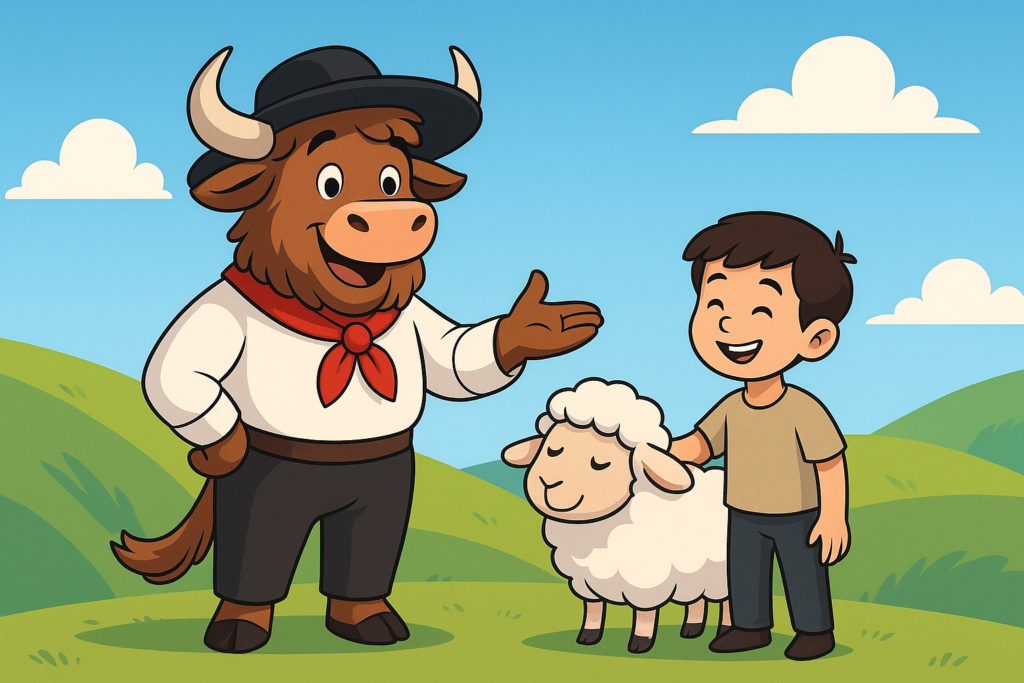
This A1 Beginner retelling of El niño y la oveja keeps the plot clear for learners while still giving the story some atmosphere and momentum. Un día, el niño y la oveja van a la colina. El niño dice: "Buenos días, oveja.
This version teaches Spanish through English and includes clickable word help inside the story, full story audio, and lesson notes after the reading. It is free to use on Yak Yacker and is designed to feel natural, readable, and manageable for learners.
Un tiene una .
Un día, y la oveja a la .
El niño : "Buenos días, oveja."
La oveja : "Beee."
El niño y la oveja .
Por la tarde, a casa.
El niño . La oveja .
A boy has a sheep.
One day, the boy and the sheep go to the hill.
The boy says: "Good morning, sheep."
The sheep says: "Baaa."
The boy laughs and the sheep eats grass.
In the afternoon, the boy and the sheep return home.
The boy is happy. The sheep too.
Let’s look at some words from the story. They’ll help you understand and talk about it. Try saying them out loud!
- el niño / la oveja – the boy / the sheep (notice 'el' for boy, 'la' for sheep)
- buenos días – good morning
- come – he/she eats (from the verb comer)
- contento – happy
In Spanish, the verb ending can tell you who is doing the action. This is different from English, where we often add words like 'he' or 'they'.
Let’s see some examples from the story.
- • 'El niño come hierba.' – The boy eats grass. ('Come' is for one person or thing.)
- • 'El niño y la oveja vuelven a casa.' – The boy and the sheep return home. ('Vuelven' is for more than one.)
- • 'El niño está contento.' – The boy is happy. For a girl or a feminine word like 'oveja', it would be 'contenta'.
Now you know some words and a little grammar from the story. The best way to remember is to use them!
Try reading the story again, this time out loud. Can you tell the story to someone else? Maybe even change it: ¿Un niño y un perro? Have fun with it. See you next time!
El niño y la oveja comes from an older public-domain story tradition and is best known as a public_domain_fable_retelling. This Yak Yacker article is an original learner retelling based on public-domain source material, so the wording here is simplified for modern learners rather than copied from one old edition.
Older printings, translations, and retellings of this story can vary quite a bit. This version is adapted for A1 Beginner learners studying Spanish.
If you want to keep going, browse more in our Spanish section and review the Geography and Location Vocabulary in Spanish. After that, try Essential Spanish Grammar Words for another useful next step.